Search This Blog

Monday, January 15, 2024

Clarence Thomas' greatness and legacy

 Clarence Thomas is a black American icon. There is no more American story, and no blacker story, than his. We should celebrate him as a living embodiment of this nation’s greatness, given his rise from the challenging circumstances of his upbringing—poverty, segregation, colorism, linguistic alienation—to holding a seat on the Supreme Court. Excluding Thomas from any history of African-descended people in this country would render it incomplete, just as ignoring his influence would leave any history of the current Court incomplete. 

Justice Clarence Thomas is unquestionably a towering figure in American jurisprudence. As Scott Douglas Gerber, a leading authority on his legal theories, has noted, Thomas’s impact on constitutional law over the last quarter-century has been stunning. His long-standing views have carried the day in major cases. He has stuck to his principles in his three decades on the Court, and it has paid off. Thus, his insistence that the Commerce Clause does not empower the federal government to regulate everything under the sun is now the law. His position that federal agencies should have relatively restricted power is now the law. His view that the Second Amendment means what it says, and that individuals have a fundamental right to carry firearms, is now the law. His conviction that no constitutional right to an abortion exists is now the law. And, perhaps most poignantly, his passionately articulated view that the Fourteenth Amendment’s Equal Protection Clause forbids racial preferences in higher-education admissions decisions is now the law. Indeed, his principled stance that the Court’s job is to discern the original understanding of the constitutional provision at issue in a case has become the Court’s dominant approach. One could even plausibly hold that this is now Justice Thomas’s Supreme Court, not Chief Justice John Roberts’s. Thomas is its longest-serving sitting member, and his legacy will continue well after his time on the bench is over, as many of his former clerks are now federal judges themselves. 

And yet, despite his now-undeniable skill as a jurist and judge, Thomas finds himself the target of criticism that differs in kind from that reserved for the Court’s other conservative justices. One expects public disagreement with his most controversial opinions; we should welcome intellectually rigorous dissent, for no one can test the validity of ideas without it. But too often, critics attack not Thomas’s ideas but the man himself—and this is especially true of black critics, who regard him not merely as mistaken but as a traitor who has forfeited his status as “authentically black.” For them, he is an Iago-like figure, driven by a perverse impulse to degrade African Americans. The quasi-religious conviction that Thomas’s reasoned defense of capitalism, color blindness, and individual liberty amounts to a disgust for his fellow blacks is, in my view, the outcome of a projected disgust for Thomas himself.

Why should this be? Other more or less conservative black figures have attained a status in the nation’s historical memory, and in the folklore of rank-and-file blacks, in line with their achievements. While Booker T. Washington’s program for post-emancipation uplift has fallen out of favor, no serious historian of African American history denies his significance. Ralph Ellison, while too idiosyncratic to pin down to any ideology, looks, from our historical vantage, like a more conservative figure than he may have appeared in his time. Though parts of Invisible Man can easily be read as a rejection of left-radical politics—the book rejects seemingly every conventional political position—its violation of the norms of contemporary mainstream black intellectual life has not kept it off college syllabi. One could argue that Invisible Man is too monumental a literary achievement simply to brush aside because of its purportedly errant politics. Even for those who see Ellison as a retrograde figure, his book is too important to the intellectual and social history of twentieth-century America to write out of the canon.

I would say something similar about Thomas. However controversial he may be, and however unrepentantly conservative his views, it is no longer possible to deny his stature and his influence on American life and law. He is a great man in a position of great power. Like any great man, he makes decisions whose consequences not even he can fully predict. And as with any great man, his very humanity—his virtues, flaws, personality, and persona—appear magnified, and often distorted, by the lens of the media and of history. His occasional errors in judgment and personal quirks take on symbolic significance. Thus, while recent controversies about his plane flights and vacations with friends may appear to tell deep verities about the nature of power, it is also true that his extraordinary biography has become an allegory of race in America. In fact, his identity as a black man sometimes overshadows the more basic, and yet more complex, fact that he is, first and foremost, a man—a human being.

The principles underpinning Booker T. Washington’s program for post-emancipation uplift have fallen out of favor. (ARTHUR P. BEDOU/ROBERT ABBOTT SENGSTACKE/GETTY IMAGES)

I do not know whether Thomas’s blackness is as front-of-mind for him as it is for his detractors. I’m not a mind reader, nor do I have the kind of relationship with him that would allow for unguarded speculation about such things. I can attest that to speak as a black man often at odds with the stated consensus of his fellow blacks can be liberating. Just as often, however, race becomes a burdensome constraint on how one’s statements are received. For some, I will always be speaking, thinking, and acting “as a black man.” The specter of race always threatens to impart an undue exemplarity to whatever I—or whatever any black people—say or do, as though the firing of every synapse in our brains could be traced back to a racial origin. In that sense, race is both qualifying and disqualifying—a reason to believe a speaker’s account of himself (for, of course, blacks are always “authentic”) and, at the same time, a reason to disbelieve it (for, of course, a black person would say that).

When public scandal arises, the situation gets even more complex. My own experience with scandal makes me sensitive to the ways that Thomas’s 1991 Senate confirmation hearings have hovered like a dark cloud over his career. Back in the 1980s, a younger woman with whom I was carrying on an affair took our breakup badly. The affair was wrong, and responsibility rests squarely on my shoulders; I was violating my marriage vows and the trust of my wife. But after the affair ended, the young woman accused me of “assault with a deadly weapon.” This was untrue: I had not assaulted her, let alone with a weapon. Nevertheless, after presenting myself at a police station, I was arrested, booked, and charged.

In the following anxiety-filled weeks, the young woman came to realize that she did not want to continue the charade, and she stopped cooperating with prosecutors. The charges were dropped shortly thereafter, but not before the press had run with the story. At the time, I was a professor at Harvard’s Kennedy School of Government, and a high-profile figure, writing magazine stories and appearing on television with some frequency. And I was a vocal conservative. My name and picture were splashed across the front page of the Boston Globe, and the story became national news: “Harvard Professor Accused of Assault.” Unfortunately for me, the follow-up, while reported in the press, did not have the same reach. A black, conservative, Ivy League professor accused of a violent crime is a juicy story. A black, conservative, Ivy League professor getting exonerated is not.

While my race was not explicitly part of the story, it lingered under the surface. The stereotype of the hypersexual black brute resides deep within America’s racial unconscious. It appears in D. W. Griffith’s The Birth of a Nation and in Invisible Man, though to very different ends. It is deployed in Alice Walker’s The Color Purple and satirized in Ishmael Reed’s brilliant riposte, Reckless Eyeballing. It writhes in the primordial swamps of America’s fantasy life, and it can spring into view with little provocation. To anyone harboring this stereotype, even without being aware of it, the idea of an ostensibly sophisticated and elite black social scientist reverting to his “true nature” would seem, I feared, all too plausible.

The persistence of certain racial tropes can compromise the judgment even of those who strive to be fair-minded—even other black people. And yet a strain exists in American politics that does not hesitate to use those tropes. Since I was not really a political figure, I avoided this fate. The scandal blew over. With time and effort, I rehabilitated my reputation. Clarence Thomas was not so lucky.

When the liberal opponents of Thomas’s nomination to the Supreme Court manufactured the Anita Hill scandal—I won’t rehash the details—Thomas fell into the position that I had been in only a few years earlier. Here again was the black brute, preying upon an innocent woman who was powerless to extricate herself from his clutches. His alleged taste in pornography became a national concern. He found himself portrayed as an insatiable, would-be predator, in whose presence no woman was safe.

Whatever happened between Hill and Thomas, the response was out of proportion to the alleged offense. Thomas was angry. I understood that anger, even though I had never suffered a comparable scrutiny. I understood what it felt like to lose control over the face that you present to the public, as the press constructs an unrecognizable version of you. I understood, too, what Thomas meant when he called the ordeal “a high-tech lynching,” and I was befuddled when his black detractors denied this. For we know why white mobs once tortured and murdered black men in this country: the allegations against them were often sex-based, even if the offense amounted only to a glance or a misconstrued word. For Thomas, the imagined crime was basically the same, even if the punishment was no longer literal death. Only this time, the right-thinking, liberal “Neo-Puritans”—as the sociologist Orlando Patterson called the feminists who were Thomas’s most ardent tormentors—led the mob. That this black man, who rose from impoverished origins in the segregated South to the pinnacle of American government, was nearly brought down by such a strategy is almost unbearably ironic.

After all, those portraying Thomas as a sexual threat were often the same people who viewed themselves as hard-line antiracists. If one dared to suggest that they were trafficking in some of the nastiest racially coded ideas that America has ever produced, they would have taken deep offense. It’s possible that they were not consciously aware of what they were doing. If they considered how things looked from Thomas’s perspective, they might have rethought their strategy. But either they didn’t consider such things or they regarded the smear campaign as necessary to prevent a conservative from ascending to the Court. One could easily conclude that, for these progressives, opposing race-baiting was noble—until it became politically convenient to remind white America about its deep-seated suspicions regarding black men’s sexuality. The attempt failed. A New York Times survey showed that more people at the time believed Thomas’s account than Hill’s. 

A psychosexual account of Thomas’s ordeal leaves unaddressed the attitude of fellow black leaders. The NAACP opposed his nomination to the Court and had previously called for his resignation from the Equal Employment Opportunity Commission. He has faced regular criticism from members of the National Bar Association, the largest African American legal network in the country. Whenever he issues a controversial opinion, a host of black commentators immediately attacks it. 

Most close observers of Thomas’s place in American life are accustomed to this reaction. Nobody blinks, for example, when Ibram X. Kendi issues yet another broadside against yet another of Thomas’s perceived sins. As far back as 2013, before Kendi was crowned the arbiter of racial goodthink, he questioned how a man like Thomas could hold the opinions he does. Writing of Thomas’s concurring opinion in Fisher v. University of Texas at Austin, Kendi finds that the justice is “either being blatantly dishonest” in his comparison of affirmative action and de jure racial segregation or that he has a “blatant inability to decipher, to assess and to judge.” It could not be that Thomas is intellectually capable of coming to this conclusion and that he believes it. What black person who grew up in segregated Georgia could? (Never mind that Kendi misreads Thomas’s opinion, accusing him of questioning the sincerity of the University of Texas’s position on diversity, while believing the sincerity of segregationists’ “separate but equal” doctrine. Thomas clearly disbelieves both.) 

This tendency to respond to Thomas by questioning either his honesty or his competence has been a through-line for his critics for decades. Thomas himself noted the phenomenon in his speech before the National Bar Association in 1998. At the time, he regularly heard the charge that he was merely following Antonin Scalia’s lead rather than working out his own conclusions about cases before the Court. Thomas remarked:

With respect to my following, or, more accurately, being led by other members of the Court, that is silly, but expected, since I couldn’t possibly think for myself. And what else could possibly be the explanation when I fail to follow the jurisprudential, ideological and intellectual, if not anti-intellectual, prescription assigned to blacks. Since thinking beyond this prescription is presumptively beyond my abilities, obviously someone must be putting these strange ideas into my mind and my opinions. Though being underestimated has its advantages, the stench of racial inferiority still confounds my olfactory nerves. 

Thomas was right to point to the racist undercurrent that flowed through questions about his competence and independence. Only a failure of intellect, of courage, of race pride, or some deeper, unnamed corruption could account for his departure from the “common sense” of his tribe. Such an attitude ironically demonstrated the soundness of Thomas’s long-standing critique of affirmative action—that it made its beneficiaries, whatever their objective merits, appear less competent than their white peers. Here was Thomas, a beneficiary of affirmative action at Holy Cross and Yale Law School, encountering the exact questions about his abilities that he worried could haunt any black person as long as affirmative action persisted.

Who asked those questions? Some whites, yes. If we are being generous, perhaps they could be forgiven for asking—if only in their minds—the questions that affirmative action suggested. But shouldn’t blacks know better? We know that the best of us are just as good, just as smart, just as competent as the best of everyone else. So why were so many blacks eager to unleash against Thomas the very tropes about inferiority that had dogged us for centuries?  

In the 1980s, I was subjected to similar criticisms. When I published my first major magazine article, “A New American Dilemma,” in The New Republic in 1984, the response was immediate. The piece called out the failure of black leadership to address persisting problems in poor communities, which the leadership continued to blame, unconvincingly, on white racism. Even before the article saw print, some of the country’s top black leaders, including Coretta Scott King and NAACP executive director Benjamin Hooks, called me into a meeting to answer for my scandalous claim that some troubles afflicting black communities—like high out-of-wedlock birthrates, violent crime, high unemployment, and lagging educational success—might have resulted from cultural maladjustment. 

They were not happy with me. King shed tears after hearing me declare, “The civil rights movement is over!” After the article’s publication, the pathbreaking black political scientist Martin Kilson, a friend and colleague at Harvard, called me a “pathetic black mascot for the right.” I had uttered an unspeakable but, to my mind, obvious truth: there was a problem within black communities, and only those communities could fix it. Black leaders should help them address those problems squarely rather than deflect blame to “white racists,” who, 20 years on from the civil rights movement, were no longer the primary roadblock to black flourishing. 

This pattern would repeat itself throughout the next 15 years. I would write or say something that ran afoul of the liberal official line of black leadership, and then get hit with criticism that usually had little to do with the merits of my position. It wasn’t just that what I was saying was beneath contempt—I was beneath contempt. There must be something wrong with me, a black man of modest origins, that would make me say such things. I wanted to curry favor with powerful conservative interests, perhaps, or I hated black people (and therefore myself). Few liberal black elites bothered responding to the substance of my arguments. 

In an essay titled “Leadership Failure and the Loyalty Trap,” included in a book I published in the 1990s, I addressed what I thought was at work. “The time has come,” I wrote, “to break ranks with [the black leadership]. These elites are caught in a ‘loyalty trap.’ They are fearful of engaging in a candid, critical appraisal of the condition of our people because they do not want to appear to be disloyal to the race.” To escape the loyalty trap, to call out the civil rights leadership for their failures, was “to invite being called a traitor, an Uncle Tom, or even a racist.” Such a conception of loyalty was not worthy of the name. It may have helped black elites maintain their status and position, but it did nothing for ordinary, struggling African Americans. 

I wasn’t the only black observer who saw and thought in this way. I met others, including Clarence Thomas, with whom I had forged a casual friendship when he was still with the EEOC. And yet I often felt alone. This is one of the most insidious effects of the loyalty trap. Falling prey to it ensures that one remains included among one’s peers; escaping it leaves one isolated and despised. The loyalty trap does not spring unexpectedly and maim you; it welcomes you in and fills you with the warmth of comradeship. That is what makes it so deadly: it feels good to be trapped.

Thomas finds himself the target of criticism different in kind from that reserved for other conservative Supreme Court justices. (SOPA IMAGES LIMITED/ALAMY LIVE NEWS)

It is not as though the tribalistic belonging that characterizes black elite consensus requires absolute ideological uniformity. If the group adopted true Soviet-style political orthodoxy, it would not be able to maintain legitimacy in its own eyes, much less those of outsiders. The rational justifications for its existence would fall away as it became clear that singularity of purpose trumped disinterested analysis. For example, as John McWhorter has observed, the brilliant liberal legal scholar Randall Kennedy remains a member in good standing of the black elite, despite the many positions he has taken that don’t jibe with mainstream race thinking. (I consider Kennedy a friend.) His heterodoxy on various issues actually strengthens the claim to legitimacy of the group as a whole. That it can accommodate thinkers like Kennedy can serve as evidence that the liberal black intelligentsia is not monolithic.

But some positions are so central to the self-conception of American blacks that anyone repudiating them will quickly find himself on the outside looking in. One such issue is race-based affirmative action; another is Clarence Thomas. For all of Kennedy’s heterodoxy, he has remained a staunch (if unusually clear-eyed) defender of the first and a staunch foe of the second. I would not impugn Kennedy’s motives for holding these positions. The more pressing question is why he and other superlative black intellectuals not only oppose Thomas’s jurisprudence and legal opinions but also seem to regard the man himself as unworthy of serious consideration. 

The title of one of Kennedy’s chapters in his recent book Say It Loud!, “Why Clarence Thomas Ought to Be Ostracized,” states the matter succinctly. Thomas is “a Republican apparatchik skilled in self-promotion and the advancement of retrograde policies”; his “attentiveness to the interests of black Americans is scant”; he is “a talented con artist”; his legal thought “is little more than a distillation of reactionary sentiments, roiling resentments, and a superficial acquaintance with black political thought.” And so on.

More than a disinterested analysis appears at work here. Kennedy loathes Thomas. Not only that, but he seems to find something incomprehensible about Thomas, something that exceeds ideological and jurisprudential disagreement. Despite the vast gulf in intellectual acuity between Ibram Kendi and Randall Kennedy, both reach essentially the same conclusion: the only way to make sense of Thomas is to sweep away his arguments and search for some character defect. Kennedy does not recommend that we—and I cannot help but think that he means we African Americans—criticize, argue against, defend against, or even impeach Thomas. He recommends instead that we “ostracize” him, declare him persona non grata. What else can we do with a figure who refuses to heed the basic tenets of black affiliation, at least as construed by the black elite? Never mind that many ordinary blacks in this country have beliefs that align much more closely with Thomas’s than Kennedy’s. On the other side of the loyalty trap, in other words, we find a “disloyalty trap.” And just as the loyalty trap seduces with the warmth of camaraderie, the disloyalty trap punishes with frigid isolation and the presumption of bad faith.

And yet, it is a mistake to view Thomas as truly “disloyal.” For if Thomas does feel a deep responsibility to his people, as he has always insisted, then his dissent from the black elite party line should be understood as an expression of fealty, not treason. True loyalty is not blind affirmation of the nostrums handed down from the front office. True loyalty requires the courage to articulate criticisms that you anticipate will not be received kindly but that you nevertheless feel must be heard.

From our historical vantage, Ralph Ellison looks like a more conservative figure than he may have appeared in his time. (DAVID ATTIE/GETTY IMAGES)

Thomas is often accused of bitterness. But what would one expect of someone regarded by so many of his people as dishonorable? I, too, have felt that bitterness. To some extent, I even gave in to it when I became something of a liberal in the 1990s and 2000s. At the time, when I “left” conservatism, I did so because I could no longer endorse its attitude toward race problems in America. But some part of me also wanted to be free of the burden of dishonor that my thought and beliefs had accorded me in the eyes of black peers. I remain proud of much of the work I did in that period, but I doubt that my political affiliations would have changed so dramatically and so publicly had I not also desired the embrace of my fellow African Americans.

For his part, Thomas seems never to have wavered. No matter how comfortable a life he has, it must require great strength and conviction to endure what he has endured in defense of the very principles that have made him an outcast. The desire for the approval of one’s peers and the tug of individual conscience are sometimes—more often than we would like to admit—at odds. In response to the leftward drift of some of his Supreme Court colleagues, Thomas has reportedly said, “I’m not evolving.” It’s a somewhat arch response to the idea that moving toward the center is a natural process that conservative justices undergo as they spend years debating with their more liberal colleagues. On the one hand, it sounds rigid. An a priori commitment to conservative jurisprudence risks closing Thomas off from arguments that, if he examined them on their merits, might persuade him to change his position. If those really are the better arguments, the more rigorous, more accurate reading of the case and the Constitution, shouldn’t he be willing to concede?

On the other hand, the idea that leftward drift is inevitable implies that something is inevitable about liberalism itself—that liberalism is the endpoint of any properly worked-through and field-tested judicial philosophy. We hear such sentiments echoed by left-liberal activists and intellectuals, who seem never to question that they are on “the right side of history,” as though the course of history were predictable, as though we had access to the judgments of the future, and as though those judgments were always unambiguous. To resist the notion of inevitable drift is to resist the idea that anything is morally and socially inevitable. We should want such sensitivity to contingency in our leaders, including our Supreme Court justices. 

It may well be that Clarence Thomas is right. It may well be that, for example, race-based affirmative action harms blacks more than helps them and that, in the long term, we’ll all be better off without it. If that turns out to be true, will Thomas’s denigrators admit that he was right? This would correct a great wrong: Thomas’s unjust exclusion from a place of honor among his peers. I would like to believe that Martin Luther King’s famous aphorism—“The arc of the moral universe is long, but it bends toward justice”—could provide some assurances. I’d like to believe that it is true. But we cannot know which way the arc bends, or what kind of justice we’ll find at its end.

Americans Can No Longer Afford Their Cars

 For decades, car ownership has been a trademark of the American lifestyle, with vehicles becoming symbols of freedom, independence and even rebellion, as well as a necessity. But in 2024, the country's legendary love story with the automobile appears to have reached a crucial point of potential no return, as cars have become unaffordable to millions.

Life has generally gotten more expensive in the aftermath of the pandemic, including the cost of cars, car insurance and car repairs.

Both new and used car prices rose to record highs during the pandemic, as the car industry was experiencing supply chain disruptions and chip shortages. Since 2020, new car prices have risen by 30 percent, according to data shared by AI car shopping app CoPilot with Newsweek. Within the same timeframe, used car prices have jumped by 38 percent.

Car showcase
People look at a Mercedes electric car at the Las Vegas Convention Center during the Consumer Electronics Show January 10, 2024, in Las Vegas, Nevada. A majority of Americans cannot afford to purchase a new car after years of price increases.BRENDAN SMIALOWSKI/AFP VIA GETTY IMAGES

In 2023—a year during which inflation slowed down to the point that the Federal Reserve decided to stop hiking rates—new car prices rose by 1 percent to an average of $50,364, while used car prices fell by only 2 percent to an average of $31,030.

But as things stand, cars are still really expensive for many Americans. Just 10 percent of new car listings are currently priced below $30,000, according to CoPilot. Things are not much better in the used car market, where only 28 percent of listings are currently priced below $20,000.

According to an October report by Market Watch, Americans needed an annual income of at least $100,000 to afford a car, at least if they're following standard budgeting advice, which says you shouldn't spend more than 10 percent of your monthly income on car-related expenses.

That means that more than 60 percent of American households currently cannot afford to buy a new car, based on Census data. For individuals, the numbers are even worse, with 82 percent of people below the $100,000 line.

"There's no doubt about it, 2023 was one of the most challenging years to buy a car, especially for more budget-conscious consumers," CoPilot CEO Pat Ryan told Newsweek.

"Prices saw a substantial run-up in the spring, driven by confident consumers at the upper end of the market, and they never fully recovered. Across most brands and segments, car prices have barely moved from the levels at which they started the year. When you also factor in multiple interest rate hikes, there were not many deals to be had for car shoppers."

"Simply put, cars have become more expensive," Joseph Yoon, consumer insights analyst at car consumer guide Edmunds—an online resource for cars inventory and information—told Newsweek. "In November 2019, the average transaction price for a new vehicle was $38,500. In November of 2023, that figure jumped to $47,939."

The pandemic's disruption of manufacturing supply chains, as well as outsized consumer demand in 2021, really put a strain on vehicle inventory and drove prices up significantly, said Yoon.

"Dealers practically had customers lined up to buy vehicles that weren't available," he told Newsweek. "Supply chain disruptions also forced manufacturers to prioritize more profitable, higher-trim vehicles in their lineups, which meant the inventory available to purchase also carried a higher sticker price."

Karl Brauer, executive analyst at iSeeCars, told Newsweek that he expects used car prices to continue falling modestly in 2024.

"The backlog in new and used car demand that grew during the pandemic is slowly moderating, but with over 2 years of restricted new car production, in 2020 through 2022, it will take at least that long for supply to catch up," he said.

"Macroeconomic factors like inflation and higher interest rates are also reducing vehicle demand, but not enough to drastically drop car prices in the foreseeable future."

But there are other reasons besides pandemic-related disruptions that there seem to be no more affordable cars in the U.S.—including that automakers are increasingly focusing on the production of expensive SUVs and trucks while dropping smaller, cheaper vehicles that would cost $20,000 or less.

"Manufacturers cite disappointing sales results as primary reasons for discontinuing smaller, more affordable vehicles from their lineup," Yoon explained.

"But car buyers' preferences have also shifted dramatically to larger trucks and SUVs in the past 10 years or so, and even more towards high-tech and comfort amenities in the form of cameras, sensors, radars and large infotainment screens," he said.

Unfortunately, all these features come at a significantly higher price—even if that's often higher than the average yearly wage of millions of Americans.

https://www.newsweek.com/americans-can-no-longer-afford-their-cars-1859929

Shut the Border or Shut the Government

When House Speaker Mike Johnson and 60 GOP members of Congress went to Eagle Pass, Texas, recently for a photo-op, they were probably shocked that the first question they were asked was for a show of hands of those who would shut down the government if President Biden doesn’t shut the border.

You see, that question actually frames unrestricted immigration at the southern border as the existential national crisis which it is. No wonder Texas Republican Rep. Pat Fallon lost it and immediately shouted, “We’re not gonna do ‘show of hands.’ We’re not in a classroom. We’re not doing ‘show of hands.’”

No, of course not. It’s much easier to shut down a reporter seeking the truth than it is to shut down the border and save the country.

The “show of hands” question came from Ben Bergquam of Real America’s Voice, one of the few journalists who has reported the hard realities about the border crisis on a near daily basis for years. He has followed migrants from the dangerous Darién Gap between Colombia and Panama all the way up the cartel corridor through Costa Rica, Nicaragua, Honduras, Guatemala, and Mexico. If you watch his reporting, you will know this is not an innocent caravan of asylum seekers; it is an invasion, plain and simple. He asks each immigrant two questions: Where are you from and where are you going? They are from across the globe, not just Central or South America. Yes, there are plenty from Venezuela, but just as many from Somalia, Egypt, West Africa, or China. And most of them are military age men. They aren’t escaping from persecution or violence; they are coming to America for jobs – and for benefits – and ultimately to drain our country of resources.

Bergquam also travels to the cities where the migrants say they want to go after the Border Patrol helps them cross the border – New York, Chicago, Los Angeles. Those cities have opened their doors to the migrant invasion, and they will pay the price as the newcomers sign up for health care, schooling, welfare, and other benefits. But we are all paying, and at a rate of at least 12,000 illegal migrants a day, the bill is rapidly becoming untenable. The influx of millions of illegals under the Biden regime has cost the nation billions of dollars at a time when our national debt has skyrocketed to an unimaginable $34 trillion. And yet Washington does nothing to solve the problem – not the Biden administration and not the Republican House of Representatives.

That’s why Bergquam asked for a show of hands from the members of Congress who had arrived in Eagle Pass, as though they had just heard of the immigration crisis. Who here is willing to shut down the government if the government doesn’t shut down the border?

It’s a reasonable question. And there were certainly some members on the tour who would have raised their hands – warriors like Andy Biggs and Eli Crane from Arizona, Matt Rosendale from Montana, and others, but the Republican leadership in the House has a dismal habit of surrendering to globalist Democrats who are more interested in settling illegal immigrants in our country than stopping them at the border.

Of course, the mainstream media paints Biggs and Rosendale and others who want to stop the flow of illegals as heartless nationalists – or worse. And when they reject fake solutions that only spend more money to make it easier for migrants to adjust to life in America, the left says they want to exploit the border crisis for political gain. No wonder weak Republicans constantly cave to the phony deals offered by Joe Biden and Sen. Chuck Schumer.

Right now, Republican Sen. James Lankford of Oklahoma is being used as the sacrificial lamb who will shepherd a fake compromise plan through Congress even though it allows up to 5,000 illegal entries per day. If this plan is approved by the Senate, it will give Republicans in the House just one logical response: Shut down the government.

And it won’t be difficult. A large part of the federal government will run out of money on Friday when the continuing resolution that Speaker Johnson “negotiated” with Democrats expires. Craven Republicans would just find some way to keep the government open and pretend that they had won a victory on border security, but smart Republicans know that the Friday deadline is a huge opportunity.

Remember, it takes just one member of the House to bring a motion to “vacate the chair,” and there is no way that Johnson would survive such a motion with the narrow majority Republicans currently hold. At least one GOP member, Marjorie Taylor Greene of Georgia, has threatened to bring such a motion unless the border is shut down. If she does, all business comes to a close until a new speaker is selected, which could easily take weeks.

In other words it would shut down the government. And that, some of us believe, would not be a bad thing – not when the alternative is business as usual at the broken border.

Frank Miele, the retired editor of the Daily Inter Lake in Kalispell, Mont., is a columnist for RealClearPolitics. His newest book, “What Matters Most: God, Country, Family and Friends,” is available from his Amazon author page. Visit him at HeartlandDiaryUSA.com or follow him on Facebook @HeartlandDiaryUSA or on Twitter or Gettr @HeartlandDiary.

https://www.realclearpolitics.com/articles/2024/01/15/shut_the_border_or_shut_the_government_150319.html

Lawfare Against Trump Is Running Out of Gas

 We should dispense with the tired narrative that four conscientious state and federal prosecutors—independently and without contact with the Biden White House or the radical Democrats in Congress—all came to the same disinterested conclusions that Donald Trump should be indicted for various crimes and put on trial during the campaign season of 2024.

The prosecutors began accelerating their indictments only once Trump started to lead incumbent Joe Biden by sizable margins in head-to-head polls. Moreover, had Trump not run for the presidency, or had he been of the same party as most of the four prosecutors, he would have never been indicted by any of them.

Yet now they are in a doom loop of discovering that the more they seek to rush to judgment before the election and gag Trump from speaking publicly about these star-chamber proceedings, the more he rises in the polls.

In truth, each succeeding cycle of corrupt leftwing lawfare that ends in failure—the Russian collusion hoax, the weaponized first impeachment, trying ex-president Trump in the Senate as a private citizen, the laptop disinformation set-up, the Alfa bank ping caper, the pathetic attempt to erase Trump from state ballots, and the unfolding Fani Willis moral debacle—does not return things to zero.

Rather, they serve as force multipliers for each other. Each overreach geometrically increases the dangers to democracy, ever more turns the public off, and ironically cascades sympathy and poll numbers for the very target of their paranoias.

Some of the prosecutors have colluded with White House lawyers and congressional liaisons. Some had run for office, offering campaign promises to get Trump convicted for something or other.

Now, after years of delays and deadends, all four are rushing to synchronize their trial dates to ensure that the front-running Trump is on the docket daily and not out on the 2024 campaign trail.

Do we recall when leftist legal eagles claimed that of all the iffy Trump indictments, Georgia prosecutor Fani Willis had the best case against Trump?

The phone call, we were told, was proof of “election interference.” It was Willis who got the first Trump “mug shot.” It was Willis, we were assured, who got Trump with the goods on tape, begging election officials to “find” the requisite missing votes that would prove his victory (note that he did not say “invent” the votes but to look for a supposedly existing trove of them).

And now Willis’s signature case is in shambles.

We learn, allegedly, that 1) Willis hired her stealth boyfriend Nathan Wade as a special counsel, the day before he filed for divorce (whose records were then mysteriously sealed by the court); 2) that Wade so far has received over $650,000 as special counsel, reportedly including a miraculous ability to charge for 24 hours of continuous legal service in a single day; 3) that Willis and Wade allegedly have used her greenlighted windfall to him to go on a number of pricey junkets and cruises; 4) that to try an ex-president and the leading candidate in the 2024 presidential election, Willis picked Wade who had never tried a single felony case and was previously a “personal injury/accident” lawyer; 5) that the supposedly apolitical Willis had consulted with the January 6 partisan congressional special committee, while Wade had met for marathon meetings with the Biden White House legal counsel (and apparently billed Georgia taxpayers for receiving such federal tutorials).

The legal community’s initial dismissal of this sordid prosecutor’s office is reminiscent of the immediate efforts to downplay Claudine Gay’s plagiarism. But the charade will eventually end the same way, in this case with the resignation and likely indictment of the prosecutor, along with her boyfriend, who concocted quite a scheme at the expense of the taxpayers. Both have made a mockery of their indictment of an ex-president and, if the allegations are true, will be disbarred and prosecuted.

The other three indictments are even weaker. Alvin Bragg claims that Donald Trump’s efforts a near decade ago to enact nondisclosure agreements and payments to remain silent about embarrassing behavior constituted “campaign finance violations.”

If so, what then defines campaign violations when Ms. Clinton brazenly destroyed nearly 30,000 subpoenaed campaign-era emails, ordered subpoenaed communication devices smashed, illegally hired a foreign national to find dirt on a campaign rival, and used three paywalls to hide her hush payments to British subject Steele to concoct a smear dossier—with help from Russian sources—to destroy her 2016 rival?

Letitia James, apparently for the first time in New York history, believes a bank was somehow wronged when its seasoned auditors viewed Trump’s assets, approved a loan to him, profited from his timely payments of interest and principles, and lodged no complaints against Trump or his company.

James apparently believes that Donald Trump is the first and most egregious real estate baron in New York history who inflated the value of his holdings. Her indictments thus supposedly have nothing to do with a left-wing political activist who ran for attorney general on promises to get Trump.

As far as Jack Smith, he supposedly was to be focused on Trump’s removal of classified presidential files to an insecure location at his Mar-a-Lago home and Trump’s “insurrectionary” actions on January 6. But he seems way beyond that now and is trying to put a gag order on the presidential frontrunner and to ensure Trump is in court during the 2024 campaign—challenging the very administration that appointed Smith in the first place.

In truth, Trump was the first ex-president in history to be indicted for a dispute with archivists over the status and security of removed classified files. Such disagreements were historically adjudicated bureaucratically rather than criminally, and certainly not with performance-art FBI swat raids into an ex-presidential residence.

Moreover, true insurrectionists do not instruct protestors to assemble peacefully and patriotically. Insurrectionists themselves do not try to overthrow governments while unarmed and accompanied by bare-chested buffoons with cow horns and slow-moving septuagenarians draped in American flags. And during an “insurrection,” unarmed “rebels” are usually not invited into the government quarters by supposed government doormen, among them perhaps 150-200 FBI informants. They are usually not shot and killed for the crime of entering a broken window while unarmed. And governments need not lie about the violence of insurrectionaries if they are truly insurrectionists.

Jack Smith’s problem—aside from his similar previous effort as special counsel to bankrupt and destroy the life and career of former Virginia governor Bob McDonald, a conviction overturned 9-0 by the Supreme Court—is that his indictments are so asymmetrical as to be surreal.

If the Department of Justice really wishes to prosecute insurrection, then it should concentrate on 120 days of arson, looting, killing, and violent protests that destroyed $2 billion in property, led to over 35 deaths, injured 1,500 law enforcement officers, and saw a federal courthouse, a police precinct, and a historic church torched by protestors, months of violent chaos planned and orchestrated by Antifa and Black Lives Matter, and enabled by leftwing inert mayors and governors.

The future Vice President of the United States, Kamala Harris, sought to organize bail for violent rioters. She boasted on television that the protests would not stop, should not stop, and would continue beyond the 2020 elections. Could she have at least suggested to the rioters to protest “peacefully and patriotically?” And just last week, President Biden praised that months-long violent summer of looting, violence, arson, and destruction, calling it “the historic movement for justice in the summer of 2020.”

Or Smith could investigate the well-orchestrated and increasingly violent pro-Hamas rallies. These are “insurrections” that have stormed the California legislature, occupied the Capitol rotunda, defaced and defiled iconic federal monuments and cemeteries, shut down key bridges and freeways, attacked law enforcement, and led to violence and assaults.

If Trump is guilty of removing files that he had the statutory right as president to formally declassify, then what was senator and subsequent Vice President Joe Biden guilty of when he stealthily and unlawfully removed hundreds of files, kept the removals secret (until his administration went after Trump for the same offense), and sloppily stored them in his insecure garage?

At each juncture of these extra-legal efforts, past precedents, former customs, and accepted traditions are being destroyed by the Left, whose endless miscarriages of justice are the real threats to constitutional government. And the more impotent these serial and unending gambits become, the more strident and desperate they appear.

Victor Davis Hanson is a distinguished fellow of the Center for American Greatness and the Martin and Illie Anderson Senior Fellow at Stanford University’s Hoover Institution. He is an American military historian, columnist, a former classics professor, and scholar of ancient warfare. He has been a visiting professor at Hillsdale College since 2004, and is the 2023 Giles O'Malley Distinguished Visiting Professor at the School of Public Policy, Pepperdine University. Hanson was awarded the National Humanities Medal in 2007 by President George W. Bush, and the Bradley Prize in 2008. Hanson is also a farmer (growing almonds on a family farm in Selma, California) and a critic of social trends related to farming and agrarianism.

https://amgreatness.com/2024/01/15/lawfare-against-trump-is-running-out-of-gas/

Corruption Charges (Still) Loom As Major Barrier To Biden Reelection In 2024: I&I/TIPP Poll

 Much of the discussion over whether President Joe Biden will drop out of the 2024 presidential race centers on his increasingly obvious age-related issues. But a potentially more serious problem awaits Biden, the latest I&I/TIPP Poll suggests: Strong evidence that he illegally profited from public office while vice president under former President Barack Obama.

At 81 years of age and with painful difficulties handling his official duties, Biden's waning mental acuity has become a serious issue. But while age and a record low approval rating are major impediments to Biden's reelection, the pile of evidence amassed in Congress' investigation into Biden's and son Hunter's legally questionable business dealings could prove lethal to his presidency.

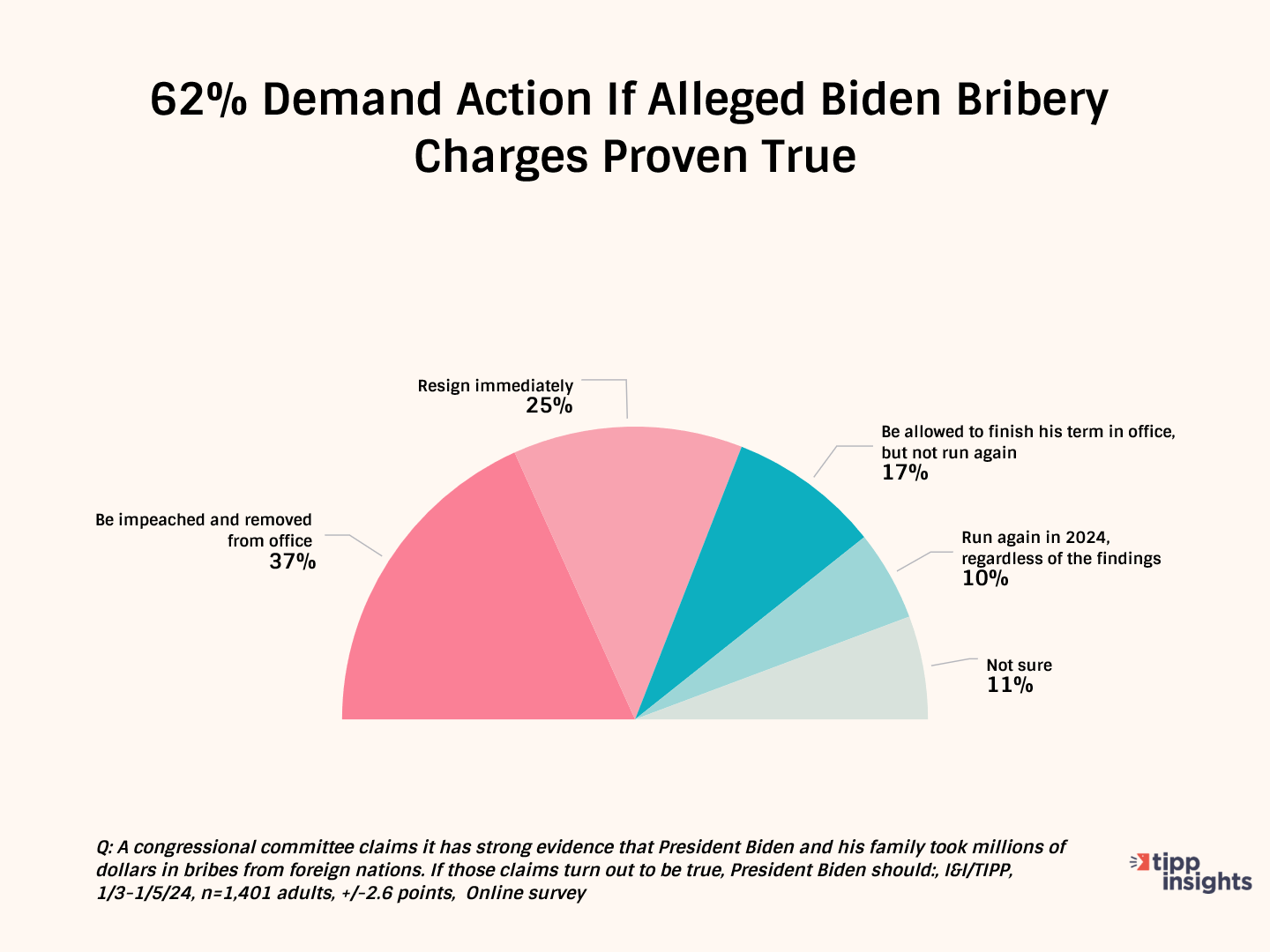
I&I/TIPP posed the following question to U.S. voters in August of 2023: "A congressional committee claims it has strong evidence that President Biden and his family took millions of dollars in bribes from foreign nations. If those claims turn out to be true, President Biden should:"

Voters were given a choice of possible answers: "Resign immediately," "Be impeached and removed from office," "Be allowed to finish his term in office, but not run again," "Run again in 2024, regardless of the findings," and "Not sure."

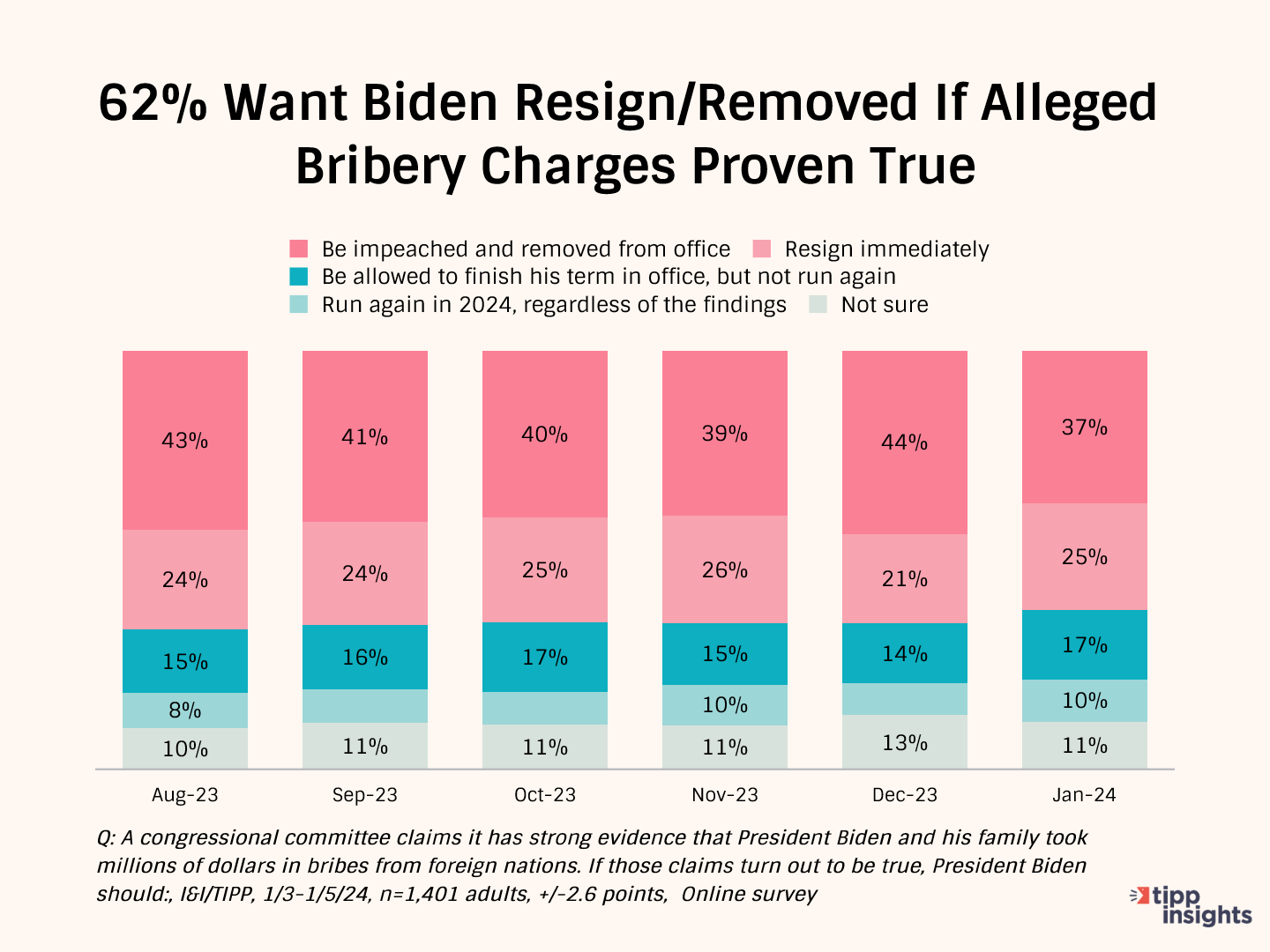
A strong majority of 67% in our poll suggested that President Joe Biden should either be impeached (43%) or resign immediately (24%) if the charges prove true. Just 15% said Biden should “Be allowed to finish his term in office, but not run again,” and another 8% said “Run again in 2024, regardless of the findings.” One in six (17%) weren’t sure.

The most recent I&I/TIPP national online poll was taken from Jan. 3-5 included 1,401 adults, with a +/-2.6 percentage-point margin of error.

Have things changed since mid-summer? Not much.

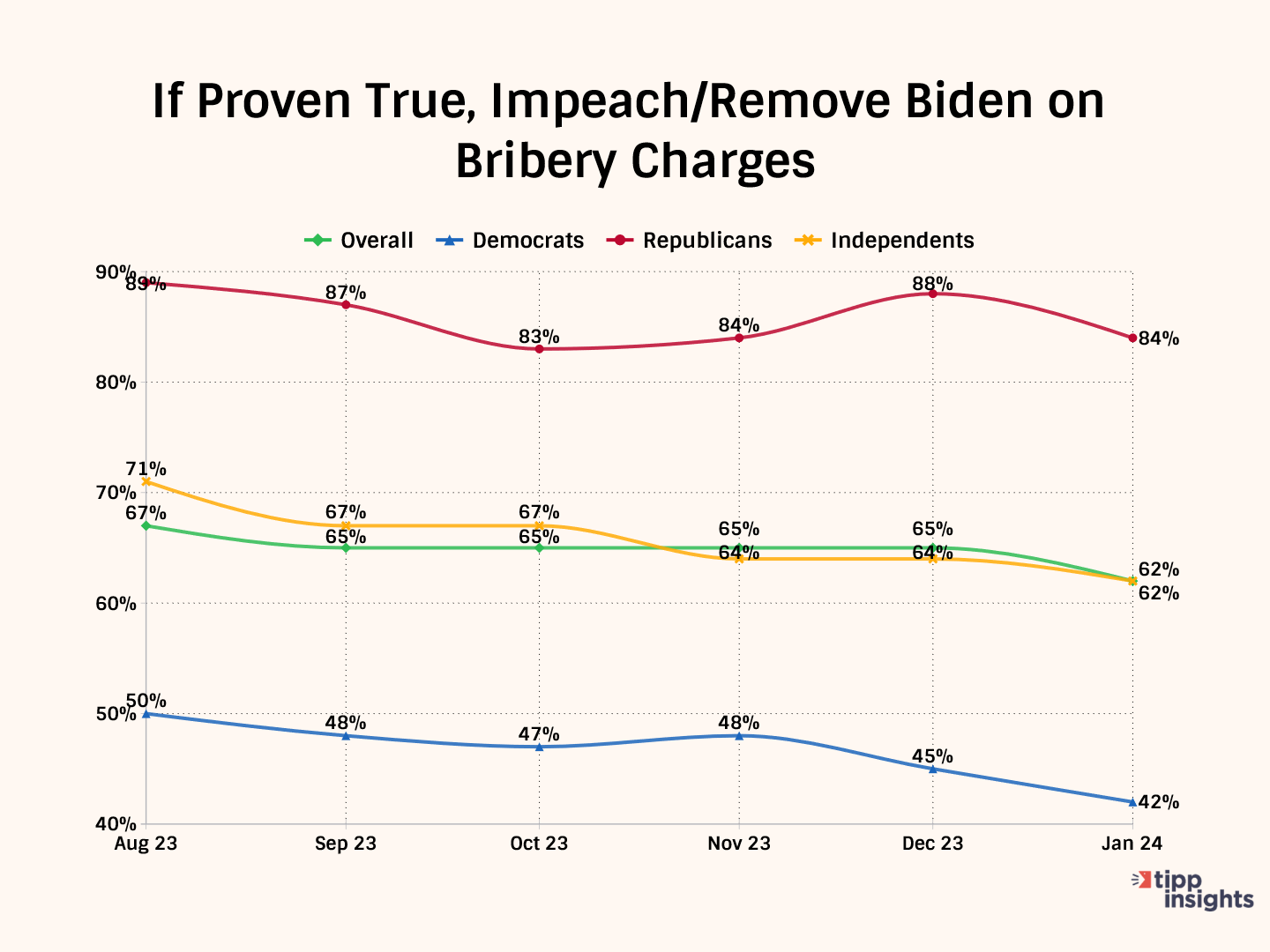
As of January 2024, 62% say Biden should either resign (25%) or be impeached (37%) for his misdeeds, with a plurality of Democrats (42%) and strong majorities of Republicans (84%) and independents (62%) agreeing.

It should be noted that of the 36 demographic groups we routinely track each month, apart from Democrats (44%), in January only African-American voters (41%) and self-described liberals (46%) were below 50% on the "resign/impeach" questions.

Of the remaining 38% of the responses, which include only the least-punitive responses, 17% said Biden should be allowed to finish his term, but not run again, while just 10% said he should be able to run, regardless of what Congress finds. Another 11% said they were "not sure."

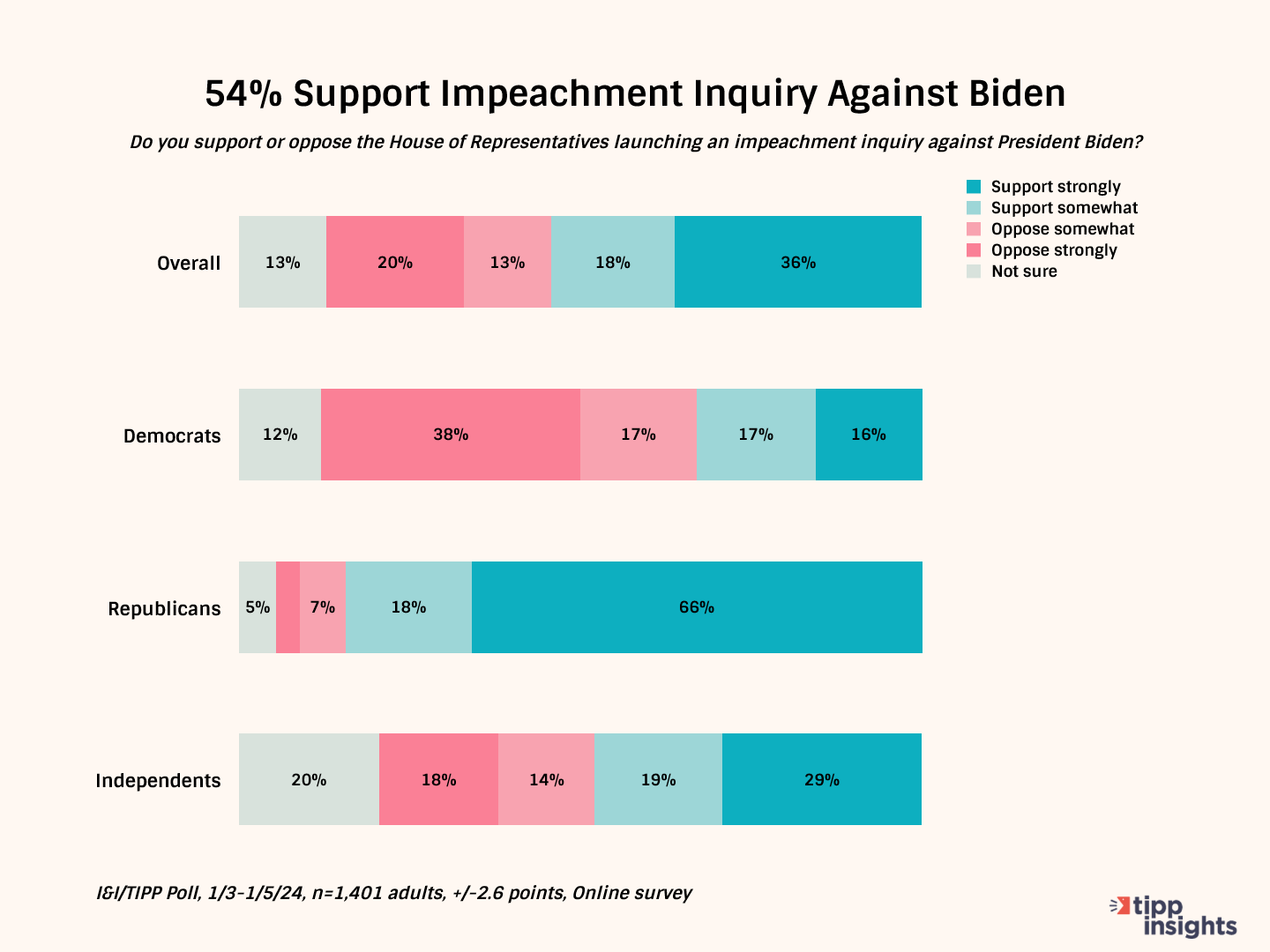
I&I/TIPP asked one more question: “Do you support or oppose the House of Representatives launching an impeachment inquiry against President Biden.”

A clear majority, 54%, said they either supported such a move “strongly” (36%) or “somewhat” (18%), while 33% opposed it either strongly (20%) or somewhat (13%). Another 13% said they were “not sure.”

These questions aren't moot. While the bad news about Biden's possible misconduct subsided during the holiday season, it's come roaring back in the New Year. And, if anything, the growing evidence of possible Biden family corruption has only grown in the past half year.

House Republicans threatened a contempt of Congress charge against Hunter Biden for refusing to testify. But Biden let it be known through his lawyer on Jan. 12 that he would testify behind closed doors if a new subpoena were issued, asserting that the earlier subpoena for him to appear before lawmakers was "legally invalid."

The revival of attention to the troubling evidence of at least $21 million paid to Biden family members by foreign governments and government-allied businesses is likely to further damage Biden's "middle-class Joe" persona in the upcoming election.

Right now, the Biden administration's position seems to be "ignore it, and maybe it will go away."

"Of the 337 scandal-related questions that White House reporters asked, (Karine) Jean-Pierre provided a definitive answer to just eight of them (2.37%)," senior research analyst and Media Editor Bill D'Agostino of the conservative-leaning Media Research Center asserted in a recent study. "This figure tracks very closely with our findings from the first half of 2023, in which the press secretary answered only six out of 252 questions (2.38%)."

Fox News, in reporting on the MRC study, noted:

Despite campaigning on restoring norms in the White House following the Trump years, Biden has granted little access to the press since he took office. Biden held fewer press conferences than every president in recent memory. He granted even fewer interviews.

Republican leaders in Congress launched their own investigation of Biden's possible corruption while in office, specifically while serving as Obama's No. 2.

Last September, in a devastating report, House Committee on Oversight and Accountability Chairman James Comer, R-Ky., argued that "overwhelming evidence" of Biden's corruption means he should be impeached.

"Evidence reveals that then-Vice President Joe Biden spoke, dined, and developed relationships with his family’s foreign business targets," according to a Comer press release dated Sept. 23 of last year. "These business targets include foreign oligarchs who sent millions of dollars to his family. It also includes a Chinese national who wired a quarter of a million dollars to his son."

Moreover, after denying his family made money in China, the "House Oversight Committee uncovered bank wires revealing how the Bidens received millions from Chinese companies with significant ties to the Chinese intelligence and the Chinese Communist Party."

As Politico noted in a November "special report," despite repeated denials by Joe Biden and those who represent him, "in recent months, as congressional Republicans have opened an impeachment inquiry and controversies related to Hunter Biden continue to be litigated in the courts and in the public square, a steady trickle of revelations have contradicted the president’s denials."

If found to have been engaged in influence peddling with foreign powers, Biden could be in deep trouble. It's not just an impeachable offense, it's a felony.

"If the president knew his family was engaged in 'influence peddling,' the president by definition is corrupt. The current defense doesn't have the legs to carry the president out of the scandal," Washington University law professor Jonathan Turley told Newsweek in late December. "Factually, it's becoming more difficult to see how the president wasn't aware of the influence peddling."

Or, as a piece in the online journal 1945 concluded in its headline, "The Joe Biden Corruption Disaster Finally Exploded."

As more information tumbles out of the ongoing investigation, it seems highly likely that Biden and his family will face some kind of serious legal reckoning — whether through impeachment (will Republicans in Congress drop impeachment and just let Biden self-destruct on his own?), or actual corruption charges leading to a public trial.

Either way, as I&I/TIPP Poll data show, American voters haven't forgotten. And if Biden and his family face legal consequences for what many legal analysts agree is corrupt behavior, losing the 2024 election might be the least of Joe Biden's problems.

I&I/TIPP publishes timely, unique, and informative data each month on topics of public interest. TIPP’s reputation for polling excellence comes from being the most accurate pollster for the past five presidential elections.

Terry Jones is an editor of Issues & Insights. His four decades of journalism experience include serving as national issues editor, economics editor, and editorial page editor for Investor’s Business Daily.


https://tippinsights.com/corruption-charges-still-loom-as-major-barrier-to-biden-reelection-in-2024-i-i-tipp-poll/

'Menthol ban backlash? Biden torn between politics, public health'

 Anti-tobacco advocates are growing increasingly concerned that a divided White House will bow to political pressure from the tobacco industry and scrap a plan to ban menthol cigarette sales, amid concerns of a backlash among Black voters ahead of the 2024 election. 

The White House is facing dueling messages, and advocates say they’ve been told the next week could make or break their efforts, if President Biden hopes to have the ban take force before the end of his first term. 

The tobacco industry has long been accused of targeting the Black community, especially with menthol products. Public health experts say banning menthol could save hundreds of thousands of lives, particularly among Black smokers. An estimated 85 percent of Black smokers use menthol cigarettes, according to federal statistics. 

A potential ban on menthol cigarettes has been discussed across multiple administrations for more than a decade and has yet to come to fruition. But the political tide has been shifting in recent years, and a majority of the Congressional Black Caucus supports Biden’s proposal.  

Still, the White House in December delayed the plan until at least March, after critics warned the White House that such a ban would anger the Black community during an election year, when Biden is already struggling to maintain their support. 

The delay came about two weeks after top administration officials met with tobacco industry lobbyists, including former Democratic congressmen, as well as high-profile civil rights attorney Ben Crump and a top executive from Rev. Al Sharpton’s National Action Network.

A public health lobbyist noted that all the people who met with the White House on Nov. 20 had some sort of paid affiliation with the tobacco industry. Among them was Democratic pollster Cornell Belcher, who circulated a poll commissioned by tobacco company Altria that showed young voters and minority voters oppose the ban. 

“You know, that spooked some folks, and I think it spooked the White House enough that we’re still pushing” well after the rule was supposed to be published, the lobbyist said. 

Since some of the provisions would take a year to implement, Biden would need to publish the rule in the next week to ensure it takes effect before a potential new administration takes over.  

The White House is also facing a potential deadline with the Congressional Review Act, which would allow Congress to vote to overturn the rule if it is announced too close to the end of the year. Some experts think the White House has until the spring. 

But if the rule is published, the tobacco industry is expected to sue, which could potentially delay implementation even further.   

“We certainly know that the longer these rules sit out there, the more time the tobacco industry is going to use to just try to pummel them and make up new claims,” said Erika Sward, assistant vice president of national advocacy at the American Lung Association. 

Public health groups are ramping up the pressure on the White House to publish the final rule, saturating the airwaves and newspapers with ads from Black public health leaders, big city health officials and prominent Democratic mayors, including Karen Bass of Los Angeles. 

The African American Tobacco Control Leadership Council is leading a “menthol funeral” on Jan. 18 in Washington, just steps from the White House, to memorialize the 45,000 Black Americans who die from tobacco-related illness each year, complete with a funeral procession and service. 

“This is ultimately coming down to a political decision by the president and his senior advisers,” Sward said, adding that Biden’s legacy issue of cutting the cancer death rate in half over the next 25 years will not happen if he backs down from banning menthol cigarettes and flavored cigars. 

“If he is following the science and following the scientific advisers, then he will finalize these rules,” Sward said. 

Congress banned flavored cigarettes as part of the 2009 law giving the Food and Drug Administration (FDA) authority to regulate tobacco products, but a loophole exempted menthol.  

Even though the FDA finally proposed a ban on menthol sales in 2022, the target date for the final rule has been slipping for months.    

The rule was initially slated for an August release but then wasn’t sent to the White House for final regulatory review until October, with the aim of releasing it by the end of the year. Now it’ll be March — if the rule is released at all.   

Public health experts have long said they’re used to making arguments that end up falling on deaf ears because of political calculations. 

Yolanda Richardson, president and CEO of the Campaign for Tobacco-Free Kids, said she’s been trying to show the White House that there’s a broad network of support for banning menthol cigarettes and that the political risks are being manufactured by the tobacco industry.   

Richardson said she’s “fairly confident” the health leaders in the White House are supportive, but “obviously this now has a political lens on it.”

“We understand that,” she said, “and we have been trying to get the messaging up to the White House that there is political coverage, if they can just get out of their own way.”

Still, she said she was surprised the White House would seriously entertain arguments from the tobacco industry.  

“We would have thought that the administration would have been prepared for this,” Richardson said. “We’re not surprised [there’s political concerns]. We are frustrated that the administration seems to have been unprepared for that kind of pushback.”

https://thehill.com/policy/healthcare/4404114-menthol-ban-backlash-biden/