New research has identified iron deficiencies in the blood as a major culprit in long COVID cases.
A new report from the University of Cambridge was able to connect that low iron levels contributed to inflammation and anemia and halted healthy red blood cell production in patients just two weeks after being diagnosed with COVID-19.
Many of those individuals reported having long COVID — which has recently been associated with a frightening IQ loss from brain fog — within months, according to the study, published in Nature Immunology.
At the minimum, about three in 10 people infected with SARS-CoV-2 have been at risk for long COVID, according to the university. The Centers for Disease Control and Prevention reports that just under an average of 3 million Americans are treated for anemia or iron deficiency.
“When the body has an infection, it responds by removing iron from the bloodstream. This protects us from potentially lethal bacteria that capture the iron in the bloodstream and grow rapidly,” said co-author Hal Drakesmith. “It’s an evolutionary response that redistributes iron in the body, and the blood plasma becomes an iron desert.”
Long COVID cases may be brought on by iron deficiencies in the blood, a new study shows.Getty Images/iStockphoto Drakesmith added that when this happens over a long duration, the lack of iron results in oxygen being “less efficiently” transported throughout the body, and it leaves negative impacts on metabolism and energy production.
Those with both severe and mild COVID cases had shown similar patterns within their blood, according to the research, which analyzed blood samples over a year.
“Although we saw evidence that the body was trying to rectify low iron availability and the resulting anemia by producing more red blood cells, it was not doing a particularly good job of it in the face of ongoing inflammation,” said researcher Dr. Aimee Hanson.
“Iron levels, and the way the body regulates iron, were disrupted early on during [a Covid] infection, and took a very long time to recover, particularly in those people who went on to report long COVID months later.”
Hanson said that a more straightforward approach — such as giving patients iron supplements — can become convoluted.
Now experts may reapproach how they treat long COVID.Getty Images Now, using the new data as a way to improve long COVID treatment, experts like Hanson are looking into controlling aggressive inflammation as quickly as possible to reduce impacts on iron levels.
“It isn’t necessarily the case that individuals don’t have enough iron in their body, it’s just that it’s trapped in the wrong place,” she said.
“What we need is a way to remobilize the iron and pull it back into the bloodstream, where it becomes more useful to the red blood cells.”
New York state Attorney General Letitia James has a beef with beef.
James last week sued JBS USA Food Co., the US subsidiary of the world’s largest beef producer, accusing it of “fraudulent and illegal business activities” and demanding “disgorgement of all profits and ill-gotten gains.”
Disregard the inflammatory language.
James’ lawsuit is frivolous — a mere publicity stunt.
She is using the state’s legal apparatus to punish individuals and industries unpopular with the left — sacrificing the rule of law in the process.
If she can make the Empire State into a living hell for beef producers, she can do it to any other industry.
Her politically motivated legal attacks will scare companies out of New York.
What’s next? Furriers, car dealerships, Big Pharma, pro-life groups, friends of Israel, companies that donate to Republicans?
Most of James’ 38-page legal complaint is a rant against beef, not JBS specifically.
“Beef has the highest total greenhouse gas emissions of any major food commodity, and beef production is linked to large-scale deforestation, especially in the Amazon rainforest.”
New York is a long way from the Brazilian rainforests or even JBS’s US operations in Colorado.
So how does she justify a New York lawsuit?
She accuses JBS of fraud for telling New York consumers the company aspires to achieve “Net Zero by 2040.”
The fraud charge is ridiculous.
Labeling chuck steak “filet mignon” would be fraud, because it would misrepresent the product being sold.
But saying you aspire to net-zero carbon emissions 20 years from now is not fraud.
Half the world’s 2,000 largest publicly listed corporations state they aspire to net zero by 2040, but very few have concrete plans on how to get there, according to Net Zero Tracker.
The technology hasn’t been developed to do it affordably.
Aspiring is not a legal commitment.
The complaint makes clear James’ goal isn’t to get JBS to refine its advertising.
She wants to put beef producers out of business.
Citing a United Nations report, James argues that emissions “cannot be eliminated through existing or anticipated technologies. Instead, scientists point to the need to reduce production of and demand for ruminant meat, including beef.”
“JBS Group plans to do the opposite,” the AG complains. “JBS Group forecasts increased demand for its products over the coming decades, and it intends to meet that demand.”
So what is JBS’s crime? Growing instead of caving to the left and closing down.
James’ lawsuit is a red-flag warning to businesses not to expect impartial justice.
She’s targeting the politically disfavored for extinction.
It will mean publicity for her but millions of dollars in defense costs for her victims.
Where is the New York State Bar Association, which is pledged to uphold the integrity of our legal system and discipline lawyers who bring frivolous lawsuits?
Rule 3.1 of its Rules of Professional Conduct defines a frivolous lawsuit as one having “no reasonable purpose other than to harass or maliciously injure.”
That’s the JBS lawsuit to a T.
Shame on the NYSBA for lacking the spine to denounce it.
Since 2019, hundreds of businesses, including major financial institutions, have fled New York because of high taxes, regulations and crime.
James’ legal vendettas will turn the business exodus into a stampede.
Instead of suing JBS, James should be calling for the repeal of the state’s insane bail “reform” and the removal of pro-criminal district attorneys like Alvin Bragg.
Can James be removed from office?
Technically, yes — by a two-thirds vote of the state Senate, on the governor’s recommendation.
But with New York’s one-party rule, that won’t happen.
It’s up to the legal community to stand up to James and demand the impartial, apolitical administration of justice.
Without it, New York’s economy cannot survive.
New York has produced legal greats like Benjamin Cardozo and Thurgood Marshall.
Don’t let James trash the rule of law here and turn the Empire State into a banana republic.
Betsy McCaughey is a former lieutenant governor of New York.
Within hours of therelease of a special prosecutor’s report finding he “willfully retained and disclosed classified materials” as a private citizen, President Biden rushed to the White House podium to blame his former “staff.”
“I take responsibility for not having seen exactly what my staff was doing,” the president maintained.
Like Biden, these staffers have avoided any criminal charges. Who are they?
Without identifying them by name, special counsel Robert Hur narrowed the suspects to two former aides: “Executive Assistant” and “Staff Assistant 3.”
He said they gathered up more than 180 classified records totaling more than 600 pages and packed them into 15 boxes as Biden left the White House in January 2017.
Gatekeepers
Documents confirm that the staffers in question are Kathy S. Chung, who worked with Hunter Biden at the Commerce Department, and Anne Marie Muldoon, nee Person, who worked for him at Rosemont Seneca Partners, a key pass-through for foreign wire payments to Hunter Biden.
Kathy S. Chung (far right) was one of then-Vice President Joe Biden’s staffers who packed classified documents for Biden before he left office in 2017.Carla Hayden / Twitter
Chung and Muldoon were the two most important people in Joe Biden’s office suite. They were the gatekeepers who controlled the front office that adjoined his West Wing office, and they stored his classified papers in file cabinets and in his safe.
Biden trusted them implicitly since they came to him on the recommendation of his son Hunter.
In effect, it was Hunter who placed them in their sensitive posts inside the White House, where they had unfettered access to “the most highly classified, sensitive, and compartmented materials recovered during our investigation,” Hur noted in his report.
And they continued to communicate with Hunter throughout their tenure in his father’s office, assisting his foreign business schemes, according to emails obtained from his abandoned laptop and from the National Archives.
Recommended
Hunter got his old Commerce colleague Chung her White House job in 2012, the year before Hunter traveled with the vice president on Air Force Two to Beijing to seal a lucrative investment deal with the Chinese. Chung booked the trip, records show.
The executive assistant post opened up in his father’s office in May 2012, and Hunter proposed his old chum take it.
He described the job as replacing the “primary gatekeeper for the VP [and the] conduit everyone goes through to get to [Joe Biden].” In addition, she’d handle “all personal stuff” for the vice president, according to Hunter’s email to Chung.
That meant, as it turned out, acting as the custodian of all of Biden’s White House records, including classified material. Chung was thrilled to be considered for the position, which required Top Secret security clearance — “Thanks for calling and thinking of me,” she emailed Hunter — and agreed to an interview.
“I just met with your Dad again and he officially offered me the job,” she gushed in a June 13, 2012, email to Hunter. “I cannot thank you enough for thinking about me and walking me thru this.”
Then in mid-2014, Hunter recommended Muldoon for the job of Chung’s assistant. At the time, she was working as Hunter’s aide at Rosemont Seneca. Her husband, Mike Muldoon, had also worked for Hunter at Rosemont Seneca years earlier.
Hunter Biden and attorney Abbe Lowell arrive for a closed-door deposition with the House Oversight and Judiciary committees last week.AFP via Getty Images
Family business
Records show Chung and Muldoon still arranged overseas trips for Hunter Biden and his Rosemont partners while working in VP Biden’s office. They sent and received hundreds of emails with Hunter and Rosemont.
Between July 2012 (when Chung came aboard) and April 2015, the latest data available, Rosemont Seneca shows up in a whopping 921 emails generated from the vice president’s office, according to a recent partial release of Vice President Biden’s records by the National Archives concerning “Hunter Biden, James Biden and their foreign business dealings.”
The records reveal that, among other things, Chung and Muldoon fielded requests from Hunter for signed photos of Joe Biden, letters from the vice president for his associates and tickets to White House events, including several state dinners and luncheons with foreign leaders.
In September 2015, for example, Chung emailed Hunter to invite him to a lunch with Chinese President Xi Jinping hosted by Biden.
In August 2016, according to Secret Service visitor logs, Muldoon escorted into the West Wing James Bulger — nephew of the notorious Irish mobster Whitey Bulger — after Bulger and Hunter formed BHR Partners, an investment fund controlled by the state-owned Bank of China.
A month after Chung oversaw the removal of the secret vice presidential papers in 2017, Hunter Biden attempted to poach her to work for him directly.
“Come work with me,” he wrote, “so that I can make everybody money.”
At the time, Hunter was courting Chinese businessmen who ended up paying him and other Biden family members $6 million for unspecified services.
Though Chung said she was interested in Hunter’s offer, she ultimately stayed on as Joe Biden’s assistant at his new digs at the Penn Biden Center in DC, where Hunter had VIP access.
It was there that Biden’s classified docs were first “discovered” by his lawyers, who were concerned about his own liability after the Justice Department raided former President Donald Trump’s home in Florida and seized boxes of classified papers.
Cozy relationship
Chung told Hur she never noticed any classified papers among the records she packed and unpacked, before filing them in unlocked cabinets and closets in Biden’s unlocked office, according to Hur.
Just weeks before she and Muldoon boxed up Biden’s records, however, they received a Jan. 3, 2017, email from the National Security Council warning them not to pack anything classified and that “only unclassified personal records” could be removed from the White House at the end of the administration, noted Hur, who ultimately punted on indicting either of them, even for gross negligence.
A lawyer for Chung — who now serves as a top aide to Defense Secretary Lloyd Austin — did not respond to requests for comment. Attempts to reach Muldoon were unsuccessful.
The issue of Hunter Biden’s cozy relationship with these aides could break into the open during Hur’s March 12 testimony on the Hill. Sources say lawmakers will press him on whether he investigated Hunter or his uncle Jim to see if either of them gained access to the stolen White House docs.
In a statement, the panel said it is “concerned that President Biden may have retained sensitive documents related to specific countries involving his family’s foreign business dealings.”
Paul Sperry is a senior investigative reporter for RealClearInvestigations. Follow him on X: @paulsperry_
We've been stating for months that both the DEI and ESG gravy trains on Wall Street are finally coming to an unceremonious end. Who would have guessed the profit motive would be incompatible with mindless, unproductive virtue signaling and reverse racism?
The pushback on DEI has been immense, with entire universities and corporations slashing their DEI departments. Subha Barry, former head of diversity at Merrill Lynch, told Bloomberg this weekend: “We’re past the peak.”
The report highlighted yet another shift on Wall Street, wherein programs open to people of color and women are "now open to all". Imagine that...
For example, Goldman Sachs has adjusted its “Possibilities Summit,” previously exclusive to Black college students, to now welcome White students as well. Bank of America Corp. has expanded its internal programs, initially aimed at women and minorities, to include all employees. Furthermore, Bank of New York Mellon Corp. has been advised by legal counsel to reevaluate and potentially eliminate strict diversity metrics from its workforce evaluations, according to a new report from Bloomberg.
For example, Goldman Sachs has adjusted its “Possibilities Summit,” previously exclusive to Black college students, to now welcome White students as well. Bank of America Corp. has expanded its internal programs, initially aimed at women and minorities, to include all employees. Furthermore, Bank of New York Mellon Corp. has been advised by legal counsel to reevaluate and potentially eliminate strict diversity metrics from its workforce evaluations, according to a new report from Bloomberg.
Executives at major banks, including Goldman Sachs, publicly affirm their commitment to diversity, despite acknowledging privately the challenges posed by a growing campaign against DEI initiatives led by figures like Elon Musk and Bill Ackman, the report says.
Efforts to recruit diverse talent through programs for women and minorities are being reassessed, along with other diversity measures within corporations. Bloomberg says the shift is notable compared to the ambitious diversity pledges made by CEOs following George Floyd's murder in 2020. Almost as if it was just mindless lip service to silence the 'woke mob'...
The recent Supreme Court decision against affirmative action in colleges has intensified legal challenges to corporate diversity efforts, with banks wary of becoming lawsuit targets over claims of reverse discrimination, the report says.
"The legal assault on corporate diversity initiatives is gathering steam" after the Supreme Court's rejection of affirmative action at colleges, the report says.
While black people make up about 14% of the total population, their representation in the senior roles at banks like Citi, JP Morgan and Goldman remains 8.7%, 5% and 3.7%, respectively, the note says. However, these figures have grown significantly since 2019:
Several other financial institutions, including the Bank of New York and Bank of America are subtly altering their approaches to diversity and inclusion initiatives.
These changes range from modifying executive compensation linked to diversity progress, adjusting the language around D&I goals, reconsidering certain mentorship programs, and adapting recruitment strategies to avoid explicit references to race and gender.
Despite these adjustments, spokespeople for these banks assert their continued commitment to fostering an inclusive workplace. And, nonetheless, industry consultants (whose meaningless careers and paychecks rely solely on racial division and DEI initiatives to begin with) and some financial executives still emphasize the importance of persevering with D&I efforts, despite these internal and external pressures.
Industry consultant Duarte McCarthy told Bloomberg: “We’re not suggesting that things stop because there’s this fear factor. But rather, take a look.”
Ana Duarte McCarthy, former chief diversity officer at Citigroup concluded: “We’re at an interesting inflection point.”
Yeah, the kind of inflection point that is going to see a lot of former "Chief Diversity Officers" scrambling through LinkedIn and updating their resumes...
Officials from the National Science Foundation tried to conceal the spending of millions of taxpayer dollars on research and development for artificial intelligence tools used to censor political speech and influence the outcome of elections, according to a new congressional report.
The report looking into the National Science Foundation (NSF) is the latest addition to a growing body of evidence that critics claim shows federal officials—especially at the FBI and the CIA—are creating a “censorship-industrial complex” to monitor American public expression and suppress speech disfavored by the government.
“In the name of combatting alleged misinformation regarding COVID-19 and the 2020 election, NSF has been issuing multimillion-dollar grants to university and nonprofit research teams,” states the report by the House Judiciary Committee and its Select Subcommittee on the Weaponization of the Federal Government.
“The purpose of these taxpayer-funded projects is to develop AI-powered censorship and propaganda tools that can be used by governments and Big Tech to shape public opinion by restricting certain viewpoints or promoting others.”
The report also described, based on previously unknown documents, elaborate efforts by NSF officials to cover up the true purposes of the research.
The efforts included tracking public criticism of the foundation’s work by conservative journalists and legal scholars.
The NSF also developed a media strategy “that considered blacklisting certain American media outlets because they were scrutinizing NSF’s funding of censorship and propaganda tools,” the report said.
NSF Responds
In a statement to The Epoch Times, an NSF spokesman categorically rejected the report’s allegations.
“NSF does not engage in censorship and has no role in content policies or regulations. Per statute and guidance from Congress, we have made investments in research to help understand communications technologies that allow for things like deep fakes and how people interact with them,” the spokesman said.
“We know our adversaries are already using these technologies against us in multiple ways. We know that scammers are using these techniques on unsuspecting victims. It is in this nation’s national and economic security interest to understand how these tools are being used and how people are responding so we can provide options for ways we can improve safety for all.”
The spokesman also denied that NSF ever sought to conceal its investments in the so-called Track F program, and that the foundation does not follow the policy regarding media that was outlined in the documents discovered by the committee.
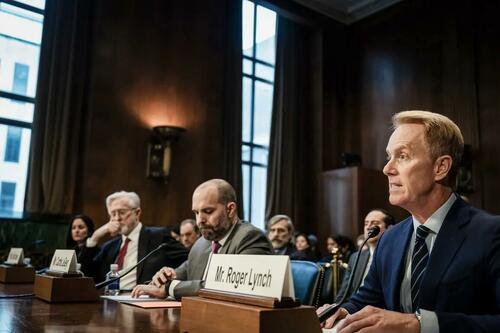
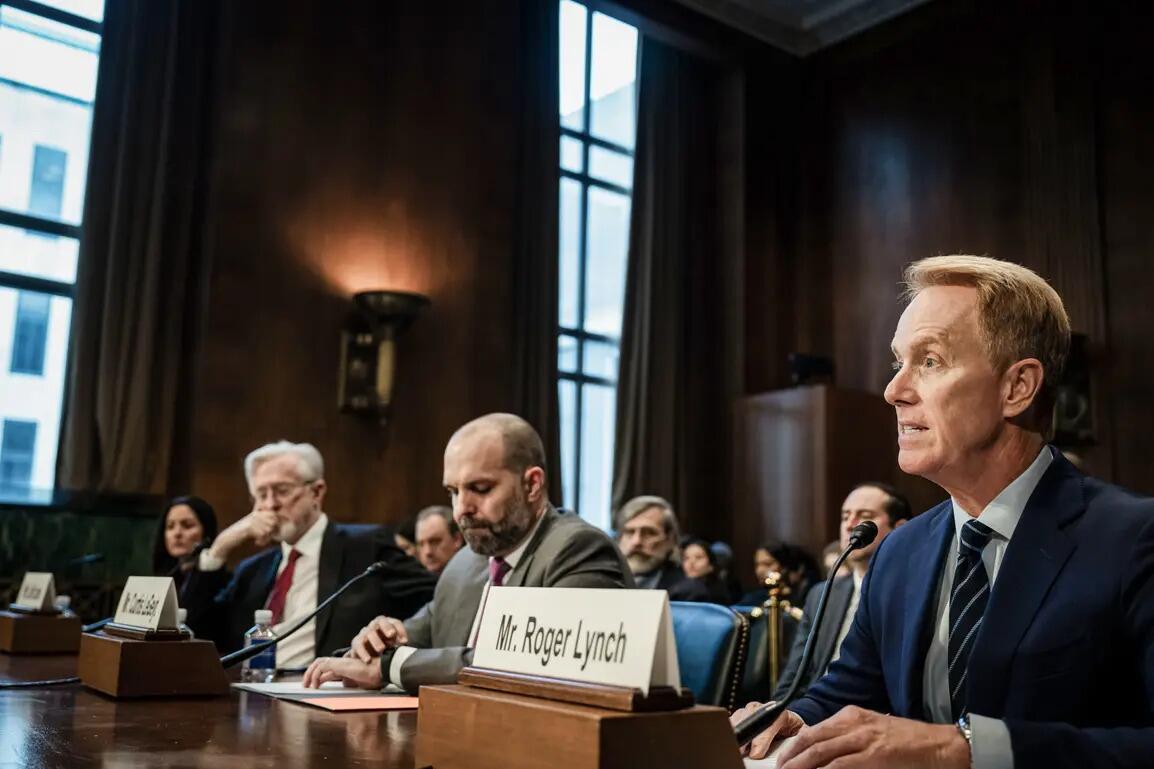
Roger Lynch, CEO of Condé Nast, testifies before a Senate committee during a hearing on artificial intelligence at the U.S. Capitol on Jan. 10, 2024. (Kent Nishimura/Getty Images)
Track F Program Funding
The $39 million Track F Program is the heart of the congressional report’s analysis of a systematic federal effort to replace human “disinformation” monitors with AI-driven digital systems that are capable of vastly more comprehensive monitoring and censoring.
“The NSF-funded projects threaten to help create a censorship regime that could significantly impede the fundamental First Amendment rights of millions of Americans, and potentially do so in a manner that is instantaneous and largely invisible to its victims,” the congressional report warned.
During NSF’s solicitation and sifting of dozens of bids it received in response to its request for proposals, a University of Michigan team, with its “WiseDex” tool, pitched federal officials on enabling the government “to externalize the difficult responsibility of censorship.”
The Michigan team was one of four Track F funding recipients spotlighted by the congressional report. A total of 12 recipients were involved in Track F funding and activities.
The second of the four spotlighted teams is from Meedan, a San Francisco-based group that describes itself as “a global technology not-for-profit that builds software and programmatic initiatives to strengthen journalism, digital literacy, and accessibility of information online and off. We develop open-source tools for creating and sharing context on digital media through annotation, verification, archival, and translation.”
In fact, according to the congressional report, Meedan’s Co-Insights Program uses AI to identify and counter “misinformation” on a massive scale.
In one illustration that the group provided to NSF in its funding pitch, was to “crawl” more than 750,000 blogs and media articles on a daily basis for misinformation and fact-checking on themes such as “undermining trust in mainstream media,” “fear-mongering and anti-Black narratives,” and “weakening political participation.”
The Co-Insights Program, according to the congressional report, was “part of a much larger, long-term goal by the nonprofit. As [Scott] Hale, the director of research at Meedan, explained in an email to NSF, in his ‘dream world,’ Big Tech would collect all of the censored content to enable ‘disinformation’ researchers to use that data to create ‘automated detection’ to censor any similar speech automatically.”
Lexi Sturdy works in Facebook's 'war room,' during a media demonstration in Menlo Park, Calif., Oct. 17, 2018. (Noah Berger/AFP via Getty Images)
The third spotlighted team is from the University of Wisconsin and its CourseCorrect tool that received $5.75 million in NSF funding “to develop a tool to ‘empower efforts by journalists, developers, and citizens to fact-check delegitimizing information’ about ‘election integrity and vaccine efficacy’ on social media.”
The tool “would allow ‘fact-checkers to perform rapid-cycle testing of fact-checking messages and monitor their real-time performance among online communities at-risk of misinformation exposure,’” the congressional report said.
‘Effective Interventions’ to Educate Americans
The Massachusetts Institute of Technology (MIT) team that developed its “Search Lit” tool with government funding was the fourth of the highlighted NSF grant recipients.
Officials with NSF asked the MIT team “to develop ‘effective interventions’ to educate Americans—specifically, those that the MIT researchers alleged ’may be more vulnerable to misinformation campaigns’—on how to discern fact from fiction online.
“In particular, the MIT team believed that conservatives, minorities, and veterans were uniquely incapable of assessing the veracity of content online,” the congressional report noted.
“In order to build a ’more digitally discerning public,' the Search Lit team proposed developing tools that could support the government’s viewpoint on COVID-19 public health measures and the 2020 election.”
In a study by one of the MIT team’s members, people who hold as sacred certain texts and documents, most notably the Bible and the U.S. Constitution, were described as “‘often focused on reading a wide array of primary sources, and performing their own synthesis,’ further alleging that, ‘unlike expert lateral readers,’ the conservative respondents made ‘no such effort’ to “eliminate bias that might skew results from search terms.”