China will boost its defence spending by 7.2% this year, fuelling a military budget that has more than doubled underXi Jinping's decade-plus in office as Beijing hardens its stance on Taiwan, according to official reports on Tuesday.
The increase mirrors the rate presented in last year's budget and comes in above the government's economic growth forecast for this year.
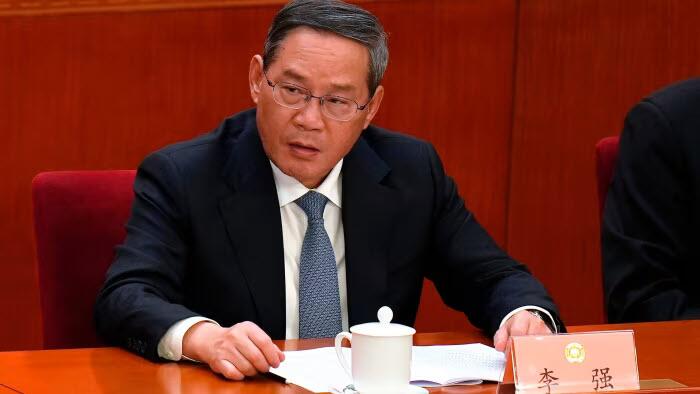
China also officially adopted tougher language against Taiwan as it released the budget figures, dropping the mention of "peaceful reunification" in a government work report delivered by Premier Li Qiang at the opening of the National People's Congress (NPC), China's rubber-stamp parliament, on Tuesday.
Tensions have risen sharply in recent years over Taiwan, the democratically ruled island that China claims as its own.
Li Mingjiang, a defence scholar at the Rajaratnam School of International Studies in Singapore, said that despite a struggling Chinese economy, Taiwan is a major consideration for Beijing's defence spending.
"China is showing that in the coming decade it wants to grow its military to the point where it is prepared to win a war if it has no choice but to fight one," Li said.
Since Xi Jinping became president and commander-in-chief more than a decade ago, the defence budget has ballooned to 1.67 trillion yuan ($230.60 billion) this year from 720 billion yuan in 2013.
The percentage rise in military spending has consistently outpaced the annual domestic economic growth target during his time in office; this year the growth target for 2024 is about 5%, similar to last year's goal, according to the government work report.
The defence budget is closely watched by China's neighbours and the United States, who are wary of Beijing's strategic intentions and the development of its armed forces.
The purchase of new equipment is likely to take up the largest single chunk of the budget as the military works to meet Xi's goal of full modernisation by 2035, according to the London-based International Institute for Strategic Studies (IISS).
Based on IISS data, this year's budget marks the 30th consecutive year of Chinese defence spending increases.
In the government work report, China reiterated a call for "reunification" with Taiwan, but added emphasis that it wants to "be firm" in doing so and dropped the descriptor "peaceful", which had been used in previous reports.
Although it is not the first time that China had omitted the word "peaceful", the change in language is closely watched as a possible sign of more assertive stance towards Taiwan.
Taiwan's defence ministry and Mainland Affairs Council did not immediately respond to requests for comment. The island's defence minister had said on Tuesday Taiwan's armed forces would increase the number of missile drills they hold this year.
Wen-Ti Sung, a political scientist and nonresident fellow at the Atlantic Council, said that the language on Taiwan has "moderately hardened".
"Beijing appears to be balancing between projecting increased toughness on Taiwan with stabilising relations with Taiwan's international friends," he said.
After the Democratic Progressive Party's Lai Ching-te won the presidential election in Taiwan, the Chinese Communist Party's fourth-ranked leader, Wang Huning, said at a high-level Taiwan policy meeting last month that China would "resolutely combat" any efforts towards Taiwan independence this year. Previous years' statements from the annual meeting only vowed to "resolutely oppose" Taiwan independence.
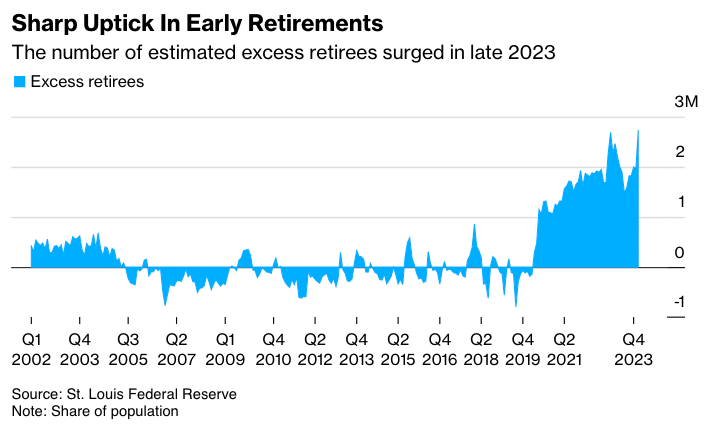
As the Magnificent 7 tech stocks and home prices grind higher, there has been a massive surge in the number of Americans taking early retirement. Bloomberg has coined this phenomenon the"Great Retirement Boom."
A model designed by economist Miguel Faria-e-Castro at the Federal Reserve Bank of St. Louis shows the US has around 2.7 million more retirees than initially forecasted.
China will target economic growth of "around 5%" this year as it works to transform its development model (read magically grow while aggressively deleveraging), curb industrial overcapacity (read build less ghost cities while trying to contain the fallout from the biggest real estate crisis in history), defuse property sector risks (read transfer ownership from countless insolvent property developers to the state while encouraging foreign investment) and cut wasteful spending by local governments (read limit corruption in a country where 1 out of every 3 yuan is embezzled, stolen or otherwise vaporized), Premier Li Qiang said on Tuesday according toReuters.
Li delivered his maiden work report at the annual meeting of the National People's Congress (NPC), China's rubber-stamp legislature, in the cavernous Great Hall of the People in Tiananmen Square.
The growth target - already the lwoest in decades - was identical to last year's but analysts warned that it would be harder to achieve this year than in 2023, when growth was flattered by a low base during the pandemic, and will require stronger government stimulus for China to reach it, as the economy remains reliant on state investments in infrastructure that have led to a mountain of municipal debt.
Almost all of the 27 economists polled by Bloomberg before the National People’s Congress expected Beijing to announce a growth target similar to last year. Economists polled in a separate, broader survey, however, said the economy would likely grow at a more realistic 4.6% in 2024.
“It’s what the Communist Party thinks is needed to keep the Chinese economy going and account for needs like employment,” Chong Ja Ian, an associate professor of political science at the National University of Singapore, said of the GDP goal for 2024.
Investors are watching this year’s “Two Sessions” of the National People’s Congress, the country’s parliament, and the Chinese People’s Political Consultative Conference, the top advisory body, for clues as to how dictator Xi plans to tackle the slowing economy. The premier’s work report, delivered to the NPC’s nearly 3,000 delegates in the Great Hall of the People in Beijing, is the keynote speech of the Two Sessions, laying out the party’s most important annual economic goals and setting the tone for policymakers for the rest of the year.
“We expect a moderate level of policy support, but given a less favourable base effect, pervasively downbeat sentiment, and property market weakness remaining an overhang, reaching 5 per cent growth this year may be more difficult,” ING greater China chief economist Lynn Song said in a note ahead of the work report.
An aborted COVID recovery in the past year has laid bare China's deep structural imbalances, from weak household consumption to increasingly lower returns on investment and a collapse in loan demand, prompting calls for a new development model.
A property crisis, deepening deflation, a stock market rout, mounting local government debt woes and a surge in protests by angry Chines workers have increased the pressure on China's leaders to respond to these calls.
"We should not lose sight of worst-case scenarios and should be well prepared for all risks and challenges," Li said. "In particular, we must push ahead with transforming the growth model, making structural adjustments, improving quality, and enhancing performance."
There were no immediate details on the changes China intended to implement.
In setting the growth target, policymakers "have taken into account the need to boost employment and incomes and prevent and defuse risks," Li said, adding China intended to have a "proactive" fiscal stance and "prudent" monetary policy.
China plans to run a budget deficit of 3% of economic output, down from a revised 3.8% last year. While generally in line with expectations, the country's stock market observers were likely hoping for "an increase in the official fiscal deficit for any clues on policy support for property and other parts of the economy,” said Derek Tay, head of investments at Kamet Capital Partners, adding that China still has other fiscal tools to work with. But, as reported in late 2023, it plans to issue 1 trillion yuan ($139 billion) in special ultra-long term treasury bonds, which are not included in the budget. That said, the impact of such debt on growth would be modest at best: China needs trillions (in USD) in new debt to kick start to languishing and deflating economy.
While the stimulus target is the same as last year, the central government special bond issuance was new compared with a year earlier.
Beijing also plans to boost defense spending by 7.2%, well above the country's economic growth target of around 5%. The pace of military expansion matches the spending budgeted under former Premier Li Keqiang's watch last year. This marks the third year in a row of military expansion above 7%, even as the economy continues to slow down.
China trails only the U.S. in military spending and has been beefing up its armed forces amid tensions with the U.S. and the West. President Xi Jinping has emphasized the significance of preparing for the 100th anniversary of the establishment of the People's Liberation Army in 2027.
The details of the defense budget expansion were not available, but the focus is understood to be on catching up with the U.S. while filling the gap in nuclear capabilities by enhancing other conventional weaponry. it also wasn't clear if China plans on invading Taiwan this year or will once again kick this particular start to WW3 to next year.
The special bond issuance quota for local governments was set at 3.9 trillion yuan, versus 3.8 trillion yuan in 2023. China also set the consumer inflation target at 3% and aims to create over 12 million urban jobs this year, keeping the jobless rate at around 5.5%. Meanwhile, it remains unclear what China's all-important youth unemployment is - the data was suspended for reporting when it hit a record over 20% and has since been restored in a several adjusted format which nobody trusts.
"The Chinese government does not want to stimulate the economy too much, ... and also wants to keep leverage relatively low," said Xia Qingjie, economics professor at Peking University. The budget deficit target can be adjusted later this year, if needed, Xia added.
According to Paul Pong, managing director at Pegasus Fund Managers, for China to achieve 5% economic growth this year forceful measures focused on boosting consumption will be needed as the property sector becomes a smaller driver of growth, with electric vehicles, sportswear and healthcare sectors are among the areas that might benefit most.
To achieve the 5% growth target, China will need to take measures to ease developers’ financing stress to avoid any unfinished homes. Sentiment remains weak, especially among foreign investors, given the property problems in China.
Analysts expect China to lower its annual growth ambitions in the future. The International Monetary Fund projects China's economic growth at 4.6% this year, declining further in the medium term to about 3.5% in 2028.
Li also said, that China will continue to pour resources into tech innovation and advanced manufacturing, in line with President Xi Jinping's push for "new productive forces." Some analysts have criticized this policy, however, saying it exacerbates industrial overcapacity, deepens deflation and heightens trade tensions with the West. At the same time, reform advocates, worried about record low consumer confidence and plunging investor and business sentiment, want China to return to a path of pro-market policies and boost household demand.
The NPC is not the traditional venue for sharp policy shifts, which are usually reserved for events known as plenums, held by the Communist Party between its once-every-five-year congresses. One such plenum was initially expected in the final months of 2023. While it could still take place later this year, the fact that it has not yet been scheduled has fuelled investor concerns over policy inaction.
The extent to which China’s economic expansion is reached or spread across the entire economy is increasingly difficult to ascertain independently given greater restrictions on data accessibility, said Chong Ja Ian, an associate professor of political science at the National University of Singapore, said of the GDP goal for 2024.
As noted earlier, China also abruptly scrapped a three-decade tradition for the premier to hold a press conference at the NPC, fanning fears about opaque policymaking.
Gen Zers are getting increasingly near-sighted from staring at their electronic devices all day and face a blindness epidemic if they continue to stay indoors while phone-addicted, a leading eye surgeon warns in a new report.
The rates of near-sightedness, or myopia, have been skyrocketing across the world with an increase of 46% in the UK over the last three decades, according to the Daily Mail.
In the US, a study from California says myopia has spiked a staggering 59% among teenagers.
And Zoomers face mounting risks of developing serious vision problems – even leading up to blindness – after missing out on natural sunlight during puberty, the outlet reports.
Gen Zers are facing a looming blindness epidemic because of their increased use of electronic devices and lack of exposure to sunshine, a leading expert says.Fxquadro – stock.adobe.com
Dr. Joern Jorgensen, a world-renowned eye surgeon at Laser Eye Clinic London, warned that the situation will only get worse because Gen Zers — people born between the mid-1990s and mid-2010s — aren’t getting enough dopamine.
In the retina, high levels of dopamine tunes vision for daylight conditions.
Time spent in the sun boosts dopamine levels while staying indoors reduces the amount of the important neurotransmitter – leading to serious eye problems.
Meanwhile, the amount of time spent staring at electronic devices a few inches away from the face can lead to myopia.
“During a critical time of their lives they are not getting natural sunlight and that in turn is causing a very noticeable rise in myopia. It is alarming and what we are seeing is an epidemic,” Jorgensen told the Daily Mail.
“Going outside in the daylight to play football, sports of any kind or just to play with friends causes a chemical process which releases dopamine,” he said.
“We know that it is an inhibitor to the type of growth in the eye which causes short-sightedness. The horizontal part of the eye lengthens and continues to grow, making it difficult to focus,” Jorgensen explained.
“We can encourage children to go outside and do more sports, but you can’t reverse what has already happened with social media playing such an important part in their lives,” he continued. “The second damaging factor is the amount of near work younger people are doing which is also damaging.”
The expert warned that myopia can lead to blindness in serious cases.
The COVID-19 pandemic kept children stuck indoors and focused on screens, which further sped up the global trend toward worsening eyesight, according to a 2022 article in Psychology Today.
Studies in California and Sydney, Australia, found that time spent outdoors was strongly linked to a lower risk of near-sightedness, according to the outlet.
The pandemic kept children stuck indoors and focused on screens, which further sped up the global trend toward worsening eyesight.Drobot Dean – stock.adobe.com
Youngsters are reportedly likely developing myopia earlier due to increased screen time and a lack of sunlight exposure – and not just because of genetics.
“We’re talking about [children who are] age 4 or 5 years old,” Dr. Maria Liu, an associate professor of clinical optometry at The University of California, Berkeley, told NPR.
By 2030, 40% of the global population will be nearsighted, according to the World Health Organization.
Holding a screen close to the face means the eyes blink less and over-compensate when focusing for hours – leading to a gradual lengthening of the eyeball and changes to the lens.
Serious cases of myopia among young people also increase the chance of them developing macular degeneration — a leading cause of blindness — by 41%, the Daily Mail reported, citing studies.
“Treating AMD (age-related macular degeneration) is one of the biggest costs facing the NHS, it is a great drain on resources,” Jorgensen said, referring to the UK’s National Health Service.
A recent study from California put the rate of near-sightedness at 59% among 17- to 19-year-olds in the US.DragonImages – stock.adobe.com
“A single injection of Lucentis, which is used to treat AMD, is £1,000 and a patient needs to have it every month or risk blindness,” he said.
“Serious short-sightedness also dramatically increases the chances of developing other serious conditions such as glaucoma and retinal detachment,” the doctor said.
“It’s a very serious situation, we are seeing cases of high myopia 30 times more often and that triggers the four drivers of eye disease, cataracts, glaucoma, retinal detachment and AMD,” he added.
Dr. Irfan Jeeva, from Pinderfields Hospital in Wakefield, West Yorkshire, said more youngsters need glasses because of their exposure to digital devices.
“We’re still learning about it, but there’s enough data for me to believe that increased screen exposure can affect your visual health, mental health, physical health and emotional health,” Jeeva told BBC Look North.
Playing outside increases the levels of the neurotransmitter dopamine.Syda Productions – stock.adobe.com
“Screens are quite addictive. They have an internal reward mechanism that makes you want to spend more time with them,” he said.
The Global Myopia Awareness Coalition has found that 52% of children play outside less than their parents did when they were young.
Last year, Myopia Focus launched a petition calling for more NHS funding to treat short-sightedness among children.
“Due to changes in lifestyle, an increasing number of people are at a higher risk of developing sight-threatening conditions linked to myopia. This should no longer be considered a potential threat — it is very real,” Jason Higginbotham, an optometrist who started the campaign, told the Daily Mail.
“We want to put pressure on ministers to do something about it now. The younger therapy commences, the less likely that your child will be at risk of sight loss in the future. We need the government to act,” he said.
Liu, the associate professor of clinical optometry at UC-Berkeley, urged parents to limit screen time and get their kids playing outside as much as possible.
“They need to play with real toys,” Liu told NPR. “They need to engage in real outdoor life.”