Search This Blog

Tuesday, March 5, 2024

Russia Says It Is Considering Putting a Nuclear Power Plant on the Moon With China

 Russia and China are considering putting a nuclear power plant on the moon from 2033-35, Yuri Borisov, the head of Russia's space agency Roscosmos said on Tuesday, something he said could one day allow lunar settlements to be built.

Borisov, a former deputy defence minister, said that Russia and China had been jointly working on a lunar programme and that Moscow was able to contribute with its expertise on "nuclear space energy".

"Today we are seriously considering a project - somewhere at the turn of 2033-2035 - to deliver and install a power unit on the lunar surface together with our Chinese colleagues," Borisov said.

Solar panels would not be able to provide enough electricity to power future lunar settlements, he said, while nuclear power could.

"This is a very serious challenge...it should be done in automatic mode, without the presence of humans," he said of the possible plan.

Borisov spoke also of Russian plans to build a nuclear-powered cargo spaceship. He said all the technical questions concerning the project had been solved apart from finding a solution on how to cool the nuclear reactor.

"We are indeed working on a space tugboat. This huge, cyclopean structure that would be able, thanks to a nuclear reactor and a high-power turbines...to transport large cargoes from one orbit to another, collect space debris and engage in many other applications," Borisov said.

Russian officials have spoken before of ambitious plans to one day mine on the Moon, but the Russian space programme has suffered a series of setbacks in recent years.

Its first moon mission in 47 years failed last year after Russia's Luna-25 spacecraft spun out of control and crashed.

Moscow has said it will launch further lunar missions and then explore the possibility of a joint Russian-China crewed mission and even a lunar base.

China said last month it aimed to put the first Chinese astronaut on the moon before 2030.

Russian President Vladimir Putin last month dismissed a warning by the United States that Moscow planned to put nuclear weapons in space as false, saying it was a ploy to draw Russia into arms negotiations on the West's terms.

https://www.usnews.com/news/world/articles/2024-03-05/russia-and-china-are-considering-putting-a-nuclear-power-unit-on-the-moon-ria

'Wonky Period After COVID Vaccine May Only Happen During One Phase'

 Women vaccinated against COVID-19 during the follicular phase of their period had their next cycle last 1 day longer than normal, according to a retrospective cohort analysis of menstrual cycle data.

That increase was 1.00 day (98.75% CI 0.88-1.13) when the first vaccine dose occurred in the follicular phase and 1.11 days (98.75% CI 0.93-1.29) for second doses that fell in that window leading up to ovulation, researchers led by Alison Edelman, MD, MPH, of the Oregon Health & Science University in Portland, reported in Obstetrics & Gynecologyopens in a new tab or window.

In this cohort of women not on hormonal contraception, there was no change in cycle length with doses given during the luteal phase, at -0.09 days for the first dose (98.75% CI -0.26 to 0.07) and 0.06 days for the second dose (98.75% CI -0.16 to 0.29), similar to a control group of unvaccinated people who also had no change in cycle length at the time either dose would have been suggested.

Additionally, people vaccinated in their follicular phase were more likely to have a clinically significant change of 8 days or more in their cycle length. This happened for 6.8% of the follicular group but only 3.3% of the luteal and 5% of the unvaccinated groups (P<0.001). Younger people from ages 18 through 29 were also more likely to have changes to their cycle (P<0.001 for both doses).

The follicular phase -- the first half of a menstrual cycle, lasting an average of 13 or 14 days until ovulation -- drives the cycle length and is "the most variable part of the cycle, whereas the luteal phase, which is post ovulation, is usually pretty set," Edelman told MedPage Today.

Edelman said that this research aids understanding of what contributes to these menstrual cycle changes on a macro level, though more research is needed to understand the micro level of what is happening with the immune system and reproductive system.

"We have a little bit of a better understanding around why this is happening and can provide folks further reassurance about getting vaccinated," Edelman said. "And if they do experience small changes in their menstrual cycle, it's temporary and it'll get back to normal."

The group had previously shown a small increase in menstrual cycle lengthopens in a new tab or window after COVID-19 vaccination that disappeared by the second cycle post-vaccination and was on par with the impact of COVID-19 infectionopens in a new tab or window.

Pamela Berens, MD, an ob/gyn at the McGovern Medical School at UTHealth Houston who was also part of the first wave of research investigating the impact of the COVID-19 vaccine on menstruation although not involved in Edelman's study, told MedPage Today that the new findings were not surprising.

"It makes sense that a stressor of any particular type would impact [the follicular] phase of the cycle ... because the last 2 weeks of the cycle usually are pretty regulated," Berens said. "And so it makes sense that something that's going to impact the cycle would impact it in the follicular phase."

She noted that the clinical message is unchanged: physicians should encourage patients to get COVID vaccines whenever they are able.

Edelman said that future research could go in several directions, such as looking at the impact of other vaccines on menstrual cycles, long COVID's effect on menstruation, and specifically analyzing data from people with irregular cycles.

In total, 19,497 participants from ages 18 through 45 prospectively logged menstrual cycle data from October 2020 through November 2021 in the app Natural Cycles, which is used to track menstrual cycles to prevent or plan pregnancy without hormonal contraception. Most were younger than 35 (80.1%) and from North America (28.6%), the U.K. (31.7%), or continental Europe (33.5%).

Participants logged COVID-19 vaccines received from January through October 2021, with mRNA vaccines accounting for 63.8%. Analysis included 9,279 individuals who got the vaccine in their follicular phase and 5,532 who received their first dose in the luteal phase. An unvaccinated group of 4,686 women served as controls. To be included, individuals had to be at least three cycles post-pregnancy, post-positive pregnancy test, or post-hormonal contraception use during the whole study period. They also had to have a normal menstrual cycle length (24 to 38 days), have known geographic location, and not be menopausal.

The primary outcome was the adjusted within-individual change in days from their normal cycle, which was the average of three menstrual cycles before vaccination. For the unvaccinated control group, cycles 4 and 5 were considered the notional first and second dose vaccination cycles for comparison. The cycle length for this group was unchanged, at 0.08 days for the first dose (98.75% CI −0.10 to 0.27) and 0.17 days for the second dose (98.75% CI −0.04 to 0.38).

Many of the study's limitations were tied to the data source, authors noted. For instance, Natural Cycles users don't use hormonal contraception and are more likely to be white, living in North America or Europe, well-educated, and have lower BMIs. Plus, the data also couldn't answer the magnitude of an individual's immune response to vaccination. Additionally, the researchers couldn't use this data to account for how SARS-CoV-2 impacts menstruation.

Disclosures

This study was funded in part by the Eunice Kennedy Shriver National Institute of Child Health and Human Development (NICHD) and the NIH Office of Research on Women's Health.

Edelman reported honoraria, travel reimbursements, or both from the American College of Obstetricians and Gynecologists (ACOG), WHO, CDC, and Gynuity. She also receives royalties from UpToDate.

Other co-authors reported honoraria and travel reimbursement from ACOG, SFP, and ABOG as well as financial ties to Borne and Elsevier. Some co-authors were employees of Natural Cycles, and the app received cost reimbursement for data processing and secure transfer.

Berens had no conflicts of interest.

Primary Source

Obstetrics & Gynecology

Source Reference: opens in a new tab or windowEdelman A, et al "Timing of coronavirus disease 2019 (COVID-19) vaccination and effects on menstrual cycle changes" Obstet Gynecol 2024; DOI: 10.1097/AOG.0000000000005550.


https://www.medpagetoday.com/obgyn/generalobgyn/108998

FDA Won't Object to Yogurt-Reduced Diabetes Risk Label Claim

 The FDA said that it will not object to the use of a qualified health claim that eating yogurt is associated with a reduced risk of type 2 diabetes, the agency announced

opens in a new tab or window Friday.

After a review of the evidence -- albeit limited evidence -- the FDA said "there is some credible evidence supporting a relationship between yogurt intake and reduced risk of type 2 diabetes." Because of this, yogurts that meet the FDA's standard of identity will be allowed to carry qualified health claims just as long as they're worded in a way that doesn't mislead consumers.

A qualified health claim must be supported by scientific evidence but doesn't have to meet the more rigorous "significant scientific agreement" standard required for an authorized health claim. The agency has allowed such qualified health claims for dietary supplements since 2000 and for food since 2002.

One study, published in BMC Medicineopens in a new tab or window in 2014, which supported this claim, showed that every one serving of yogurt per day was incrementally linked with a 17% lower risk for development of type 2 diabetes (HR 0.83, 95% CI 0.75-0.92). The same study failed to find a significant association between total dairy consumption and type 2 diabetes risk.

Of note, the association between yogurt intake and reduced risk of type 2 diabetes is based on yogurt itself as a food and not a particular nutrient or compound in yogurt, regardless of fat or sugar content.

The FDA's decision comes after Danone North America submitted a qualified health claimopens in a new tab or window petition to the FDA nearly 5 years ago that requested that the agency review the use of this type of claim for the association between consumption of yogurt and reduced risk of type 2 diabetes.

"We know that a growing body of research suggests regular yogurt consumption could reduce your risk of developing one of the most significant and rapidly rising health ailments in the United States," said Miguel Freitas, PhD, Danone North America's vice president of Health and Scientific Affairs, in a company press releaseopens in a new tab or window. "That's why we decided to submit a petition for this first-of-its-kind qualified health claim. Our hope is that this announcement will empower consumers with simple, actionable information they can use to help lower their risk of developing type 2 diabetes through a realistic, easy-to-make dietary modification."

The FDA considers 2 cups, or 3 servings, per week of yogurt to be the minimum amount to make this qualified health claim, so yogurt companies can word claims like the following: "Eating yogurt regularly, at least 2 cups (3 servings) per week, may reduce the risk of type 2 diabetes. FDA has concluded that there is limited information supporting this claim."

https://www.medpagetoday.com/endocrinology/diabetes/109004

'Ketamine Clinics Diverge From APA Recommendations'

 The proliferation of ketamine clinics in the U.S. has veered far off course from the recommendations of the nation's premier psychiatric association when it comes to using the anesthetic to treat mood disorders, experts say.

In 2017, the American Psychiatric Association (APA) issued a consensus statementopens in a new tab or window on the use of ketamine in treating mood disorders, published in JAMA Psychiatry.

But the ketamine clinics cropping up across the U.S. don't appear to follow that guidance, Smita Das, MD, PhD, MPH, of Stanford University and a spokesperson for the APA, told MedPage Today.

"[Intravenous] ketamine is being offered in smaller clinics off-label and there isn't a practice guideline from the American Psychiatric Association that's recommending ketamine for use in the way that it's being used," Das said, noting that these clinics -- which tend not to involve psychiatric or mental health professionals -- often tout ketamine as a "miracle treatment."

She said the surge of ketamine clinics is something of a "wild westopens in a new tab or window" where vulnerable patients are being offered treatment without being informed of the downsides.

Only one ketamine product -- the nasal spray esketamineopens in a new tab or window (Spravato), made by Johnson & Johnson -- has been approvedopens in a new tab or window for treating a mood disorder by the FDA. It's specifically indicated for use in conjunction with an oral antidepressant for adults with treatment-resistant depression. In addition, it's only available through a Risk Evaluation and Mitigation Strategy (REMS) program.

Yet those restrictions and cautions seem to have little impact on the public demand for ketamine in mood disorders.

APA members have raised concerns about patients taking ketamine outside of their prescribed treatment regimens, Das said.

There's also been an increasing number of psychiatrists who have said that perhaps they should be more involved with these clinics, at the very least to help guide best practices and treatment decisions, as these clinics don't always employ mental health professionals, she noted.

Other members have expressed an interest in learning more about when ketamine may be appropriate for their patients, she added.

The organization has developed someopens in a new tab or window continuing medical education (CME) coursesopens in a new tab or window about ketamine, including one titledopens in a new tab or window, "Ketamine for Depression: Is the Hype Holding Up?"

For now, the best guidance for practice is the 2017 consensus statement, Das said. It was drafted by the APA's Council of Research Task Force on Novel Biomarkers and Treatments, and that group continues to monitor trends in ketamine use as well as the body of evidence behind it. Das said she expects the council will update the guidance when there's sufficient additional evidence.

The 2017 statement focused on data from seven published placebo-controlled, double-blind randomized clinical studies on ketamine infusions for depression, totaling 147 patients -- an exceedingly small number.

It details expectations for appropriate clinical training, dosing, and treatment setting, and notes important key components of using ketamine for mood disorders, including a comprehensive diagnostic evaluation; a thorough review of depression severity, past responses to medications, and medical status; and informed consent including review of alternative treatments and discussion of IV ketamine as an off-label treatment.

Clinicians delivering the treatment should be licensed to administer Schedule III medication and obtain an Advanced Cardiac Life Support certification, it states. Ketamine should also be administered in facilities equipped to monitor basic cardiovascular and respiratory function, including access to electrocardiograms and end-tidal CO2 monitors. And facilities should be able to stabilize patients in the event of a respiratory event.

Since the 2017 guidance, additional studies have been published, including one in the New England Journal of Medicine that found ketamine equivalent to electroconvulsive therapyopens in a new tab or window in treatment-resistant major depression. However, the APA has not confirmed a timeline for an updated literature review and, thus, updated guidance.

The organization currently stands by the 2017 guidance, which it says remains sound. Nonetheless, Das warned that it's not frequently followed by ketamine infusion clinics.

Robert Freedman, MD, of the University of Colorado School of Medicine and a former editor of the APA's American Journal of Psychiatry, cautioned that the booming use of the drug, without enough guardrails to ensure patient safety, could ultimately spell its end in psychiatric indications.

"We just have to be careful that it doesn't become a drug that has its usefulness curtailed because there are people who are having so many bad reactions," Freedman told MedPage Today.

He noted that the FDA has limited regulatory authority when it comes to using ketamine in mood disorders. The agency released a compounding risk alertopens in a new tab or window for ketamine in October, in response to the rise of compounding pharmacies producing unregulated versions of the drug. That alert emphasized that ketamine is not approved for treatment of any psychiatric condition. The agency also published a similar alertopens in a new tab or window 2 years ago.

In a statement to MedPage Today, the FDA reiterated that ketamine "is not FDA-approved for the treatment of any psychiatric disorder. However, we are aware that some healthcare providers may be prescribing ketamine for psychiatric disorders when they judge that it is medically appropriate for their patient."

"We are not aware of sufficient evidence to suggest that ketamine is safer, more effective, or works faster than medications that are FDA-approved for the treatment of certain psychiatric disorders, including depression," the statement continued. "We continue to monitor data and evidence, which we will use to identify additional regulatory actions and non-regulatory activities as appropriate."


https://www.medpagetoday.com/special-reports/exclusives/109012

Gain: Data Shows Impact On Cellular Death For Treating Parkinson's

 Gain Therapeutics Inc 

+ Free Alerts
 announces the presentation of a poster at the International Conference on Alzheimer’s and Parkinson’s Diseases and related neurological disorders (AD/PD 2024) related to the mechanism of action of the company’s lead compound, GT-02287.

The poster demonstrates how GT-02287, through its interaction with glucocerebrosidase (GCase) in the endoplasmic reticulum (ER), aids in correct GCase folding, preventing ER retention, ER stress and ER-associated degradation of mutated GCase enzyme.

GCase is consequently able to travel to the lysosome, resulting in enhanced lysosomal activity and efficient processing of the GCase substrate glucosylceramide. 

An increase in GCase substrate in the lysosome was previously shown to be associated with the accumulation of aggregated alpha-synuclein, a pathological hallmark of Parkinson’s disease and related disorders. 

“These data further confirm our understanding of the mechanism of action of GT-02287, how it impacts cellular health by preventing the downstream consequences of GCase misfolding, including cellular stress and lysosomal dysfunction” commented Dr. Natalia Perez-Carmona, Senior Director of Biology at Gain Therapeutics and presenting author. 

Gain Therapeutics’ lead drug candidate, GT-02287, is in clinical development for GBA1 Parkinson’s disease (GBA1-PD). 

The orally administered, brain-penetrant small molecule is an allosteric protein modulator that restores the function of the lysosomal protein enzyme glucocerebrosidase (GCase), which becomes misfolded and impaired due to a GBA1 gene mutation, the most common genetic abnormality associated with PD. 

Last week, Gain Therapeutics initiated the Multiple Ascending Dose (MAD) part of the Phase 1 trial of GT-02287 for GBA1 Parkinson’s disease.

Last month, Gain Therapeutics announced preclinical data demonstrating that its GT-02287 provided neuroprotection and restored motor function in Parkinson’s disease models following delayed administration. 

Animals in the most challenging treatment group – those that began treatment eight days following the onset of the disease – showed motor improvement from day 14 to day 27, which suggests a progressive reversal of neuronal deficit associated with continued treatment duration.

https://www.benzinga.com/general/biotech/24/03/37478966/exclusive-gain-therapeutics-highlights-lead-program-data-showcasing-its-impact-on-cellular-death-

Boeing, Boeing, Gone: US Factory Orders Plunge Most Since COVID Lockdowns In January

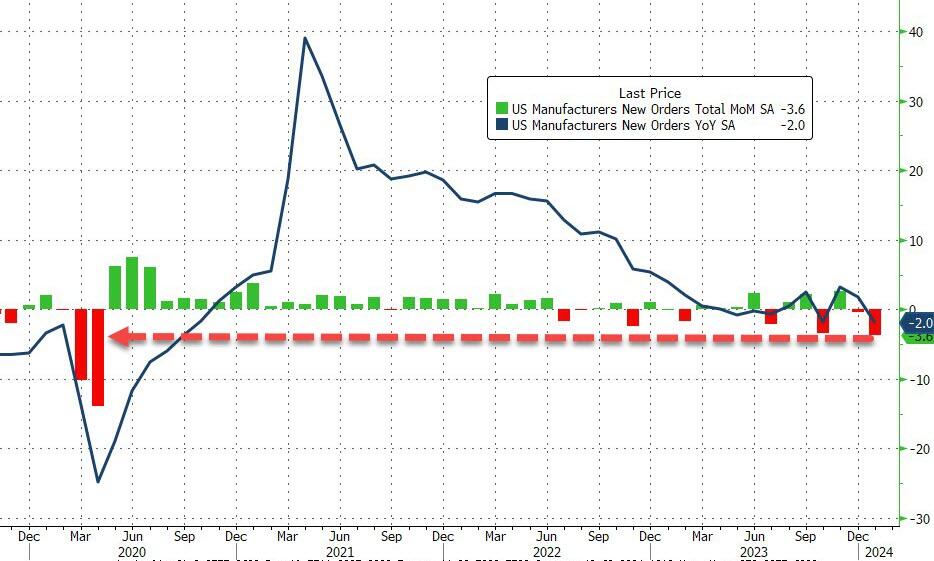
 US factory orders crashed  3.6% MoM in January, notably worse than the 2.9% MoM decline expected and worse still that December's 0.2% MoM rise was revised to a 0.3% decline. This didappointment pulled orders down 2.0% YoY - the worst annual decline since Sept 2020...

Source: Bloomberg

Garland's Latest Lawfare Tactic: Deliberate Regressivism

 Attorney General Merrick Garland should pay attention to what the United States Supreme Court said on Monday in a landmark ruling on Colorado's decision to remove former President Trump from that state's primary ballot. 

In a unanimous 9-0 verdict, the Supreme Court overturned Colorado's decision and ruled that states cannot kick Trump off the ballot over his alleged "insurrectionist" actions on January 6. The ruling said:

Because the Constitution makes Congress, rather than the states, responsible for enforcing Section 3 against all federal officeholders and candidates, we reverse.

The decision immediately nullified similar bans on Trump by Maine and, recently, Illinois. Regardless of party, all future presidents will no longer be subject to the humiliation of being denied ballot access by overzealous state officials. States are still at liberty to disqualify candidates from holding or seeking state office. 

The 9-0 decision is a stern reminder to lawfare-loving Garland and the Left that using laws to settle disputes with political opponents stifles democracy, and interfering in elections by using the state's judicial power is a firm no-no. Every justice, from the far left of the spectrum to the far right, felt that it was critical to say so. 

The decision couldn't have come at a better time. Over the weekend, AG Garland was at it again. Having unleashed Jack Smith as a Special Prosecutor to viciously go after Trump in friendly Washington DC courts and in Florida, on a skimpy obstruction of justice charge regarding the handling of classified documents, Garland turned to a favorite topic of his:

Fighting discriminatory, burdensome, and unnecessary voter ID election laws.

Speaking to a predominantly African-American crowd at a Black Selma church service, he said:

The right to vote is still under attack, and that is why the Justice Department is fighting back. We are challenging efforts by states and jurisdictions who implement discriminatory, burdensome, and unnecessary restrictions on access to the ballot, including those related to mail-in voting, the use of drop boxes and voter ID requirements.

No, AG Garland, the right to vote is NOT under attack. Georgia, which passed its reform laws after the 2020 election and invited a boycott of woke companies, including Major League Baseball (which canceled the All-Star game in Atlanta), reported that more voters and more minority voters participated in the 2022 elections than at any time in Georgia history. Even Stacey Abrams, the losing candidate for governor in 2018, who never conceded her defeat and became a media darling, accepted that she lost her rematch against Brian Kemp. 

In Garland's world, it should be easy for people to vote even if they do not provide convincing proof that they are American citizens. He believes that requiring voters to obtain a voter ID to present on Election Day is so burdensome that poll workers should not insist on such proof and let people in to vote anyway.

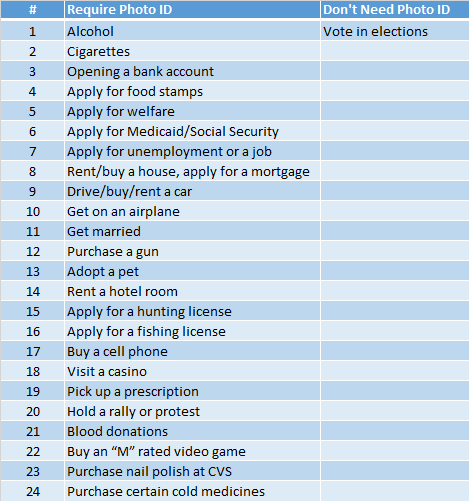
24 things that require a photo ID. Source: Washington Examiner

Garland's position is so left-wing that it does not make any sense to most Americans. Presenting some form of picture identification is required on a daily basis in numerous life circumstances, including opening a bank account, receiving a welfare check, buying cigarettes, or entering a federal building. 

An American citizen's most storied privilege and right is to participate in our democracy. Unlike citizens of many countries, an American's choice can be profoundly consequential, given the country’s global standing. For a voter to gain entry to a polling booth, most states require voters to present some form of photo identification where the photo matches the face, and the name and address on the identification match official records. According to Garland, requiring this photo identification is ‘discriminatory, burdensome, and unnecessary.’ 

Texas has one of the most stringent voter rules in the country—a state that is constantly on Garland's radar. Even Texas allows voters to present just one of seven IDs to prove citizenship. And do you know, AG Garland, how much the Texas ID costs? $6 for citizens 60 and older, valid for six years (that's $1 a year). If you're 59 or younger, it costs $16, again, good for six years. This is burdensome?

Suppose a voter does not have even one of the seven IDs mentioned above? In that case, they can still fill out a Reasonable Impediment Declaration form, show one of six other documents, such as a utility bill, bank statement, or paycheck, and vote. The ballot is later verified by the county and counted if the document presented is valid. How, pray Garland, is any of this discriminatory, burdensome, and unnecessary

The only reasonable conclusion we can draw is that Garland is OK with people casting their votes even if they're not eligible to vote - that is, cheating - demeaning the very nature of American participatory democracy. It is a preposterous position for the chief law enforcement officer of the United States to take.

The Department of Justice has the power to litigate against states and counties leading up to Election Day to scare poll workers into allowing ineligible voters to cast their ballots. An aggressive DOJ could paralyze elections by going to federal court and seeking injunctions against polling stations, confusing voters when concern regarding election integrity is at the top of people's minds. Indeed, Garland boasted that he would do precisely that. He said he has doubled the staff of the office within the DOJ's Civil Rights Division focusing on elections. 

Our latest TIPP poll shows that President Biden is leading former President Trump by only one point, well within the margin of error. Americans are deeply concerned about the country's direction, with 67% in the RealClearPolitics average saying the country is on the wrong track. 

Garland's plan is clear: Unleash the incredible power of the DOJ to neutralize common-sense election integrity laws across the Red states and deliver the White House back to Biden. 


https://tippinsights.com/garland-unleashes-doj-power-to-challenge-election-laws-and-help-biden/