Search This Blog

Monday, March 11, 2024

At Boeing, Speed, Not Safety, Is the Company’s Top Concern

 We now have a good picture of why the door of the Alaska Airlines 737 blew off mid-flight. The answer is speed and sloppiness every step of the way. Here are the details.


Out of Sequence Production

Out of sequence production to keep production lines moving and sloppy work procedures and Behind the Alaska Blowout.

Months before a piece of a Boeing 737 blew out midflight, leaving a door-sized hole in its side, the plane spent nearly three weeks shuffling down an assembly line with faulty rivets in need of repair.

Workers had spotted the bad parts almost immediately after the plane’s fuselage arrived at the factory. But they didn’t make the fix right away and the 737 continued on to the next workstation. When crews completed the repair 19 days later, they failed to replace four critical bolts on a plug door they had opened to do the job, leading to the Jan. 5 accident on an Alaska Airlines flight.

At Boeing, there is a term for situations such as this one, when work is completed out of the production line’s ordinary sequence: traveled work. Four years ago, in the aftermath of a pair of fatal MAX crashes, Boeing laid out five values central to improving safety. Number three on the list: eliminate traveled work.

Traveled work emerged as a problem during a review of Boeing’s safety culture on behalf of the Federal Aviation Administration. 

Employees are told that safety is the top priority “but then they see airplanes being pushed out with work not being finished,” said Javier de Luis, who was part of an independent panel that conducted the review. 

Spotting Bad Parts

“Workers had spotted the bad parts almost immediately after the plane’s fuselage arrived at the factory.”

Questions Abound

  • Why is it that no one can spot bad parts and rivets before a fuselage arrives at the factory?
  • Why was the door removal not properly logged?
  • Who is it that is supposed to double or triple check everything done out of sequence?
  • If it takes 19 days to do a repair what else is suspect on the plane?
  • Is there no quality control in building the fuselages?

Spirit AeroSystems makes fuselages for Boeing’s 737 Max jets.

If Boeing can spot the bad parts immediately, why couldn’t or didn’t Spirit AeroSystems spot bad rivets?

Is there no one at Boeing on sight at Sprit checking anything?

Boeing is in Talks to Buy Back Fuselage Maker Spirit AeroSystems

On March 1, CNBC reported Boeing is in Talks to Buy Back Fuselage Maker Spirit AeroSystems After Spate of Quality Defects

Boeing in 2005 spun off operations in Kansas and Oklahoma that became the present-day Spirit AeroSystems. About 70% of Spirit’s revenue last year came from Boeing, and roughly a quarter came from making parts for Boeing’s main rival, Airbus, according to a securities filing.

“We believe that the reintegration of Boeing and Spirit AeroSystems’ manufacturing operations would further strengthen aviation safety, improve quality and serve the interests of our customers, employees, and shareholders,” Boeing said in a statement on Friday. “Although there can be no assurance that we will be able to reach an agreement, we are committed to finding ways to continue to improve the safety and quality of the airplanes on which millions of people depend each and every day.”

Explaining Quality Control at Spirit AeroSystems

Spirit has struggled financially, and was last profitable in 2019, before the pandemic. In October, Spirit appointed Pat Shanahan, who spent about three decades at Boeing, as its new, interim CEO.

Spirit has lost money since 2019. That explains why Spirit AeroSystems would rush things. In turn, Boeing rushed things.

Boeing Door Blowout Reveals Cockpit Security Problems As Well

Also recall Boeing Door Blowout Reveals Cockpit Security Problems As Well

The jet cockpit door is designed to open during decompression. This is a mistake for two reasons. The door blowoff incident at Alaska airlines exposed both issues.

How Doors Blow Off Mid-Flight

Everyone is rushing things, doing things out of order, not properly logging things done out of order, and not rechecking things done out of order.

In short, speed is the #1 priority.

That is the bottom line story of how airplane doors (where there isn’t even supposed to be a door), blow off mid-flight.

https://mishtalk.com/economics/at-boeing-speed-not-safety-is-the-companys-top-concern/

Biden’s Proposal to Boost Federal Spending by $400 Billion is a Nonstarter

 The President wants to boost handouts to families and raise taxes. It’s a progressive push that’s all take and no give.

More Handouts and Higher Taxes

President Biden’s Budget Proposal would would boost federal spending to $7.3 trillion next fiscal year up from $6.9 billion paid for by higher taxes.

President Biden’s proposed budget would boost federal spending to $7.3 trillion next fiscal year and raise taxes on wealthy people and large corporations, in an attempt to cut the deficit while also lowering the costs of prescription drugs, child care and housing.

The budget leaves some blank spaces. It lists principles for shoring up Social Security, without specifying a plan. It calls for paying for extensions of tax cuts for most households after 2025 but doesn’t detail how that would be paid for. And it calls for restoring the expanded child tax credit, but only temporarily, lumping that into the broader 2025 tax debate.

Under his plan, families making less than $200,000 a year would be guaranteed subsidized child care, with the lowest income families paying nothing. The president proposed building or preserving more than two million housing units, and a series of tax credits to ease the high cost of purchasing a home. He calls for spending $12 billion to come up with strategies to reduce the cost of college, while expanding Pell Grants and offering tuition-free community college. And he again outlined a federal paid family and medical leave program.

Biden’s budget would ensure the solvency of a Medicare hospital-insurance trust fund by increasing taxes on the wages, investment gains and self-employment income of people earning more than $400,000 a year.

The president’s proposal would significantly expand the number of drugs subject to price negotiation in Medicare, a federal health program for seniors and the disabled, to 50 a year from a maximum of 20. It would extend a $2,000 cap on out-of-pocket prescription drugs in Medicare, and a $35 cost-sharing cap for a month of the diabetes drug insulin, to the commercial market.

The budget doesn’t include a detailed plan for stabilizing Social Security, which like Medicare, faces a shortfall in the coming decade. Instead, the president proposes working with Congress to strengthen the program, prevent cuts and ensure its solvency by increasing unspecified taxes on wealthy Americans.

Many of the tax cuts enacted in 2017 by Republicans expire after 2025. Like last year, Biden’s budget says that the president supports extending those tax cuts for households making under $400,000 and paying for those extensions to avoid increasing budget deficits. But he doesn’t lay out a specific plan for doing so,

Biden also calls for restoring the expanded child tax credit that was in effect during 2021—but only temporarily through 2025.

Sleight of Hand Gimmicks

The reason for “temporary” proposals is that under CBO rules temporary proposals do not add to the deficit.

Biden accuses Trump of having no plan for addressing Social Security but he does not have one either.

In addition, Biden tells a flat out lie on Trump cutting Social Security when in fact the Trump plan and the Biden plan are identical. Both maintain they will not touch Social Security. That means automatic reductions in payouts starting as soon as 2032.

All Take and No Give

Biden continues the progressive push that may as well been written by Elizabeth Warren and perhaps was. Biden again proposed a wealth tax on unrealized profits.

Warren has been advocating that for years. However, the ideas appears to be blatantly unconstitutional. It’s foolish regardless.

Highly Inflationary Proposals

Expanded child tax credits, tax credit to purchase a home, free college tuition, and free child care are all highly inflationary.

Child tax credits encourage people not to work. So does Medicaid expansion.

Biden’s Misguided Woke Apology

An illegal immigrant charged with crimes in NY and GA was released, then killed nursing student Laken Riley.

Biden apologized for using the term illegal in his SOTU address when discussing the murder.

Biden won’t treat any of these people, even murders and rapists, with disrespect.


Woke apologies to murderers, or perceived apologies to murderers, can only backfire. This was Biden’s hyena moment. Expect more of them.

The budget is a nonstarter and Biden knows that. But he cannot help himself. Everything he says and does is a direct appeal to the radical Left.

Yet, here were are. Both Biden and Trump are openly ignoring the voters who will decide the election.

Biggest Lie in Campaign History

Biden promised to be a healer and a moderate. It was the biggest lie in campaign history.

On the other side of the ledger, it’s counterproductive for Trump to continue with name calling. Labeling Nikki Haley “bird brain” and California Governor Gavin Newsom “New Scum” cannot possibly win a single vote!

Trump could easily win this in a blowout if he would just stop personal attacks.

Polls Show Biden is Losing Black, Hispanic, and Young Voters to Trump

One of them will succeed in their competitive effort to offend the most independents, moderates, and young voters. Right now, my bet is Biden will succeed in doing that.

In turn, this means I expect Trump to win the election. But this is a current snapshot. There’s still 8 months to go.

The real wildcard may not be the criminal trials but the economy. There’s a good chance of recession by the election just as everyone is cheering a soft landing.

Hoot of the Day “The Fed Has Reached the Soft Landing Runway”

The uphill battle for Biden is very steep. He has done too many things wrong.

People may not like Trump, but too many people realize they were economically better off before this massive inflation.

https://mishtalk.com/economics/bidens-proposal-to-boost-federal-spending-by-400-billion-is-a-nonstarter/

Biora Therapeutics Further Reduces Net Debt and Monetizes Legacy Asset

 Monetization of legacy asset brings in $3 million in nondilutive capital

Convertible notes exchange brings in another $2.8 million in new capital and reduces Biora’s net debt

https://www.globenewswire.com/news-release/2024/03/11/2843734/0/en/Biora-Therapeutics-Further-Reduces-Net-Debt-and-Monetizes-Legacy-Asset.html

After crushing loss last year, Acelyrin rebounds with psoriatic arthritis victory

 Acelyrin’s lead asset, izokibep, outperformed placebo as a treatment for psoriatic arthritis in a phase 2b/3 trial, rebounding from a previous clinical loss that crunched the company’s value. 

The biotech says izokibep notched a statistically significant improvement in the skin condition compared to placebo at week 16, according to Monday’s announcement. The primary endpoint was ARC50, encompassing patients who recorded a 50% improvement in symptoms. Acelyrin also said that 160 mg of izokibep given weekly or every other week “showed improved magnitude of responses” on additional symptom endpoints tracking 70% and 100% improvement, and minimal disease activity compared to 80 mg given every other week. 

Less than 3% of patients discontinued the study with Acelyrin saying the drug has a favorable safety profile. CEO Shao-Lee Lin, M.D., Ph.D., said in a release that the data validate the profile of the 160 mg dose and give the company “conviction” in its efficacy and safety profile. 

“We have observed from the phase 2 46-week data that there is no safety limitation to long-term treatment with izokibep and that longer duration of therapy demonstrated the potential for even further improvements over time,” said Philip Mease, M.D., in a release, director of rheumatology research at the Swedish Medical Center in Seattle and an investigator for the trial. 

Acelyrin’s shares rose just under 7% to $7.99 shortly after the markets opened Monday morning. The results were a much-needed win after izokibep failed in a phase 2b/3 test for patients with hidradenitis suppurativa (HS). That September disclosure sent the company’s share price nosediving, and it has yet to recover. 

Two months later, in late November 2023, Acelyrin said its contract research organization, Fortrea, had slipped up on the dosing schedule in the psoriatic arthritis trial, prompting a full look at the izokibep program, including the hidradenitis suppurativa study. The company vowed to not use Fortrea for any future trials. 

Acelyrin did have a glimmer of hope to share on the HS trial Monday, reporting 32-week follow-up data from the phase 2b portion that indicated continued izokibep use “was associated with further clinical improvements over time.” Acelyrin says the majority of treated patients achieved at least a 75% reduction in symptoms, though it’s unclear how that compares to placebo over the same period. 

Izokibep is Acelyrin’s main clinical bet, with four mid- to late-stage programs across immunology. The therapy helped propel the company to a $540 million IPO in 2023, one of just a handful of biotechs that made it onto the public market last year. As of the end of September 2023, Acelyrin had nearly $790 million in available cash. 

https://www.fiercebiotech.com/biotech/acelyrin-rebounds-psoriatic-arthritis-victory

Lexicon to Resubmit Sotagliflozin NDA for Type 1 Diabetes After FDA Feedback

 Preparations Underway for Resubmission of New Drug Application for Sotagliflozin as an Adjunct to Insulin Therapy for Glycemic Control in Patients with Type 1 Diabetes and Chronic Kidney Disease

Resubmission is Anticipated Mid-2024

https://www.globenewswire.com/news-release/2024/03/11/2843620/0/en/Lexicon-Preparing-to-Resubmit-Sotagliflozin-NDA-for-Type-1-Diabetes-Following-Feedback-From-FDA.html

NY Fed Finds Medium, Long-Term Inflation Expectations Jump Amid Surge In Stock Market Optimism

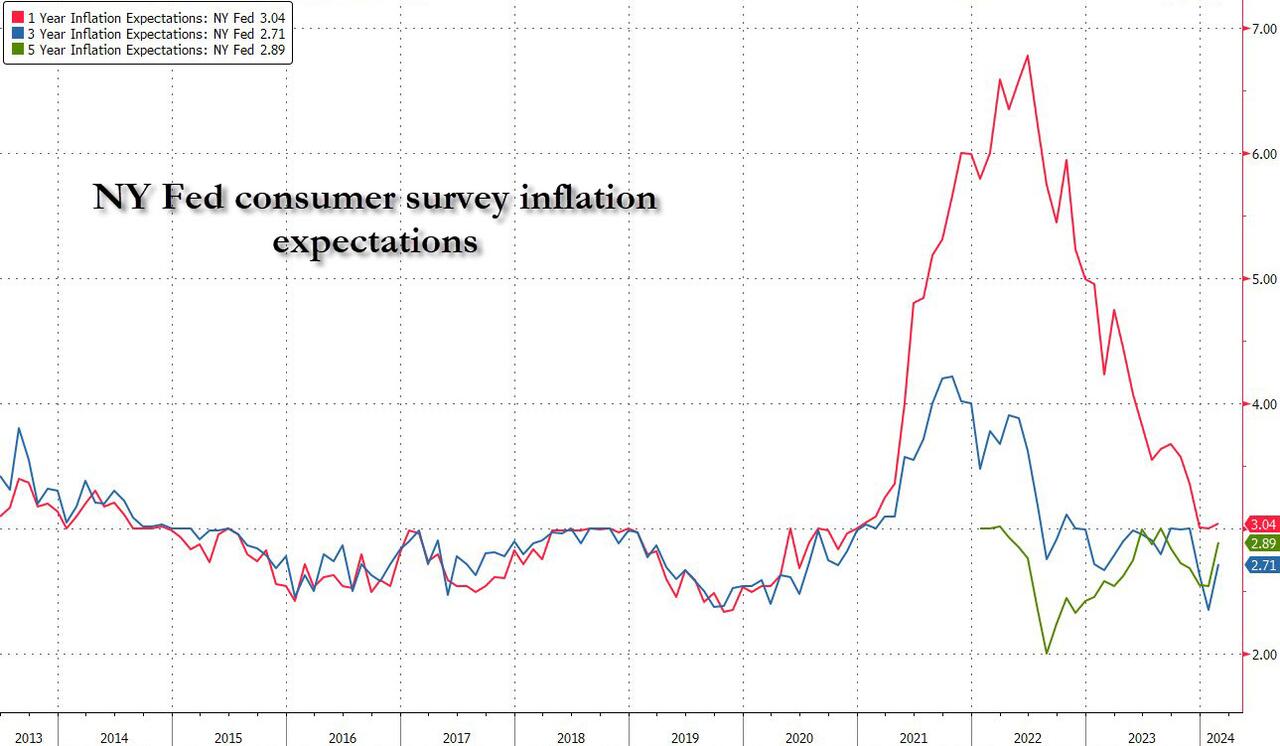
 One month after the inflation outlook tracked by the NY Fed Consumer Survey extended their late 2023 slide, with 3Y inflation expectations in January sliding to a record low 2.4% (from 2.6% in December), even as 1 and 5Y inflation forecasts remained flat, moments ago the NY Fed reported that in February there was a sharp rebound in longer-term inflation expectations, rising to 2.7% from 2.4% at the three-year ahead horizon, and jumping to 2.9% from 2.5% at the five-year ahead horizon, while the 1Y inflation outlook was flat for the 3rd month in a row, stuck at 3.0%. 

The increases in both the three-year ahead and five-year ahead measures were most pronounced for respondents with at most high school degrees (in other words, the "really smart folks" are expecting deflation soon). The survey’s measure of disagreement across respondents (the difference between the 75th and 25th percentile of inflation expectations) decreased at all horizons, while the median inflation uncertainty—or the uncertainty expressed regarding future inflation outcomes—declined at the one- and three-year ahead horizons and remained unchanged at the five-year ahead horizon.

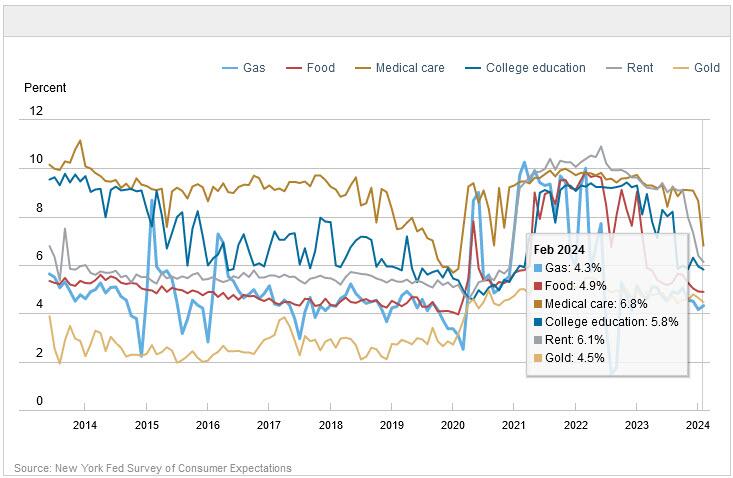
Going down the survey, we find that the median year-ahead expected price changes increased by 0.1 percentage point to 4.3% for gas; decreased by 1.8 percentage points to 6.8% for the cost of medical care (its lowest reading since September 2020); decreased by 0.1 percentage point to 5.8% for the cost of a college education; and surprisingly decreased by 0.3 percentage point for rent to 6.1% (its lowest reading since December 2020), and remained flat for food at 4.9%.

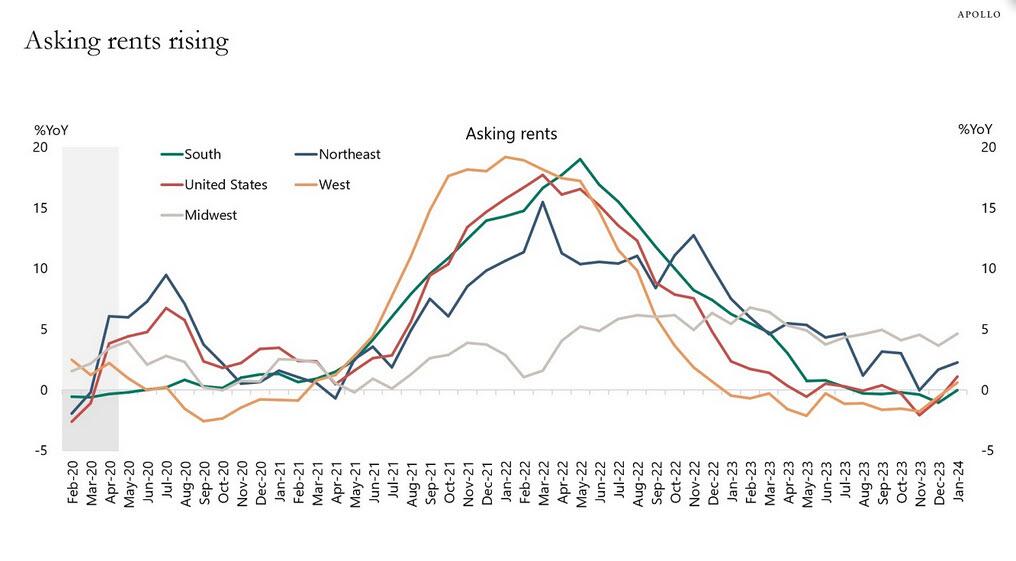
We find the rent expectations surprising because it is happening just asking rents are rising across the country.

At the same time as consumers erroneously saw sharply lower rents, median home price growth expectations remained unchanged for the fifth consecutive month at 3.0%.

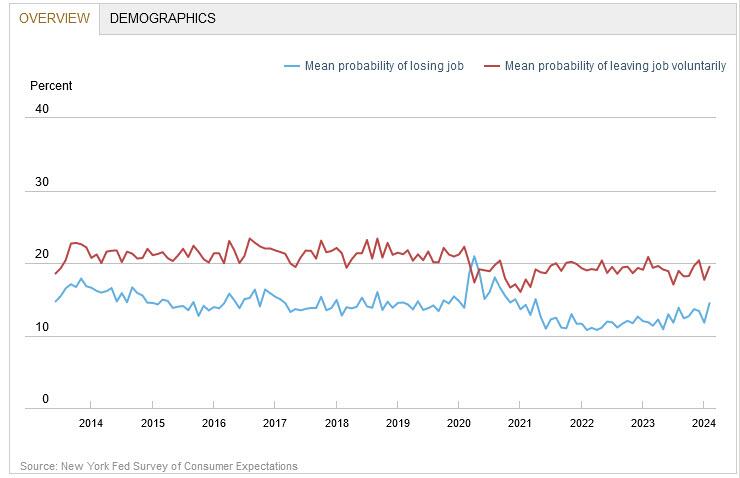
Turning to the labor market, the survey found that the average perceived likelihood of voluntary and involuntary job separations increased, while the perceived likelihood of finding a job (in the event of a job loss) declined. "The mean probability of leaving one’s job voluntarily in the next 12 months also increased, by 1.8 percentage points to 19.5%."

Mean unemployment expectations - or the mean probability that the U.S. unemployment rate will be higher one year from now - decreased by 1.1 percentage points to 36.1%, the lowest reading since February 2022. Additionally, the median one-year-ahead expected earnings growth was unchanged at 2.8%, remaining slightly below its 12-month trailing average of 2.9%.

Turning to household finance, we find the following:

  • The median expected growth in household income remained unchanged at 3.1%. The series has been moving within a narrow range of 2.9% to 3.3% since January 2023, and remains above the February 2020 pre-pandemic level of 2.7%.
  • Median household spending growth expectations increased by 0.2 percentage point to 5.2%. The increase was driven by respondents with a high school degree or less.
  • Median year-ahead expected growth in government debt increased to 9.3% from 8.9%.
  • The mean perceived probability that the average interest rate on saving accounts will be higher in 12 months increased by 0.6 percentage point to 26.1%, remaining below its 12-month trailing average of 30%.
  • Perceptions about households’ current financial situations deteriorated somewhat with fewer respondents reporting being better off than a year ago. Year-ahead expectations also deteriorated marginally with a smaller share of respondents expecting to be better off and a slightly larger share of respondents expecting to be worse off a year from now.
  • The mean perceived probability that U.S. stock prices will be higher 12 months from now increased by 1.4 percentage point to 38.9%.
  • At the same time, perceptions and expectations about credit access turned less optimistic: "Perceptions of credit access compared to a year ago deteriorated with a larger share of respondents reporting tighter conditions and a smaller share reporting looser conditions compared to a year ago."

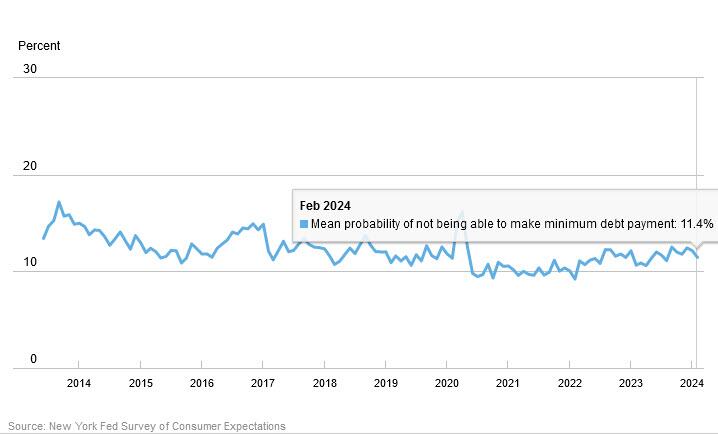
Also, a smaller percentage of consumers, 11.45% vs 12.14% in prior month, expect to not be able to make minimum debt payment over the next three months

Last, and perhaps most humorous, is the now traditional cognitive dissonance one observes with these polls, because at a time when long-term inflation expectations jumped, which clearly suggests that financial conditions will need to be tightened, the number of respondents expecting higher stock prices one year from today jumped to the highest since November 2021... which incidentally is just when the market topped out during the last cycle before suffering a painful bear market.

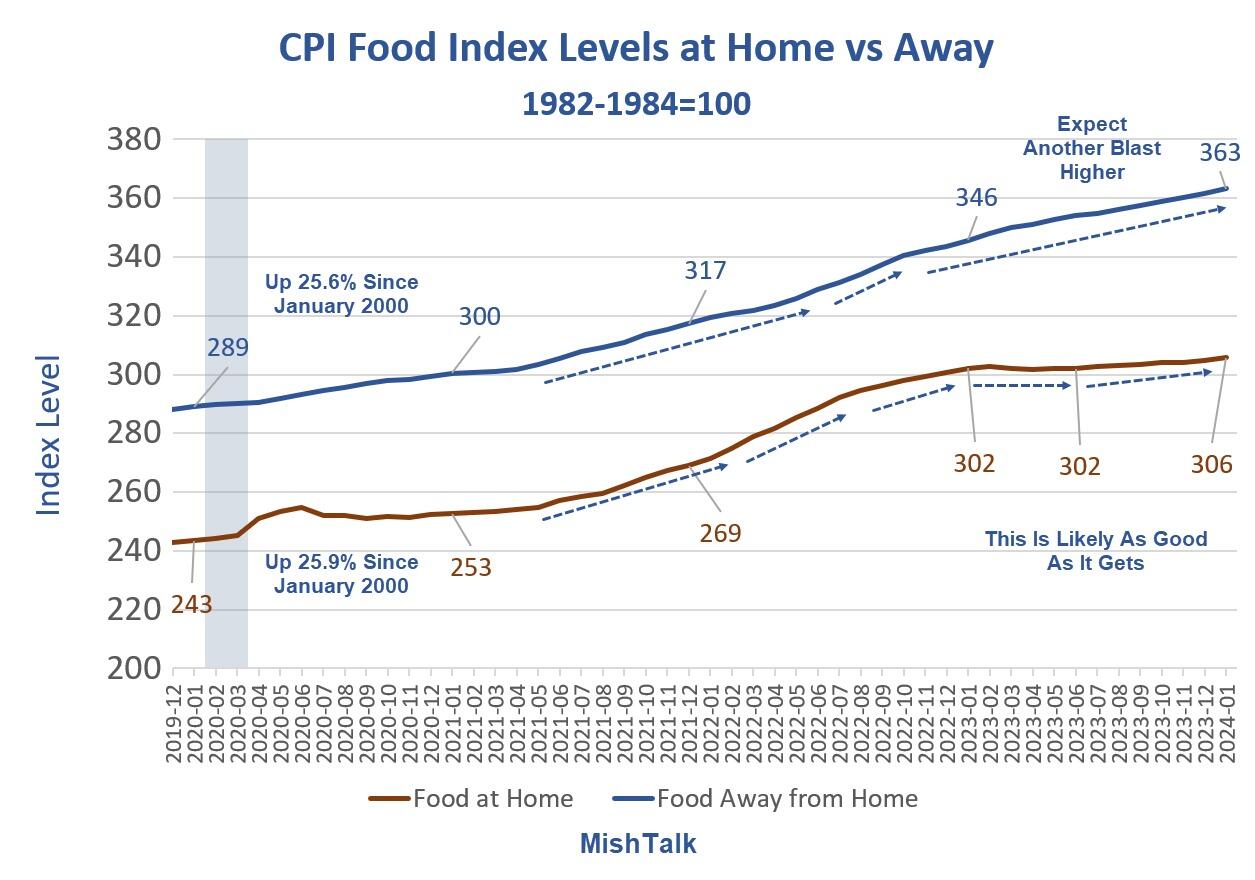
Expect Another Surge In Food Prices Fueled By 'Dynamic Pricing'

 by Mike Shedlock via MishTalk.com,

Restaurants are moving towards dynamic menu prices. Expect big surcharges for peak times. Don’t expect off peak prices to drop much. Labor costs are rising too.