Search This Blog

Monday, March 11, 2024

Serious Issues With Slow Heartbeat Flagged for Afib Patients on Antiarrhythmics

 Old concerns about the safety of rhythm control drugs for atrial fibrillation (Afib or AF) resurfaced in a contemporary large Korean population-based study.

Afib patients prescribed antiarrhythmic drugs (AADs) had several-fold higher risks of cardiac events believed to be related to a decline in heart rate. Compared with other Afib patients, these AAD users showed more frequent:

  • Pacemaker implantation or syncope: 16.3 vs 4.8 events per 1,000 person-years (adjusted HR 3.50, 95% CI 3.29-3.71)
  • Syncope: 5.5 vs 2.6 events per 1,000 person-years (adjusted HR 2.14, 95% CI 1.95-2.35)
  • Pacemaker implantation: 11.3 vs 2.2 events per 1,000 person-years (adjusted HR 5.26, 95% CI 4.86-5.70)

The association between AADs and risk of pacemaker implantation or syncope was consistent across various subgroups. In fact, older people and women appeared to be disproportionately susceptible to these events after starting AAD therapy, reported Jong-Il Choi, MD, PhD, MHS, MSc, of Korea University College of Medicine and Korea University Anam Hospital in Seoul, and colleagues in the Journal of the American College of Cardiologyopens in a new tab or window.

"Although rhythm control is an established treatment strategy for patients with new-onset AF, the potential for bradycardia-related adverse effects of AADs, including pill-in-the-pocket strategy, should be considered," the authors urged.

"The progressive nature of sick sinus syndrome and atrioventricular node block is another concern for patients with AF taking prolonged AAD treatment," they added.

The AADs analyzed in this study were flecainide, propafenone, pilsicainide, amiodarone, dronedarone, and sotalol.

As a treatment for new-onset Afib, early rhythm control therapy with AADs had been controversial since the old AFFIRM trialopens in a new tab or window showed no clear benefit of rhythm control over rate-controlling drugs, with a numerical excess in all-cause deaths to boot. Cardiac arrest due to pulseless electrical activity or bradycardia was significantly more common in the rhythm control group in AFFIRM, Choi's group noted.

Fast forward nearly two decades later, however, and EAST-AFNET 4opens in a new tab or window showed that rhythm control, when initiated early in the contemporary era with newer therapies, significantly reduced the risk of the composite endpoint of cardiovascular death, stroke, or hospitalization for worsening heart failure or acute coronary syndrome -- the downside being a nonsignificant trend for more bradycardia or syncope.

The EAST-AFNET 4 trial nevertheless made AADs a mainstream treatment strategy for new-onset Afib in recent years.

The present Korean study is a reminder of the bradycardia risk being "an important and heretofore relatively ignored aspect of AAD use," commented a trio led by Sanjay Dixit, MD, of the Hospital of the University of Pennsylvania in Philadelphia.

"It is worth noting that although the HR of the primary endpoint was highest in the initial 6 months after starting AADs, this risk persisted for more than 2 years. This is an important observation, and it raises the question of whether AF patients on long-term AADs who are at a higher risk for developing bradyarrhythmias may benefit from extended monitoring by insertable cardiac monitors?" they posed in an accompanying editorialopens in a new tab or window.

"It is, however, encouraging to note that the overall occurrence of syncope and [permanent pacemaker] implantations in this large database was quite low. Nevertheless, these observations should certainly make us more cautious when using AADs, especially in older patients and women," according to the editorialists.

They noted that catheter ablation, used as endorsed by the guidelines, could be considered an alternative to achieve rhythm control.

"Whether catheter ablation is superior to AADs for reducing adverse clinical events is unclear; however, it can be a good alternative for patients contraindicated or intolerant to AADs," Choi and colleagues agreed.

Their study was based on prescription history and billing claims from the Korean National Health Insurance Service system.

Study authors identified 770,977 new-onset Afib diagnoses from 2013-2019 and identified 142,141 patients who had been prescribed AADs within 1 year of Afib diagnosis. People with a history of syncope or permanent pacemaker implantation were excluded.

Around 60% of the included patients were age 65 or older. The AAD user subgroup had a significantly greater proportion of men (59.2% vs 51.5%) and fewer people with a prior stroke (6.7% vs 10.4%) compared with controls.

Propensity score-matched analysis supported the main result of the study, namely a significant association between AAD use and the risk of pacemaker implantation or syncope.

The observational, retrospective study left room for selection bias with regard to prescribers choosing AADs for healthier Afib patients.

"Physicians probably use AADs in patients without history of bradycardia, dizziness, and syncope. Use of AADs in this study showed more than a 3-fold increased risk of syncope or pacemaker implantation despite such potential selection bias," Choi and colleagues maintained.

Other study limitations include its limited generalizability due to the enrollment of only East Asian individuals, and an incomplete prescription and medical history for each person.

Dixit's group highlighted the lack of information on the dose of prescribed AADs and patient compliance, concurrent use of atrioventricular nodal blockers, and baseline sinus node dysfunction and conduction system disease.

Disclosures

This work was supported by grants from Korea University, Korea University Anam Hospital, and the National Research Foundation of Korea.

Choi and study co-authors had no disclosures.

Dixit and editorialists had no disclosures.

Primary Source

Journal of the American College of Cardiology

Source Reference: opens in a new tab or windowKim YG, et al "Association of antiarrhythmic drug therapy with syncope and pacemaker implantation in patients with atrial fibrillation" J Am Coll Cardiol 2024; DOI: 10.1016/j.jacc.2024.01.013.

Secondary Source

Journal of the American College of Cardiology

Source Reference: opens in a new tab or windowDixit S, et al "Atrial fibrillation management with antiarrhythmic drug therapy: balancing benefits and bradycardia risks" J Am Coll Cardiol 2024; DOI: 10.1016/j.jacc.2024.01.015.

https://www.medpagetoday.com/cardiology/arrhythmias/109118

Acadia Pharmaceuticals' schizophrenia drug fails in late-stage study

 Acadia Pharmaceuticals said on Monday its experimental drug to treat negative symptoms of schizophrenia failed to meet the main goal in a late-stage study.

https://finance.yahoo.com/news/acadia-pharmaceuticals-schizophrenia-drug-fails-201310896.html

Pittsburgh Police No Longer Responding To "Non-Emergency" Calls;:Report

 by Steve Watson via Modernity.news,

WPXI Channel 11 out of Pittsburgh reports that police will no longer be responding to calls that are not deemed to be “in-progress emergencies,” meaning theft, harassment, criminal mischief, and burglary alarms will essentially be ignored.

US Swing States Misery Index Shows Bidenomics Is Failing

 by Daniel Lacalle,

One of the most dangerous things that a government can do is present a glossy picture of the economy at a time when families and small businesses are suffering. Governments are always optimistic, but sending euphoric messages tends to backfire, especially when the situation for the middle class is complicated.

In the United States, the Biden administration’s message of “the strongest economy in decades” is not just an exaggeration; it may anger voters who suffer the burden of negative real wage growth, accumulated inflation, and higher taxes.

According to a study by the Tax Policy Center, 20 to 30 percent of middle-income households saw a tax hike in 2022 and according to the Tax Foundation, workers bear an estimated 70 percent of the corporate income tax hikes. Indirect taxation is only one source of purchasing power loss for families. Rising taxation on productive capacity reduces the availability of manufacturing jobs, limits real wage growth, and creates higher costs for consumers.

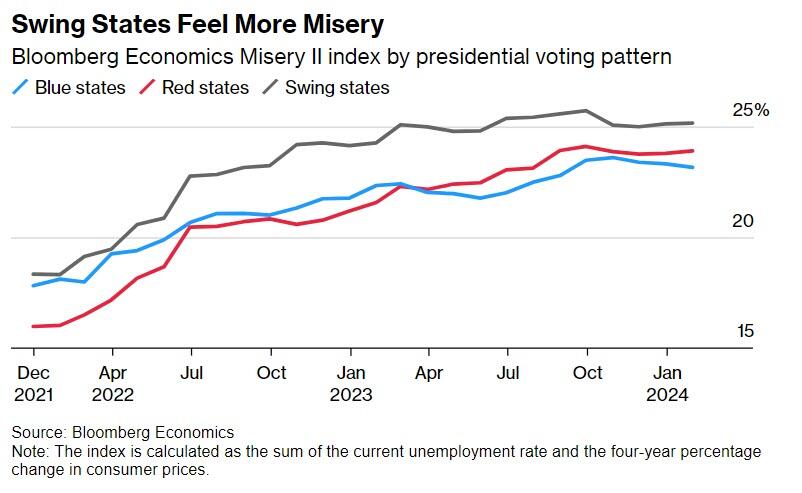
One way of measuring the situation of families in the United States is the Misery II Index, calculated as the current unemployment rate added to the accumulated consumer price index measure of inflation over the past four years. Historically, the Misery II Index, according to Bloomberg Economics, has been 17.65% in years when the current president wins an election. However, the reality of the United States economy today is much worse.

The Misery II Index for the United States stands at 23% for the whole nation, and Bloomberg Economics estimates that it will reach a staggering 24% by the time of the elections.

This means that the average US citizen has lost an enormous amount of wealth and purchasing power in salaries due to accumulated inflation, and low unemployment may not create voter support as the reality of real wage growth also shows that the average U.S. worker is struggling.

As Ryan McMaken points out, the recent minuscule increase in real wages is hardly good news when it comes after 25 months in a row of year-over-year declines in real wages from mid-2021 to mid-2023. This means that the average hourly wage has increased by just 0.76% over the past four years, when in the previous four years real wages rose three times more, or 2.8 percent.

This Misery II Index is not just bad for the whole United States. According to Bloomberg, swing-state economies have fared relatively poorly during the Biden presidency, especially since mid-2022,” with the Misery II Index for swing states almost two percentage points higher than other states.

We do not know if this will make a strong difference in voters’ decisions, but the weakening of workers’ and businesses conditions are signs of why the average American sees a much weaker economy than headlines suggest.

There is a lesson here that no government will learn. Inflationist policies never work and may make the administration lose an election. Wrongly named stimulus plans only leave a massive trail of debt and impoverishment for citizens.

The government tries to blame inflation on anything and everything except the insane fiscal and monetary policy of the past years. There is no such thing as commodity inflation, corporate greedflation, cost-push inflation, or shrinkflation. The only thing that can make aggregate prices rise in unison, consolidate the increase, and continue rising even if it is at a slower pace is the destruction of the purchasing power of the U.S. dollar through the monetary mismanagement caused by monetizing an unsustainable and ever-increasing public deficit. If any of the aforementioned factors had contributed to inflation, we would currently be experiencing deflation rather than persistent inflation, which only refers to a slower rate of price increases. Inflation is always the destruction of the purchasing power of the currency and that is what Americans received when they were promised free things: lower real wages and a diminishing purchasing power of deposit savings.

The so-called Bidemomics has brought debt to an all-time high and no real wage growth with low official unemployment that disguises labor participation and employment to population ratios below the 2019 level.

Yes, the government is to blame for inflation, and a strong economy does not show an average 0.7% real wage growth in four years, a two trillion dollar annual government deficit with $34 trillion debt, and a 17.6% accumulated official CPI inflation that is 33.7% if we consider food, 18.7% in shelter and 32.8% in energy, an estimated 30% in all non-replaceable goods, according to the Bureau of Labor Statistics 2021-2023.

Governments are to blame for inflation, and this may be a key factor in the elections.

https://www.zerohedge.com/personal-finance/us-swing-states-misery-index-shows-bidenomics-failing

Novartis’ Remibrutinib Shows Promise in Small Mid-Stage Hidradenitis Suppurativa Study

 Novartis’ investigational BTK inhibitor remibrutinib may also hold promise for hidradenitis suppurativa, potentially opening another therapeutic area for the candidate beyond its lead indication, according to several media reports.

Over the weekend, at the American Academy of Dermatology annual meeting, Novartis revealed early Phase IIb data from 66 patients who had been treated with either 25 mg or 100 mg of remibrutinib, which was dosed twice-daily, according to Fierce Biotech. The study’s primary endpoint was a 50% decrease in abscesses and inflammatory nodules, along with no increase in draining tunnels compared with baseline.

At 16 weeks, around 73% of patients treated with the 25-mg dose responded to remibrutinib, while the higher dose level was slightly less effective at 49%. By comparison, 34.7% of those in the placebo group reached the primary outcome, according to Endpoints News.

Remibrutinib also outperformed placebo at clearing 50%, 70% and 90% of abscesses and inflammatory nodules, respectively, reported Fierce Biotech. Around 36% of patients in the lower-dose group saw 90% clearance, compared to only 8% of placebo counterparts.

In terms of safety, the mid-stage study flagged five cases of grade three and four adverse events in the remibrutinib group and four grade three toxicities in the placebo arm. One patient given the 25-mg remibrutinib dose was found to have heightened levels of liver enzymes, which could be suggestive of liver damage, though this was ultimately deemed unrelated to the study drug.

Designed to be orally available, remibrutinib is a highly selective and covalent inhibitor of the Bruton’s tyrosine kinase (BTK) protein, which is central to B-cell development and the production of antibodies and cytokines.

Remibrutinib’s lead indication is chronic spontaneous urticaria, an inflammatory skin disease characterized by itchy hives and swelling. In August 2023, Novartis released results from two Phase III studies demonstrating that remibrutinib can significantly improve weekly urticaria activity score through 12 weeks of follow-up.

Novartis is planning to make regulatory filings for remibrutinib in this indication within the year. During its fourth-quarter and full-year 2023 financial report in January 2024, the company named rumibrutinib as one of its key milestones this year that will help it meet its growth target.

If approved, remibrutinib could help the company shore up any revenue losses that will come with the loss of Xolair’s patent protections, some of which are set to expire this year.

In addition to chronic spontaneous urticaria, Novartis is also assessing the potential of remibrutinib in other immune-mediated conditions including chronic inducible urticaria, multiple sclerosis, food allergies and hidradenitis suppurativa.

https://www.biospace.com/article/novartis-remibrutinib-shows-promise-in-small-mid-stage-hidradenitis-suppurativa-study/

FDA Rejects Viatris, Mapi’s Long-Acting Multiple Sclerosis Injection

 The FDA has rejected Viatris and Mapi Pharma’s investigational formulation of glatiramer acetate, dubbed GA Depot 40, for the treatment of relapsing forms of multiple sclerosis, the companies announced on Monday.

Details of the FDA’s rejection were scant and the partners only said that they are currently reviewing the Complete Response Letter to better determine the “appropriate next steps” for GA Depot 40.

“The companies continue to believe in the potential of the product to provide an important new treatment advancement for patients with multiple sclerosis,” according to the announcement. 

Glatiramer acetate, the active ingredient of GA Depot 40 is an immunomodulator that targets the inflammatory pathways underpinning multiple sclerosis (MS). The drug itself cannot cross the blood-brain barrier but exerts its effects through peripheral helper cells, which can then potentially enter the brain and reduce inflammation within the central nervous system.

Originally developed by Teva Pharmaceuticals, glatiramer acetate was first approved in the U.S. in 1996 for the treatment of relapsing forms of MS. It carries the brand name Copaxone.

Viatris and Israel-based partner Mapi were proposing their investigational long-acting formulation of glatiramer acetate, which is designed to be given via an intramuscular injection every four weeks.

The partners supported their New Drug Application, which the FDA accepted in August 2023, with Phase III data obtained from more than 1,000 patients who received a total of 13 doses of either 40-mg GA Depot or placebo. Results showed that the long-acting formulation could cut the annualized relapse rate by 30.1% versus placebo, an effect that was statistically significant with a p-value of 0.0066.

GA Depot also offered patients a preferable dosing schedule and elicited fewer injection site reactions as compared with other products.

At the time, Viatris President Rajiv Malik said in a statement that GA depot, if approved, could “improve patient experience through fewer injections, greater tolerability and increased compliance.”

Monday’s rejection continues biopharma’s losing streak in the MS space. Last week, Merck KGaA announced that it was abandoning the development of its BTK inhibitor evobrutinib in MS. The decision comes after the candidate failed two Phase III trials in December 2023, unable to significantly reduce annualized relapse rate versus teriflunomide.

Other BTK inhibitors have also stumbled in MS. Sanofi’s tolebrutinib was put under partial clinical hold in June 2022 due to drug-induced liver injury. Roche’s candidate fenebrutinib ran into the same problem in December 2023, when the FDA also put a regulatory pause on the BTK inhibitor for potential liver injury.

https://www.biospace.com/article/fda-rejects-viatris-mapi-s-long-acting-multiple-sclerosis-injection/

Bristol cut to Hold by SocGen

 From Buy

https://finviz.com/quote.ashx?t=BMY&p=d