Search This Blog

Wednesday, April 17, 2024

Boeing Whistleblower Tells Lawmakers: "They Are Putting Out Defective Airplanes"

 Update (1530ET): 

"I have serious concerns about the safety of the 787 and 777 aircraft, and I'm willing to take on professional risk to talk about them," Boeing whistleblower Sam Salehpour said in his opening statement on Capitol Hill today at the second Senate committee investigating the plane manufacturer's safety problems. He said when he raised concerns about the 787 Dreamliner, he was "ignored" by the company and "told not to create delays. I was told, frankly, to shut up."

Salehpour warned that the 787 Dreamliner fuselage was improperly put together and that the company "rushed to address the bottlenecks in production." The result, he warned, is "premature fatigue failure" on these planes. He noted, "They are putting out defective airplanes." 

"If something happens to me, I am at peace because I feel like coming forward, I will be saving a lot of lives," he added.

Boeing did not have any witnesses at the hearing, but a spokesperson for the company told The Hill the company "understands the important oversight responsibilities of the Subcommittee and we are cooperating with this inquiry. We have offered to provide documents, testimony, and technical briefings, and are in discussions with the Subcommittee regarding next steps."

Sen. Richard Blumenthal (D-Conn.), the committee chair, thanked the whistleblower for "speaking truth to power in the best sense of that word. Thank you for facing down one of the most powerful companies in the world." 

Blumenthal added, "We intend to uncover what has enabled the culture of safety disregard to exist, so that we can change it for good."

In early March, the last Boeing whistleblower was found dead in his car from a "self-inflicted wound." 

*   *   *

Update (1113ET):

The second Senate hearing on Boeing is about to begin (1115 ET). Lawmakers will hear whistleblower allegations about significant safety lapses in Boeing's manufacturing of the 787 Dreamliner. 

*   *   *

Update (0955ET):

Boeing faces two hearings on Capitol Hill today: 

First: Senate Commerce Committee

US Senator Maria Cantwell (D-Wash.), Chair of the Senate Committee on Commerce, Science and Transportation, will convene a full committee hearing titled "FAA Organization Designation Authorization (ODA) Expert Panel Report" on Wednesday, April 17, 2024, at 10:00 AM EDT. This hearing will review the findings and recommendations from the Organization Designation Authorization (ODA) Expert Review Panel's final report. The landmark Aircraft Certification, Safety, and Accountability Act required the FAA to convene an independent expert panel to review the safety management processes and culture of ODA holders like Boeing and make recommendations to address any safety deficiencies.

Watch Live:

The whistleblower hearing begins at 1115 ET.  

*   *   *

The Senate Commerce Committee, which oversees the Federal Aviation Administration and Boeing, will kick off today's first hearing at 1000 ET. This will feature a panel of aviation experts who recently released a report criticizing Boeing's "inadequate" and "confusing" safety culture and has called for significant changes. 

The report states, "The procedures and training are complex and in a constant state of change, creating employee confusion, especially among different work sites and employee groups." The experts noted "a lack of awareness of safety-related metrics" across all levels of the company. 

Sen. Tammy Duckworth (D-Ill.), chair of the Senate Commerce Aviation subcommittee, said Tuesday that the Federal Aviation Administration "needs to look at what Boeing does, not just what it says it's doing." 

Duckworth, who will attend the first of today's two hearings, said there is a real possibility that the FAA "is willing to use its "civil enforcement authority when appropriate" against Boeing. 

The second hearing (beginning at 1115 ET) will feature a Boeing quality engineer turned whistleblower who will testify before the Senate Homeland Security Committee's Permanent Subcommittee on Investigations about the alleged poor manufacturing quality of the 787 Dreamliner. 

The whistleblower is Sam Salehpour, a quality engineer at Boeing. In a report released last week, he told The New York Times about large sections of the 787's fuselage that were improperly connected and could break down over time. 

"The entire fleet worldwide, as far as I'm concerned right now, needs attention," Salehpour told NBC News, adding, "The attention is that you need to check your gaps and make sure that you don't have the potential for premature failure."

"The is going to surface some really shocking allegations about failures and safety practices and culture and light and retaliation that should shock the conscience of corporations as well as Americans," subcommittee Chair Richard Blumenthal (D-Conn.) told The Hill.

Blumenthal added, "The whistleblower will have the guts to show up, and I'm hoping that Dave Calhoun will as well at some point." 

Meanwhile, Boeing CEO David Calhoun plans to step down at the end of this year. He has repeatedly stated that he wants to improve manufacturing quality and safety culture. Calhoun has not publicly said if he will attend the hearings today. 

https://www.zerohedge.com/markets/boeing-braces-turbulence-ahead-back-back-senate-hearings-crisis-confidence-worsens

Beige Book Reveals Economy In Far Worse Shape Than White House Claims

 There was something odd about the latest Beige book (which was prepared based on information collected on or before April 8, 2024, so before the latest CPI print): if accurate, it would suggest that the rosy economic picture painted by the White House is woefully incorrect, whether on purpose or not (spoiler alert: it is on purpose).

Reading the Beige Book, we find that contrary to the official GDP print which claims the economy is cruising at a brisk 3%, ten out of twelve Districts experienced "either slight or modest" economic growth, while the other two reported no changes in activity.

What is more concerning for the economy where spending amounts for 70% of all economic growth, the Beige Book found that consumer spending "barely increased" overall, but reports were quite mixed across Districts and spending categories:

  • Several reports mentioned weakness in discretionary spending, as consumers' price sensitivity remained elevated.
  • Auto spending was buoyed notably in some Districts by improved inventories and dealer incentives, but sales remained sluggish in other Districts.
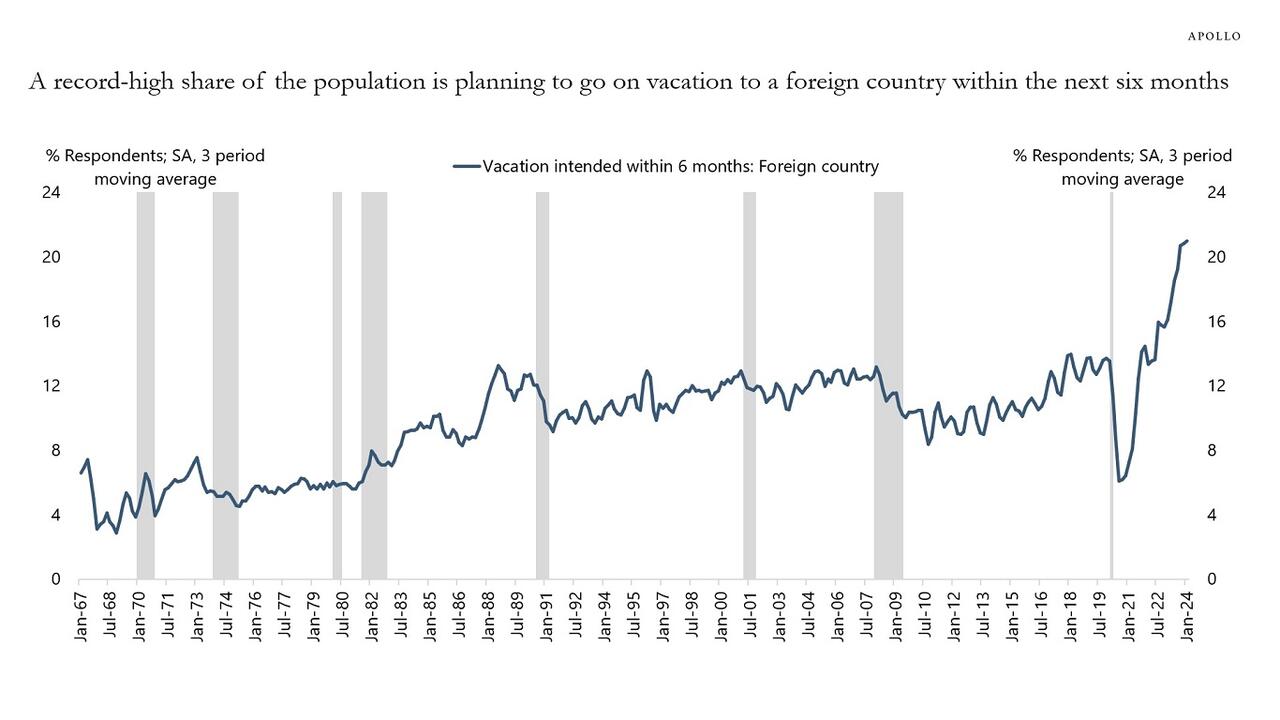
  • Tourism activity increased modestly, on average, which is odd considering the recent Conference Board survey found a record number of people planned on traveling abroad. Almost as if they lied...

  • Manufacturing activity declined slightly, as only three Districts reported growth in that sector.
  • Contacts reported slight increases in nonfinancial services activity, on average, and bank lending was roughly flat overall.
  • Residential construction increased a little, on average, and home sales strengthened in most Districts. In contrast, nonresidential construction was flat, and commercial real estate leasing fell slightly.
  • The economic outlook among contacts was cautiously optimistic, on balance.

Next, we turn to employment, where contrary to the BLS claims that jobs are soaring month after month (even if they are all part-time workers, mostly going to illegal aliens), the Beige Book found that employment rose at a slight pace overall, with nine Districts reporting very slow to modest increases, and the remaining three Districts reporting no changes in employment.

Not surprisingly, most Districts noted increases in labor supply - which makes sense in a country where 10 million Biden voters illegals have entered in the past year. Yet despite the improvements in "labor supply", many Districts described persistent shortages of qualified applicants for certain positions, including machinists, trades workers, and hospitality workers. Guess you can only have so many gardeners and construction workers. Several Districts reported improved retention of employees, and others pointed to staff reductions at some firms.

There's more: contrary to the surging wages of the post-covid era, the Beige Book found that Multiple Districts said that annual wage growth rates had recently returned to their historical averages. On balance, contacts expected that labor demand and supply would remain relatively stable, with modest further job gains and continued moderation of wage growth back to pre-pandemic levels.

Last but not least, the Beige Book commented on inflation and found that price increases were modest, on average, running at about the same pace as in the last report, as disruptions in the Red Sea and the collapse of Baltimore's Key Bridge caused some shipping delays but so far did not lead to widespread price increases. Movements in raw materials prices were mixed, but six Districts noted moderate increases in energy prices. Another widely known fact: several Districts reported sharp increases in insurance rates, for both businesses and homeowners.

Most ominously, another frequent comment was that firms' ability to pass cost increases on to consumers had weakened considerably in recent months, resulting in smaller profit margins. That's hardly the stuff soft- or no-landings are made of.

Inflation also caused strain at nonprofit entities, resulting in service reductions in some cases.

On balance, contacts expected that inflation would hold steady at a slow pace moving forward. At the same time, contacts in a few Districts—mostly manufacturers—perceived upside risks to near-term inflation in both input prices and output prices.

Turning to the specific regional Feds, we found these summaries notable:

  • Boston: Business activity expanded at a modest pace in recent weeks, and prices rose slightly. Employment was flat overall, but one retailer reported significant layoffs. Convention and tourism activity grew at a robust pace. Home sales increased on a year-over-year basis, marking a turnaround. The outlook ranged from cautiously optimistic to bullish.
  • New York: On balance, regional economic activity remained flat. Labor market conditions were solid and continued to normalize as labor supply and labor demand came into better balance. Consumer spending was unchanged after a weak first quarter. Housing markets strengthened, with the spring selling season picking up beyond the seasonal norm. The pace of selling price increases remained modest.
  • Philadelphia: On balance, business activity was flat in the current Beige Book period—after declining slightly last period. Employment edged up, despite staffing and recruitment efforts slowing to a crawl. Wage and price inflation continue to moderate; however, housing affordability continues to be a concern. Overall, the outlook is positive, as firms remained optimistic about expectations for future growth.
  • Cleveland: District business activity increased modestly, as did employment. Firms anticipated greater ease filling open positions, including those that have been particularly challenging, because of increased labor availability. Wage pressures continued to normalize, and some contacts reduced starting wages for new roles. Cost and price pressures changed little.
  • Richmond: The regional economy grew at slight pace since our previous report. Consumer spending on retail goods was mixed but spending on travel and tourism was up slightly. Fifth District port activity slowed and was impacted by the collapse of the Francis Scott Key Bridge. Employment growth slowed from a moderate to a modest rate in recent weeks, but wages continued to grow moderately. Price growth also remained moderate.
  • Atlanta: The Sixth District economy grew modestly. Labor markets continued to stabilize; wage pressures eased. Many nonlabor costs moderated. Retail sales were steady, but consumers remained price conscious. Tourism remained robust. Commercial real estate conditions slowed. Transportation activity was mixed. Manufacturing grew slightly. Loan demand was flat. Energy activity improved.
  • Chicago: Economic activity increased slightly. Employment increased modestly; business and consumer spending rose slightly; nonbusiness contacts saw no change in activity; and manufacturing and construction and real estate activity were flat. Prices and wages rose moderately, while financial conditions were stable. Prospects for 2024 farm income were unchanged.
  • St. Louis: Economic activity has continued to increase slightly since our previous report. Prices have increased modestly, as contacts are broadly feeling the pressures of increases in both labor and non-labor costs. The outlook was neutral to slightly optimistic, which is generally unchanged from our previous report, but better than one year ago.
  • Minneapolis: District economic activity grew slightly. Employment grew some, but labor demand was softer. Wage pressures were present but continued to ease, while price pressures ticked up. Consumer spending was mostly flat, and manufacturing slowed modestly. Commercial and residential construction improved slightly. Agricultural conditions were steady at low levels.
  • Kansas City: The District economy expanded modestly. Demand for auto loans and residential mortgages rose as borrowing rates declined. Demand for HELOC also increased as a means to consolidate or refinance household debt. Job gains were modest even as worker availability improved slightly.
  • Dallas: The Eleventh District economy expanded modestly. While activity in services and housing grew, manufacturing output, retail sales, and loan demand declined slightly. Employment growth slowed as wages, input costs, and selling prices grew at a moderate pace. Overall, Texas firms noted an uptick in uncertainty.
  • San Francisco: Economic activity continued to grow at a slight pace, employment levels were little changed, and prices and wages rose slightly. Retail sales were unchanged, and demand for services grew modestly. Demand for manufactured products changed little, and conditions in agriculture were mixed. Real estate activity was slightly down. Financial sector conditions were largely unchanged.

More in the full beige book

https://www.zerohedge.com/economics/beige-book-reveals-economy-far-worse-shape-white-house-claims

'Can Testosterone Aid Women's Menopausal Symptoms?'

 In 2022, Aisha Kabia started to experience symptoms she originally thought could be long COVID: brain fog, fatigue, and joint pain. As an actor based in Los Angeles, she was used to memorizing huge chunks of dialogue, but she suddenly needed a teleprompter for routine performances.

After screenings requested by her gynecologist and endocrinologist came back negative, a nurse practitioner ordered a hormonal blood panel. Women are born with about a tenth of the amount of testosterone in their bodies as men, and it wanes over time. At 42, Kabia was told she had undetectable levels of testosterone, and her NP prescribed her a testosterone cream to boost her levels. That, Kabia said, ended up being the "key" that made her feel "whole" again.

"I feel like I got my life back," Kabia told MedPage Today. "Slowly but surely over the next year, I got my brain and my muscles back. Everything came back online."

There is debateopens in a new tab or window within the medical community as to whether testosterone should be prescribed to women during menopause and the time before and after it.

In theory, androgen insufficiencyopens in a new tab or window and hormonal changes in menopause can cause sexual dysfunction, so getting testosterone levels back to their mid-reproductive age levels may be able to help alleviate these symptomsopens in a new tab or window. Kelly Casperson, MD, a urologist and menopause specialist based in Bellingham, Washington, told MedPage Today that women "have way more testosterone than estrogen in their bodies" so it "makes logical sense to give a woman testosterone in menopause as her ovaries decrease their production of both testosterone and estrogen."

But other physicians say there is a lack of long-term dataopens in a new tab or window to support its safety and efficacy in this patient population and that it shouldn't be prescribed until a product for this purpose has been approved by the FDA.

Some are especially criticalopens in a new tab or window of influencers and other media personalities touting testosterone as a cure-all for mood and cognitive changes, fatigue, reduced muscle strength, and other symptoms associated with menopause. Although testosterone's effect on outcomes like bone density in postmenopausal women is being studiedopens in a new tab or window, research on these other outcomes is lacking.

In 2019, a group of medical societies including the International Menopause Society, the International Society for the Study of Women's Sexual Health (ISSWSH), and the Endocrine Society found the only indication with enough evidence to support testosterone in women was hypoactive sexual desire disorderopens in a new tab or window (HSDD), in which a lack of sexual desire is causing a patient distress.

"It would be nice to have some longer-term data so that we could have a better understanding of the risks and benefits of testosterone in women," Stephanie Faubion, MD, director of the Mayo Clinic Center for Women's Health and medical director of the Menopause Society, told MedPage Today. "Unfortunately, we just don't have that right now, which is partly why it's not FDA-approved."

A few testosterone formulations, all designed to treat HSDD, have gone before the FDA. Ever since Viagra was approved in 1998, drugmakers have been searching for a similar treatment for women's sexual dysfunction -- although some argueopens in a new tab or window that it's unclear what "normal" levels of sexual desire are among women and that drugmakers are trying to pathologize them for profit.

In 2004, the FDA reviewed a testosterone patch from Procter & Gamble called Intrinsa. Although the patch was associated with improvement in the number of sexual experiences for women, it was rejected due to a lack of long-term dataopens in a new tab or window and safety concerns. In 2010, BioSante Pharmaceuticals applied for approval of a testosterone gel called LibiGel, but it wasn't approved due to a higher-than-anticipated placebo response.

When asked to elaborate on why these two products were not approved, the FDA told MedPage Today in an email that the agency is generally unable to discuss existing or potential applications and that the data requested was confidential commercial information. Neither Procter & Gamble or BioSante Pharmaceuticals responded to a request for comment as of press time.

"The decision to treat a patient with a drug for an unapproved use is up to the treating healthcare professional," an FDA spokesperson wrote in an email. "Generally speaking, the practice of medicine is not regulated by the FDA."

Around the time that these drugs went through the review process, the 2002 Women's Health Initiative studyopens in a new tab or window found women given estrogen had an increased risk of cancer and cardiovascular disease. Research conducted since thenopens in a new tab or window has challenged those findings, and the tide seems to be turning againopens in a new tab or window, particularly for certain menopause symptoms like hot flashes and night sweats. Regardless, the original 2002 findings may be contributing to some providers' hesitancy to prescribe testosterone for postmenopausal women off-label.

"You end up having hesitancy [among providers] for a variety of reasons," Sharon Parish, MD, an internist at Weill Cornell Medicine in New York City, told MedPage Today. "It's not easy to prescribe testosterone to women."

Further complicating things is the fact that testosterone is a Schedule III controlled substance along with drugs like ketamine, meaning providers are required to adhere to additional dispensing laws when prescribing it. Accurately detecting testosterone levels in women can also be challenging in the first place. Although liquid chromatography-mass spectrometry assays are sensitive enough to detect lower testosterone levels, the more common and economic laboratory radioimmunoassay has been reported to have challenges with sensitivity.

Regardless, there is no standardization of levels considered "low," that could help doctors diagnose whether a woman needs treatment anyway, said James Simon, MD, a women's sexual health specialist at George Washington University in Washington, D.C., who has been writing about using testosterone for this purpose for a decade.

"If you send a testosterone test for your average woman, whatever her age is, and you don't specify, you get the quick and dirty man's test applied to the woman," Simon told MedPage Today. "You might as well throw a dart at a dartboard."

Some say the lack of an FDA-approved product is pushing women to use men's formulations purchased out-of-pocket at compounding pharmacies, which can be hard to dose and lead to unwanted side effects like hair growth or, in severe cases, clitoral enlargement or voice changes.

Because testosterone for postmenopausal women is an off-label treatment, it's unclear how prescription patterns have changed in recent years in the U.S. However, national data from the U.K.opens in a new tab or window suggest a 10-fold increase in the number of women over 50 prescribed testosterone between 2015 and 2022.

Australia is the only country in which a testosterone product has been approved for womenopens in a new tab or window.

Although menopause has been having a momentopens in a new tab or window, it has been largely misunderstood and understudied for years both in and outside of the medical community. A 2023 review published in Cellopens in a new tab or window found that 85% of women in high-income countries don't receive adequate treatmentopens in a new tab or window for menopausal symptoms, and a 2022 paper published in Menopauseopens in a new tab or window found two-thirds of residency programs surveyed did not have a menopause curriculum.

The first two doctors Kabia went to with her symptoms suggested more exercise and a better diet to help her feel better. But she was already exercising, eating well, and even working on daily mental health practices like meditation. She had heard women on testosterone anecdotally reportingopens in a new tab or window that it helped with some of the same symptoms she had, and she felt like she didn't have many other options.

"Menopause is a normal part of a woman's life cycle," Kabia said. "The suffering piece is the part that is not."

https://www.medpagetoday.com/obgyn/menopause/109693

Should DOs and MDs Have Separate Licensing Boards? They Still Do in 13 States

 Tom Takubo, DO, an osteopathic physician and pulmonary critical care specialist, is exasperated and crestfallen.

Since 2017, the West Virginia state senator has questioned why his state has two separate agencies to license and discipline its osteopathic versus its allopathic physicians. Each board has its own rules and standards of practice that vary in at least a dozen perplexing ways. He said it's confusing to patients, it's strange, and constitutes a double standard.

"Why are we working under two separate rules, depending only on where we went to medical school?" Takubo asked during an interview with MedPage Today.

It's an important question.

After all, 37 states and the District of Columbiaopens in a new tab or window -- including large states like New York, Texas, Illinois, and Ohio -- license all their allopathic and osteopathic physicians under one board. That accounts for some 65% of the nation's doctors.

In February, Takubo introduced a billopens in a new tab or window that would combine the two boards to oversee professional conduct for its 9,067 MDs and 1,800 DOs. Though he had strong support from both chambers and the two state boards, he lost his fight. In late March, West Virginia Gov. Jim Justice (R) vetoedopens in a new tab or window that bill. Organized osteopathic associations argued that combining the two licensing agencies would be disastrous for DO autonomy.

Times Have Changed

The origins of osteopathic philosophy 150 years ago were based on a concept that the roots of illness could be found in misalignments of the body's structure, which could be repaired through musculoskeletal correction. Founder A.T. Still eschewed treatment with surgery or drugs, which arguably were much less effective than they are today.

The American Medical Association at one point called osteopathic doctors a "cultopens in a new tab or window," in part because of their training in osteopathic manipulation treatmentopens in a new tab or window (OMT).

Today, those early concepts are long gone. Osteopathic medicine is no longer held with disdain, and DOs' treatment is almost indistinguishable from that of MDs. Although osteopathic medical schools still teach what they claim is a more "holistic" approach to healthcare, DOs' privileges and prescribing practices are virtually identical to the MDs they work alongside in every state.

Indeed, a 2023 studyopens in a new tab or window in the Annals of Internal Medicine found that DOs and MDs delivered similar quality of care for hospitalized Medicare beneficiaries.

And their numbers are growing. About 25% of medical studentsopens in a new tab or window are enrolled in the country's 60 osteopathic medical school campuses, which now graduate between 8,000 and 10,000 students a year, according to the American Osteopathic Association (AOA). In 2023, the AOA counted 148,829opens in a new tab or window actively practicing DOs, and a 2017 report from the group predictedopens in a new tab or window that by 2030, one in five practicing physicians will be a DO.

Also, their graduate training is now essentially the same as that of MDs. In 2015, the AOA turned over its authority to accredit graduate medical education programs to the Accreditation Council for Graduate Medical Education in a merger processopens in a new tab or window that was completed in 2020. Since then, all DOs compete for the same training slots as MDs, and their 2024 match ratesopens in a new tab or window -- 92.3% and 93.5% -- were virtually identical.

So why have two separate licensing boards?

"It's almost inevitable that state licensing agencies would try to consolidate now that there's one accrediting body for postdoctoral medical education," said Norman Gevitz, PhD, senior vice president of academic affairs at the nation's first osteopathic medical school, A.T. Still University in Kirksville, Missouri.

Gevitz, author of a bookopens in a new tab or window detailing the tortured history of osteopathic medicine, said states that created separate osteopathic licensing boards established them "because of the fear of prejudice, that the allopathic physicians would put impediments in the way of their licensure."

And while there is still some discrimination and prejudice -- some MDs believe that it is easier to get into osteopathic medical school than an allopathic school -- times have changed dramatically.

Part of Takubo's reason for wanting to combine the boards was to develop a stronger voice to advocate for better health policies, especially in West Virginia, which is listed as one of the least healthy and most medically underserved states. It could produce more alignment in efforts to reduce lung cancer death and improve other health outcomes. They'd have more clout to work against scope creep, and advocate for better physician pay, especially for those treating the underserved, he said.

His bill called for naming five DOs and five MDs to the board, and most importantly, it would dissolve the discordant standards that Takubo said contribute to an antiquated belief, still held by some, that DO physicians just aren't as good as MDs.

For example:

• In a disciplinary proceeding against an MD, the West Virginia Board of Medicine must see "clear and convincingopens in a new tab or window" evidence of wrongdoing to justify action. In a case against a DO, the West Virginia Board of Osteopathic Medicine needs to find only a "preponderance of evidence." Takubo said the burden of proof difference is like having 80% evidence of medical misconduct versus 51%.

• MDs must take 50 hours of CME for re-licensure every 2 years while DOs need only 32.

• The MD board can issue temporary licenses for applicants who need to start working immediately. It also can issue special administrative licenses for non-practicing clinicians. The DO board has no such capabilities.

• No academic MD can sit on the MD board, but academic DOs can be members of the DO board.

Governor's Veto

But support for the bill was not enough.

It met vehement opposition from the AOA and the West Virginia Osteopathic Medical Association (WVOMA), which feared a loss of autonomy and independence.

WVOMA's executive director, Penny Fioravante, called the bill "a political ploy, "totally unnecessary," and "a political trade with a large hospital system."

Late last month, Justice vetoedopens in a new tab or window Takubo's bill, saying that DOs and MDs "are two separate and distinct" medical doctors. He mentioned opposition from "the osteopathic community."

"I hated that veto letter because he makes it look like DOs are different, that we want to be separate," Takubo said. "But we don't. That's not what we have fought for for so long."

Besides, he added, "What better says that we are now equal than when a DO is signing the license to allow an MD to be a physician?" Justice's veto "set us back decades," referencing a time when osteopathic physicians were held with disdain by their MD colleagues, and their practice was equated with that of naturopaths.

In an interview with MedPage Today, AOA President Ira Monka, DO, said he opposes consolidation of DO and MD licensing agencies in those 13 states. He said it would strip osteopathic physicians of their distinctive training and autonomy, including OMT.

"The allopathic boards don't always have the training to understand how to evaluate the training we have, especially when it comes to osteopathic principles in medicine," Monka said. An AOA media representative was present during the call.

But almost all of the states that combine DO and MD licensing have at least oneopens in a new tab or window, and sometimes two or three, DOs on their boards. Wouldn't they defend an unjustly accused DO?

Not necessarily, Monka said. "We're pretty much outnumbered at the get-go. When you have your own osteopathic board," he said, "the majority is taking care of you."

Much of DOs' fear about being robbed of their autonomy and philosophy, and suffering unfairly at the hands of MD-dominated boards, stems from what happened more than 60 years ago in California, which still maintains separate DO and MD licensing boards.

Essentially, California DOs, who were more progressive and practiced more similarly to their MD colleagues, made a deal with the California Medical Association to exchange their DO licenses for MDs for a $65 fee and one course of study, and most of them did. (See a sidebar on this story hereopens in a new tab or window.)

Some of osteopathic organizations' distrust of MD oversight appears to center on doubts that MDs have enough understanding of OMT, but that concern is rapidly losing relevance. While OMT training is still emphasized in osteopathic medical schools, dozens of DOs interviewed for this story said they rarely if ever perform it, and several studiesopens in a new tab or window have documented how seldom DOs actually use it in practice.

First, many payers won't reimburse for it, the DOs said. Second, the procedure requires time to relax and position the patient, time that is increasingly scarce in busy clinical practice.

Takubo, who also teaches medical students at West Virginia University Health System where he is the executive vice president of provider relations, says he has talked with well over 100 DO students about the state's dual licensing board system and "the vast majority are in favor of combined boards. They felt it would further remove perceived bias and stigma and help them get into competitive rotations.

Charlie Wray, DO, an internist at the University of California San Francisco, thinks there's no reason to have separate boards since there is so little difference today in their delivery of care. He complained that licensing rules for DOs require that they obtain separate and expensive osteopathic continuing medical education (CME), often requiring out of state travel, when he's exposed almost daily to the same course material -- for free -- that qualifies for MDs' CME.

The AOA's Monka acknowledged that many DOs support merged boards, perhaps because they don't know the history, and think parity with MDs would only be enhanced if they were licensed by the same board. "It's really those under 45 versus the ones over 45. That's the number we throw around where the mindset is so different," Monka said.

The New Mexico Merger

Seeing an opportunity for consistency, New Mexico lawmakers recently combined its two boards. State officials and osteopathic physicians acknowledged that the old way wasn't giving its 1,000 DOs the attention their practice of medicine deserved. In that case, the DO board was housed in a different government section that also oversaw the licenses of chiropractors, tattoo artists, and barbers.

Steven Jenkusky, MD, medical director of the New Mexico Medical Board, recalled the history behind that state's 2021 merger of its DO and MD licensing agencies. Discussions had begun years earlier because the state has a relatively small number of DOs and because of concerns the DO board was inefficiently processing licenses. Talks went nowhere because the dean of the state's only osteopathic medical school was adamantly opposed.

But that dean left, and was replaced by "a new dean who was from Texas. The new dean said, 'We have only one board in Texas; I don't see an issue.' And that's what got the ball rolling," Jenkusky said.

Brad Scoggins, DO, past president of the New Mexico Osteopathic Medical Association, said it seemed important that DOs who were the subject of complaints would be investigated by officials who also explored accusations against MDs. "In states with larger numbers, you could make an argument for keeping the boards separate," he said. But in New Mexico, DOs are in leadership roles, chiefs of staff, surgery, and medicine. "Parity has been pretty well achieved."

MedPage Today interviewed DOs from about a dozen states with combined boards from New York to Oregon, and all said that DOs were treated the same as MDs under a combined board.

"It's antiquated," said Marc Price, DO, from Malta, New York. "We learn the same thing from the same books."

"I think it should all be combined into one," said Spencer Nadolsky, DO, of North Carolina. "I also think letters after our names should be somewhat consolidated. If they want to have some difference, it could be 'MDo.' It's confusing to patients!"

Cheryl Clark has been a medical & science journalist for more than three decades.

https://www.medpagetoday.com/special-reports/exclusives/109695

Could Francis Collins's Prostate Cancer Story Deter Men From Active Surveillance?

 Former NIH director Francis Collins, MD, PhD, one of America's most prominent physicians and the leader of the ground-breaking Human Genome Project, has gone public with his "aggressive" prostate cancer diagnosis

opens in a new tab or window. As he revealed in an op-ed in the Washington Post on April 12, he has been on active surveillance (AS) for the last 5 years since his doctor noted his slow-growing grade of prostate cancer, and just recently became aware of a sudden progression in his cancer. He is planning to undergo a radical prostatectomy later this month.

He said he was going public to help other men -- he wants "to lift the veil and share lifesaving information."

But I have to ask, why did he choose to wait to share his story until his cancer became potentially deadly? My concern is that his experience could scare other men, newly diagnosed with lower-risk prostate cancer, into avoiding AS (close monitoring, which is considered the standard of careopens in a new tab or window for low-risk prostate cancer). For others who are already on AS, it could lead to "anxious surveillance" -- deciding enough is enough and quitting the protocol to opt for more invasive treatment because they fear their cancer may pose a serious threat.

Only time will tell. But, without a doubt, such a diagnosis can become ever more shocking and frightening when it happens to one of the world's leading doctors.

So, in order to quell the fears of men currently on AS, I spoke with several leading experts to determine how common Collins's situation really is -- based on what he has shared publicly. Collins declined my interview request to address issues about his case.

What We Know About Collins's Diagnosis

Collins wroteopens in a new tab or window that a biopsy showed he had a 22 ng/mL PSA (prostate-specific antigen) blood level, which at his age -- 73 years old when he published the op-ed, now 74 -- should be less than 5 ng/mL PSA. But he didn't share the level of his previous PSA, one of many unanswered questions. He also didn't say what his Gleason score was from a previous biopsy. But this time around, Collins's Gleason reached a 9 -- on the 10-point scale.

From the point of view of a prostate cancer patient like me (with a very low-risk Gleason 6 cancer), it's alarming that something like this could develop seemingly overnight.

What exactly happened? And how common is this situation?

The Experts Weigh In

After Collins's commentary was published, I received many emails from patients on AS, as well as advocates, and also exchanged emails with some of the world's leading prostate experts.

Paul Schellhammer, MD, is a prostate cancer patient, a urologist, and a professor emeritus at East Virginia Medical School. He's also involved in urology research, and is a past president of the American Urological Association (but is not speaking for them).

Schellhammer wondered whether Collins's seemingly rapid PSA and Gleason score increases were "a black swan event," or, in other words, a rarity.

I also spoke with two of the "fathers" of AS -- Laurence Klotz, MD, and Peter Carroll, MD, MPH, who pioneered AS in the 1990s -- to find out what they thought. Both confirmed that cases like Collins's occur, but they are rare. They offered reassurance to AS patients.

Klotz, of the University of Toronto, said, "There is a saying in law, 'Bad cases make bad law.' A case like this doesn't change anything at all. Cases like this are well documented but are rare -- perhaps 0.1 to 0.5% of men on surveillance. Biology is dynamic, and perfection in anything is not attainable."

Carroll, of the University of California San Francisco, backed Klotz.

He said: "I agree completely [that] this is a rare event. I have seen them, but they are exceedingly uncommon. The data on AS is clear and refined and supports its widespread use in well-evaluated patients. It would be unfortunate, to say the least, that a very rare event leads us back to the era when too many men underwent treatment with its attendant costs [psychological, physical, and monetary] with no benefit."

Carroll emphasized what Collins has thus far not disclosed: "We do not know the details of his case [PI-RADS at diagnosis, PSA Density, tumor volume, frequency of testing, etc.]. Such knowledge refines risk."

Meanwhile, I continued to wonder: will patients be scared off of AS? This is more a matter of education and communication with the low-risk prostate cancer population. Collins cited statistics showing that around 40% of men over 65 have been diagnosed with low-grade prostate cancer: "Many of them never know it, and very few of them develop advanced disease," he wrote.

Schellhammer warned: "The AS community [patients and physicians] need to be concerned and aware about the emotional weight of risk in the risk/benefit equation of AS decision-making."

He worries that Collins's experience will scare some patients into unnecessary treatment, potentially resulting in impotence and incontinence, even though their low-grade cancer is unlikely to spread or kill them.

Mark Lichty, a 19-year patient on AS and chair of Active Surveillance Patients International, the first global support and education group for AS, conceded some patients may be scared off, but he believes the rarity of what happened to Collins should be reassuring.

Personally, I suspect most patients will understand and accept what happened to Collins and go on with their lives. But I also know some men are skittish, and hearing about Collins's case may be enough to push them into unnecessary treatment. Doctors and support groups need to reassure patients that the science is on the side of AS for low-risk patients, and they should continue follow-up discussions and education.

As for me, I still hope that Collins will share more about his case. It could help patients clarify their understanding and inform their decisions.

Howard Wolinsky is a Chicago-based medical writer. He has been on active surveillance for very low-risk prostate cancer for 13 years.

https://www.medpagetoday.com/special-reports/apatientsjourney/109711