Search This Blog

Thursday, May 23, 2024

AstraZeneca Snags Option to Buy Versant’s New Obesity Biotech SixPeaks

 SixPeaks Bio has emerged from stealth with up to $110 million for obesity R&D and an agreement that could see it acquired by AstraZeneca within two years, the startup said Wednesday.

Venture capital firm Versant Ventures founded SixPeaks at its site in Switzerland in 2022 to develop better therapies for weight loss. People can experience significant weight loss when taking GLP-1 receptor agonists such as Eli Lilly’s Zepbound (rirzepatide) and Novo Nordisk’s Wegovy (semaglutide) but they lose both fat and muscle. SixPeaks wants to help people preserve muscle mass while losing weight.

AstraZeneca sees promise in the idea. The drugmaker has committed up to $80 million in upfront and near-term payments to support SixPeaks over the next two years. In return, AstraZeneca has received an option to buy SixPeaks at an agreed price when the biotech files to study its lead candidate in humans.

SixPeaks raised a further $30 million in a Series A round led by Versant. AstraZeneca contributed to the financing round. The biotech will use the money to push two obesity drug candidates toward the clinic.

The pipeline is built on an activin IIA/B receptor antibody. Studies have shown inhibiting activin signaling drives significant increases in muscle mass, leading SixPeaks and other research groups to pursue the blockade of the receptors to potentially address the limitations of GLP-1 drugs.

Regeneron began a Phase II trial of molecules including the anti-activin A antibody garetosmab in March 2024. Eli Lilly acquired Versanis for a monoclonal antibody that binds activin type II A and B receptors in 2023 in deal worth up to almost $2 billion. A Phase II trial of Versanis’ antibody in combination with Wegovy is scheduled to reach primary completion this week.

SixPeaks is yet to reach human testing but said preclinical studies suggest it has best-in-class efficacy for muscle mass preservation. The claimed benefits are linked to improved potency, biophysical properties, and pharmacokinetics and pharmacodynamics, plus reduced off-target binding. SixPeaks has attached its antibody to a GLP-1 peptide to create a candidate that could both drive fat loss and muscle retention.

If AstraZeneca acquires SixPeaks, the candidates will slot into a pipeline that already includes a clutch of obesity programs. The company has an oral GLP-1 molecule, a long-acting amylin and a GLP-1/glucagon dual active peptide that are approaching Phase II. AstraZeneca sees opportunities to use the molecules in combination with other assets to treat overweight and obesity, as well as associated comorbidities.

At an investor day Tuesday, Martin Cowie, interim senior vice president for late-stage development at the AstraZeneca group handling obesity, said the company wants “high quality weight loss, not losing muscle as well as fat.” Cowie said maintaining muscle is “super important for the long term.” The long-acting amylin is one way AstraZeneca wants to help people retain muscle. SixPeaks could provide other options.

https://www.biospace.com/article/astrazeneca-snags-option-to-buy-versant-s-new-obesity-biotech-sixpeaks/

Wednesday, May 22, 2024

Moderna Among Companies Partnering With OpenAI to Boost AI Efforts

 As biopharma companies navigate the world of generative AI, some are formalizing their efforts by partnering with OpenAI, developer of the ChatGPT chatbot. Those organizations include Moderna, which has collaborated with OpenAI since 2023.  

Artificial intelligence has the potential to transform data-driven industries like biopharma, according to Brice Challamel, vice president of AI products and platforms at Moderna, which recently moved into its new headquarters. He told BioSpace the company has seen firsthand the impact AI can have on developing new classes of medicines.  

“The informational nature of mRNA lends itself well to drug design simulation and optimization,” Challamel said. “Beyond early-stage drug development, implementing AI across the value chain, from research to manufacturing to commercialization, allows us to accelerate and improve our outcome at every step of the way to deliver mRNA medicines.” 

AI in Life Sciences

Some life sciences companies are proceeding with caution on certain aspects of AI, according to a ZoomRx survey of over 200 industry professionals. It found that 53% of life sciences companies—including 65% of the top 20 pharma businesses—ban employees from using ChatGPT. That said, 57% of workers use it. The survey also found that 58% of companies using AI are in the early stages of implementation.  

ZoomRx reported six use cases for artificial intelligence in life sciences organizations: 

  • Drug discovery (41%). 

  • Precision/personalized medicine (36%). 

  • Copywriting (33%). 

  • Trial optimization (27%). 

  • Safety prediction/monitoring (24%). 

  • Data analysis/knowledge base (21%).  

A recent BioSpace article echoed those findings, noting that companies are looking to use generative AI to optimize pharma R&D, from target discovery to drug development to regulatory approval to commercialization and postmarket pharmacovigilance.   

Some biopharma firms are partnering with life sciences–focused AI services organizations or Big Tech businesses wanting to tap the biopharma market, as detailed in a recent BioSpace story about generative AI’s role in drug development. Others are developing generative AI technology in house or working directly with OpenAI. 

In addition to Moderna, biopharma companies partnering with OpenAI include Amgen, Genmab and e-therapeutics. Amgen and Genmab are working with the organization in a similar fashion as Moderna, according to BioPharma Dive, and OpenAI named Amgen as an early ChatGPT Enterprise customer. With ChatGPT Enterprise, companies own and control their business data, as OpenAI doesn’t train on their data or conversations, and its models don’t learn from organizations’ usage.  

In 2023, London-based biotech company e-therapeutics shared it was integrating large language models (LLMs) such as Open AI’s GPT model to enhance computational capabilities and transform HepNet, its hepatocyte-focused computational biology platform, into a dynamic knowledge resource. The company’s long-term vision is to use OpenAI’s GPT-4 and LLMs to fully automate the preclinical drug discovery process.  

How Moderna Is Partnering With OpenAI

Moderna’s partnership with OpenAI is part of the company’s vision to use AI to scale its development of life-saving mRNA medicines and maximize its impact on patients, according to Challamel. 

An OpenAI case study highlights key collaboration milestones, including Moderna launching an internal AI chatbot tool, mChat. More than 80% of the biopharma company’s workforce adopted the tool. Another milestone is deployment of ChatGPT Enterprise, which allows the organization’s employees to create their own GPTs. Within two months of the launch, Moderna had 750 GPTs across the company.  

The organization’s GPTs include Dose ID, intended for use as a data-analysis assistant to the clinical study team. According to Moderna, Dose ID can help evaluate optimal vaccine doses that the team selects. By applying standard dose selection criteria and principles, the GPT provides a rationale, references its sources and generates informative charts illustrating its findings.  

How Moderna Trained Employees for AI

Moderna laid the groundwork for employee adoption of AI before its partnership with OpenAI began. Challamel shared that in late 2021, the company launched its AI Academy to build artificial intelligence capabilities and skills across the entire organization. He said it’s since moved beyond educational content and courses to serve as an innovation incubator for AI capability, projects and ideas. 

Successful AI implementation requires an intentional cultural transformation and a mindset shift around how each employee approaches their work, according to Challamel.  

“Our people can no longer be on the receiving end of technology and change,” he said. “They now embrace it and share best practices with each other as an intelligent and constantly learning organization.” 

Challamel also noted the importance of the employees themselves to AI success.  

“We recognize that technology alone does not drive change—people do,” he said. “How we work, and the tools we enable, are critically important to realizing our mission.” 

What’s Next for Moderna’s Partnership With OpenAI

Moving forward, Moderna’s partnership with OpenAI will continue to be important, as Challamel noted the biopharma company is advancing a broad and diverse pipeline at a scale never seen before in the industry. According to the OpenAI case study, Moderna is looking to bring up to 15 new products to market in the next five years. Given the organization’s plans, Challamel said, it needs to have a highly skilled and adaptable team—and artificial intelligence can help. 

“We believe a few thousand with the right AI mindset and technology can achieve the same as a traditional biopharma of tens or hundreds of thousands, and this partnership will drive that human augmentation forward with not only a major leap forward in productivity, but also in innovation and quality of outcome,” Challamel said. “This partnership with OpenAI is the outcome of more than a decade of engagement with AI, and yet it is only the beginning of our journey.” 

https://www.biospace.com/article/moderna-among-companies-partnering-with-openai-to-boost-ai-efforts/

Taiwan dispatches forces to areas around island after China starts 'punishment' drills

 Taiwan's military mobilized its forces and said it was confident it could protect the island, after China started two days of "punishment" drills around Taiwan on Thursday in what it said was a response to "separatist acts".

The exercises, in the Taiwan Strait and around groups of Taiwan-controlled islands that sit next to the Chinese coast, come just three days after Lai Ching-te took office as Taiwan's new president, a man Beijing detests as a "separatist".

China, which views democratically governed Taiwan as its own territory, has denounced Lai's inauguration speech on Monday, in which he called on China to stop its threats and on Tuesday Chinese Foreign Minister Wang Yi called Lai "disgraceful".

Lai has repeatedly offered talks with China but been rebuffed. He says only Taiwan's people can decide their future, and rejects Beijing's sovereignty claims.

The Eastern Theatre Command of the Chinese People's Liberation Army (PLA) said it had started joint military drills, involving the army, navy, air force and rocket force, in areas around Taiwan at 7:45 a.m. (2345 GMT).

The drills are being conducted in the Taiwan Strait, the north, south and east of Taiwan, as well as areas around the Taiwan-controlled islands of Kinmen, Matsu, Wuqiu and Dongyin, the command said in a statement.

Taiwan's defence ministry condemned the drills, saying that it had dispatched forces to areas around the island and was confident it could protect its territory.

"The launch of military exercises on this occasion not only does not contribute to the peace and stability of the Taiwan Strait, it also highlights (China's) militaristic mentality," the ministry said.

A senior Taiwan official, speaking anonymously given the sensitivity of the matter, told Reuters that the drills are part of a scenario Taiwan had anticipated and that the island's government has a "comprehensive grasp" of Chinese military movements.

Taiwanese officials had said in the run-up to the inauguration they were keeping watch for Chinese military movements.

The drills focus on joint sea-air combat-readiness patrols, precision strikes on key targets, and integrated operations inside and outside the island chain to test the "joint real combat capabilities" of the forces, China's military said.

"This is also a strong punishment for the separatist acts of Taiwan independence forces and a stern warning against the interference and provocation by external forces," the command added.

Chinese state media published a map of the drills zones, in five areas all around Taiwan and the islands Taiwan controls near the Chinese coast.

Su Tzu-yun, a research fellow at Taiwan's top military think tank, the Institute for National Defence and Security Research, said that although the drills would only last two days, the scope is large relative to previous exercises, as they included Taiwan's outlying islands.

This is designed to demonstrate China's ability to control the seas and prevent the involvement of foreign forces, he added.

"The political signals here are greater than the military ones," he added.

There was no sign of alarm in Taiwan, where people are long used to Chinese military activity. The benchmark stock index, currently at a historic high, was up 0.2% on Thursday morning.

"The drills will have a short-term psychological impact, but won't reverse the long-term upward trend of Taiwan stocks," said Mega International Investment Services vice president Alex Huang.

In August 2022, China launched live-fire military exercises around Taiwan immediately after a visit, much condemned by Beijing, by former U.S. House speaker Nancy Pelosi. That series of exercises, the scale of which was unprecedented, lasted for four days, followed by several days of additional drills.

https://uk.news.yahoo.com/china-starts-military-drills-around-003531004.html

Long-Wear, Noise-Canceling, And Wireless: How Earphones Damage Our Hearing

 by Marina Zhang via The Epoch Times (emphasis ours),

On Nov. 24, 2019, a new thread titled “AirPods causing tinnitus?” appeared on the Apple community forum page.

The Apple user said that after using AirPods for a while, he noticed a high-pitched ringing in his ears that didn’t go away.

According to him, he has always been highly protective of his hearing; he doesn’t listen to anything loud and always carries earplugs in case he encounters anything that could damage his hearing. But things only got worse.

“Having said all that, now I notice that when I put my AirPods in my ears and have nothing playing, they emit a high pitched tone that I would say exactly replicates the tone of my tinnitus, leaving to me believe that the AirPods actually caused my tinnitus,” the user wrote.

Since the thread was published in 2019over 3,200 Apple users have responded with “Me too.”

The introduction of Apple wireless earphones has had a noticeable effect on earphone use, with younger generations using them more than older generations, said Julie Prutsman, an audiologist and founder of the Sound Relief Hearing Center. For the past few years, she has seen an increasing number of younger people show up to her clinics with hearing loss and tinnitus.

AirPods and other Apple earphones make up the majority of earphones used by teenagers today. In 2021, Apple earphones were ranked first in the American headphone and earphone market. A 2022 survey by Piper Sandler surveyed more than 7,000 teenagers and found that 72 percent owned AirPods.

The audiologist told The Epoch Times that the root problem lies not with what earphones people use but with a common phenomenon: irresponsible earphone use. The convenient wireless and noise-canceling features, along with better sound quality, have further exacerbated people’s overuse.

“It is becoming a real issue,” Ms. Prutsman said, “and unfortunately, they’re not educated about what can happen.”

High ‘Dose’ and Prolonged Use

The American Osteopathic Association estimates that 20 percent of teenagers today will experience hearing loss, partially due to their headphone and earphone use. A review published in the International Journal of Audiology found that about 6 percent to 60 percent of earphone users show symptoms of hearing loss, including hearing difficulties and tinnitus.

At the same time, more and more youths are regularly using earphones. In February, a University of Michigan poll surveyed parents of 5-to-12-year-olds and found that two-thirds reported that their children use headphones and earphones.

Most people know that loud sounds can damage the ears. However, Dr. Clarice Saba, a Brazilian otorhinolaryngologist, said listening at low volume for extended periods can also induce damage.

People put on their earphones at work, at home, and even during sleep. Even if the sounds may not always be loud, having earphones in for hours can still overwork the ears, Dr. Saba said.

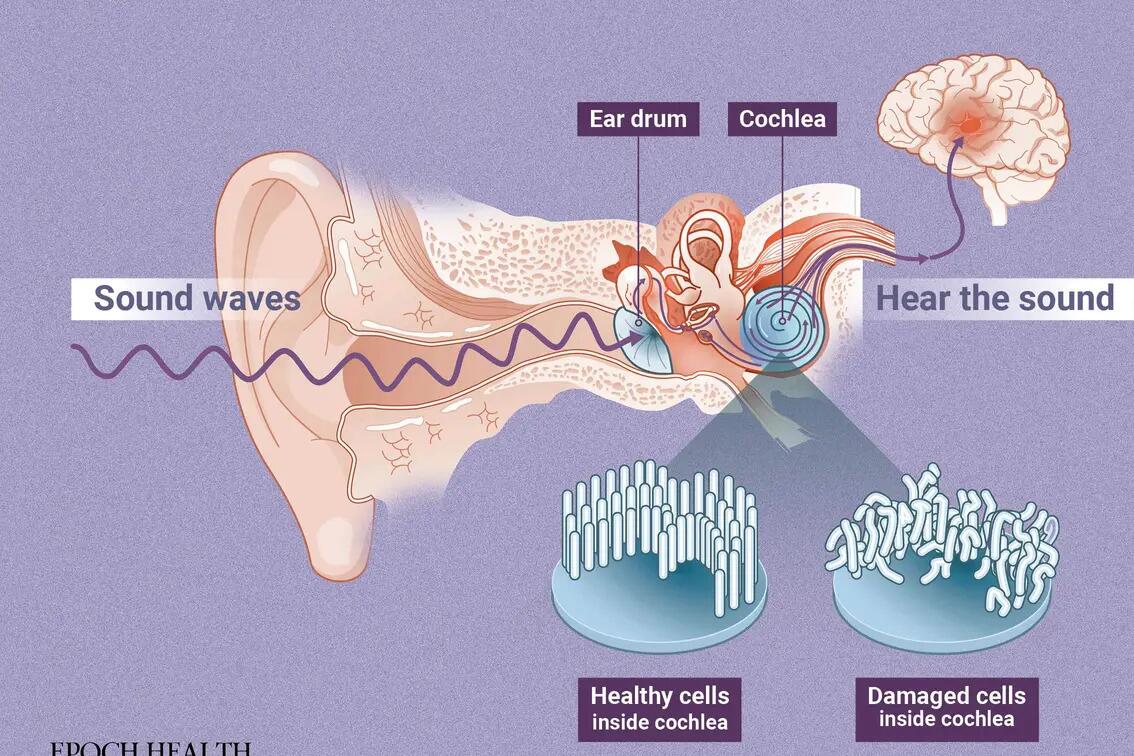
The cochlea is located inside our ears. It sits behind the ear drum and is responsible for turning sound waves into electrical signals that are then transmitted to the brain. Prolonged use of earphones stresses and damages cochlea cells. If some of them die, hearing loss can occur.

The cochlea sits behind the ear drum and turns sound waves into electrical signals that are then transmitted to the brain. (Illustration by The Epoch Times, Shutterstock)

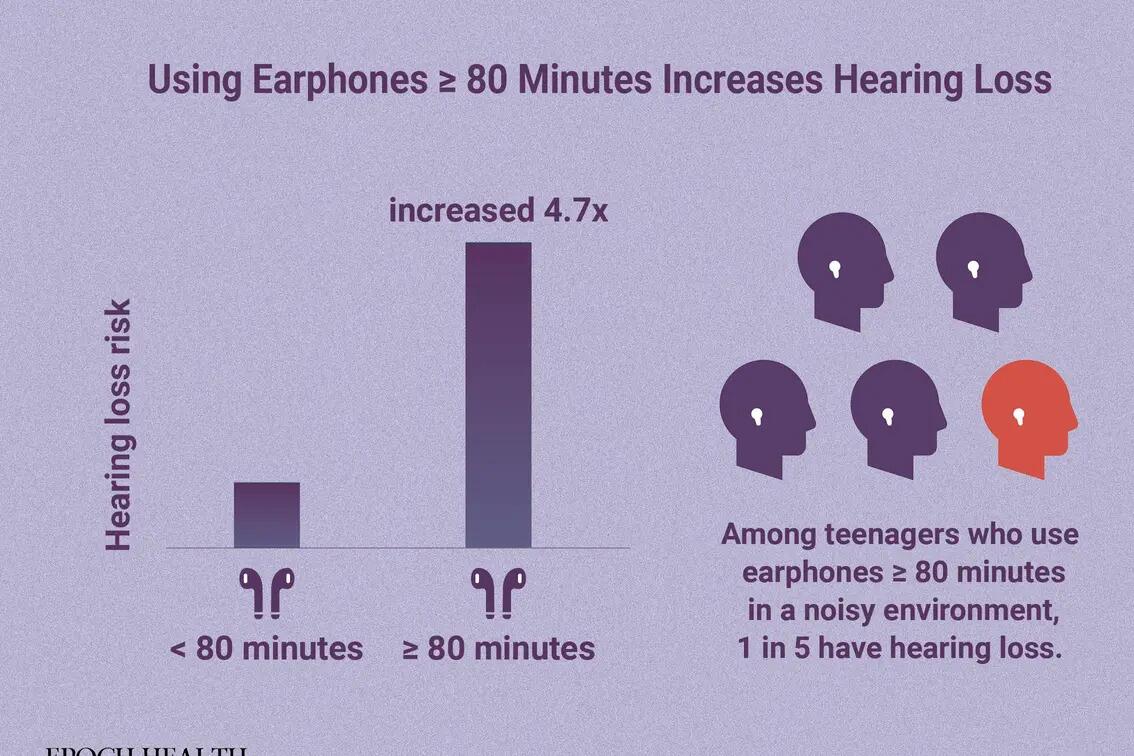
Ms. Prutsman added that noise-induced damage is “dose-dependent” and cumulates. A 2021 study published in the journal Medicine found that among teenagers who use earphones for more than 80 minutes a day in a noisy environment, one in five suffer hearing loss. The risks are 4.7 times higher than they are for those who use earphones for shorter periods.

Using earphones for 80 minutes or more increases the risk of hearing loss by almost fivefold. (Illustration by The Epoch Times, Shutterstock)

Depending on the severity of the damage, the person may experience reduced sound sensitivity, problems with discerning sound, tinnitus, and even hearing loss.

Constantly keeping earphones in the ear canals can also cause a congested and humid environment, which may be conducive to ear infections. They also create greater in-ear pressure compared to over-ear headsets.

In-ear earphones, especially, rub against the delicate skin inside our ears. “If you scratch the ear inadvertently while inserting the AirPods, there can be micro-breaks in the skin that can lead to infection,” otolaryngologist Dr. Michael Seidman told The Epoch Times.

Besides, some people may not routinely clean their earphones, and debris on them can increase the risk. The earpieces also block most of the canal from outside oxygen, disrupting the health of the ear microbiome.

“The skin in the ears needs to breathe,” Dr. Saba said, then compared them to hands. “If you use gloves all the time, you can have problems.”

Noise Cancellation

In recent years, more noise-canceling earphones and headphones have hit the market, lending people the much-needed privacy to shield their music from those around them.

However, noise cancellation comes with caveats.

Since these earphones silence environmental sounds, their prolonged use may lead to hyperacusis, a condition in which the brain’s tolerance for sound decreases so that even ambient environmental sounds, such as coughing or typing on the keyboard, can trigger a stressful response.

https://www.zerohedge.com/medical/long-wear-noise-canceling-and-wireless-how-earphones-damage-our-hearing

Is This A Joke? Baltimore City Declares Toxic Inner Harbor "Swimmable"

 No, this is not a joke. 

The Waterfront Partnership, led by Laurie Schwartz for nearly two decades, and Baltimore City Mayor Brandon Scott have announced that the water in the Inner Harbor—a long-standing industrial port city on the East Coast known for its history of industry, manufacturing, shipping, transportation, toxic pollutants, and chronic sewage spillovers—has suddenly become "swimmable and fishable."

Health-tech startup Tempus AI files for an estimated $600 million IPO

 Tempus AI, which provides data and analytics tools for precision medicine, filed on Monday with the SEC to raise up to $100 million in an initial public offering. However, the deal size is likely a placeholder for an IPO that we estimate could raise $600 million. 


Tempus is focused on unlocking the power of precision medicine through the practical application of artificial intelligence in healthcare, resulting in the creation of its Tempus Platform. The platform includes proprietary software and dedicated data pipelines that create a network of healthcare institutions through approximately 450 unique data connections across more than 2,000 healthcare institutions. This proprietary technology has allowed Tempus to amass what it considers to be one of the largest libraries of clinical and molecular oncology data in the world.

The Chicago, IL-based company was founded in 2015 and booked $562 million in revenue for the 12 months ended March 31, 2024. It plans to list on the Nasdaq under the symbol TEM. Tempus AI filed confidentially on September 1, 2021. The company was previously known as Tempus Labs until it rebranded as Tempus AI in December 2023. Morgan Stanley, J.P. Morgan, Allen & Company, BofA Securities, TD Cowen, Stifel, and William Blair are the joint bookrunners on the deal. No pricing terms were disclosed.

Judge says Ultragenyx must face Henrietta Lacks estate suit

 An attempt by Ultragenyx to have a lawsuit filed by the family of Henrietta Lacks dismissed before it could be heard has failed.

US District Judge Deborah Boardman turned down Ultragenyx’s request in a Baltimore federal court, concluding that the allegation that the company had profited from cells harvested from Lacks without her consent should be held up to scrutiny.

The complaint – filed last year – claims that Ultragenyx made “a conscious choice” to commercialise Lacks’ living genetic material in the form of so-called HeLa cells, derived from cervical cancer cells taken from Lacks by clinicians at Johns Hopkins University shortly before her death more than 70 years ago.

They were the first cells able to be grown continuously in the lab, facilitating big leaps forward in medical research in the intervening decades. The Lacks estate filed its lawsuit against Ultragenyx shortly after Thermo Fisher settled a similar case for an undisclosed amount.

According to the lawsuit, Ultragenyx’s work on gene therapies – based on adeno-associated virus (AAV) vectors that are generated in HeLa cells – is effectively “treating Mrs Lacks’ body as a mere manufacturing tool without consent” and “denies her and her family basic dignity.”

As part of her decision, Boardman wrote: “Today, the court reaches one modest conclusion about this dispute: if what Lacks alleges is true, it is plausible that Ultragenyx is liable to Lacks for unjust enrichment. For the reasons explained in this opinion, Ultragenyx’s motion to dismiss is denied.”

While it was not illegal to take patient samples without permission at the time, and Johns Hopkins University has said it did not profit from the cell line, the broad utility of HeLa cells meant other companies patented methods of use that have generated revenues.

“This historic ruling is not only a victory for Henrietta Lacks’ family; it presents an opportunity to correct a monumental wrong,” said the Lacks estate attorneys Ben Crump of Ben Crump Law and Christopher Seeger of Seeger Weiss in a statement shared with pharmaphorum. “We invite Big Pharma to the table to resolve this on behalf of Henrietta Lacks’ family.”

Ultragenyx, which has not commented publicly on the ruling, had moved for dismissal on various grounds, including that too much time had elapsed before the claim was filed and that its alleged enrichment from HeLa cells is too remote from the original wrongs against Henrietta Lacks to state a claim for unjust enrichment. It also said that the estate is seeking a payout on “huge profits” that simply do not exist.

Boardman wrote in her 76-page opinion that none of its arguments were valid under Maryland law.

https://pharmaphorum.com/news/judge-says-ultragenyx-must-face-henrietta-lacks-estate-suit