A minor brouhaha erupted on social media this week when the editor of Scientific American, Laura Helmuth, in a late-night fit of rage, posted profanity-filled and disparaging comments about those who voted for Donald Trump.1 As often happens in social media brouhahas, many are calling for Helmuth to be fired from her role as editor.
However, this is not simply about a highly partisan editor at a magazine and firing her would not address the deeper issues. Rather, this episode reflects how intense partisanship, often accompanied by intolerance and vitriol, have become normalized in areas of science that are especially close to policy and politics. Every day I could point you to social media comments by leading and celebrated scientists that make Helmuth’s diatribe look tame.
Leaders of important scientific institutions — including journals, universities, and academies — have not only condoned partisanship and intolerance, they have often rewarded it.2 Consider actions by the leaders of the most prestigious science journals:
The British journal Nature endorsed Kamala Harris, warning apocalyptically that “the fate of US democracy, science and evidence-based policy hangs in the balance.”
Following the election, Nature framed the comprehensive Republican victory as being in opposition to the global scientific community: “Scientists around the world expressed disappointment and alarm as Republican Donald Trump won the final votes needed to secure the US presidency.”
“[T]hey don't actually want science, they want scientific information they can use as they see fit. This gives people the permission to say things like "climate change may be real, but I don't think we should have government regulation to deal with it," which is unacceptable.”
He left X/Twitter soon after.
When it was revealed in climate scientist Michael Mann’s defamation case that Mann — a blistering political partisan — had spread false rumors accusing a female colleague of sleeping her way to a faculty position and interfering in a journal’s peer review process to prevent a paper’s publication, Thorp simply brushed off this unacceptable behavior: “Passion is not misconduct … It’s perfectly human to react when attacked.”
The increasing partisanship among many in leadership roles in the scientific community is well understood. For example, a 2022 study of campaign donations by U.S. scientists found — coincident with Trump’s first candidacy — a sharp increase in donations to Democrats and decrease to Republicans:
Analysis of the FEC data confirms that American scientists who donate to political candidates favor Democratic candidates and organizations over Republican ones. In fact, they do so dramatically. However, this is a relatively recent phenomenon. From 1984–2000, the proportion of donations to Republicans among all university and college employees was fairly stable, at around 40 percent. Academic employees favored Democrats, but only slightly. (Data are not available to separately analyze scientists vs. other academic employees before 2002.) But, from 2000–2021, donations to Republicans fell drastically, to less than 10 percent (Fig. 1). Starting in 2016, professors gave even less to Republicans than did university employees overall, with only about 5 percent of donations from the professoriate going to Republicans. Ivy League professors gave less still—about 2 percent. The total dollar value of aggregate donations increased dramatically in 2019, when academic donations to Republicans were at a recent historic low. Thus, we can observe that in the past 3 years, academic scientists’ giving has gone almost entirely to Democratic candidates.
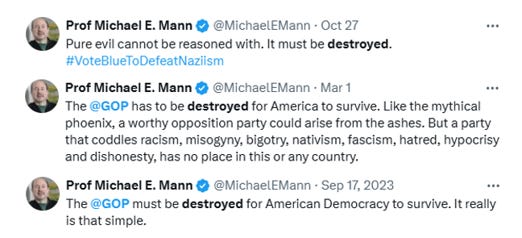
I have no doubt that the comments by Helmuth and Thorp about those Americans who voted for Donald Trump represent their deeply and sincerely held views against their fellow citizens. Climate scientist Mann goes further and often invokes the language of war against his fellow citizens.
We too must choose to do battle against the forces of darkness, fighting back against a malevolent movement that represents fascism, authoritarianism, racism, misogyny, and bigotry, a movement that uses antiscientific disinformation as its preferred weapon.4 We do this not because our success is guaranteed. Given the forces mobilized against us, we are clearly the underdog.
I cite Mann not because he is an outlier in the scientific community, but because he is so representative of many who hold positions of leadership and authority — not to mention his blissful unawareness of how offensive his daily public rants are to those who do not share his extreme politics.5
There are an enormous diversity of political views across the United States, on the left and on the right. There is absolutely nothing wrong with any scientist holding extreme political views or expressing them in public — It is a free country, and I support all who wish to participate in public debates and discussions.
The larger issue is that the scientific community has chosen to elevate into leadership positions many scientists who oppose and even denigrate the majority of fellow Americans who voted Republican in 2024. At the same time, the scientific community has ostracized and cast off from their own ranks those perceived to deviate in their views even a small amount from this orthodoxy.6 Among some scientists, there is even a view that the scientific community is part of “the resistance” against their fellow citizens.7
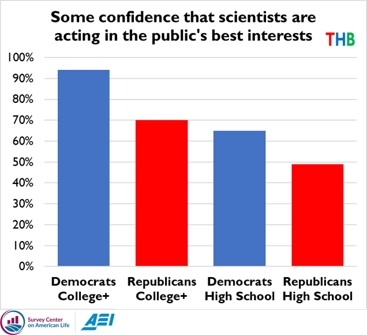
It can come as no surprise that as the scientific community has increasingly organized itself against normal Americans, many of these normal Americans are increasingly distrustful of scientists and scientific institutions. For instance, (emphasis added below):
[F]rom January 2019 to May 2023, the percentage of Hispanic Americans expressing a great deal or some confidence in scientists dropped from 82 percent to 61 percent. The pattern is similar for black Americans—from 85 percent to 69 percent over that same period. Generally, non-white Democrats are half as likely as white Democrats to express a great deal of confidence in scientists.
With the red wave that just swept the United States, there are some early encouraging signs within the scientific community that the extreme partisanship of its leaders must now change.
In an editorial yesterday titled ‘Time to Take Stock,” Thorp, the editor of Science, shows a growing awareness of the current realities:
“[Trump’s] his message resonates with a large portion of the American populace who feel alienated from America’s governmental, social, and economic institutions. These include science and higher education. Winning back this disaffected group will require science leaders to foster and promote a more inclusive scientific landscape for all Americans and lay out how science can be successful under Trump.”
Yet, Thorp’s essay also reads as if he is struggling to reconcile a profound dissonance between this growing awareness and where the scientific community has been focused over the past decade:
“During Trump's previous term in office, scientists often responded to incidents by fighting back on social media and cable news. (I was an enthusiastic participant but left Twitter, now called X, a year ago.) Although this animated and often confrontational banter created a sense of unity among many scientists and provided a platform to defend science, it ultimately failed to persuade the public that the attacks were baseless.”
He almost gets there. The “banter” was indeed persuasive to the public — it helped to persuade them that the scientific community deserves less of their trust.
Similarly, in a long essay lamenting Trump’s election, Nature includes the wisdom of Harvard’s Sheila Jasanoff, a long-time scholar of science and technology studies:
“I think it’s a learning moment,” says Sheila Jasanoff, a social scientist at Harvard University in Cambridge, Massachusetts. Trump’s victory illustrates a fundamental disconnect between academic researchers and many Republican voters. Finding common ground will require social engagement, and probably humility on the part of scientists, who have yet to fully come to grips with this social and political divide. For many Republicans, Jasanoff says, “the problem is us” — the academic ‘elites’.”
There is ample evidence revealing the dynamics underlying decreasing trust in science, but leaders of the scientific community have instead chosen denial. For example, a 2023 study looked at the effects among the public of Nature’s 2020 endorsement of Joe Biden, finding that it decreased trust in science overall:
[E]lectoral endorsements by Nature and potentially other scientific journals or organizations can undermine public trust in the endorser, particularly among supporters of the out-party candidate. This has negative impacts on trust in the scientific community as a whole and on information acquisition behaviours with respect to critical public health issues. Positive effects among supporters of the endorsed candidate are null or small, and they do not offset the negative effects among the opposite camp. This probably results in a lower overall level of public confidence and more polarization along the party line. There is little evidence that seeing the endorsement message changes opinions about the candidates.
Natureeditorialized on the study — completely rejecting it — and of course chose in 2024 to again offer a presidential endorsement.
The scientific community is not a subset of a political party. The scientific community is not the opposition or engaged in a war against other citizens. The U.S. scientific community is largely funded by the public in support of performing research and education to serve the broad interests of the nation and its citizens — all of its citizens regardless who they choose to vote for.
We should fully expect some in the scientific community to double down on partisanship and vitriol — It’s them, not us! Of course, thinking in terms of us and them is a huge part of the problem.8
The first priority of those who lead important institutions of science must be to reestablish a spirit of public service, recognizing that we serve the public, we do not lead the public. That will mean leadership that works to ensure that every American can see themselves benefitting from the work of the scientific community.
If current leaders are unable or unwilling to make what will necessarily be difficult and unsettling changes, then it is time for new leadership.
Roger Pielke Jr. is a nonresident senior fellow at the American Enterprise Institute (AEI), where he focuses on science and technology policy,
The U.S. presidential elections are closely watched even beyond American borders. After all, the White House decides and directs American foreign policy. As Donald Trump cruised to election victory and reclaimed the American presidency, world leaders quickly congratulated him. Friends and foes sent best wishes, some more warm than others, while expressing hopes of working together.
Canada welcomed Trump, saying, "The friendship between Canada and the U.S. is the envy of the world. I know President Trump and I will work together to create more opportunity, prosperity, and security for both of our nations."
Israeli Prime Minister Benjamin Netanyahu was among the first to congratulate President-elect Trump. Calling it "history's greatest comeback," he wrote, "Your historic return to the White House offers a new beginning for America and a powerful recommitment to the great alliance between Israel and America. This is a huge victory!" Tel Aviv is undoubtedly relieved to have the staunch supporter back in the White House.
With Trump back in the White House, India sees an opportunity to strengthen ties under Prime Minister Modi’s leadership. Modi congratulated Trump on his re-election, emphasizing shared goals of security, prosperity, and strategic partnership. Indians also celebrated Usha Vance, wife of Senator J.D. Vance and of Indian heritage, as a symbol of growing Indian-American influence—a bridge for deepening U.S.-India cultural and economic ties. The Trump-Modi relationship, underscored by events like Howdy Modi rally in Texas and Namaste Trump rally in India, reflects a commitment to national strength and growth. As Trump shifts supply chains away from China, India could become a key manufacturing hub for U.S. firms. With Trump’s focus on reducing U.S. involvement in Ukraine, India is poised to be a central partner in his vision for a rebalanced world order.
Trump had, during his campaign, vowed to end the Ukraine war in twenty-four hours if he was elected. President Volodymyr Zelensky, citing Trump's "impressive" election win, also expressed hope for a personal meeting while stating, "I appreciate President Trump's commitment to the "peace through strength" approach in global affairs. This is exactly the principle that can practically bring just peace in Ukraine closer. I am hopeful that we will put it into action together. We look forward to an era of a strong United States of America under President Trump's decisive leadership. We rely on continued strong bipartisan support for Ukraine in the United States."
Meanwhile,RussianPresident Vladimir Putin was more circumspect in his address, stating, "I don't know what will happen now; I have no idea." He also opined that Trump's "desire to restore relations with Russia, to help end the Ukrainian crisis...deserves attention at least." Cheekily, Putin, who is in his third term in office, pointed out that this would be Trump's last presidency.
Hailing Trump's return to power, U.K. Prime Minister Keir Starmer said, "From growth and security to innovation and tech, I know that the UK-US special relationship will continue to prosper on both sides of the Atlantic."
In her message, European Commission President Ursula von der Leyen reiterated that the E.U. and the U.S. are more than just allies, adding, "We are bound by a true partnership between our people, uniting 800 million citizens. So let's work together on a strong transatlantic agenda that keeps delivering for them."
In his congratulatory message, Chinese President Xi Jinping, who had a rocky relationship with the president-elect during his first term, advised that "history tells us that both countries stand to gain from cooperation and lose from confrontation." Calling for a "stable, healthy and sustainable development" that would "serve the common interests of the two countries and meet the expectations of the international community," he expressed hope that the second term would be based on "mutual respect, peaceful coexistence, and win-win cooperation."
While extending "sincere congratulations,"Taiwan'sPresident Lai Ching-te hoped, "I'm confident that the longstanding Taiwan-US partnership, built on shared values and interests, will continue to serve as a cornerstone for regional stability and lead to greater prosperity for us all."
Iran, one of the U.S.'s most bitter foes, downplayed Trump's return and did not directly offer congratulations. Instead, government spokesperson Fatemeh Mohajerani is reported to have said, "The U.S. elections are not really our business. Our policies are steady and don't change based on individuals."
Despite ominous threats of tariff hikes and mass deportations, America's neighbors vowed to work with the new administration. Mexican President Claudia Sheinbaum said, "We are a free, independent, sovereign country, and there will be good relations with the United States. I am convinced of this." Venezuelan President Nicolas Maduro said in his message, "This is a new beginning for us to aim for a win-win situation that benefits both the United States and Venezuela."
Leaders and countries are waiting to see how Trump will handle and steer his second term. On his first outing, Trump was an unknown on the international political stage. His first term saw him veer from predictable political formulae and embrace untried and risky strategies, often upsetting traditionalists. Trump administration policies and legislations questioned the entrenched world order. This time around, world leaders know what to expect. At least, they think they do. But then, Trump has always surprised everyone.
Nov. 5 wasn’t just a great night for America — it was a great night for law and order.
LA voters, sick of the massive damage that woke DA George Gascón (once a Soros darling now abandoned by his benefactor) has done their city, handed him a crushing defeat.
Gascóneliminated cash bail and effectively legalized many low-level crimes, bringing a countywide 8% crime spike from 2019 to 2023, and an exodus of experienced prosecutors.
Los Angeles County District Attorney George Gascon lost his re-election bid.AP Photo/Damian Dovarganes
Now he met his deserved fate, and good riddance. We welcome efforts of winner Nathan Hochman to (in his words) “make crimes illegal again.”
And it’s not just Los Angeles.
Monstrous Oakland DA Pamela Price, a race hustler who went soft on the brutal killers of an Asian toddlerandhosted trainings attacking crime victims for being white, is out of a job too.
Oakland voters sick of living in fear launched a recall effort; it succeeded Wednesday with almost 65% of the vote.
Nor is Cali’s crimefighting kick confined to gritty cities.
Over 70% of voters statewide justpassed Proposition 36, a rollback of the criminal justice “reforms” Cali saw implemented in 2014 as Prop 47. (Gascón was a co-author of 47; as always, the Golden State’s a pioneer of bad policy.)
This is great news for everyday Americans punished by the crime waves the left has unleashed, intensified after the 2020 riots.
But it’s only a start: Far too many Soros picks remain in power.
Like Philly DA Larry Krasner, who’s compared cops to organized criminals and overseen record homicides— but leaped into action against Elon Musk over his voter registration lottery.
Or Austin, where Soros darling Jose Garza has also overseen record homicides yet just won re-election.
But the results from California show that these people, with time and patience and effort, can be beaten.
For the sake of average Americans everywhere, they must be.
Nuclear energy stocks have become a favorite of Wall Street this year as the artificial intelligence boom spreads and Big Tech searches for ways to meet its growing power demand.
They helped power the S&P 500’s Utilities index (XLU) to all-time highs — the index is on track to outperform the S&P 500's equal-weighted counterpart (^SPXEW) in 7 of the past 10 months, according to data compiled by Bloomberg. And Vistra (VST), a nuclear power company, recently surpassed Nvidia (NVDA) as the biggest gainer in the S&P 500 (^GSPC) year to date.
Big Tech firms, including Amazon (AMZN), Microsoft (MSFT), and Google (GOOG), drove the gains, announcing hundreds of millions of dollars in investments in nuclear power names over the course of several weeks.
It’s a story the market ran with. Then came a regulatory wrist slap that briefly stopped the nuclear energy rally in its tracks.
In a 2-to-1 ruling on Nov. 1, the Federal Energy Regulatory Commission (FERC) rejected a request from Talen Energy (TLN) to increase the power it could provide Amazon from its Susquehanna power plant, citing concerns about grid reliability and energy affordability.
Several nuclear energy stocks, including Talen, Oklo (OKLO), Centrus Energy (LEU), Vistra (VST), and NuScale Power (SMR), tumbled the following Monday.
Amazon is expected to petition the decision, according to CFRA analyst Daniel Rich. But for investors, “it certainly is a setback,” Rich said.
Rich explained that co-location agreements have become a major focus for the tech industry, as they allow hyperscalers to buy power directly from an existing energy source for their data centers. This enables them to build more data centers at speed and at lower costs.
But these agreements may be a sticking point for regulators, which is why Big Tech has pursued other strategies, such as creating new sources of nuclear energy through small modular reactors (SMRs).
Though there are currently no SMRs in the United States, companies like Amazon see them as a way to affordably add to the power grid while also meeting the increased energy demands AI requires.
"The order may not represent a long-term risk," ClearView Energy Partners managing director Timothy Fox told Yahoo Finance. "It’s more that FERC may have punted or didn’t want to set a precedent about co-location until it had firm policy."
3 New York Cities of power
Clay Sell, the CEO of nuclear reactor designer X-energy, told Yahoo Finance that “a significant portion of the increased electricity demand in the US for the next 25 years is going to come from AI.”
“It could be as high as 10%, 20%,” Sell added.
Apollo chief economist Torsten Sløk also recently contextualized the amount of power the AI boom is going to require. His data shows that you’d have to add three New York Cities' worth of power to the grid by 2030 to meet the demand that is going to come from artificial intelligence. (Disclosure: Yahoo Finance is owned by Apollo Global Management.)
That may be one reason why Amazon is not done with co-location, telling Yahoo Finance via email that “we remain committed to continue innovating and advancing carbon-free energy solutions with companies like Talen Energy to power data center operations in the United States and the many technologies supporting our customers and our daily lives.”
Constellation Energy CEO Joseph Dominguez also rebuffed regulators on his company's earnings call, which came one day after the ruling, saying, "Co-location in competitive markets remains one of the best ways for the US to quickly build the large data centers that are necessary to lead on AI."
Despite beating on earnings and revenue, Constellation stock (CEG) fell after the company reported third quarter results due to fallout from the Talen news.
But CFRA's Rich said Constellation is a stock to watch in nuclear.
“I think Constellation is the most buyable dip," he said. "Constellation … is by far and away the largest nuclear operator, more than three times more megawatt capacity than the next competitor. And we think that in our view, nuclear is really one of the best ways to service this type of demand from companies like Amazon, Microsoft, [and Magnificent Seven] names that have large needs for power
President-elect Donald Trump has flipped Nevada, nearly three days after he was declared winner of the 2024 race to the White House.
The race was called at 9:15 p.m. PT on Nov. 8. Trump has now won six of the seven swing states and appears poised to capture them all.
He is leading in Arizona, the final battleground that has not yet been called.
With this win, Trump becomes the first Republican to win the Silver State since 2004.
He lost the 2016 race here to Hillary Clinton by 2.42 percentage points and the 2020 contest to candidate Joe Biden by 2.4 points.
Republicans had reason to believe Trump’s third time would be the charm after posting a robust in-person early vote lead and registration gains since 2020.
While Harris has consistently, but narrowly, led in Nevada polls since succeeding Biden as the Democrat’s nominee in July, two of four late surveys showed Trump suddenly surging as a clear favorite.
An Atlas Intel Nov. 1–2 survey of 782 likely voters had Trump leading by 5.5 percentage points and a Susquehanna Oct. 28–31 poll of 400 likely voters had Trump up by a breakaway 6 percentage points.
Meanwhile, a NY Times/Siena Oct. 24 to Nov. 2 survey of 1,010 likely voters had Harris up 2-to-3 percentage points and an Emerson Oct. 29 to Oct. 31 poll of 700 likely voters put her up by 1 percent.
Many media outlets had declared Trump the winner of the battleground state’s six Electoral College votes for days before the AP formally finally did so.
AP called the race with 96 percent of statewide ballots counted. Trump had 724,498 votes, 50.7 percent, to Harris’s 678,399 votes, or 47.4 percent.
He led by 3.3 percent, or by 46,099 votes.
There had been as many as 13,000 mail-in ballots, including more than 11,000 from Clark County, flagged for discrepancies, primarily mismatched signatures. Elections offices had been frantically scrambling to contact affected voters to “cure” or verify those votes by Nov. 9.
Trump was not only winning Washoe County - which includes Reno and is Nevada’s second-largest voting constituency - by about 1,600 votes but had garnered more than 478,000 votes in Clark County, where 71 percent of the state’s 3.2 million residents and 2.03 million active voters live, and where Democrats need to run up big numbers to win statewide races.
That doesn’t appear to have happened in 2024. While Harris was leading in Clark County with 504,828 votes late afternoon Nov. 8, that was only 26,000 more than what Trump had received in the blue county, significantly below the threshold needed to overcome GOP votes across the state.
Interestingly, in both these cases - Arizona and Nevada - the incumbent Democrat Senators are leading despite President Trump's lead in the presidential race:
Jacky Rosen (D) has been declared the winner over Veteran Sam Brown...
But, In Arizona, Kari Lake (R) is holding it close still...
Lake and campaign officials have been expressing confidence that Lake, who lost the 2022 gubernatorial election, will ultimately win the Arizona Senate race. They’ve been urging people to cure ballots, meaning fix mistakes on ballots so their votes are counted.
Under Arizona law, voters have five days after Election Day to fix issues with their ballots.
“There are lawyers and trained observers monitoring tabulation of ballots, duplicating, and adjudication until we are done. I’m in constant touch with Kari’s lawyers and supporters about this and we are watching every ballot drop,” Harmeet Dhillon, a lawyer who leads an election integrity team for state and national Republicans, said on the social media platform X.
As of the current projections, Republicans will have 53 Senate seats in the next Congress, compared to 45 for Democrats or nominal independents who caucus with the Democrats.