Search This Blog

Friday, January 17, 2025

Stryker commences tender offer for all outstanding shares of common stock of Inari Medical

 Stryker (NYSE: SYK) today announced that it is commencing, through a wholly owned subsidiary, Eagle 1 Merger Sub, Inc., a cash tender offer to purchase all of the issued and outstanding shares of common stock of Inari Medical, Inc. (NASDAQ: NARI) for $80.00 per share in cash. The offer is being made pursuant to the previously announced merger agreement, dated as of January 6, 2025, among Stryker, Eagle 1 Merger Sub, Inc and Inari.

The tender offer is scheduled to expire at one minute past 11:59 p.m. Eastern Time, on February 18, 2025, unless extended in accordance with the terms of the merger agreement. The tender offer is subject to various conditions, including the minimum tender of at least a majority of the issued and outstanding shares of Inari common stock, the expiration or termination of the waiting period under the Hart-Scott-Rodino Antitrust Improvements Act and other customary conditions. The transaction is anticipated to close by the end of the first quarter of 2025, as previously announced.

https://www.globenewswire.com/news-release/2025/01/17/3011710/0/en/Stryker-commences-tender-offer-for-all-outstanding-shares-of-common-stock-of-Inari-Medical-Inc.html

Arrowhead Application OKd for Familial Chylomicronemia Syndrome Therapy

 - The New Drug Application is based on positive results from the Phase 3 PALISADE study

- People living with familial chylomicronemia syndrome have extremely high triglyceride levels and a substantially higher risk of developing acute pancreatitis and associated long-term complications, including poor quality of life

https://www.businesswire.com/news/home/20250117349461/en

Moderna gets $590M HHS contract to develop mRNA pandemic flu vaccines

 The U.S. government has awarded Moderna $590 million to advance the development of its bird flu vaccine, as the country doubles down on efforts to tackle increasing infections in humans.

This is in addition to $176 million awarded by the U.S. Department of Health and Human Services (HHS) last year to complete the late-stage development and testing of a pre-pandemic mRNA-based vaccine against the H5N1 avian influenza.

The award will also support the expansion of clinical studies for up to five additional subtypes of pandemic influenza, Moderna said on Friday.

"Avian flu variants have proven to be particularly unpredictable and dangerous to humans in the past. Accelerating the development of new vaccines will allow us to stay ahead and ensure that Americans have the tools they need to stay safe," HHS Secretary Xavier Becerra said in a statement.

The drugmaker said it is preparing to advance its experimental shot, mRNA-1018, into late-stage trials based on preliminary data from an early-to-mid stage study and plans to present the data at an upcoming medical meeting.

Shares of the company were up 5% at $35.8 in extended trading on Friday.

The award was made through the Rapid Response Partnership Vehicle (RRPV) Consortium with funding from the U.S. Biomedical Advanced Research and Development Authority.

Nearly 70 people in the U.S., most of them farmworkers, have contracted bird flu since April, as the virus has circulated among poultry flocks and dairy herds.

Most infections in humans have been mild, but one fatality was reported in Louisiana last week.

The risk to the general public from bird flu is low, and there has been no further evidence of person to person spread, according to the U.S. Centers for Disease Control and Prevention.

https://finance.yahoo.com/news/us-awards-moderna-590-million-210545008.html

Biogen Sued by Neuroscience Company Sage After Buyout Offer

 Sage Therapeutics Inc. sued Biogen Inc. on Friday, a week after the biotech giant made an unsolicited offer to acquire the smaller neuroscience company for about $469 million.

The lawsuit remains under seal with Delaware’s Chancery Court, the leading US forum for merger fights and corporate cases. But a related public filing indicates Sage is seeking an injunction to enforce a standstill agreement against Biogen, its largest shareholder and partner on the postpartum depression drug Zurzuvae. Biogen currently holds a roughly 10% stake in Sage.

https://news.bloomberglaw.com/esg/biogen-sued-by-neuroscience-company-sage-days-after-buyout-offer

What Will Trump Do for Europe?

 Editor’s note: For the past week our friends Sean Ring and Byron King over at The Rude Awakening have been breaking down implications of President Trump’s second term. In the article below, Sean explains how Trump 2.0 looks from a European perspective. With his boots on the ground in Italy, his perspective is definitely worth paying attention to.

Energy: Cheap and Secure

Germany, America’s chief poodle on The Continent, jumped all in to this Ukrainian thing because if they didn’t, they’d have been accused of reverting to National Socialism. That’s harsh but true, and Ze Germans are well-trained vassals by now.
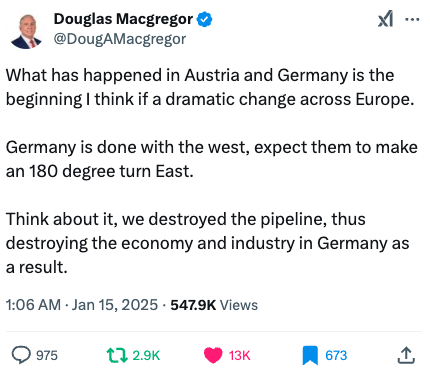
image 2

Source: X.com

However, this unconditional backing has destroyed the German economy. That’s not hyperbole; it’s the truth. I’m not sure General Macgregor is correct in his above tweet, but the Germans must be thinking about alternatives by now. I’ll spare you the details, but here’s all you need to know about the deindustrialization of Germany:
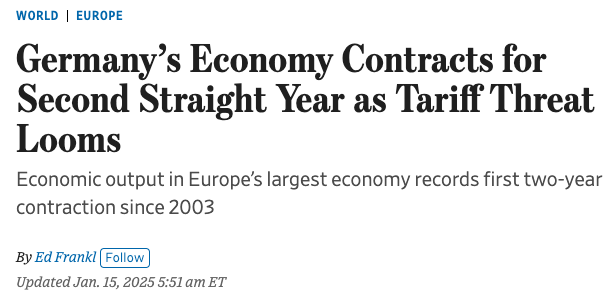
image 3

Source: The Wall Street Journal

In aid of this, here are some things the US can do to help out its allies, energy-wise:

The U.S. has become a top liquefied natural gas (LNG) exporter. Trump could expand this capacity, providing Europe with a cheaper alternative to Russian gas. Incentives for private-sector investment in LNG infrastructure—both in the U.S. and Europe—would bolster this effort.

Trump’s administration should push for joint investments in nuclear energy technology. This would aid Europe’s transition to a genuinely sustainable energy infrastructure, reducing dependency on volatile global markets. But, the Germans would have to remove Green lunatics from their government.

Finally, form a U.S.-European energy council. The Trump administration could facilitate collaboration on supply chain security and create strategic reserves to shield allies from market shocks.

Failing all that, let the Germans buy cheap Russian pipelined gas without giving them guff over it.

It’s Trump Week: three more days until the inauguration of the once and future president.

Each day this week, the Rude dives into what to expect from Donald Trump’s second term. This has YUGE implications for America and the world, certainly the economy and our investments.

On Monday, we discussed looming executive orders from Trump’s inbound administration. On Tuesday, we discussed tariffs. In Wednesday’s Rude, we discussed the possibility of a Biden recession, which would be handed off to Trump.

Today, let’s examine Europe’s future. The economy is tough here, and the euro is fading into toilet paper-like irrelevance.

And post-Ukraine, the entire NATO alliance is up for grabs.

What can Trump do? And what should you do? Read on…

With Allies Like America, Who Needs Enemies?

Let’s address a few things Americans never think about that are perpetually on the minds of their allies.

The first is America’s “exorbitant privilege” of having the USD as the world’s reserve currency. While Americans complain that Europeans never pay their “fair share” for NATO or enough for America’s Big Pharma drugs, it’s worth understanding that printing every $100 bill costs the U.S. Treasury only 5.4 cents. Yet, the U.S. demands $100 worth of real goods for this paper. This economic system has been a staggering ripoff from the start.

Second, if you believe five drunken Ukrainians came up with a plan to blow up Nordstream and then executed that plan, I’ve got a bridge over the East River to sell you. Whether America used proxies or not, one of its three-letter agencies either came up with the idea, supported it, or both. So, America blew up Germany’s cheap energy source and then demanded it pay full market price for American LNG… which is 4x as expensive! And then, in an act of industrial thievery, the USG happily allowed German companies to up sticks and move to America because energy is cheaper there.

Third, Donald Trump is coming in and saying he’s going to pull out of NATO and slap tariffs on the EU. Is that how you’re supposed to treat your allies? I’m all for NATO disbanding, as it should’ve been over 30 years ago. But equally, I’m sure the U.S. military-industrial complex will hate it, as European allies have to buy U.S. equipment to comply with NATO standards. As for tariffs, sure, you can do that, but expect the EU to retaliate. I wonder how he will close the trade deficit when no trading is happening.

A small note on the UK, which is no longer in the EU: I hope Trump punishes Starmer’s government for interfering in U.S. elections. The Brits need to be put back in their box.
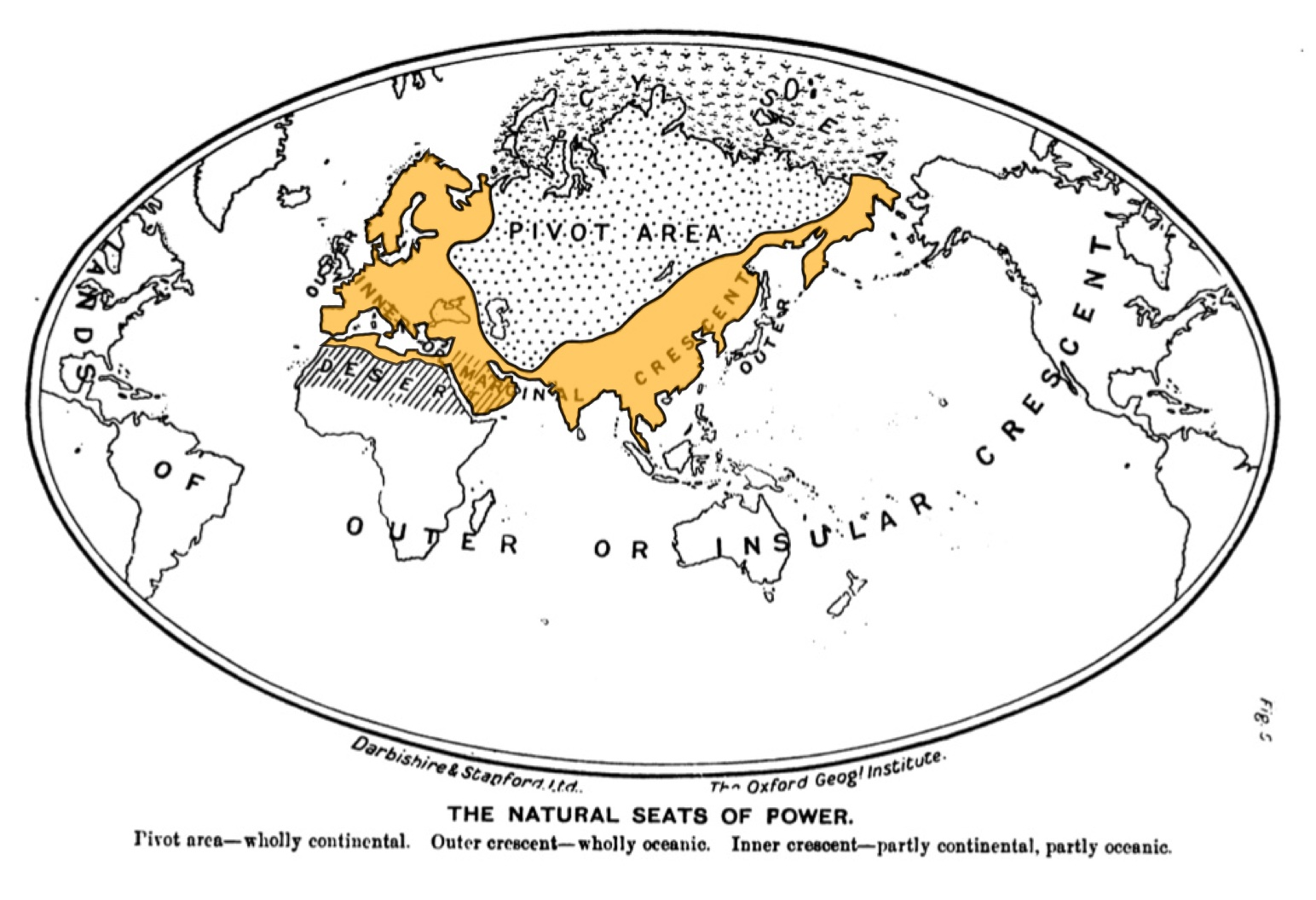
image 1

Halford Mackinder’s map (Heartland Theory) makes it easy to see Europe’s geography… and options.

As Philosopher-Truck Driver John Ring is wont to tell me, “You’ll catch more flies with honey than vinegar.” In that vein, here are a few ideas for Donald Trump to help his European allies out so he can stop making Russia, China, and BRICS look like attractive alternatives.

Manufacturing: “Allies First?”

European manufacturing has struggled due to supply chain disruptions, energy price volatility, and Asian competitive pressures. Trump’s “America First” ethos ought to evolve into a broader “Allies First” strategy.

From Capital Economics on how Trump-style U.S. protectionism will hurt Europe:

“Germany and Italy will be the hardest hit of the major economies. Their exposure to the US is more than twice that of France or Spain. Germany is also most at risk from additional tariffs on vehicles. And its large bilateral surplus with the US may make it a target for Trump.”

Trump should support policies encouraging European companies to reshore critical manufacturing and offer joint ventures with U.S. firms to leverage shared technological and capital resources.

Creating a robust transatlantic supply chain network would counteract overdependence on China. Sectors like semiconductors, pharmaceuticals, and electric vehicle components stand to benefit.

The Donald can encourage investment in high-tech manufacturing across Europe through tax breaks, deregulation, and not levying tariffs, especially in areas that suffered industrial decline.

Technology: A Secure Cyberspace

Europe faces a technology gap, particularly in artificial intelligence, green tech, and cybersecurity. The U.S. can play a pivotal role in helping allies maintain competitive edges.

Trump’s administration should establish cross-border research programs to accelerate innovation in emerging technologies. This would combine Europe’s regulatory expertise (which it excels at) with the U.S. entrepreneurial spirit.

By partnering with European governments and private firms, the U.S. can roll out more 5G and explore the potential of 6G networks. Then, European allies will remain at the forefront of connectivity without resorting to Chinese technology.

Europe’s cybersecurity vulnerabilities threaten its industries and transatlantic security. DJT should lead a NATO-aligned initiative to bolster cyber defenses, train joint task forces, and enhance information-sharing frameworks.

If the Trump administration does nothing, Europe’s head will turn in other directions.

Wrap Up

The Donald’s love for making deals can revitalize U.S.-Europe relations. The US can support its European allies by addressing energy diversification, manufacturing resilience, and technological leadership.

The challenge, of course, is getting it done. If Trump wants to keep Europe in his orbit, he must prioritize long-term strategic alignment. If he succeeds, the transatlantic alliance will emerge more assertive, competitive, and prepared for global challenges.

https://dailyreckoning.com/what-will-trump-do-for-europe/

Nearly Half Of Federal Employees Say They Plan To Resist Trump's Incoming Administration: Poll

Via American Greatness,

A poll conducted by RMG Research reveals a startling number of federal government managers who say they will actively oppose the incoming administration when Donald Trump is inaugurated on January 20.

The Daily Signal reports that RMG Research polled three separate segments of the population including what it calls the “Elite 1%”  with postgraduate degrees, earning more than $150,000 annually and live in highly populated areas, “Main Street Americans” who represent roughly 75% of the U.S. population and, finally, federal managers who live near the nation’s Capital city and earn $75,000 or more annually.

When asked if they would most likely be supporting or resisting the Trump administration over the next four years, government managers were almost evenly split with 44% saying they would support the administration and 42% saying they would resist.

But the divide between those federal managers who would resist and those who would support the incoming Trump administration grew much sharper when respondents were questioned along party lines.

89% of Republican federal employees said they would either “somewhat support” or “strongly support” the administration, while 73% of Democrat bureaucrats surveyed said they would either “somewhat resist” or “strongly resist.”

Removing bad or insubordinate employees from federal service has become more difficult over the years with truly bad employees typically being promoted or transferred to less visible positions while retaining their employment.

Given the incoming Trump administration’s stated goal of finding and cutting out wasteful and abusive use of taxpayer dollars, there may be a price to be paid by those employees who draw too much attention to their resistance after taking an oath of service.

The survey also revealed that the so-called Elite 1% and Main Street Americans showed considerable alignment on issues like the economy and immigration.

Federal government managers who were polled placed a higher priority on guns and crime, equality and climate change - issues that registered far lower importance among most other Americans.

https://www.zerohedge.com/political/nearly-half-federal-employees-say-they-plan-resist-trumps-incoming-administration-new

Russia & Iran Sign 20-Year Defense, Energy Pact 3 Days Before Trump Inauguration

 President Vladimir Putin of Russia and President Masoud Pezeshkian of Iran on Friday signed a 20-year pact between their countries at the Kremlin, just three days before Trump's inauguration.

Dubbed the Comprehensive Strategic Partnership Treaty, the Kremlin is hailing it as bringing relations with the Islamic Republic to a new level, enshrining the two countries' status as strategic partners. Putin hailed the "real breakthrough, creating conditions for the stable and sustainable development of Russia, Iran and the entire region."

Russian media has described it covers all spheres, including defense, counter-terrorism, energy, finance, transport, industry, agriculture, culture, science and engineering.

The allies are also working on linking their national payment systems: "According to the Russian leader, in 2024, the share of transactions in Russian rubles and Iranian rials exceeded 95% of all bilateral trade operations," TASS noted.

Putin further said in a press conference with Pezeshkian, "Our countries firmly uphold the principles of the supremacy of international law, the sovereignty of states, non-interference in the internal affairs of other countries." As for Pezeshkian, he said the following:

"We witness a new chapter of strategic relations," the Iranian president said, adding that the countries were set to expand trade ties and also boost the "level of security cooperation."

The pact is heavily focused on defense and security cooperation. "It will confirm the parties' desire for closer cooperation in the field of defense and interaction in the interests of peace and security at the regional and global levels," Russian Foreign Minister Sergey Lavrov had earlier stated.

Already, the two sides cooperate closely on drones. Russia has since the Ukraine war's start been using Iran-produced 'Shahed' kamikaze drones against Ukrainian cities, and Iran has reportedly set up a major UAV production facility on Russian soil at Moscow's invitation

Moscow and Tehran early last month lost a key Middle East ally upon the fall of Bashar al Assad, after Islamic insurgents rampaged across the country and the demoralized and underpaid Syrian Army quickly collapsed. Turkey was widely seen as supporting the insurgents with intelligence and equipment, and likely other NATO states played a background role as well.

Via Associated Press

As for Iran, it sees the treaty as further safeguarding independence and national sovereignty:

Discussing the specifics of the deal, Jalali told Iran's state-run Young Journalists Club (YJC), "The independence and security of our country, as well as self-reliance, are crucial elements, and we are not particularly inclined to align ourselves with any specific bloc."

"National independence is of great importance to the Islamic Republic of Iran. After all, we have been paying the price for it for 45 years," he added in an article published Saturday.

But both countries have come under far-reaching US and EU sanctions for what's happening in Ukraine. Western intelligence has warned against the transfer of Iranian ballistic missiles to Russia in the context of the Ukraine war as well. While there have been some reports suggesting this has happened, there's as yet no definitive evidence.

https://www.zerohedge.com/geopolitical/russia-iran-sign-20-year-defense-energy-pact-three-days-trump-inauguration