Search This Blog

Saturday, January 18, 2025

PART II: Implications of plasmid DNA fragments in blood products

 Part I of this investigation examined the findings of researcher Sandeep Chakraborty, who identified unexpected DNA sequences in the blood of individuals vaccinated with mRNA COVID-19 vaccines—sequences that should not have been present.

The detection of gene fragments encoding 'SV40' and 'Kanamycin,' which are specific to the plasmid DNA used in vaccine manufacturing, has now raised significant concerns about the safety of blood products.

If these genetic sequences can persist in the bloodstream after vaccination, and potentially end up in blood products such as fresh frozen plasma, whole blood, or cryoprecipitate, what risks might they pose to recipients?"

Experts in blood safety are now questioning whether Australia’s current blood donation and monitoring systems are sufficiently equipped to manage these potential health risks.

Australia’s Current Approach

The Australian Red Cross Lifeblood recommends waiting three days after receiving a COVID-19 vaccine before donating blood, primarily to ensure donors feel well and exhibit no immediate side effects.

However, the organisation has confirmed it does not track the COVID-19 vaccination status of donors, nor has it tested for these genetic components of mRNA vaccines in donated blood.

In a statement, it said:

Whilst blood services cannot guarantee with absolute certainty that there are no vaccine components in donated blood, in the small chance it was there, it would be at ultra-low levels and there is no evidence of a risk to a recipient.

Richard Davis, a retired anaesthetist and former member of the South Australian Red Cross blood transfusion committee, has questioned the robustness of these assurances.

“If the Red Cross is not documenting the vaccination status of donors, how can it possibly track any harm?” asked Dr Davis.

“Further, the Red Cross should not claim there is no evidence of risk to recipients when such effects may take years to manifest,” he added.
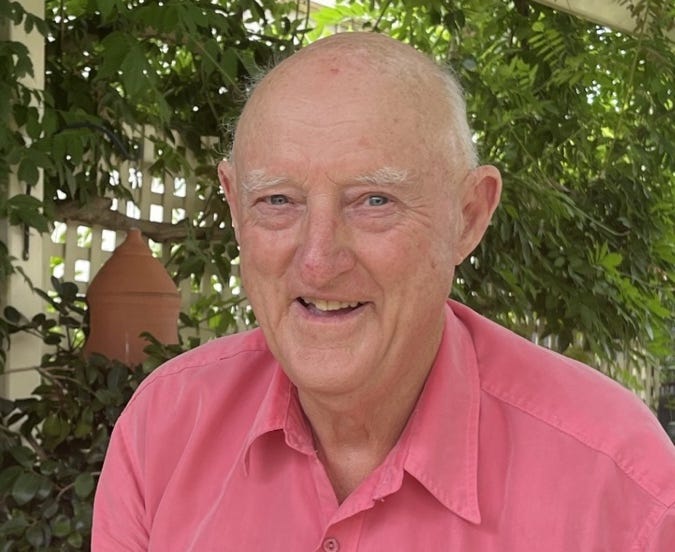
Dr Richard Davis MBBS FFARACS FANZCA RAAMC (Rtd) CF

Dr Davis, whose research into safe blood transfusions earned him the Gilbert Brown Prize in 1980 from the Royal Australasian College of Anaesthetists, brings decades of experience in ensuring blood transfusion safety.

Despite assurances of progress over the decades, Dr Davis continues to hear reports from patients who have received blood products, only to discover that no record of the transfusion exists—and it is this lack of oversight that concerns him.

The “Look Back” program

The Australian Red Cross has a "Look Back" program designed to investigate cases where recipients may have been harmed by contaminated blood products within the past 20 years.

However, Dr Davis has raised concerns about the program’s limitations in addressing novel risks like potential DNA contamination in donor blood.

No studies have been conducted to determine whether these genetic sequences impact specific types of donated blood components—red cells, plasma, or platelets.

“If they’re not monitoring the problem of genetic sequences in donor blood, then they won’t be able to follow up on anything if this contamination becomes a problem in the future,” Dr Davis noted.

Historical failures

In the 1980s and 1990s, Australia experienced the ‘tainted’ blood scandal, where thousands of Australians were infected with HIV and Hepatitis C through contaminated blood transfusions.

In 2004, a submission to the Senate review reported that about 80% of those infected were never contacted by the Australian Red Cross about receiving tainted blood, nor were they offered any medical support.

“We cannot afford to repeat those mistakes by ignoring the findings of foreign genetic sequences in blood,” Dr Davis warned. “The organisation has a history of denying there is a problem, until it becomes impossible to ignore.”

The National Blood Authority, responsible for overseeing blood safety in Australia, has not responded to media enquiries.

United States

In the United States, the American Red Cross has taken a more rigid position regarding concerns about potential contaminants in the vaccine ending up in donor blood.

As late as September 2022, the American Red Cross stated on X, “We don’t label blood products as containing vaccinated or unvaccinated blood as the COVID-19 vaccine does not enter the bloodstream.”
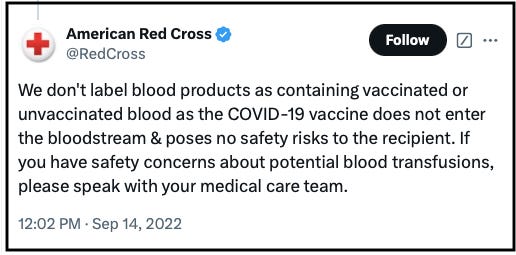
However, this assertion that “the COVID-19 vaccine does not enter the bloodstream,” is patently false.

Findings by Chakraborty, data from biodistribution studies in Japanese regulatory documents, and a study published this month in Nature, all clearly show that the vaccine leaves the injection site and circulates widely throughout the body.

This leaves significant blind spots in ensuring transfusion safety and allowing recipients of blood products to fully understand what they are consenting to receive.

Peri-operative blood transfusions carry lower risk, as they are almost exclusively composed of packed red blood cells, which lack a nucleus and therefore cannot produce spike protein or risk DNA integration.

The need for scrutiny

Currently, no authority has announced plans to investigate whether plasmid DNA sequences persist in donated blood or to examine the long-term implications for the safety of blood products.

Could these genetic sequences be transfused into recipients and cause unforeseen health effects? Would recipients have religious or ethical objections to receiving blood products contaminated with plasmid DNA fragments?

“Without data, we are left in a dangerous state of speculation,” Dr Davis said. “It’s critical that we address these uncertainties head-on. Ignoring them now could have serious consequences in the future.”

He added, “In my experience, these organisations appear more focused on preserving public confidence than addressing valid scientific concerns. This lack of transparency is deeply troubling.”

Until further studies are conducted, the implications of plasmid DNA sequences in donor blood remain a troubling unknown for policymakers, healthcare providers, and the public.


See PART I: Blood samples contain DNA sequences from COVID-19 mRNA vaccine


https://blog.maryannedemasi.com/p/part-ii-implications-of-plasmid-dna

Official legal notice to HHS, CDC, FDA, NIH, CMS, etc., all their employees and officials

 Official legal notice to HHS, CDC, FDA, NIH, CMS, etc., and all their employees and officials, to not destroy, delete, or modify any documents, and an intent to refer any violations to the Department of Justice.

https://lnkd.in/gbMC9-kz

Aaron Siri, Esq. Elizabeth A. Brehm, Esq. 
745 Fifth Avenue, Suite 500 New York, NY 10151
 (888) 747-4529 aaron@sirillp.com ebrehm@sirillp.com


Gaza Ceasefire Will Begin 8:30AM Sunday - 33 Israeli Hostages To Be Freed In 1st Phase

 After Israel's cabinet on Friday approved the Gaza ceasefire and hostage deal, it is expected to finally take effect beginning at 8:30am Sunday (local), and initially three Israeli women are expected to be named and freed.

"As coordinated by the parties to the agreement and the mediators, the ceasefire in the Gaza Strip will begin at 8:30 a.m. on Sunday, January 19, local time in Gaza," Qatar’s Foreign Ministry spokesman Majed al-Ansari announced on X. "We advise the inhabitants to take precaution, exercise the utmost caution, and wait for directions from official sources."

CNN writes of the Israeli government that "The 33-member group of ministers approved the agreement following a recommendation earlier Friday by the smaller security cabinet. Deliberations stretched over seven hours, late into the night on Friday into early Saturday morning local time."

Getty Images

The Israel Defense Forces (IDF) also confirmed the ceasefire's start time, and three civilian women who are on a list of 33 hostages to be freed in the 42-day first phase of the deal are set to be handed over, after which up to 1,904 Palestinian prisoners will be released from Israeli prisons. 735 of these prisoners will be released in the first phase. 

"The State of Israel is committed to achieving all the goals of the war, including the return of all our hostages – both living and dead," the Prime Minister’s Office said.

Times of Israel notes that the Palestinian freed will include "several serving multiple life sentences for deadly terror attacks and murders."

At least 50 humanitarian aid and fuel trucks are awaiting to enter the Strip as soon as the truce takes effect Sunday morning. 

A surge of homeless Gazan refugees are expected to seek to return to their communities in Northern Gaza, but the Israeli army is warning that the situation will still be dangerous.

The Israeli army's Arabic-language spokesperson Avichay Adraee issued instructions for Palestinians for when the ceasefire takes effect. Al Jazeera listed out a translation of the instructions as follows:

  • Moving from the south to the north of the Gaza Strip or towards the Netzarim Corridor remains dangerous in light of the military activities in the area. Once movement is permitted, instructions will be given.
  • The Israeli army will remain deployed in specific areas of the Gaza Strip. You must not approach its officers until further notice and doing so could expose you to danger.
  • It is dangerous to approach the Rafah crossing, the Philadelphi Corridor and all areas in southern Gaza where Israeli forces are deployed.
  • In the coastal area along the Strip, fishing, swimming and diving is dangerous and we warn against entering the sea in the coming days.
  • It is forbidden to approach Israeli territory and the buffer zone. Approaching the buffer zone is very dangerous.

Still, there's some last minute details still reportedly being worked out, including a demand by Prime Minister Benjamin Netanyahu who says Israel will not proceed with the ceasefire until a list of the 33 captives who will be released by Hamas in the first phase is received.

"We will not move forward with the agreement until we receive the list of hostages who will be released, as agreed. Israel will not tolerate violations of the agreement. The sole responsibility lies with Hamas," Netanyahu said on X.

https://www.zerohedge.com/geopolitical/gaza-ceasefire-will-begin-830am-sunday-33-israeli-hostages-be-freed-1st-phase

You have minutes to flee your house. What do you take?

When describing how the River Fire devoured her home in August 2021, Lizz Porter broke down only once, after I asked her what she wished she had taken with her.

"This is the worst part," Porter, 47, said. "It was our first evacuation, so we were like, ‘there's no way our house is going to burn down.’"

She left her grandmother's paintings, the external hard drive with her son's baby pictures stored on it, her husband's family Bible that had four generations of baptisms and marriages written in it. Her wedding dress.

"We never thought that we would actually lose…" Porter's voice trailed off.

As firefighters battle to bring the blazes across Los Angeles under control, many of us, upon reading the accounts of survivors, may look around our homes and wonder what we would take with us in an emergency.

The recommendations from experts amount to a straightforward and pragmatic checklist: birth certificates, passports, and financial information. These items are for immediate survival and to provide the rebuilding blocks when the disaster passes and the days — and weeks — after it descends.

What's harder to choose and practically impossible to pack ahead of time in a go-bag are those possessions that are largely uninsurable, irreplaceable, and priceless.

Really, what you need to take with you depends on a host of factors. How much time you have, the nature of the disaster, your state of mind, the time of day, whether you have electricity, and whether you're home at the time. Even the best-laid preparations might not be enough.

I spoke with four people who had to evacuate their homes during a disaster, two of whom experienced a total loss. Here's what they took and didn't.

The big regret

By many accounts, Porter and her family were well-equipped to handle an evacuation of their home in Colfax, Calif. Raised in California, she and her husband have always been prepared for an earthquake. The teardrop camper in their driveway served as a supped-up go-bag and roaming shelter in the event of an emergency.

"We grow up being taught to have an earthquake emergency plan, and so that was always our plan. We didn't make a lot of adjustments for fire," Porter, who designs home goods, said.

With an hour to evacuate, Porter and her family each packed a bag of clothes. She tucked a box of her childhood photos into the car, along with a bin of stuff from when her son was born. They also took their bin of important papers, which "actually turned out to be more than just papers and I'm eternally thankful to my disorganized self," she said.

But it's those other left-behind items she tries to not beat herself up about.

"I've been through enough in my life and I need to get as much as I can out of every day, so I try really hard not to have a bunch of regrets," she said. "But that's the big one."

Seven hours to think

Aparna Shewakramani had about seven hours to consider what in her house she wanted to save, as floodwaters from Hurricane Harvey crept higher in her one-story home near Houston, and she and her mother, recovering from hip surgery, waited for rescue.

She stacked photos and personal memorabilia high on shelves and piled her clothes, shoes, and whatever else she could on top of her bed.

"You have to start assessing if the water reaches here, am I OK with this going?" Shewakramani, 40, said. "So your most precious things are as high as possible, and then it goes down in importance, which is a weird assessment to be making as your home is literally flooding."

Aparna Shewakramani's damaged belongings from Hurricane Harvey. (Photo courtesy of Aparna Shewakramani)

By her own admission, Shewakramani was ill-prepared for the hurricane. Someone at work gave her a case of bottled water the day before when he heard she had none stocked. As the water seeped into her home, Shewakramani finally packed a go bag. In it went birth certificates, Social Security cards, passports, medicine, dog food, two outfits, and pajamas. As the hours ticked by, she took pictures of her flooded home and filed claims with her insurer — she's an insurance lawyer by trade.

Official help never came to her house, but Barb on a kayak did. Barb — Shewakramani didn't get her last name and never found her post-hurricane — paddled Shewakramani, her mother, and her two dogs to higher ground at a local high school. Later, FEMA boats would take them to a road where Shewakramani's uncle waited to take them to his house.

"When the waters had receded, the water had come into about our knees," she said. "So everything below the knees was ruined."

What was stacked on the bed was saved.


House still standing

For Shannah Game, she didn't have to worry too much about her home and everything in it. She had to worry about it becoming uninhabitable after Hurricane Helene pummeled her hometown of Asheville, N.C., in September 2024.

Game, 47, and her husband had prepped before the storm by filling the bathtub with water, gassing the car, and stocking up with flashlights and candles, but those preparations did little to help them in the aftermath. Though their basement flooded, they were largely spared the worst damage. But the area was without electricity for 10 days, without water for two weeks, and without clean water for a month and half.

"Now we were in a survival situation," said Game, a podcast host and money educator. "We had absolutely no idea the amount of devastation that would be caused."

They loaded water into buckets from a neighborhood creek to flush the toilet. Game's husband stood in a grocery store for six hours and by the time he got into the store, almost everything had been picked through. Stores would only take cash and the Games had just $8 on hand.

After eight days, Game and her husband packed up their dog, the bag with their important documents, and some clothes and left their home behind. They didn't return for another month.

"There was a huge amount of anxiety because you don't quite know what's going to happen," Game said. "Do we leave, do we stay? How long is this going to be? Is it even safe for us to be here?"

No chance at all

Marika Porter (no relation to Lizz Porter) had not one second to save anything in her home, including her two dogs and cats in 2009 when a wildfire rampaged through her neighborhood in Auburn, Calif.

She was at the movies with her husband and 4-year-old daughter and when they emerged from the theater, Porter saw a massive plume of black smoke coming from up the hill near where her house stood.

Her husband, who had met them at the theater on his motorcycle, raced up the road to save her pets, but he couldn't get close. The roads were closed off. On the phone, Porter begged him to get her animals.

"He said, 'you don't understand,' and those words are so profound now. I didn't understand," Porter, a small business owner, recounted. "I had absolutely no idea of what was happening or what I would have to experience."

When her landlord called sobbing later — he had broken through the fire line — Porter knew the worst had happened. She sat in her van parked as close as she could to where her home once stood, doing her best to explain it to her daughter.

"This little girl climbs out of her booster seat, picks up the one toy that I hadn't cleaned out of the van that morning, and said, 'it's OK, Mommy, I have one toy,'" Porter, 57, said. "And I lost it."


What they would do differently

While Shewakramani advises people to have a go-bag, she still doesn't have one of her own despite her experience. Game, on the other hand, dedicated a closet for disaster preparedness. It includes all the items she wished they had before: solar phone chargers, bottled water, non-perishable food, a camping stove, a gas jug, a fire extinguisher, and a lot more cash.

Marika Porter also has a go-bag, but now she stores it in her car. A few years ago, when a neighbor pounded on the door saying they needed to evacuate because of another fire, "the go bags that had been so carefully packed, we didn't even grab," she said. "Our only thought was get the animals, get out the door."

Porter, who also formed an online support group for wildfire survivors, also recommends "as inconvenient as it is" to store important papers in a safe deposit box off-site. Fire-rated safes often can't survive the heat of wildfire and everything in them would be lost.

Lizz Porter thinks everyone should make a priority checklist now before any catastrophe strikes. Beyond the pragmatic, the checklist should include those sentimental items you wouldn't want to lose and where they're located. It should be stashed on top of your go-bag.

But for Porter, that thought exercise she recommends is now moot.

"The irony of it is that the things I have now have so little actual sentimental value that I don't… care if I lose it," she said, "because I've already lost all of the things that really mattered."


https://finance.yahoo.com/news/you-have-minutes-to-flee-your-house-what-do-you-take-160204395.html