Search This Blog

Wednesday, March 12, 2025

Russia says no peacekeepers in Ukraine ‘under any conditions’, Trump reups ‘devastating’ sanctions threat

 The Russian government issued its strongest statement yet Wednesday against a provisional cease-fire agreed by the US and Ukraine a day earlier following marathon talks in Saudi Arabia.

“Nobody is talking to us,” Foreign Minister Sergey Lavrov said in an interview with pro-Kremlin US bloggers.

“They keep saying, ‘nothing about Ukraine without Ukraine,’ but they do everything about Russia without Russia.”

Lavrov also reiterated that Russia would not accept peacekeeping troops from any NATO country on Ukrainian territory “under any conditions,” a direct rebuke to a proposal floated by French President Emmanuel Macron and British Prime Minister Keir Starmer.

Russian Foreign Minister Sergey Lavrov said peacekeepers from any NATO country in Ukraine are not acceptable “under any conditions.”YouTube/Ministry of Foreign Affairs of Russia
00:00
04:42

Russian President Vladimir Putin also appeared in a Kremlin-produced video released Wednesday dressed in military camouflage — a rare occurrence — and vowing to regain all of the Kursk province held for seven months by Ukrainian forces.

During his remarks, Putin ominously added that any Ukrainians found on Russian land will be treated like “terrorists.”

A US delegation led by Secretary of State Marco Rubio agreed with their Ukrainian counterparts Tuesday to establish a 30-day ceasefire if Russia signed onto the deal — which Moscow has shown no inclination of doing.

The American team met last month with Russian officials, also in Saudi Arabia, to discuss a framework for warming bilateral relations and eventually talking about a peace deal with Ukraine.

In Washington, President Trump reiterated his threat to sanction Moscow if it did not agree to parley about Ukraine, saying he could unload “devastating” financial sanctions in response to Russian noncompliance.

European leaders have floated the idea of putting peacekeepers in Ukraine after peace is reached.AP

“There are things that wouldn’t be pleasant in a financial sense. I can do things financially that would be very bad for Russia. I don’t want to do it that because I want to get peace,” Trump told reporters in the Oval Office during his bilateral meeting alongside Irish Taoiseach Micheál Martin

“In a financial sense, yes we could do things that would be very bad for Russia, that would be devastating for Russia. But I don’t want to do that.”

National security adviser Mike Waltz called his Russian counterpart to discuss the cease-fire on Wednesday, White House press secretary Karoline Leavitt told reporters outside the West Wing, not commenting on how the conversation went. 

“We urge the Russians to sign on to this plan,” Leavitt said, revealing special Middle East envoy Steve Witkoff will fly to Russia later this week for diplomatic talks.

“This is the closest we have been to peace in this war. We are at the 10-yard line and the president expects the Russians to help us run this into the end zone.”

Trump has dismissed the idea of Ukraine joining NATO, but was open to the presence of peacekeepers from individual countries.

President Donald Trump answers reporters’ questions while hosting Irish Taoiseach Micheal Martin in the Oval Office at the White House on March 12, 2025 in Washington, DC.Getty Images

The president even said he spoke to Putin about the peacekeeping possibility.

“Yeah, he will accept that. I’ve asked him that question,” Trump said in the Oval Office alongside Macron on Feb. 24.

“Look, if we do this deal, he’s not looking for more war. He doesn’t mind.”

Smoke rises at the site of a Russian drone strike, amid Russia’s attack on Ukraine, in Odesa, Ukraine March 11, 2025.REUTERS

Kremlin spokesman Dmitry Peskov responded by referring reporters to Lavrov’s comments from a week earlier following the US-Russia summit in Riyadh.

“We explained today, the appearance of armed forces from the same countries, albeit under a foreign flag, under the flag of the European Union or under national flags, does not change anything in this regard,” the Russian diplomat had said.

“This is, of course, unacceptable to us.”

The White House did not immediately respond to an inquiry from The Post.

https://nypost.com/2025/03/12/us-news/russia-says-no-peacekeepers-in-ukraine-under-any-conditions-as-trump-reups-threat-of-devastating-sanctions/

Russia lays out demands for talks with US on Ukraine, sources say

 Russia has presented the U.S. with a list of demands for a deal to end its war against Ukraine and reset relations with Washington, according to two people familiar with the matter.

It is not clear what exactly Moscow included on its list or whether it is willing to engage in peace talks with Kyiv prior to their acceptance. Russian and American officials discussed the terms during in-person and virtual conversations over the last three weeks, the people said.

They described the Kremlin's terms as broad and similar to demands it previously has presented to Ukraine, the U.S. and NATO.

Those earlier terms included no NATO membership for Kyiv, an agreement not to deploy foreign troops in Ukraine and international recognition of President Vladimir Putin's claim that Crimea and four provinces belong to Russia.

Russia, in recent years, also has demanded the U.S. and NATO address what it has called the "root causes" of the war, including NATO's eastward expansion.

U.S. President Donald Trump is awaiting word from Putin on whether he will agree to a 30-day truce that Ukrainian President Volodymyr Zelenskiy said on Tuesday he would accept as a first step toward peace talks.

Putin's commitment to a potential ceasefire agreement is still uncertain, with details yet to be finalized.

Some U.S. officials, lawmakers and experts fear that Putin, a former KGB officer, would use a truce to intensify what they say is an effort to divide the U.S., Ukraine and Europe and undermine any talks.

The Russian embassy in Washington and the White House did not immediately respond to a request for comment.

In Kyiv, Ukrainian President Volodymyr Zelenskiy hailed this week's meeting in Saudi Arabia between U.S. and Ukrainian officials as constructive, and said a potential 30-day ceasefire with Russia could be used to draft a broader peace deal.

Moscow has raised many of these same demands over the last two decades, some making their way into formal negotiations with the U.S. and Europe.

Most recently, Moscow discussed them with the Biden administration in a series of meetings in late 2021 and early 2022 as tens of thousands of Russian troops sat on Ukraine’s border, awaiting the order to invade.

They included demands that would constrain U.S. and NATO military operations from Eastern Europe to Central Asia.

While rejecting some of the terms, the Biden administration sought to forestall the invasion by engaging with Russia on several of them, according to U.S. government documents reviewed by Reuters and multiple former U.S. officials.

The effort failed and Russia attacked on February 24, 2022.

U.S. and Russian officials in recent weeks have said that a draft agreement discussed by Washington, Kyiv and Moscow in Istanbul in 2022 could be a starting point for peace talks. The agreement never went through.

In those talks, Russia demanded that Ukraine give up its NATO ambitions and accept a permanent nuclear-free status. It also demanded a veto over actions by countries that wanted to assist Ukraine in the event of war.

The Trump administration has not explained how it is approaching its negotiations with Moscow. The two sides are engaged in two separate conversations: one on resetting U.S.-Russia relations and the other on a Ukraine peace agreement.

The administration appears to be divided on how to proceed.

U.S. Middle East envoy Steve Witkoff, who is helping lead the discussion with Moscow, last month on CNN described the Istanbul talks as “cogent and substantive negotiations” and said that they could be “a guidepost to get a peace deal done.”

But Trump's top Ukraine and Russia envoy, retired Gen. Keith Kellogg, told a Council on Foreign Relations audience last week that he did not see the Istanbul agreement as a starting point.

“I think we have to develop something entirely new,” he said.

OLD DEMANDS

Experts say Russia's demands likely are not only intended to shape an eventual agreement with Ukraine, but also to be the basis of accords with its Western supporters.

Russia has made similar demands of the U.S. over the last two decades – demands that would limit the West’s ability to build a stronger military presence in Europe and potentially allow Putin to expand his influence in the continent.

“There’s no sign that the Russians are willing to make any concessions,” said Angela Stent, a senior fellow at the Brookings Institution who was the top U.S. intelligence analyst for Russia and Eurasia. “The demands haven’t changed at all. I think they are not really interested in peace or a meaningful ceasefire.”

In their effort to forestall what U.S. intelligence officials concluded was an imminent Russian invasion, senior Biden administration officials engaged with Russian counterparts on three of the Kremlin's demands, according to the U.S. government documents reviewed by Reuters.

They were a ban on military exercises by U.S. and other NATO forces on the territories of new alliance members and a ban on U.S. intermediate-range missile deployments in Europe or elsewhere within range of Russian territory, according to the documents.

The Russians also sought to bar military exercises by the U.S. or NATO from Eastern Europe to the Caucasus and Central Asia, the documents showed.

"These are the same Russian demands that have been made since 1945," said Kori Schake, a former Pentagon official who directs foreign and defense policy studies at the American Enterprise Institute. "With the behavior of the Trump administration in recent weeks, Europeans aren’t just scared we’re abandoning them, they’re afraid we’ve joined the enemy."

https://www.yahoo.com/news/russia-lays-demands-talks-us-001214694.html

Arbitrator instructs ex-Meta employee to stop promoting, publishing book alleging company misconduct

 An arbitrator has decided in favor of Meta in a case the company brought against Sarah Wynn-Williams, the former Meta employee who wrote a memoir published this week detailing alleged claims of misconduct at the company. Macmillan Publishers and its imprint that published the memoir, Flatiron Books, were also named as respondents.

The memoir, titled Careless People: A Cautionary Tale of Power, Greed, and Lost Idealism, details alleged claims of sexual harassment, including by current policy chief Joel Kaplan, who was her boss, according to NBC News.

In the decision, the arbitrator said Wynn-Williams must stop making disparaging remarks against Meta and its employees and, to the extent that she can control, cease further promoting the book, further publishing the book, and further repetition of previous disparaging remarks. The decision also says she must retract disparaging remarks from where they have appeared.

However, it’s unclear if this arbitrator actually has the authority to halt the publishing of the book or if Wynn-Williams can stop the creation of future versions; as of this writing, it’s currently for sale at stores like Amazon and Barnes & Noble. In the decision, the arbitrator noted that the lawyer representing Macmillian and Flatiron objected to its jurisdiction. Wynn-Williams appears to have signed an arbitration agreement when she left Meta in 2017.

Meta, Macmillan, and Flatiron didn’t immediately reply to requests for comment.

“This ruling affirms that Sarah Wynn-Williams’ false and defamatory book should never have been published,” Meta spokesperson Andy Stone says in a statement. “This urgent legal action was made necessary by Williams, who more than eight years after being terminated by the company, deliberately concealed the existence of her book project and avoided the industry’s standard fact-checking process in order to rush it to shelves after waiting for eight years.”

https://www.theverge.com/news/628643/meta-careless-people-sarah-wynn-williams-arbitrator-suing

A ‘Putin’s Puppet’ President? Obama’s Truly Shocking Record


We hear a lot of talk about how Trump has “upset norms,” and “abandoned our allies” to “side with a dictator,” but so far as I can tell, while Trump is “siding” with Putin, nobody has ever accused him of “wooing” Putin. “Wooing” isn’t even my word. It’s the Washington Post’s and it’s not about Trump. It’s about Obama. In May 2012, having watched Obama debase himself for the better part of four years, the Post had had enough and called it “wooing.” Trump’s been accused of pretty much everything as it relates to Putin, but never “wooing.”

In fact, a very good argument could be made that Obama’s 2008-2012 first term “wooing” softened the ground for Putin’s geopolitical adventurism ever since.

When one reviews Obama’s table-setting rhetorical blunders and truly shocking betrayals of allies, stripped of the whipped cream of the legacy media, it makes it painfully easy to see who was, in reality, “aligned with Putin” and was, in fact, his “puppet.”

It starts a month before the 2008 general election. In the final, October presidential debate, Obama makes his intentions clear: ‘We simply cannot return to a “cold war posture“ with Russia.

YouTube screen grab (edited for clarity).

Weeks later, having won the White House and before even assuming office, Obama tells his transition team to get busy with a “reset.”

Next, Obama (via Secretary of State Hillary Clinton) makes his intentions tangible with a gift. A literal reset button,. Except… oops. Turns out “peregruzka,” the word they had printed on the button, means “overloaded” or “overcharged.”

Summer comes to the first year of Obama’s new presidency and he travels to Moscow. Surely his young Ivy League mob of over-educated White House aides have done voluminous research in advance of the trip so the likelihood of him having another “pregruzka” moment is small.

Oops:

[Obama speaking in Moscow] Good afternoon. Dobryy den’. (Applause.) It is a great privilege to join all of you today... Russia and the U.S. first established diplomatic relations more than 200 years ago…(and) along the way you gave us a pretty good deal on Alaska. Thank you.

A little humor is always good, right?

Wrong:

Czar Alexander II’s sale of Alaska to the United States in 1867 for $7.2 million in gold, around 1.9 cents per acre, was regarded by Russians as a national disgrace...

Oops. Ouch. Ok…

What’s Obama’s next move? Further appeasement, this time by angering our ally Poland. He reneges on America’s promise to provide them with a missile shield. Russia will love that (seeing it, as they do, as provocative).

“How could [he] choose such a day?” That was the anguished outburst of a senior Polish officer… when asked what he thought… The announcement came on Sept. 17, the 70th anniversary of the Soviet invasion of Poland.

Oops. Double-ouch. Okay, well, that was worse than planned.

2010 brings with it the hope of a Russian Silicon Valley, Skolkovo. Obama is “convinced that the U.S.-Russia economic potential is great,” but it turns out, ultimately, to be “pitiful”—except for Russia.

Reports were rife not long after Skolkovo got up and running that pretty much any Western tech operation foolish enough to set up shop there was immediately spied on and ripped off. As The National Review described it, “It’s unlikely Putin could believe his good fortune: The project was like an espionage operation in broad daylight, openly enhancing Russia’s military and cyber capabilities.”

Oops.

2011 comes and—shockingly <sarc>—Obama still hasn’t earned Putin’s respect, so what’s he do? Harm another ally. As unbelievable as it seems, Obama decides that giving up some classified intel might warm Putin’s heart. Secrets are always good currency, especially when they’re not really yours to tell:

Information about every Trident missile the US supplies to Britain will be given to Russia as part of an arms control deal... The fact that the Americans used British nuclear secrets as a bargaining chip also sheds new light on the so-called ‘special relationship’, which is shown often to be a one-sided affair…

Surely, Obama must think, now that he’s left Poland vulnerable and dropped England’s nuclear pants, Putin will be favorably impressed.

Not so much. Months later, during a televised meeting with supporters, Putin openly threatens nuclear war against America and Obama whom he derides as the self-styled “master of the planet.”

“We are the largest nuclear power,” Putin said.

A crafty old KGB agent doesn’t say “my nuke pile is bigger than your nuke pile” unless he means it as a threat.

This brings us to 2012.

Springtime is in the air in Washington and, once again, our young president’s fancy turns to thoughts of sharing more classified information with Vladimir Putin. Obama decides on a little “I’ll show you mine, but you don’t have to show me yours.” From Reuters:

The Obama administration disclosed on Tuesday that it is considering sharing some (more) classified U.S. data (with Russia)…

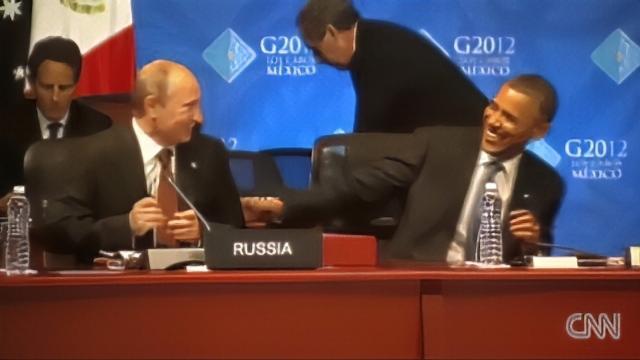
One might think the president’s puppy-dog entreaties to Putin might finally, at long last, be tempered, that Obama might remember himself and have a bit more dignity, but nooooo… Just three short weeks later, the infamous hot mic incident took place.

I’ll have more flexibility after the November election.

Just two months later, Obama invites Putin for an honored visit at the G-8 Summit at Camp David.

What’d Putin do?

Blows him off.

Aaaaand that’s when Obama lost The Washington Post, which had seen quite enough. “Obama’s Misguided Wooing of an Uninterested Putin”:

...A rude rebuff. Obama had tailored the conclave to Putin... (and had) dispatched (an administration official) to Moscow to hand Putin what a Russian official described... (a) message... ‘that Obama is ready to cooperate with Putin.’ Putin’s response was... to skip Camp David...

Four solid years of rhetoric and importantly, choices, actions, which, had Trump chosen them, any one of them, would have branded him—rightly—a puppet of Putin’s. But, because The One did them, well, his heart is pure and his intentions were good so for him, it was just diplomacy…or something.

https://www.americanthinker.com/articles/2025/03/a_putin_s_puppet_president_obama_s_truly_shocking_record.html

New report: Civilians stop more active shooters than law enforcement


The Crime Prevention Research Center brought the receipts.

According to the findings of a new study from the CPRC, armed civilians “do a better job” than law enforcement officers to stop active shooters, “with fewer mistakes” to boot. Here’s what John R. Lott, Jr., president of the the CPRC, explained of the findings:

In non-gun-free zones, where civilians are legally able to carry guns, concealed carry permit holders stopped 51.5 percent of active shootings, compared to 44.6 percent stopped by police, CPRC found in a deep dive into active shooter scenarios between 2014 and 2023.

Not only do permit holders succeed in stopping active shooters at a higher rate, but law enforcement officers face significantly greater risks when intervening. Our research found police were nearly six times more likely to be killed and 17 percent more likely to be wounded than armed civilians.

I say this in all seriousness, God bless the work of the CPRC because compiled and organized data is invaluable in the gun debate, but of course armed Americans physically present for what’s fixing to be a massacre do a better job of preserving innocent life than government hires not near the coming carnage. As the saying goes, “When seconds count, police are minutes away.”

Remember Eli Dicken in Indiana who took out a would-be mass shooter loaded with extra magazines full of rifle rounds?

What about Jack Wilson, who saved a whole church full of people when he took down the shooter with a headshot from at least 50 feet away?

The Center also revealed that of the 180 cases its researchers looked into, a bystander was hit in only one instance (.56%) of the time, interference with police happened zero times, armed civilians suffered injuries themselves 24.4% of the time, and “the shooting they prevented [was] likely to be a mass public shooting” in a whopping 32% of the case examples.

It’s not unknown why the Founders included the Second Amendment—unless you’re a leftist idiot—and it wasn’t because they just wanted to guarantee a person’s right to to don waders and go duckhunting, but once again, with the data in, the Second Amendment proves itself to be the best protection against undeserved violence. Not only the violence that the state would surely inflict upon us if we were unarmed (all states do), but against violence from those who should be our very neighbor.

In the words of George Mason: “I ask, sir, what is the militia? It is the whole people except for a few public officials.”

Hat tip: Thomas Lifson.

https://www.americanthinker.com/blog/2025/03/new_report_civilians_stop_more_active_shooters_than_law_enforcement.html

Surprise! Greenland election goes Trump's way


Greenland's residents certainly didn't do what Denmark and the rest of Europe wanted them to do at their elections Tuesday, which was to vote for euro-leftists.

Instead, they did this, as BBC reported:

Greenland's centre-right opposition has won a surprise general election victory - in a vote dominated by independence and US President Donald Trump's pledge to take over the semi-autonomous territory.

The Democratic party, which favours a gradual approach to independence from Denmark - achieved around 30% of the vote, near-complete results show.

"Greenland needs us to stand together in a time of great interest from outside," party leader Jens-Frederik Nielsen told local media. "There is a need for unity, so we will enter into negotiations with everyone."

His party will now have to negotiate with other parties in order to form a coalition.

That must have shocked Europe, which up until now has scorned President Trump's offer to buy Greenland and take it off Denmark's hands. "Greenland is not for sale," Danish officials have sniffed.

Greenlanders' election result, though, suggests a little more flexibility.

The guys who won were center-right, and usually, that's a good enough result from the U.S. point of view, particularly if it means some distancing from the EU, but get a load at who seems set to come in second, according to the BBC:

Another opposition party, Naleraq, which is looking to immediately kick off the independence process and forge closer ties with the US, is on course for second place with almost a quarter of the vote.

Support for Naleraq was boosted ahead of the vote by the decision of one of Greenland's most popular young politicians, Aki-Matilda Hoegh-Dam, to switch from one of the ruling parties. She came second only to Democrats leader Jens Frederik Nielsen in the popular vote.

The winning Democrats (no, not the donkey kind) were an upstart party themselves whose numbers grew sharply from the last election cycle, according to the BBC.

But the second-place finishers are even more upstart-ish as well as dramatic in their gains -- they're pro-independence and pro-U.S., which sounds like they could agree to join the U.S. given some time, particularly since they are led by Greenland's young people among the island's 40,000 voters.

That suggests that there's a problem out there with Denmark's intrusive rule, which has obviously had some kind of influence in overbearing fishing regulations, which is the one factor reportedly driving the vote outcome.

BBC has a good backgrounder about this, here.

When you think about it, it seems like it must be the big one.

For Greenlanders, fish is their bread and butter, to mix a metaphor, it's the way they make their living.

Why shouldn't Greenlanders be able to develop their fishing industries, instead of endure greenie overregulation which develops fisheries much less?

The whole world desperately needs more fish, particularly the obesity-plagued U.S., in order to dine in the MAHA-style for good health, and it would be great for the states if prices of fish went down as a result of Greenland's ample supply. They already ship a lot of good healthy fish here, but why not help them sell more?

Why wouldn't the U.S. offer to Greenlanders to come on over and join the states be an attractive one, just for the fish issue alone? Greenlanders could be living like Switzerlanders if they can develop their fisheries even more than they already have right now. This is where their talents and expertise lie, so why not shoot for the moon?

Sure, the minerals and the sea lines as Russia and China expand their Arctic presence are important, as President Trump has noted. But with so many of the world's fisheries devastated by illegal Chicom trawlers, and greenie regulations put out by places like Denmark likely hampering the harvest, it shouldn't surprise anyone that fisheries are really the golden goose that brings Greenland towards the U.S.

So the next time Denmark, or its EU buddies sneers at Trump for offering Greenland more as a part of the U.S., Trump can smile to himself and see how he can make his deal with them even more likely, because he's got the ball rolling. This election result sounds like they're on the road towards becoming America and if it happens, it will be a win-win-win for everyone involved.

https://www.americanthinker.com/blog/2025/03/greenland_election_goes_trump_s_way.html