Search This Blog

Tuesday, April 8, 2025

Laffer: Trump's tariffs are a 'win-win strategy' to negotiate trade deals

 Former Reagan economic advisor Art Laffer said Tuesday on "Varney & Co" that both the world and U.S. would see benefit from President Donald Trump’s tariffs and the trade negotiations that arise out of them. 

His appearance on "Varney & Co" came after he and Stephen Moore wrote an opinion piece titled "A Win-Win Exit Strategy for Trump on Tariffs" that was published Monday in the Wall Street Journal.

Art Laffer on the US economy, inflation

Former Reagan economist discusses the U.S. economy on 'Cavuto: Coast to Coast.' (Fox News)

"The win-win strategy is Trump is just phenomenal at negotiating," Laffer said Tuesday, adding that he agreed with President Donald Trump that foreign countries getting hit with the president’s latest levies "have far higher tariffs and non-tariff barriers and quotas than we do." 

"But what he’s done now is he’s gotten them in a position where they’re going to lose their access to the U.S. market if they don’t redress these types of inequities that they’ve done," the former Reagan economic advisor continued. "And Trump is a master negotiator, and I’m watching these people calling into Trump — this is exactly what he does beautifully and wonderfully — and I believe he can negotiate freer trade deals, get those tariffs way, way down, much lower than they are now, by primarily those people lowering their tariffs and us keeping ours low or even going lower, and it’ll be a win, win." 

Last week, Trump unveiled new tariffs on goods imported from foreign countries, including a baseline levy of 10% and "individualized higher tariffs" on certain countries holding large trade deficits with America.

reasury Sec. Scott Bessent told FOX Business’ Larry Kudlow on Monday that "there are 50, 60, maybe almost 70 countries now who have approached us" about negotiating trade in the wake of that. 

"The world will prosper. We’ll have a great economy, and the U.S. will be in perfect, beautiful shape for economic growth," Laffer said of negotiating new trade deals out of the tariffs. 

He said Trump "has already" threatened the tariffs to make countries willing to negotiate.

"Now the exit strategy is he doesn’t impose those tariffs. He takes those tariffs away. He even reduces our tariffs on those countries if they will eliminate their tariffs on us, and that would be the exit strategy, which would be a win, win, win, win." 

Laffer warned if the tariffs go into effect, remain in force for a long time and "we have a huge escalation of tariffs," it would be a "disastrous" for both America and the world economy. 

Trump "should be able to negotiate getting rid of tariffs for them and for us." 

"Everybody loses in trade wars, but we all don’t lose the same amount. Americans will lose a lot less than the foreigners do, so therefore, they have an incentive to come down to the table and really drop their tariffs on our products," he also said. "It will help them as well, too. Stuart, I mean, their tariffs on our products hurt their countries." 

The reciprocal import tariffs are slated to go live on Thursday. The baseline 10% levies went into force late last week.  

The White House said in an April 2 fact sheet that they will stay in place "until such a time as President Trump determines that the threat posed by the trade deficit and underlying nonreciprocal treatment is satisfied, resolved, or mitigated." 

Israel, Japan, Vietnam, Argentina and Indonesia are among some of the countries that are pursuing negotiations with the Trump administration.

https://www.foxbusiness.com/economy/economist-says-trumps-tariffs-win-win-strategy-negotiate-trade-deals

Nonprofit Got $22 Million in Government Grants to Teach Kids About Sex Toys

 For nearly a decade, the federal government has funded a nonprofit group that works to educate minors about sex toys, while discouraging them from telling their parents about it. The Center for Innovative Public Health Research has received more than $22 million in federal money since 2016. According to its website, the group creates “health education programs” that “promote positive human development.” But the content of those programs—and the comments of the organization’s CEO, Michele Ybarra—suggest that CIPHR’s “human development” goals are anything but positive.

Take Girl2Girl. Launched in 2017 and run by CIPHR, it’s a federally funded “sex ed program just for teen girls who are into girls.” Its website allows users—mostly between ages 14 and 16, according to one study—to sign up for “daily text messages . . . about things like sex with girls and boys.”

The content of those messages raises serious concerns. According to the program’s website, Girl2Girl texts minors about “lube and sex toys,” “the different types of sex and ways to increase pleasure,” and “what it’s like growing up as [a] teen girl who is into girls.” The site also encourages participants to make their “own decision[s] about whether to take part in the research”—and explicitly advises them not to tell their parents if they’d prefer not to.

In 2023, CIPHR launched Transcendent Health, a sex-education program for minors who identify as transgender. The initiative, which received a $1.3 million federal grant that expired last month, conducted “focus group discussions with gender minority teens across the country.” To participate in the focus group, teens had to fill out a form asking whether they had had sex “with a transgender guy” or “with a non-binary person.”

Spearheading these projects is CIPHR’s CEO, Ybarra, who has shown little respect for parental rights. In a 2022 Brown University webinar, for example, Ybarra noted how her researchers prepare “young person[s]” for her focus groups. “If we’re doing focus groups,” she said, “we will ask, ‘Okay, so what happens if somebody comes into the room and sees words like penis and sex toys on your screen—on your computer screen or on your phone? What if it’s your mom?’”

Ybarra has a long history of such disturbing work. In 2017, she presented the results of a survey that CIPHR administered, which asked kids aged 14 to 16 whether they had had “receptive anal sex” or “insertive anal sex.” In the 2022 webinar, she added that she and her research team “wanted to know a bit more about when and why and where trans kids are choosing to have sex.”

The federal government should not fund programs that send sexually explicit messages to minors and encourage them to conceal these communications from parents. To protect children and prevent further harm, the Department of Health and Human Services should immediately cancel CIPHR’s active contract and deny its future grant applications. By doing so, the Trump administration can send a clear message: taxpayers will no longer foot the bill for perverted “research” projects.

Keep CCP Spyware Out of U.S. Healthcare

 Federal agencies are sounding the alarm about Chinese spyware in U.S. healthcare. From patient monitors to internet-connected cameras, to DNA sequencers and WiFi routers, a range of Chinese products have come under scrutiny for potentially providing Beijing with backdoor access to sensitive American healthcare data.

Here’s the problem: Chinese companies in America are beholden to two contradictory sets of laws – American laws that require data privacy and Chinese laws that require intelligence work. China’s Communist Party has effectively obliterated the distinction between “private sector” Chinese companies and the surveillance state they all must serve. The solution requires a concerted effort by U.S. policymakers, state and federal law enforcement, and American corporations to keep CCP spyware out of U.S. healthcare.
Patient healthcare monitors provide attending physicians with a live feed of a patient’s vital signs. Disturbingly, Chinese monitors that are sold throughout the U.S. come with suspicious additional features. “Contec CMS8000 Contains a Backdoor,” reads a February fact sheet from the Cybersecurity and Infrastructure Security Agency (CISA).  The Food and Drug Administration (FDA) matched CISA’s warning with a safety communication titled “Cybersecurity Vulnerabilities with Certain Patient Monitors from Contec and Epsimed.” CISA analysts discovered one functionality that “enables patient data spillage,” and another “which may allow remote code execution and device modification.” In other words, hackers can potentially steal patient data and alter the device’s readings.
The problems don’t stop there. A February bulletin from the Department of Homeland Security (DHS) warns that internet-connected Chinese cameras give the Chinese government the ability to “conduct espionage or disrupt U.S. critical infrastructure,” which includes healthcare and the public health sector.
Perhaps the most pernicious threat comes from Beijing’s plan to dominate in genetic sequencing technologies in order to achieve broader biotechnology dominance. Beijing Genomics Institute (BGI), a Chinese genetic sequencing national champion, has been blacklisted by the Department of Defense as a Chinese Military Company operating in the U.S. and sanctioned by the Department of Commerce because their “collection and analysis of genetic data present a significant risk of diversion to China's military programs.”
Congressmen John Moolenaar and Raja Krishnamoorthi, leaders of the House Select Committee on the Chinese Communist Party, warn of Chinese military plans to leverage genetic data to create diseases that are “more toxic, more contagious, and more resistant.” What are the key inputs for China’s military medical infrastructure? U.S. IP and medical data, like that collected by BGI.
The Select Committee also recently argued for the removal of Chinese TP-Link wireless routers in March hearings. Rob Joyce, the former director of cybersecurity at the National Security Agency, claimed that TP-Link “appears to be selling at price points below profitability to drive out Western competition,” allowing TP-Link to rapidly seize market share. Joyce also testified that the routers expose individuals and businesses to cyber-intrusion that could be used to launch attacks on critical infrastructure, such as the public health sector.
China’s 2017 National Intelligence Law and a range of other party-state security measures require Chinese companies to serve the Communist Party surveillance state. Former National Security Advisor Robert C. O’Brien wrote that the Intelligence Law “obligates individuals, organizations, and institutions to assist the PRC security and intelligence services in carrying out a wide variety of intelligence work.”
These contradictions must be exposed and worked through by President Trump, Congress, statehouses leaders, and the courts. President Trump and Congress must rapidly assess American healthcare exposure to insecure CCP technologies, and ban technologies that present data risks. States are leveraging their regulatory powers to block Chinese genomic technologies within their borders, with Idaho and Tennessee banning Chinese genetic sequencers and a dozen more states considering similar measures. Insecure technologies need to be removed from hospitals and healthcare more broadly.
Finally, state Attorneys General should take aim at Chinese products that make false claims about security and data privacy, and examine these discrepancies against state consumer fraud, data privacy, and product liability laws. American companies that resell flawed Chinese products under an American brand, a practice known as “white-labelling,” deserve even greater scrutiny. AGs must protect American consumers and patients.
China’s Communist Party has executed the state-sponsored theft of trillions in intellectual property and more personal data than all other countries put together. Chinese healthcare products are subject to party control, which presents unacceptable data and security risks in America’s healthcare sector. 
Michael Lucci is the Founder and CEO of State Armor 

What RFK Jr. Gets Wrong About Chronic Disease

 In his confirmation hearing as Secretary of Health and Human Services, Robert F. Kennedy Jr. argued that U.S. health-care spending represents a “20 percent tax on the entire economy.” Rather than engage in a “divisive debate about who pays,” he suggested the nation ask, “Why are health-care costs so high in the first place?”

Kennedy offered his own answer: “chronic disease,” to which “90 percent of health-care spending” is devoted. He specifically pointed to rising rates of obesity, diabetes, and cancer, as well as “autoimmune diseases, neurodevelopmental disorders, Alzheimer’s, asthma, addiction,” and more besides. He blames poor diets and environmental toxins for the rise in chronic disease rates.

In truth, the growing burden of chronic disease owes mostly to increased affliction by the diseases of old age. In 2019, the year before Covid hit, U.S. life expectancy was 78.8—a hair’s breadth below 2014’s all-time high of 78.9, and well up from 47.3 in 1900. This owes much to progress in medical science and increased spending on health care; but it also reflects improvements in urban sanitation, widespread vaccination, and reduced consumption of alcohol and tobacco.

Obesity remains a problem. The U.S. obesity rate is twice the average for developed countries, which accounts for America’s higher rates of heart disease, diabetes, cancer, and stroke. It also explains America’s higher death rate from Covid-19.

Though Americans’ diets are more varied and fresh than a half-century ago, they also consume more sugars, soda, and processed foods. Kennedy blames these, along with additives and dyes, for much of the nation’s ill health, telling Congress that “we shouldn’t be giving 60% of the kids in school processed food that is making them sick.”

Americans have always eaten a lot. Nineteenth-century Americans consumed over 1,000 calories more per day than the English and French. But it’s hard to force Americans to change their diets, as New York mayor Michael Bloomberg discovered when he attempted to ban the sale of supersized sodas. “I don’t want to take food away from anybody,” Kennedy assured Congress. “If you like a McDonald’s cheeseburger or a Diet Coke, which my boss loves, you should be able to get them.”

As Secretary of Health and Human Services, Kennedy will lack the power to alter meaningfully Americans’ diets. Congressional agriculture committees view farm subsidies, like those supporting high-fructose corn syrup, as their prized possessions. They also control the food stamp and school breakfast programs, the latter of which has been shown to increase obesity. When Congress has delegated authority over dietary guidelines to the executive branch, it has entrusted them to the Secretary of Agriculture. In President Trump’s first term, that led to an effort to alter food stamp program nutrition requirements so that they could be satisfied by canned spray cheese and beef jerky.

For the bulk of his career, RFK was an environmental activist committed to clearing rivers of chemical pollutants. In his confirmation hearing, he argued that “human health and environmental injuries are intertwined,” noting that the “same chemicals that kill fish make people sick also.” He can do little about this at HHS, as the regulation of pesticides is entrusted to the Environmental Protection Agency.

Kennedy’s environmentalism seems to have left him with a prejudice that nature inherently means humans well, and that unexplained disease is likely the product of artificial toxins. He has speculated that Wi-Fi causes cancer, that school shootings are caused by antidepressants, that chemicals in the water are responsible for gender identity disorders, and that vaccines cause autism.

To be sure, overmedication is a real problem. America has seen a proliferation of costly drugs with only slight therapeutic benefits, which may unleash a prescription cascade to deal with side effects. RFK Jr.’s skepticism of “unnatural” pharma may therefore be helpful if it leads him to resist attempts to weaken prior-authorization oversight on utilization.

Elsewhere, though, his instincts lead him astray. Kennedy told Congress, “I was raised in a time when we did not have a chronic disease epidemic,” and suggested that, since his uncle’s presidency, the proportion of children with chronic illnesses had surged from 2 percent to 66 percent.

These seemingly alarming statistics owe much to greatly broadened definitions and increases in the diagnosis of food allergies and behavioral health conditions that no one was tracking when JFK was in the White House. In reality, child health has improved dramatically, and the rate of mortality per 100,000 children has declined from 68.6 in 1962 to 24.9 in 2018.

RFK also claimed, “We spent zero on chronic disease during the Kennedy administration. Today we spend $4.3 trillion a year.” The first statistic is clearly false (cancer and heart disease existed in the early 1960s); and much of the second can be explained by increased longevity.

Chronic disease is often a price of medical success and of aging. Improved treatment has turned the most serious medical conditions, such as heart disease, into things that people live with for years instead of dying quickly—and cheaply. Consider: age-adjusted deaths from heart disease fell by 67 percent from 1970 to 2018, while those from strokes declined by 75 percent. Deaths from prostate, colorectal, lung, and stomach cancers have all been halved since 1990.

The more medicine advances, the more work it has to do. Tissues, glands, and bones degener

ate over time, and the effectiveness of medical care diminishes with age.  The longer medical progress helps people live into old age, the more drawn out the period of bodily decline will be, with intractable and hard-to-cure conditions figuring more prominently.

This burden of chronic disease falls largely on the elderly. Relative to adults aged 35 to 50, those over 80 are nine times more likely to have cancer, ten times more likely to have diabetes, 18 times more likely to have COPD, and 47 times more likely to have a stroke. Whereas Alzheimer’s disease afflicts only 2 percent of those aged 65 to 74, it touches 43 percent of those 85 and older.

Environmental toxins and unhealthy lifestyles can certainly precipitate bodily decay, but they are not the main reason for the rising cost of chronic illness. Increased spending on the treatment of chronic medical conditions is the product of a wealthier society with greater longevity. It’s an unpleasant problem, but it beats the alternative.

Vaccination Rates Plummeted Due to Pandemic Lockdowns


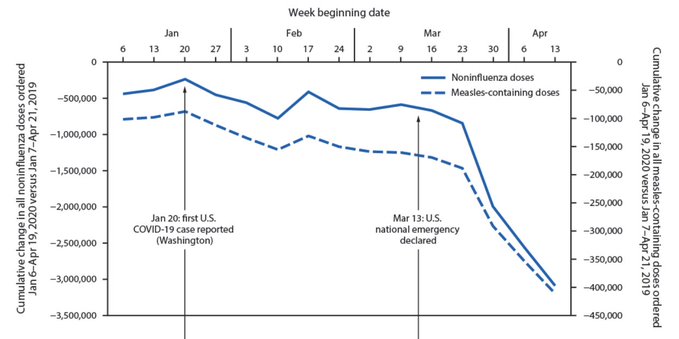
 Vaccination rates plummeted due to pandemic lockdowns. Please blame lockdown advocates for subsequent measles outbreaks.

Santoli et al., Effects of the COVID-19 Pandemic on Routine Pediatric Vaccine Ordering and Administration — United States, 2020. MMWR, 69:591–593, 2020.

Trump says US taking in $2 billion a day from tariffs

 U.S. President Donald Trump said on Tuesday the United States is taking in $2 billion per day from tariffs.

He made the comment without providing details during an event at the White House.

Trump has imposed an array of tariffs on other countries since taking office in January.

The Treasury Department’s daily statement of deposits into and withdrawals from the its general account, the federal government’s main operating account, shows "Customs and Certain Excise Taxes" deposits have on average totaled around $200 million a day so far this month.

For the entire month of February, the latest full month available, the Treasury netted about $7.25 billion in customs duties. The monthly budget statement for March will be released on Thursday, which will show the latest monthly figures.

https://www.investing.com/news/economic-indicators/trump-says-us-taking-in-2-billion-a-day-from-tariffs-3975171