Search This Blog

Wednesday, April 9, 2025

U.S. States With The Most Criminals Still At Large

 A study by Spartacus Law Firm ranked U.S. states by the number of criminals still at large, factoring in violent crime rates, solve rates, population, and land area. The final metric—criminals at large per square mile adjusted for population—put California at the top due to its high rate of unsolved violent crimes.

California leads U.S. states in criminals still at large, with 303 per square mile when adjusted for population. The state reported 198,000 violent incidents—60% unsolved—leaving nearly 119,000 offenders unaccounted for.

Tennessee ranks second with 211 per square mile, driven by the highest violent crime rate nationally (628 per 100K people) and a low 39% solve rate, according to Spartacus Law Firm.

Massachusetts takes third at 144 per square mile. Despite a 50% clearance rate and fewer incidents, its small size boosts offender density.

Maryland places fourth with 119, mirroring Tennessee’s 39% solve rate but with fewer incidents and a higher population density.

Florida is fifth at 97 per square mile, hampered by the lowest clearance rate (30%) among the top ten, resulting in nearly 46,000 unsolved cases.

New York comes sixth with 76. Though it boasts the highest solve rate (58%) of the group, its large population drives high total incidents.

The report says that Rhode Island is seventh at 53, with the lowest crime rate and total incidents, but a modest solve rate of 47%.

New Jersey ranks eighth with 31, a slightly better solve rate than Rhode Island’s, but a much higher volume of unsolved crimes.

Michigan places ninth at 26, with a high crime rate and low solve rate, totaling over 25,000 unsolved cases.

Illinois rounds out the list at tenth with 24 per square mile, similar to Michigan in solve rate and crime volume, with around 19,500 cases unresolved.

"The concentration of violent criminals at large in urban centers reveals a complex interplay between criminal justice resources, population density, and geographic constraints. This geographic lens shifts the conversation from comparing solve rates to considering how unresolved crimes create "hot zones" of impunity," Chandon Alexander, CEO of Spartacus Law Firm, commented on the study.

He continued: "Law enforcement agencies might benefit from targeted resource allocation based on these density metrics rather than raw crime statistics. The stark differences between states with similar solve rates but vastly different criminal concentrations suggests that traditional policing approaches may need regional customization, particularly in states where criminals benefit from proximity to jurisdictional boundaries or transportation networks that facilitate mobility after committing violent acts.”

The full study data can be found here

https://www.zerohedge.com/markets/these-are-us-states-most-criminals-still-large

China Strikes Back: Hikes Tariffs On US Goods To 84%

 Update: 

After Beijing’s overnight inaction in response to President Trump’s new 104% effective-rate tariff on Chinese goods—and the release of a white paper on trade between the two superpowers—there now appears to be a response from the Chinese side.

Bloomberg reports that China plans to counter Trump's tariffs with an effective tariff rate of around 84%, escalating the trade war. These countermeasures go into effect on Thursday. 

More from Bloomberg:

A day earlier, China vowed to "fight to the end" if the US insists on new tariffs. Chinese exports were already facing blanket levies imposed this year and punitive taxes from Trump's first term and the following Biden administration. China also added six firms to its unreliable entity list, and 12 US entities to its export control list. Initially, Trump justified the 34% tariff hike on China as a fair way to match the barriers that Beijing has in place against US firms and goods, and then added to them after Beijing retaliated with its own levies.

In markets, European equity futures are down more than 3%. Equity futures in the US are down over 1% for the S&P500 and Nasdaq.
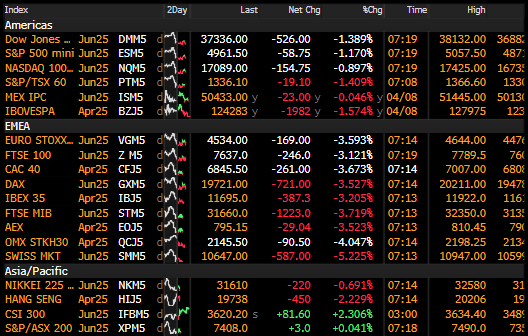
Rollercoaster of headlines for S&P500 futs... 
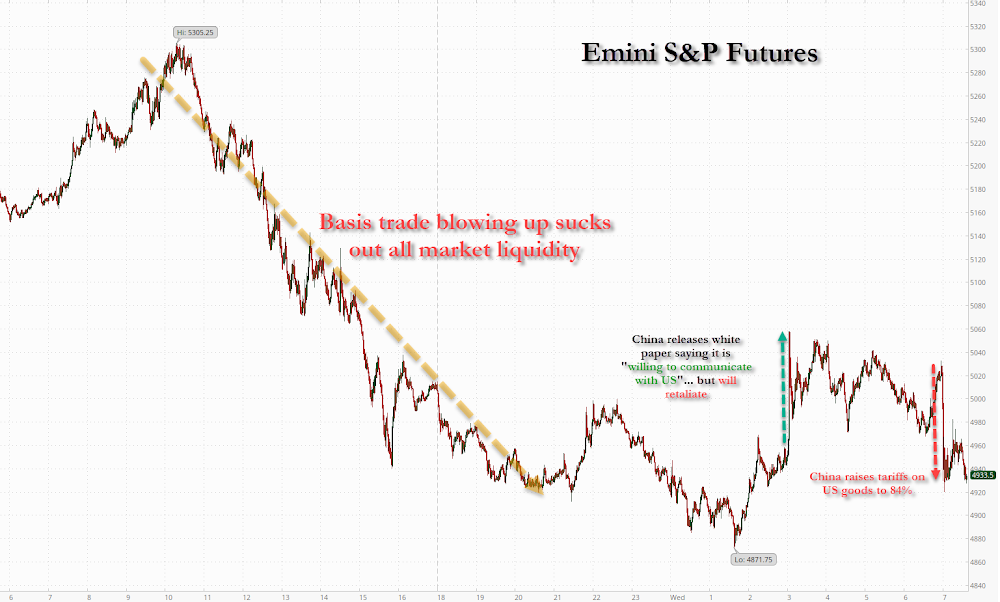
And what a mess. The PboC has been propping up Chinese markets, while the Federal Reserve has been stuck in wait-and-see mode as the basis trade unravels (readhere). 

*   *   *

President Donald Trump's reciprocal tariffs took effect at 12:01 a.m. Wednesday in Washington, sending shockwaves through global markets as he advances the 'America First' agenda to reshape the international economic order. In a notable shift from the previous tariff rounds, Beijing refrained from immediately firing back with countermeasures to the new 104% effective-rate tariffs. Instead, Beijing released a 28,000-character white paper detailing its economic relationship with the US as foundational to global stability.

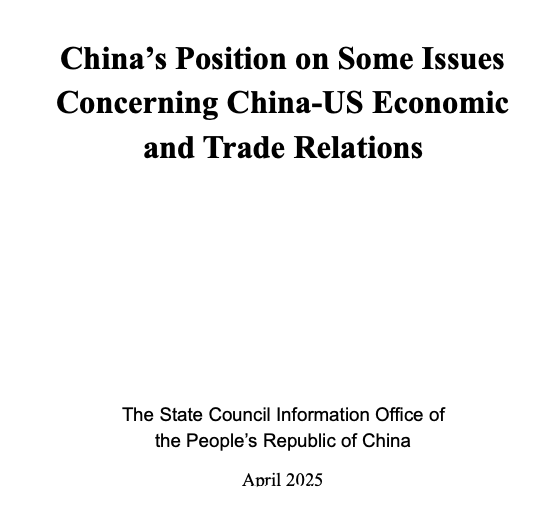
China's State Council Information Office released the white paper on Wednesday titled "China's Position on Some Issues Concerning China-U.S. Economic and Trade Relations." The paper provides statistics about China-U.S. economic and trade relations.
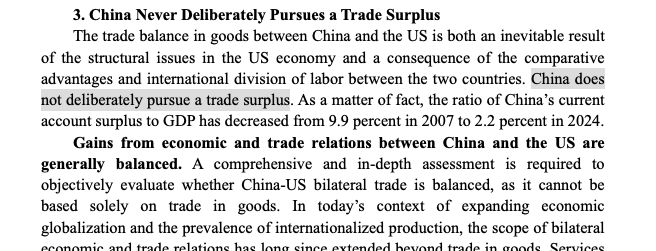
"China does not deliberately pursue a trade surplus," the white paper said, adding, "The trade imbalance in goods between China and the U.S. is both an inevitable result of structural issues in the U.S. economy and a consequence of the comparative advantages and international division of labour between the two countries."
Chinese state media Xinhua News Agency provided more details about the white paper:

The white paper came as rising unilateralism and protectionism in the United States have significantly impeded normal economic and trade cooperation between the two countries.

. . .

These measures -- revealing the isolationist and coercive nature of US conduct -- run counter to the principles of the market economy and multilateralism, and will have serious repercussions for China-U.S. economic and trade relations, the white paper said.

In response to the US moves, China has taken forceful countermeasures to defend its national interests, and has remained committed to resolving disputes through dialogue and consultation, with multiple rounds of consultations with the US side to stabilize bilateral economic and trade relations, according to the document.

The Chinese side has always maintained that China-U.S. economic and trade relations are mutually beneficial and win-win in nature, the white paper said.

The White Paper concluded that cooperation—not confrontation—between both sides is essential for global economic growth, technological governance, and security, urging the US for a winnable solution through dialogue:

Trade wars produce no winners, and protectionism leads up a blind alley. The economic success of both China and the US presents shared opportunities rather than mutual threats

The reason for the Chinese restraint remains unclear, though Bloomberg noted that President Xi Jinping "could still hit back later today as U.S. markets open, or in the coming week."

On Tuesday, two Chinese bloggers leaked potential countermeasures Beijing could unleash on the US, such as banning imports of US poultry and Hollywood films. 

Commenting on markets, Goldman analysts told clients:

Surprise move from HK/China markets where we saw incremental recovery, in a tape where trade war headlines had turned worse. Beijing's lack of an immediate response to new incremental US tariffs (104%), was a departure from last two episodes of President Trump hiking duties (Last two instances, Beijing hit back within minutes).

Around 3 p.m. local time, Beijing released a 28,000-character white paper on trade with the US Accompanying it was a question-and-answer document in which the Ministry of Commerce reiterated China is willing to talk with the US

HSI saw a reversal of ~4% over the day, from being more than 3% weaker at the open to ending 70bps above water. Southbound net buying a record $4.6Bn was the most notable metric for the day, as support from retail and foreign investors accelerated. Turnover remained upbeat and above the HK$400Bn mark.

Earlier, Xinhua reported that Beijing would fight until the end if the US deepens the trade war. The Ministry of Commerce said it has "abundant means" to take countermeasures. It noted that Beijing and Washington could resolve trade differences through dialogue. 

In a separate report, Reuters said top officials in Beijing plan to meet and discuss measures to boost the economy and stabilize capital markets amid the tariff turmoil with the US.

Both sides—Beijing and the US—will likely need stabilizing policies for markets and the economy to fight the trade war.

As we noted on Tuesday, a basis trade blow-up might force the Federal Reserve into emergency QE. Deutsche Bank followed our lead on Wednesday.

https://www.zerohedge.com/markets/china-holds-back-retaliation-opts-strategic-messaging-through-white-paper-trade

UK Columnist Suggests Big Business Could 'Put A Hit Out On Trump'

 by Paul Joseph Watson via Modernity.news,

A prominent British newspaper columnist suggested that big business could ‘put a hit out on Trump’ in response to his tariffs.

Writing for the Telegraph, Tim Stanley made clear that he supported Trump’s tariff regime, asserting that the U.S. president is “trying to change history, rather than just caretake it.”

“In fact, Trump is correcting a 50-year misdirection in US life, and one that the hero of many Trumpers, Richard Nixon, also attempted to fix,” he wrote.

However, Stanley made clear that the backlash to Trump’s efforts to upturn the global order could be brutal.

“Were I a foreign manufacturer, I’d wager this policy will be reversed at least by 2028 when a new president is elected – or big business puts out a hit on Trump, because they’ll tolerate anything but the devaluing of their stock price. The next gun that fires at the president will probably be made in America,” he wrote.

It’s not clear whether the columnist was actually saying Trump could be physically taken out by monied interests, although his choice of words certainly seems to suggest this is the case.

As we reported yesterday, despite Trump surviving two assassination plots last year, vile leftists would be happy to see him killed.

A poll conducted by the Network Contagion Research Institute found that over 55 per cent of respondents said it would be “justified” to murder President Trump, with just under 50 per cent believing the same about Elon Musk.

As we highlight in the video below, Stephen Colbert also ‘joked’ that if the deep state existed, it should step in to do something about Trump’s tariffs, referencing the word “Fidelio” from the movie Eyes Wide Shut, which is about a secret society that kills people who expose it.https://www.zerohedge.com/political/columnist-suggests-big-business-could-put-hit-out-trump

Neogen (NASDAQ:NEOG) Misses Q1 Views

 Life sciences company Neogen (NASDAQ:NEOG) missed Wall Street’s revenue expectations in Q1 CY2025, with sales falling 3.4% year on year to $221 million. The company’s full-year revenue guidance of $895 million at the midpoint came in 1.7% below analysts’ estimates. Its non-GAAP profit of $0.10 per share was 13% below analysts’ consensus estimates.

Neogen (NEOG) Q1 CY2025 Highlights:

  • Revenue: $221 million vs analyst estimates of $224.2 million (3.4% year-on-year decline, 1.5% miss)

  • Adjusted EPS: $0.10 vs analyst expectations of $0.12 (13% miss)

  • Adjusted EBITDA: $48.51 million vs analyst estimates of $52.73 million (22% margin, 8% miss)

  • EBITDA guidance for the full year is $195 million at the midpoint, below analyst estimates of $207.8 million

  • Operating Margin: 2.5%, down from 5.3% in the same quarter last year

  • Market Capitalization: $1.53 billion

Tuesday, April 8, 2025

US Space Chief Warns Congress Of China's Space Capabilities In Potential Indo–Pacific War

 by Frank Fang via The Epoch Times,

China’s ambitions in space pose a “powerful destabilizing force” to the U.S. economy and national security, according to Gen. Chance Saltzman, chief of space operations for the U.S. Space Force.

“Space has become a warfighting domain,” Saltzman told the U.S.-China Economic and Security Review Commission, a bipartisan congressional panel, in a hearing on April 3.

“Over the last two decades, our competitors, China in particular, have invested heavily in counter space threats, kinetic and non-kinetic weapons that can deny, degrade, or destroy our satellites,” Saltzman warned.

The hearing took place as tensions have mounted between China and the United States regarding trade policies and tariffs. Saltzman’s testimony sheds light on the challenges that the U.S. military could face over a potential conflict in the western Pacific, including Taiwan.

Saltzman explained that China has been able to advance its space capabilities quickly because it has a “Western Pacific mindset,” pooling all its resources and advancing all capabilities in that region. In contrast, the United States has more global concerns, according to the Space Force commander.

“The modern battlefield has to account for the space domain,“ he said. 

”If we can’t continue to protect our use of the domain and we can’t deny an adversary, it’s going to be tough to meet military objectives in any of the other domains.”

In his written testimony, Saltzman explained that the Chinese regime’s military, the People’s Liberation Army (PLA), has set out military objectives for the space domain.

“Intelligence suggests the PLA likely sees counterspace operations as a means to deter and counter U.S. military intervention in a regional conflict,” Saltzman wrote.

The general said China’s space weapons include ground-to-space missiles and ground-based lasers, the latter of which can “disrupt, degrade, or damage satellite sensors.”

“By the mid-to-late 2020s, we expect them to deploy systems high enough in power that they can physically damage satellite structures,” his testimony reads.

Currently, China’s military exercises “regularly incorporate radio frequency jammers” against space-based communications, radars, and navigation systems, according to Saltzman.

“Intelligence suggests the PLA may be developing jammers to target a greater range of frequencies, including U.S. military protected extremely-high-frequency (EHF) systems,” he said.

In 2022, China used a satellite equipped with a robotic arm to tow a defunct Chinese navigation satellite to a graveyard orbit. Saltzman said such a robot-armed satellite was an example of how satellites can have both civilian and military applications and that it is “not a science fiction” that China can use such technology to “capture enemy satellites.”

China is also practicing “dogfighting in space,” Saltzman said, saying his service has seen Chinese experimental satellites conducting “unusual, large, and rapid maneuvers” in geostationary orbit in recent years. Based on the observation, Saltzman said Beijing “is resolved to contest [U.S.] spacepower through combat operations.”

“China’s advancement in space technology, their stated desire to dominate, and Beijing’s disregard for international norms for the responsible use of space make them an incredible danger to U.S. prosperity and security,” he said.

“China’s determination to deny U.S. spacepower in the Indo–Pacific could not only degrade of [sic] our military space-based capability, but it would threaten the satellites of our allies and commercial partners as well.”

https://www.zerohedge.com/military/us-space-chief-warns-congress-chinas-space-capabilities-potential-indo-pacific-war

Trump says he told TSMC it would pay 100% tax if it doesn't build in US

 President Donald Trump on Tuesday said he told the Taiwan Semiconductor Manufacturing Company, which has pledged to build new factories in the United States, it would pay a tax of up to 100% if it didn't build its plants in the country.

Speaking at a Republican National Congressional Committee event, Trump criticized former president Joe Biden's administration for providing a $6.6 billion grant to TSMC's U.S. unit for semiconductor production in Phoenix, Arizona, saying semiconductor companies don't need the money.

"TSMC, I gave them no money ... all I did was say, if you don't build your plant here, you're going to pay a big tax," Trump said.

In March, TSMC, the world's biggest contract chipmaker, said at the White House that it plans to make a fresh $100 billion investment in the U.S. that includes building five additional chip facilities in coming years.

Earlier on Tuesday, Reuters reported the chipmaker could face a penalty of $1 billion or more to settle a U.S. export control investigation over a chip it made that ended up inside a Huawei AI processor.

https://www.aol.com/news/trump-says-told-tsmc-pay-005809472.html

US to 'take back' Panama Canal from Chinese influence, visiting Pentagon chief says

 The United States and Panama will work together to take back the Panama Canal from “China’s influence,” Defense Secretary Pete Hegseth said Tuesday while standing in front of the vital shipping lane.

Hegseth, who was in Panama to meet with its government officials, spoke from a new U.S.-financed pier at the Vasco Nuñez de Balboa Naval Base, where he said Beijing would not be allowed to “weaponize” the canal via a commercial presence.

“The United States of America will not allow communist China or any other country to threaten the canal’s operation or integrity,” he said. 

He noted that the U.S. and Panama strengthened their defense and security cooperation in recent weeks and together “will take back the Panama Canal from China’s influence.”

“China did not build this canal. China does not operate this canal and China will not weaponize this canal,” Hegseth said from the pier. “Together with Panama in the lead, we will keep the canal secure and available for all nations.”

The message had a conciliatory tone compared with that of his boss, President Trump, who has vowed to take back the Panama Canal from Panama. Trump has claimed that China effectively controls the trade route via two major ports on either end of the shipping lane. 

Panama has rejected these assertions, pointing to its withdrawal earlier this year of its Belt and Road Initiative agreements with Beijing, made in 2017.

Trump has not ruled out the use of military force in taking over the canal, and NBC News last month reported that the White House had directed the Pentagon “to draw up options to increase the American troop presence in Panama.”

Trump in his March 5 congressional address also claimed that “to further enhance our national security, my administration will be reclaiming the Panama Canal, and we’ve already started doing it.” 

But Panama’s President José Raúl Mulino asserted the canal “is, and will continue to be, Panamanian,” as it has been since 1999.

Hegseth’s visit to the country included a meeting with Mulino as well as Panama Public Security Minister Frank Abrego and other officials.

The Pentagon chief notably did not assert that China controls the canal or that the U.S. should reclaim it, instead lauding a growing security relationship between the two countries “in part to meet communist China’s rising challenges.”

He also warned that Chinese companies continue to install “critical infrastructure” in the canal, giving Beijing the “potential” ability to “conduct surveillance.”

The Panama Canal is the world’s second-busiest interoceanic shipping lane and is vital to U.S. container traffic, with roughly $270 billion worth of goods passing through the waterway annually.

https://thehill.com/policy/defense/5238988-us-panama-cooperation/