Search This Blog

Thursday, May 8, 2025

FBI Probes Alarming Incidents Amid “Poor Culture of Safety” at NIH’s High Security Pathogen Lab

 by Paul Thacker

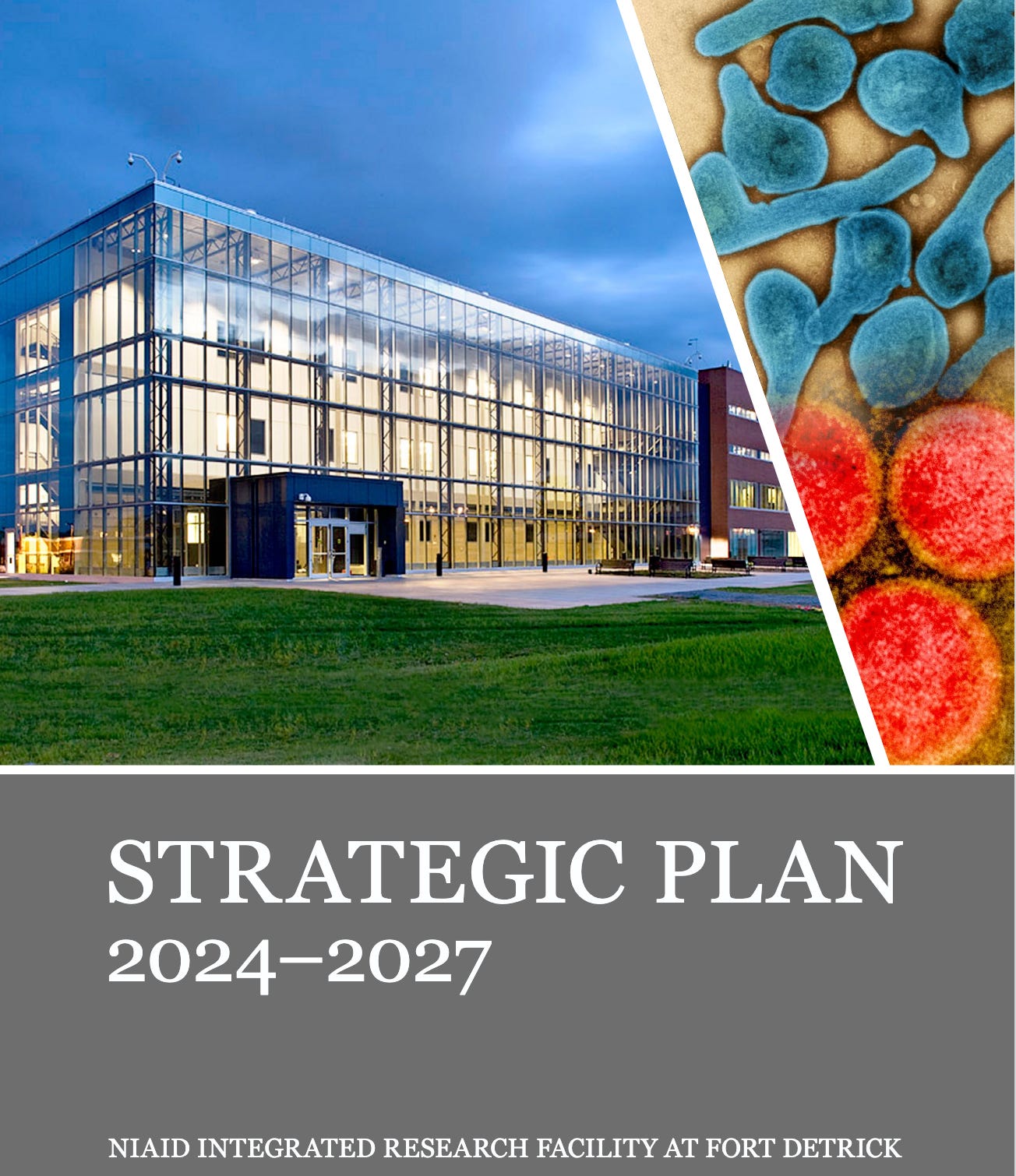
The FBI launched an investigation last week into security violations at the NIH’s Integrated Research Facility at Fort Detrick following several dangerous incidents in which a contractor cut holes in an employee’s biocontainment suit designed to protect against infection from pathogens such as Ebola, according to interviews and documents viewed by The DisInformation Chronicle.

Violations of safety protocol at the research facility were uncovered by Jeffrey Taubenberger on his first day as Acting Director of the NIAID, the NIH Institute formerly run by Anthony Fauci. Fort Detrick houses multiple government germ labs, including the United States Army Medical Research Institute of Infectious Diseases. The Army’s lab was shut down in 2009 and again in 2019, both times due to safety concerns.

“Many issues have been known for months if not years and previous NIAID leadership did nothing about it,” explained an NIH official, detailing problems at the facility which was described as having a “poor culture of safety.”
Incidents in November and March occurred under the watch of NIAID Director Jeanne Marrazzo, who was let go last month during a round of federal cuts. The NIH also uncovered poor documentation of select agents, with logs not matching inventory, although all missing vials have apparently been accounted for.

An NIH employee leaked an incomplete email to Wired Magazine last week which ran a story that downplayed safety breaches and accused Secretary Robert F. Kennedy of shutting the lab down as part of “the latest disruption to federal science agencies.” The article quoted Johns Hopkins researcher Gigi Gronvall complaining that the lab shut down would harm research and cost taxpayer money.

“The sacrifice to research is immense,” Gigi Gronvall told Wired. “If things are unused for a period of time, it will cost more money to get them ready to be used again.”
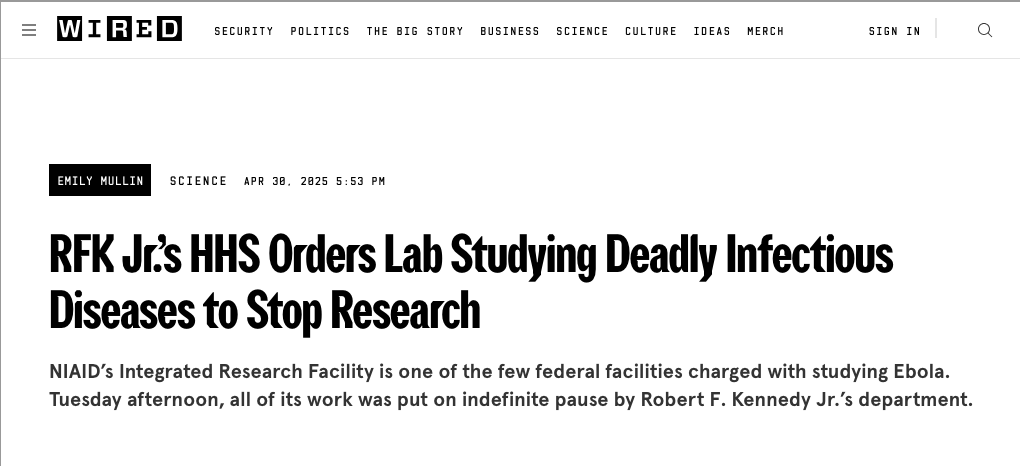
Wired’s science editor, Tim Marchman, did not respond to questions asking why Wired’s story downplayed security violations and culture of poor safety, nor did he explain whether the magazine plans to correct or update their reporting. Gronvall has been an ardent supporter of dangerous gain-of-function virus research, much of which was ended yesterday with an executive order signed by President Trump.

Gronvall did not respond to questions asking if she felt a lab that studies deadly infectious diseases such as SARS-COV-2, the Ebola virus, Lassa Fever and Eastern equine encephalitis should be shut down following dangerous safety breaches.

Over the weekend, Fox News reported that the lab shut down stemmed from a lover's spat between researchers in March. One of the individuals retaliated by poking holes in the other person’s personal protective equipment (PPE), and was then fired. Leadership at the facility have been put on leave and the NIH expects the FBI to brief officials after finishing their investigation.

Animals present in the NIH facility are said to be uninfected and under veterinary care. An NIH official stated that no research with pathogens will move forward until a full evaluation and restructuring of the program is completed.

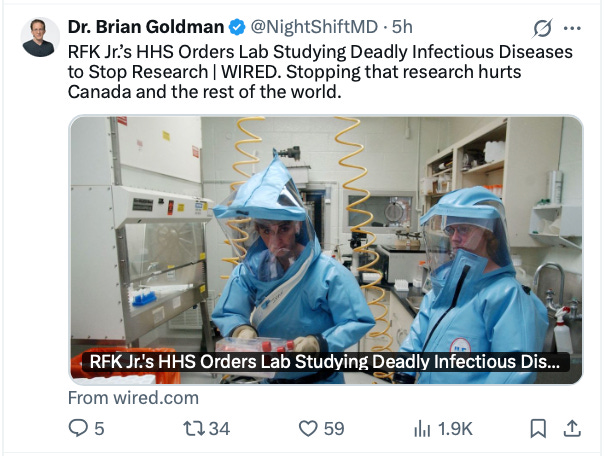
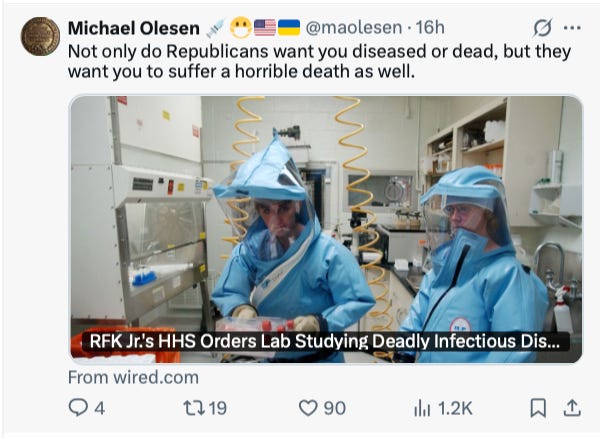
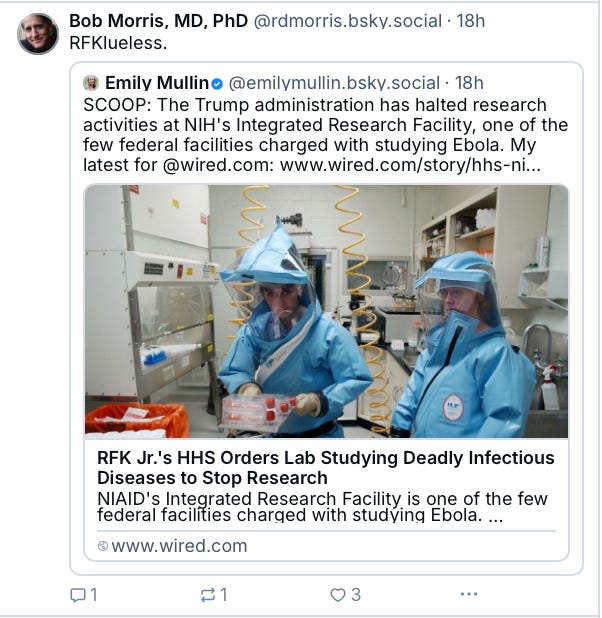
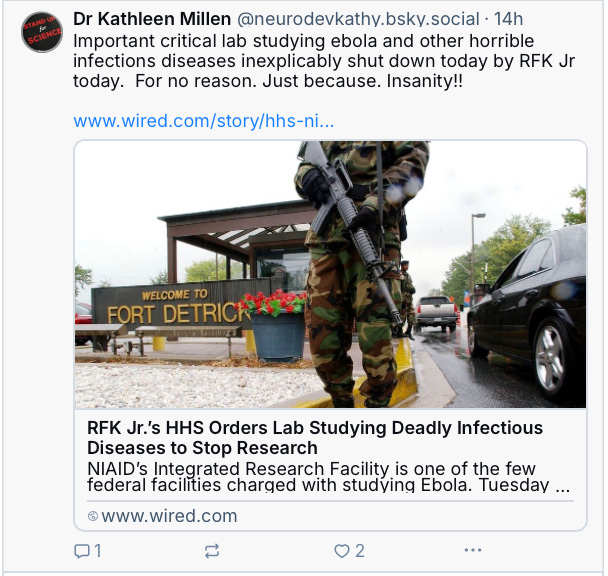
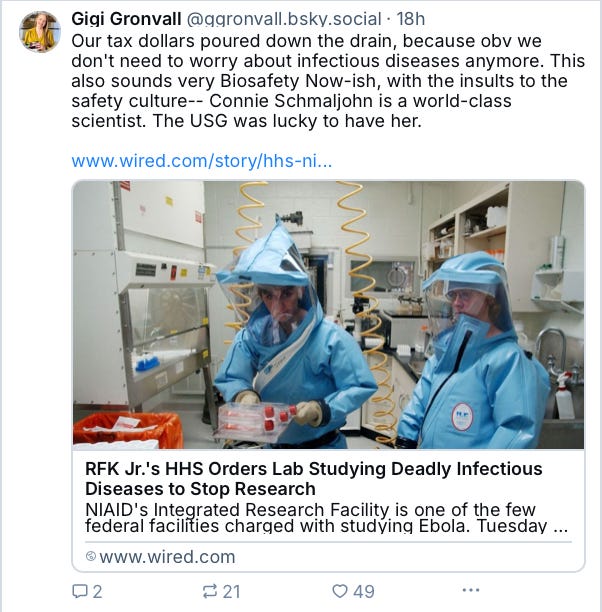
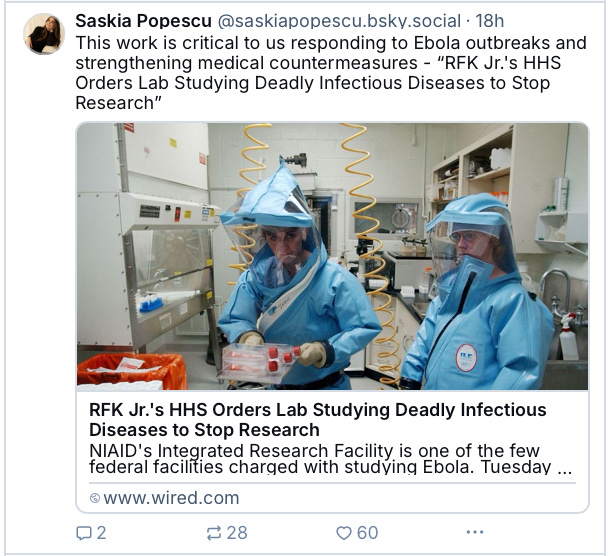
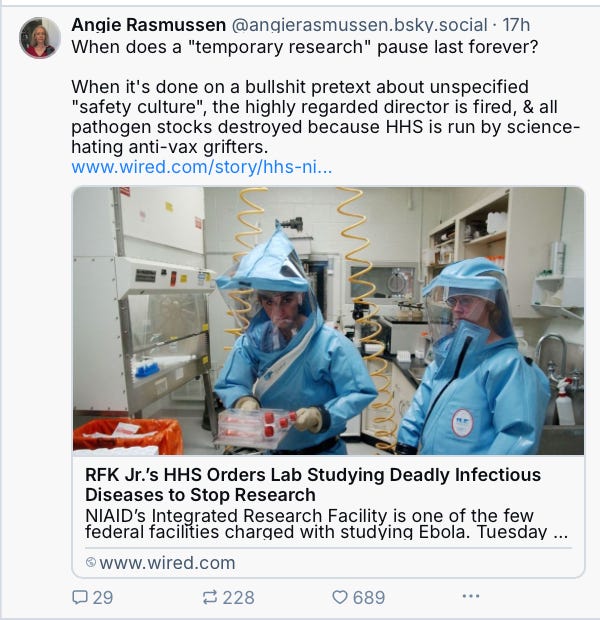
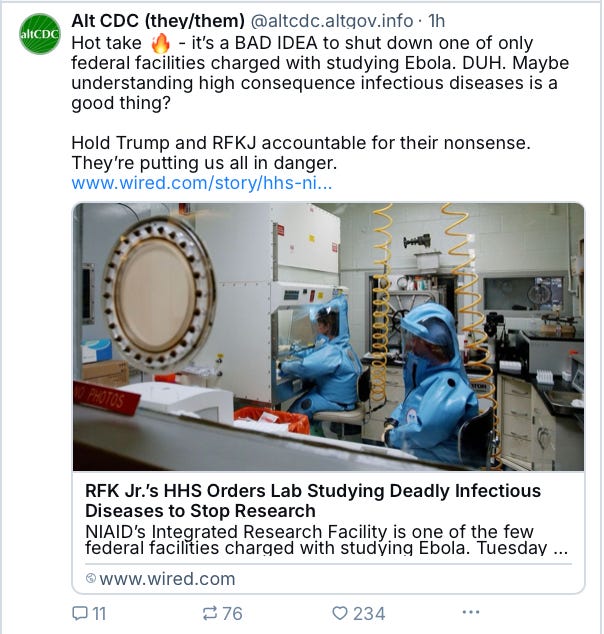
Wired Magazine’s misleading report led to a panic among researchers on Bluesky, who seemed less worried about lab safety than plowing forward with studies. A selection of those posts below
Dentsply Sirona Inc Q1 Profit Increases, Beats Estimates

 Dentsply Sirona Inc (XRAY) reported earnings for its first quarter that increased from last year and beat the Street estimates.

The company's earnings came in at $20 million, or $0.10 per share. This compares with $18 million, or $0.09 per share, last year.

Excluding items, Dentsply Sirona Inc reported adjusted earnings of $87 million or $0.43 per share for the period.

Analysts on average had expected the company to earn $0.30 per share. Analysts' estimates typically exclude special items.

The company's revenue for the period fell 7.8% to $879 million from $953 million last year.

Dentsply Sirona Inc earnings at a glance (GAAP) :

-Earnings: $20 Mln. vs. $18 Mln. last year. -EPS: $0.10 vs. $0.09 last year. -Revenue: $879 Mln vs. $953 Mln last year.

-Guidance: Full year EPS guidance: $1.80 - $2.00 Full year revenue guidance: $3.60 - $3.70 Bln

https://www.nasdaq.com/articles/dentsply-sirona-inc-q1-profit-increases-beats-estimates

argenyx business update

argenx (ARGX) reported strong Q1 2025 financial results with $790 million in global product net sales, representing 99% year-over-year growth. The company achieved profitability with $169.5 million in net income ($2.78 per share) compared to a loss in Q1 2024. Key developments include the launch of VYVGART Hytrulo pre-filled syringe for self-injection in US and Germany, and a positive CHMP opinion for VYVGART-SC in EU for CIDP. The company maintains its 'Vision 2030' strategy to reach 50,000 patients across 10 labeled indications. Operating expenses increased to $668.4 million, with R&D expenses at $309 million and SG&A at $276.2 million. The company reaffirmed its financial guidance of approximately $2.5 billion in combined SG&A and R&D expenses for 2025.

Dyne Therapeutics Pipeline Progress

 - FDA (CDER) Type C meeting held in May 2025 for DYNE-101 in DM1 and Dyne plans to provide a regulatory update following receipt of meeting minutes -

- Registrational Expansion Cohort of ACHIEVE Trial of DYNE-101 in DM1 initiated to support potential submission for U.S. Accelerated Approval in H1 2026 -

- Registrational Expansion Cohort of DELIVER Trial of DYNE-251 in DMD fully enrolled to support potential submission for U.S. Accelerated Approval in early 2026 -

https://finviz.com/news/51439/dyne-therapeutics-reports-first-quarter-2025-financial-results-and-recent-business-highlights

'AI trained on NHS data 'may predict ill health in advance''

 An artificial intelligence model that is being trained on de-identified data from 57 million people in England has the potential to predict future health risks and help improve healthcare, according to its developers.

The AI – known as Foresight – is being put through its paces in a pilot study carried out by researchers at University College London (UCL) and King's College London (KCL) and uses a generative AI (GenAI) approach similar to ChatGPT.

The hope is that it will allow a national predictive healthcare approach that can identify people who may be at high risk and open a window of opportunity to intervene earlier and save lives, which would be a help to the NHS's focus on disease prevention as one of the pillars of reforms alongside moving care from hospitals to the community and embracing digital technologies.

It also ties into the UK's ambition to harness health data for medical research, backed by a £600 million ($764 million) investment by the government announced last month.

"AI models are only as good as the data on which they're trained," commented Dr Chris Tomlinson, one of the lead researchers from UCL.

"So if we want a model that can benefit all patients, with all conditions, then the AI needs to have seen that during training," he added. "Using national-scale data allows us to represent the kaleidoscopic diversity of England's population, particularly for minority groups and rare diseases, which are often excluded from research."

Ultimately, the hope is that Foresight will be able to predict hospitalisations, heart attacks or a new disease diagnosis, according to the researchers, who believe this is the first time that an AI has been trained on health data on a national scale.

The data used to train the AI – including vaccination records, GP visits, hospital admissions, and A&E attendances – is being provided under the NHS England Secure Data Environment (SDE) to ensure patient privacy and can only be run on NHS computer systems.

The privacy measures controls were welcomed by Dr Luc Rocher, senior research fellow at the Oxford Internet Institute (OII) at the University of Oxford, who cautioned, however, that "the very richness of data that makes it valuable for AI also makes it incredibly hard to anonymise."

"These models should remain under strict NHS control where they can be safely used," he said.

Meanwhile, Dr Wahbi El-Bouri, senior lecturer in digital twins and in silico trials at the University of Liverpool, said that while this sort of data is vital to help improve health outcomes in the UK, "developing these AI models requires good quality data."

He added that "researchers who have worked with NHS data will know that data quality can often be poor, with large amounts of missing data, or incorrect reporting," and warned that "NHS data is the wrong type of data to tackle prevention as when someone has visited the NHS it is because something is already wrong."

Another researcher working on the project, KCL's Prof Richard Dobson, acknowledged that currently the data in the pilot is "broad but shallow, and ultimately we'd like to harness the expertise and AI platforms behind Foresight by including richer sources of information like clinicians' notes, or results of investigations such as blood tests and scans if they become available."

https://pharmaphorum.com/news/ai-trained-nhs-data-may-predict-ill-health-advance