Search This Blog

Thursday, May 8, 2025

Pogrom Brewing in Canada

 Late last year I sat down to breakfast in Ottawa, Ontario, with Dr. Einat Wilf, one of the world’s foremost experts on the Israeli-Palestinian conflict. She had come to Canada’s capital to speak about the war in Israel, what Palestinians really want, and the future of a possible two-state solution. Near the end of our chat, I asked if she had seen any of the “pro-Palestinian” rallies that had become a weekly occurrence in the city. “One of them went by my hotel last night,” Wilf said. “There’s a very dark energy to them. Serious pre-pogrom vibes.”

The word pogrom is the Yiddish word for “devastation” or “destruction.” What it refers to, historically, are the mob attacks that were a regular feature of life for Jews in the 19th and early 20th centuries—attacks that most often were passively or openly supported by the state.

Wilf chose it deliberately.

In the roughly six months since we sat down together, the situation in Ottawa and across the country has only worsened. Canada has become one of the most antisemitic countries in the Western world.

If you doubt that assertion, it’s important to note that’s how others have described it, too.

In a report released on May 6 by Israel’s Ministry for Diaspora Affairs and Combating Antisemitism, it states that from October 7, 2023 through the end of 2024, antisemitism in Canada skyrocketed an astounding 670 percent. Further, between October 7, 2023 and October 7, 2024, there were 1,500 pro-Palestinian rallies in Toronto alone. That’s over four a day—every day—for a year straight.

While the outbreak of antisemitism throughout the West has been precipitous in virtually every country—the tenor, violence, and extremist nature of Jew-hatred in Canada has ratcheted up in a way few other places on Earth have experienced.

Consider the following—much of which has gotten scant media attention.

Targeting Jews in Their Backyards

  • In September 2024 protesters sympathetic to Hamas and the “resistance” jubilantly rallied outside a Jewish retirement facility in Ottawa where several Holocaust survivors live, and where 60 percent of the residents suffer from dementia. Chants of “Go back to Europe” and “We want bullets and missiles!” in Arabic could be heard from their bedrooms.

  • On Remembrance Day in 2024 at Sir Robert Borden public school in Ottawa, where there is a large Jewish student body, a Palestinian protest song was the only song played during an event to honor Canadian soldiers. When pressed on the choice of music, Principal Aaron Hobbs said it was chosen to add some diversity and inclusion to a day usually about “a white guy who has done something related to the military.”

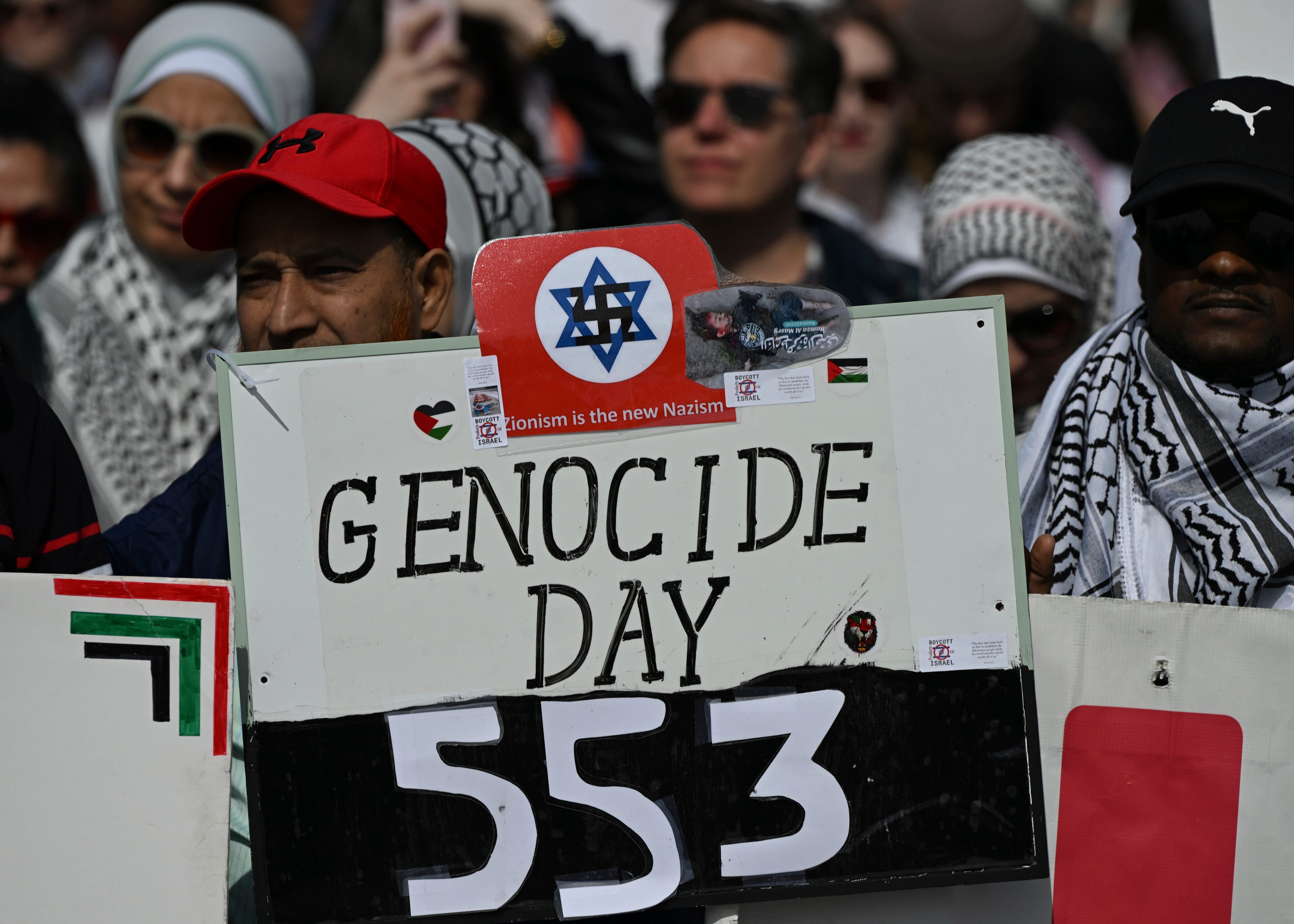
  • At a softball game for teenage girls between Canada and Israel as part of last year’s Canada Cup Women’s International Softball Championship in Surrey, British Columbia, protesters stood on the sidelines wearing keffiyehs, holding signs that read “Israel is a genocidal state,” with another equating Israel with Nazi Germany.

  • During Israel’s official day of remembrance for fallen soldiers and victims of terrorism on April 29, protesters stood in front of Beth Emeth Bais Yehuda Synagogue in Toronto waving Palestinian flags. One man wore a sweater that read “Palestinian Holocaust: Never Again Is Now.”

  • Earlier this month in Montreal, protesters were filmed chanting “All the Zionists are racists” through megaphones at a school for students ages 4 to 16 with intellectual disabilities and autism-spectrum disorders.

These activities aren’t normal protests. They aren’t in front of the Israeli embassy in Ottawa or the Israeli consulate in Toronto. They aren’t directed toward a specific Israeli policy, law, regulation, or act, and they certainly make no mention of Hamas, Hezbollah, or any other terrorist organization that has brought immense death and destruction upon the Palestinians. These are belligerent acts of aggression designed to intimidate Canada’s Jewish community, to coerce them into silence, and ultimately, to extinguish their public presence.
A Pogrom Is Brewing in Canada
Activists gather during the Stop The Genocide rally in Edmonton, Alberta, on April 13, 2025. (Artur Widak/NurPhoto via AP)

Open Antisemitism and Valorizing Terrorism

  • In Vancouver, British Columbia, protesters gathered on the one-year anniversary of the October 7, 2023 massacre and declared “We are Hezbollah, and we are Hamas” while burning the Canadian flag.

  • Last March, in downtown Ottawa—on the same streets where former prime minister Justin Trudeau invoked the Emergencies Act in response to the trucker convoy in 2022— a young man dressed as a Hamas terrorist taunted shocked onlookers, the flags of Lebanon and Palestine blowing in the wind behind him.

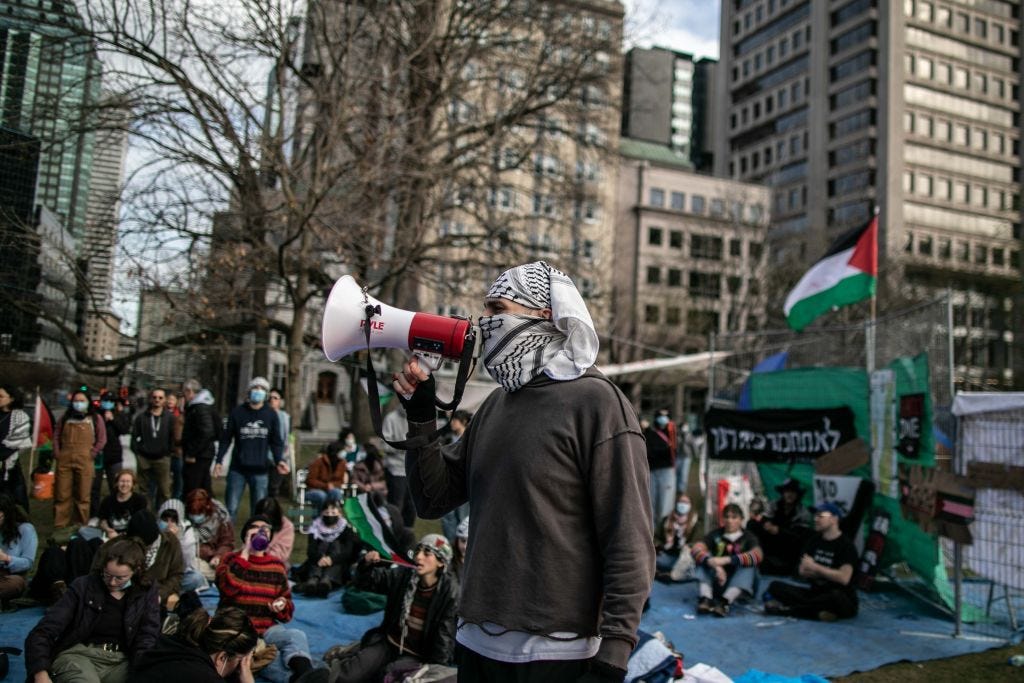
  • In November 2024, an estimated 50,000 students, as well as faculty, from universities including Concordia, McGill, and Dawson College took to the streets and campuses, where they overran buildings, destroyed property, and led schools to close. Chants of “Long live the intifada” could be heard, with one protester saying on camera, “The final solution is coming your way.”

Violent Attacks

Since October 7, 2023, there have also been nearly a dozen terrorism-related incidents in Canada or abroad involving Canadians. These include:

And this list does not include the Jewish girls school in Toronto that was hit with gunfire on three separate occasions, the multiple shootings at a Jewish school in Montreal, the firebombing of a synagogue in Montrealthe firebombing of a synagogue near Montreal, the endless vandalism of Jewish-owned businessesthe vandalism of homes with swastikas, and the destruction of campaign signs for Jewish politicians running in the 2025 federal election.

Nor does it capture the anti-Israel indoctrination occurring at public schools, universities, and unions across the country, among many other things.

What all of this has led to is the suppression of open Jewish life in Canada, the hiding of Jewish symbols, the need to host Jewish events in secret or with even more intense security, and even some people fleeing the country. Students at Toronto Metropolitan University who recently shared that they “can’t be openly Jewish” on campus aren’t the exception. They’ve become the norm. “I went in with people hating me right off the bat and me not being able to make any friends who are non-Jewish in my classes or in my program,” one student said.

What is unfolding in Canada is not a grassroots, spontaneous expression of solidarity for Palestinians, although the press covers it that way.

This is an orchestrated effort to normalize antisemitic incitement under the guise of political activism. The days of exclusionary signs at golf clubs have been replaced by open calls for jihad and terrorist cosplay—all animated by an obsession with intimidating Jews, including in their own neighborhoods.
A Pogrom Is Brewing in Canada
Students at McGill University protest Israeli attacks on Gaza on April 29, 2024 in Montreal, Canada. (Amru Salahuddien/Anadolu via Getty Images)

Pogroms rarely begin with organized massacres; typically, they start with tolerated incitement, with mobs unpunished, and with authorities hesitant to act decisively for fear of political blowback.

And that is perhaps the most alarming thing of all happening right now in Canada.

On more than one occasion, protesters clad in keffiyehs, inciting violence, intimidating Jews and non-Jews alike, and calling for the erasure of Israel have been met with equivocation.

Too often, authorities have hesitated to enforce laws against harassment and incitement when masked by the rhetoric of “resistance.” Political leaders have downplayed the extremist nature of these rallies. Universities and unions have wavered in condemning overt Jew-hatred cloaked in the language of activism, righteousness, and progressivism.

On one occasion, for instance, police officers in Toronto handed out coffee and baked goods to protesters. On another occasion, they allegedly arrested a Jewish man, in a Jewish neighborhood this month, for confronting the terrorist supporters who have taken to the streets every weekend since October 7, 2023. For nearly 600 days, Jews in Canada have been asking themselves: Is the state still on our side? Is law enforcement willing to do what it takes to shut this down?

In this sense, Wilf was perhaps more right than she could have imagined.

Canada now faces a moral test. Our institutions—from police and prosecutors to politicians and civil society—must decide whether to confront antisemitic threats firmly or equivocate and excuse them as protest.

This is not a Jewish issue. It is a Canadian one. A society that allows a vulnerable minority to be openly menaced cannot claim to be safe or just for any of its citizens. Antisemitism is often the first sign of broader social decay. If mobs can intimidate Jewish schools and hospitals today, what do we expect they’ll do tomorrow?

Everyone with eyes is bracing for the explosion.

Dr. Casey Babb is a senior fellow at the Macdonald-Laurier Institute’s Center for North American Prosperity and Security, a fellow with the Institute for National Security Studies in Tel Aviv, and an adviser with Secure Canada in Toronto.

https://www.thefp.com/p/a-pogrom-is-brewing-in-canada-antisemitism

ProPublica Wins Pulitzer for Politicized Deception

 Yesterday, the Pulitzer Prize board announced its 2025 winners.

In the category of “Public Service,” ProPublica won the coveted prize for its series titled “Life of the Mother: How Abortion Bans Lead to Preventable Deaths.”

National Review has doggedly pointed out the misrepresentations platformed in this series — misrepresentations stemming from the authors’ evident bias for “abortion rights.”

The Pulitzer Prize Board — which determines the winners of journalism’s most prestigious award — includes members such as Claire Shipman, the acting president of Columbia University (who replaced Katrina Armstrong, who replaced Minouche Shafik); Viet Thanh Nguyen, professor of American studies and ethnicity at USC and author of Race and Resistance: Literature and Politics in Asian America; and Ginger Thompson, the managing editor of ProPublica.

To be clear, the stories covered in ProPublica’s “Life of the Mother” series are utterly tragic — and we should be furious that these mothers died preventable deaths.

However, ProPublica — along with virtually every other mainstream media outlet — contributed to the smoke screen that has clouded the actual cause of death in ProPublica’s biggest stories: the cases of Amber Thurman and Candi Miller.

These women did not die because of pro-life legislation. These women did not die because doctors risked legal persecution if they intervened. These women died because abortion pills — especially when taken after the first seven weeks of pregnancy — are incredibly dangerous. One out of ten women experience a serious adverse event, such as sepsis or hemorrhage, within 45 days of taking mifepristone. While no investigation has been completed, it also appears that the negligence of their medical providers played a role.

The real story here, which has received little to no attention in the mainstream media, is how the FDA has slowly but surely removed most of the original guardrails concerning the administration of the abortion pill. Now, young mothers are taking the chemical abortifacient regimen of mifepristone and misoprostol, unaware of its potentially fatal consequences.

As I wrote in the aftermath of Amber Thurman’s tragic death last year:


The primary cause of her death was sepsis, a potential side effect of the most common chemical abortifacient — a regimen of mifepristone and misoprostol. Crucially, the FDA has dramatically loosened regulations on the drugs in recent years — regulations that would help keep women safe.


As National Review highlighted last year, the mifepristone-based chemical-abortion pill RU-486 has become the go-to method of abortion across the U.S.:


According to the pro-abortion Guttmacher Institute, medication abortions have increased steadily with each regulatory shift: The pill was used in 17 percent of all U.S. abortions at the end of the Bush administration, but that increased to under a third a decade ago, to a little over half on the eve of the Dobbs decision, and to nearly two-thirds in 2023.


This growth is connected to these pills’ ease of access and the litany of progressive NGOs that seek to distribute them to women across the country, no questions asked.

However, these drugs are known to send women to the emergency room.


A woman who takes abortion pills late in her pregnancy — anytime after two months — could land in the emergency room for extensive bleeding, sepsis, or worse. The FDA’s own label for abortion pills says that approximately one in 25 women who take the drugs will end up in the emergency room. That likelihood increases with gestational age. Among women who take abortion pills after 84 days of gestation, nearly 40 percent will require follow-up surgery, and 4 percent will sustain significant infection.


In its “Life of the Mother” series, ProPublica has also published several stories attacking failed data-gathering, such as “The CDC Hasn’t Asked States to Track Deaths Linked to Abortion Bans.” Ironically, pro-lifers have been asking for record-keeping requirements so that data-gathering bodies can track all the ER visits connected to side effects of chemical abortifacients. Without these records, research institutes have had to use other methods to determine the real dangers of mifepristone. According to a massive study of nearly 900,000 insurance claims, conducted by the Ethics and Public Policy Center, “10.93 percent of women experience sepsis, infection, hemorrhaging, or another serious adverse event within 45 days following a mifepristone abortion.”

Pro-abortion advocates have religiously held that (1) chemical abortion is safe and (2) it’s the fault of pro-life legislation when mothers die from taking it.

In total, ProPublica’s “Life of the Mother” series contains ten articles that all blame pro-life legislation for preventable deaths. Two heart-wrenching articles from the series share the stories of Amber Thurman and Candi Miller, mothers who died preventable deaths after succumbing to fatal side effects of the abortion pill. Two other articles share the tragic stories of Josseli Barnica and Nevaeh Crain — young women who died from miscarriage-related sepsis. (Abortifacients did not play a role in their deaths.)

Regardless of the cause of a miscarriage, all OB-GYN medical providers are trained on the proper response to ensure that the mother does not suffer from infection. Every piece of pro-life legislation distinguishes between a remedial dilation and curettage (D&C) procedure and an elective surgical abortion. As I have written before, in the case of Amber Thurman:

A D&C is a standard medical practice, most often used in the first trimester if a woman suffers an incomplete miscarriage, to ensure that all fetal remains have been cleared from the womb. …And even if, somehow, the fetus in Thurman’s infected womb had still had a heartbeat, the doctors and nurses attending to her would have been clearly free to perform a D&C on her under Georgia law.

House Bill 481, known as the “Living Infants Fairness and Equality (LIFE) Act,” states:

(b) No abortion is authorized or shall be performed if the probable gestational age of the unborn child has been determined…to have a detectable human heartbeat except when:

  1. A physician determines, in reasonable medical judgment, that a medical emergency exists.
  2. The probable gestational age of the unborn child is 20 weeks or less and the pregnancy is the result of rape or incest in which an official police report has been filed alleging the offense of rape or incest.
  3. A physician determines, in reasonable medical judgment, that the pregnancy is medically futile.

While pro-life legislation varies state by state, all share similar clarifications and exemptions to those outlined in Georgia’s LIFE Act.

Any medical professional who refuses to treat a woman undergoing a miscarriage, for fear of “breaking” a pro-life law, is detrimentally misinformed. No doctors or nurses are at risk of being sued by the state if they care for women. (Rather, they risk a malpractice suit for negligence.)

If medical professionals are truly refusing to treat mothers because of misinformation about the content of pro-life legislation, this is a damning evaluation of the media outlets that misinformed them.

Amber Thurman, Candi Miller, Josseli Barnica, and Nevaeh Crain should all have received prompt and lifesaving care from their medical providers. They didn’t get it.

ProPublica has argued in its series that pro-life legislation places undue burdens on medical providers, making it hard to determine when they are allowed to act. This is both false and patronizing. As Dan McLaughlin has clearly argued, all medical providers operate within a web of rules and regulations.


Georgia hospitals, like hospitals all across the country, operate in an Amazonian jungle of laws and regulations, federal and state, and comply with extensive standards of judge-made tort law. . . . Hospitals and doctors practice medicine every day knowing that they can be sued for medical malpractice, sanctioned by the state medical board, or denied payment by Medicare or Medicaid or private insurance if they fail to adhere to prevailing medical standards, fail to provide medically necessary care, provide medically unnecessary care, or provide substandard care. More than 10,000 medical-malpractice claims are filed in the United States every year, many of them asserting that doctors failed to do something necessary to save a life.


Certainly, doctors from organizations such as ACOG, the American College of Obstetricians and Gynecologists, are champing at the bit to claim that pro-life legislation leads to the death of women. However, for an organization that is dedicated to abortion advocacy, ACOG has many motivating factors to blame pro-life legislation for the harms done by dangerous abortifacients or hospital failures.

While ProPublica enjoys its prize, I hope more medical providers will not be cowed into fear or negligence by pro-choice disinformation campaigns.

Kayla Bartsch is a William F. Buckley, Jr. Fellow in Political Journalism. She is a recent graduate of Yale College and a former teaching assistant for Hudson Institute Political Studies.

https://amac.us/newsline/society/propublica-wins-pulitzer-for-politicized-deception/

Principles of New Environmentalism

 by Edward Ring

Last month, in recognition of the annual celebration of Earth Day, it seemed appropriate to compile a list of ten common myths that constitute the major premises of modern environmentalism. That list, along with explanations of why each of these premises is unfounded and counterproductive, can be summarized as follows:

1 – There is no climate crisis.
2 – There are not too many people on Earth.
3 – We are not running out of oil/gas/coal.
4 – Biofuel is not renewable or sustainable.
5 – Offshore wind is not renewable or sustainable.
6 – Renewables are not renewable.
7 – Renewables cannot replace oil/gas/coal.
8 – Housing should not be confined to densifying existing cities.
9 – Mass transit is almost never cost-effective.
10 – Wilderness areas are not sacred.

Environmentalism, pursuant to these myths, is not a movement primarily devoted to protecting the planet’s ecosystems. It is a totalitarian political agenda that aims to consolidate power and wealth in the hands of a managerial elite that will wield absolute control over every aspect of human life. Where you live or travel, what you purchase or produce, and what you can own and consume will all be specified, monitored, and rationed. And the moral justification for this will be the “climate emergency.”

There are few examples in history that can compare to the political power grab enabled by the alleged “existential threat” of climate change. But of equal concern is the fraudulent essence of the economic and technological agenda pushed in the name of fighting climate change. It not only discredits environmentalism in the eyes of awakening millions, but, as explained in the ten myths, it also will wreak environmental havoc.

Meanwhile, true environmentalist values, uncorrupted, remain of vital importance to humanity. It is necessary to expose how special interests have hijacked the environmentalist movement. But it is equally necessary to articulate principles that may inform a new environmentalism focused on authentic threats and propose ways to counter these threats without compromising individual freedom and prosperity. To that end, here are some ideas.

Principles of New Environmentalism

1 – Questioning the “climate emergency” does not mean someone is not an environmentalist.

2 – Public investments and public policies designed to combat the alleged climate emergency must still pass a cost/benefit analysis that does not take into account “climate impact.”

3 – Over-regulation is a primary cause of unaffordability, but deregulation cannot be selectively targeted to favor, for example, “renewables” or “affordable housing.” A level, deregulated playing field must be created for all investments, including energy, water, and housing.

4 – The priorities of environmentalists must return to addressing genuine environmental threats, for example:
– The steady and significant decline in global insect mass.
– Overfishing the oceans.
– Poaching of endangered species.
– Aquatic dead zones.
– Deforestation and wildlife depletion in nations denied access to conventional energy and commercial agriculture because of the “climate emergency.”
– Actual air and water pollution, mostly in developing nations.
– Biofuel plantations destroying hundreds of thousands of square miles of rainforest.
– Massive oceanic garbage patches.
– The worsening human population crash and environmental factors that may be contributing to worldwide loss of fertility.

5 – Mitigating even genuine environmental challenges must avoid extremes. Advances in genomics can now identify subspecies as unique even if they are otherwise indistinguishable apart from minute genetic differences. Similarly, we now can measure toxins in parts-per-trillion quantities. But now that science’s ability to identify subspecies and measure toxins greatly exceeds our economic capacity to mitigate, a balance must be struck.

6 – “Smart Growth” is not smart. It is a heavily subsidized and highly inefficient way to create housing that most people don’t prefer. The alternative to Smart Growth might be called “New Suburbanism,” an unsubsidized, family-friendly approach that recognizes consumer preferences and, contrary to agenda-driven misinformation, does not consume excessive land.

7 – In a reasonably regulated, competitive commercial environment, private industry can operate far more efficiently than government. Private investment in, for example, energy production, water infrastructure, mineral extraction, and forestry will create jobs, generate tax revenue, and lower the cost of living.

8 – A corollary to the principle of private investment being more efficient is the unavoidable necessity for public utilities. You can’t change the route of a pipeline or railroad for every property owner who will not consent to an easement. But public utilities should not be guaranteed revenue on a cost-plus model, and their profits should not be “decoupled” from their productivity.

9 – For everyone on earth to use half as much energy as Americans do per capita, global energy production must double. In 2023, wind, solar, and geothermal energy only accounted for 2.5 percent of global energy production. Scaling these “renewable” sources of energy while they remain technologically immature is not sustainable. We need to continue to develop conventional energy while continuing to aggressively research new energy technologies. Access to energy is a prerequisite to prosperity and wealth, which in turn is a prerequisite for nations to have the wherewithal to address and solve genuine environmental challenges.

10 – Around the world, the challenge to achieve abundance is governed more by politics and culture than by limited resources. The scarcity agenda inherent in “climate” policy guarantees societal instability and inadequate resources to eliminate genuine pollution. Abundance is achieved through economic freedom and competitive capitalism, subject to reasonable regulatory restraints. Beware of the “abundance” mantra increasingly being adopted by the left or by climate zealots. Even if they are sincere, their solutions are unworkable.

These are a few of the principles that might help redefine environmentalism for the 21st century and restore its credibility. They offer a new approach that not only rescues the natural environment but also preserves freedom and nurtures worldwide prosperity. Moreover, because they make practical economic sense and are predicated on reality instead of theory and mythology, adhering to these principles would set an example that other nations would enthusiastically emulate.

The next time you hear a politician or pundit blithely discuss the “climate emergency,” as if it is something we all accept as indisputable truth, think about the dubious premises they rely on to make these claims. And think about new approaches that will allow us to more effectively care for our beautiful world, along with everyone living here.

https://amgreatness.com/2025/05/07/principles-of-new-environmentalism/