Search This Blog

Thursday, May 8, 2025

Online networks like ‘764’ target children for chilling violence

 Parents, do you know what your kids are doing online?

If not, the answer may terrify you.

Last month, the FBI issued a warning about the growing threat of violent online networks targeting minors.

Lurking on gaming platforms, social media or self-help forums, members of these networks lavish attention on their targets.

After the grooming comes the demands: that victims carve occult symbols or the names of their abusers onto their bodies (a practice known as “fansigning”).

That they share sexually explicit videos or mutilate their pets on camera.

That they livestream their own suicides.

When victims disengage, they’re doxed and swatted, threatened with violence, blackmailed or extorted.

Most victims are teens.

Some are younger.

It’s the stuff of nightmares, and dismantling these virulent networks is now a top national security priority across the United States and Europe.

764 propaganda that was shared on Telegram.

But most parents have no idea they exist.

Many of these networks, with names like 764, the Com, No Lives Matter and True Crime Community, belong to a loosely connected subculture called nihilistic violent extremism.

This is influencer culture at its darkest, where status comes from creating the worst-possible content. Videos of beheadings, dismemberings, torture and child pornography freely circulate.

Consuming ultra-violent content online fuels real-world creation.

Take 17-year-old Solomon Henderson, who shot and killed a student at his school in Antioch, Tenn., in January, wounding two others before taking his own life.

Bradley Cadenhead, who went by Felix and Brad764 online, created 764 in 2020 when he was 15 and named it after his zip code.Erath County Jail

He left behind a manifesto, now standard procedure for online extremists.

No surprise his manifesto and social-media footprint are rife with tragedy, self-loathing and rage — along with horrific imagery and references to nihilistic extremism and neo-Nazism

It glorified school shooters he idolized — including Natalie Rupnow, who killed two of her classmates and wounded six more in December 2024 in Madison, Wis., before taking her own life.

She frequented school-shooter-obsessed forums of the True Crime Community and admired prior attacks.

That Henderson was a black self-identified white supremacist and that Rupnow was a rare female school shooter underline the strange, shape-shifting nature of nihilistic violent extremism.

Tennessee school shooter Solomon Henderson, 17, shot and killed a student at his high school earlier this year before committing suicide.WSMV via Metro Nashville PD

Crackdown underway

Last week, two alleged leaders of 764 were arrested — one in North Carolina and one in Greece, after an investigation by the FBI, NYPD and partners.

They’re accused of directing minors worldwide to cut symbols into their bodies, produce explicit videos and engage in self-harm.

These arrests are a breakthrough, but the threat remains.

A 764 member in Kentucky recently pleaded guilty to plotting to kill a minor who refused to continue making coerced sexual videos.

An Arizona man associated with 764 allegedly forced a 13-year-old girl to carve his alias, satanic symbols and swastikas into “every possible place” on her body, threatening to leak sexually explicit images of her if she didn’t comply.

Wisconsin school shooter Natalie Rupnow killed two of her classmates last December before taking her own life.Natalie Rupnow/X

And in California, minors were blackmailed into filming themselves performing torture rituals.

Worse still, today’s victims can become tomorrow’s abusers.

A 15-year-old Eastern European girl who convinced a Minnesota man to livestream his self-immolation had been terrorized by 764 before she became one of their recruiters.

These aren’t isolated examples.

Since we began investigating this threat three years ago, we’ve identified over 500 cases — and those are just the ones we know about.

In addition to arrests, the FBI-led Joint Terrorism Task Force has been working to alert law enforcement worldwide to the dangers of these networks.

NYPD detectives and FBI agents have briefed school officials and community partners worldwide, flagging indicators: cutting and fansigning, isolation, doxing, swatting and retributive bomb threats seen in schools since the pandemic.

This work is urgent, vital and growing.

Be on the lookout

But while law enforcement is working aggressively to identify and dismantle these networks, early intervention starts with the people closest to the kids, not after a case is opened.

The truth is arrests aren’t enough.

We need awareness.

We need parents to understand what’s out there.

We need teachers to recognize the signs.

We need tech companies to take responsibility for what’s happening on their platforms.

And we need survivors to know they’re not alone — that there’s a way back.

The good news is, recovery is possible.

We’ve worked with families who’ve pulled their kids out of these networks and helped them start over — safe and supported.

When that happens, we don’t just save one life.

We protect future victims and prevent others from becoming victimizers.

It takes vigilance. It takes early intervention.

And it takes adults who are paying attention.

If you’re a parent, ask your kids what they’re doing online.

Don’t just monitor — engage.

If you’re a teacher, don’t ignore the strange symbols or sudden withdrawal.

Ask questions.

If you’re a friend, speak up.

This is a new kind of extremism — grounded in the belief that nothing matters and that causing harm is the only way to feel anything at all.

We can stop it.

But only if we know it’s there.

Jessica Tisch is commissioner of the New York City Police Department, where Rebecca Weiner is deputy commissioner for intel and counterterrorism.

https://nypost.com/2025/05/07/opinion/violent-online-networks-like-764-show-how-terrifying-the-dark-web-is-for-young-children/

RFK Jr. Blows The Lid Off Big Food's Worst Scam

Via VigilantFox.com,

HHS Secretary Robert F. Kennedy Jr. sat down with Newsmax’s Greta Van Susteren Tuesday evening and exposed the dirtiest trick in the American food system.

He says corporations hijacked an FDA loophole called “GRAS” to quietly flood our food with untested chemicals - without ever proving they were safe.

And the consequences didn’t take long to show up.

In the late 1980s and early ’90s, something strange started happening in America. Chronic illness was on the rise. Obesity rates soared. Autoimmune diseases became more common.

It felt like the health of the nation was unraveling.

According to HHS Secretary Robert F. Kennedy Jr., that wasn’t a coincidence. It was the result of a corporate takeover.

“At that time… the tobacco industry took over the food industry,” he said.

“By the early 1990s, the two biggest food companies in the world were R.J. Reynolds and Philip Morris.”

The same companies that had perfected the art of chemical addiction through cigarettes were now running the food system. And Kennedy says they brought the same playbook with them.

“They began moving scientists from the endeavor of making tobacco more addictive to developing new lab ingredients that would make food addictive.”

That’s when everything changed.

What had once been real food—grown, cooked, and served—became something else entirely. A highly engineered product designed not to nourish, but to keep people hooked.

The health consequences were immediate. But behind it all, there was something even more insidious: the regulatory system meant to protect Americans had already been compromised.

“Those chemicals were largely untested because of the capture of the FDA by the food and drug industries,” Kennedy warned.

The public trusted the FDA. But the FDA, Kennedy says, had already been captured by the very industries it was supposed to regulate.

Then came the dirtiest trick of all.

Kennedy revealed how the food industry hijacked a decades-old FDA loophole—one that allowed a flood of untested chemicals into our diets.

It started back in the 1940s, when the FDA first began regulating food.

At the time, they made one reasonable exception: ingredients with a long history of safe use—like wheat, eggs, and dairy—wouldn’t need testing.

“When the FDA first began regulating foods in the 1940s, it exempted food ingredients that had been used for generations—like wheat, eggs, and dairy,” Kennedy said.

“They didn’t require testing for those.” But decades later, that narrow exemption was quietly weaponized.

“The food industry later captured that label and applied it to every new chemical they wanted to add.”

Instead of testing new additives, companies simply claimed they were “generally recognized as safe.” And the FDA, Kennedy said, went along with it.

The result? America now has more than 10,000 approved food ingredients. Europe? Just 400.

“In the U.S., chemicals are never safety tested before being added to food,” he said.

Some of those ingredients are derived from petroleum. Others mimic the flavor of strawberries or blueberries, without providing a single nutrient. And they’re not just empty calories.

“These chemicals hijack the brain and trick the body into eating more food while getting less nutrition.” That’s not just unhealthy—it’s unprecedented.

“We are now the fourth most obese country in the world,” Kennedy said, “yet for the first time in history, obesity is often accompanied by malnutrition.”

Think about that for a second.

The people who are most obese are also malnourished. That’s never been seen before in human history.”

But Kennedy isn’t just exposing the problem—he’s taking action.

For decades, food companies have been allowed to slip harmful ingredients into our food. That may finally change.

In March, Secretary Kennedy directed the FDA to begin dismantling the very loophole that made this possible.

He instructed Acting FDA Commissioner Sara Brenner to “take steps to explore potential rulemaking to revise its Substances Generally Recognized as Safe (GRAS) Final Rule and related guidance to eliminate the self-affirmed GRAS pathway,” according to an HHS press release.

Translation: no more rubber-stamping chemicals without oversight.

HHS also announced plans to work with Congress to pass new legislation that would formally close the GRAS loophole.

As of now, the timeline for these changes remains unclear—HHS did not respond when asked how soon they plan to act.

Kennedy wrapped it all up with a hopeful message.

“The team here is extraordinary. A lot of people are coming to HHS now because they see an intergenerational opportunity to change the way we do things, and we’re moving fast.”

He outlined several major steps already underway.

“We’ve announced a ban on all petroleum-based synthetic food dyes. We’ve changed the GRAS standards so people can’t rubber-stamp chemicals into food anymore.”

“We’re reviewing chemicals already in our food.”

“We’ve launched Operation Stork Speed to ensure mothers can get the healthiest milk for their children.”

The system was rigged. But now, the tide is turning. And this time, it’s the people—not the corporations—who are finally calling the shots.

https://www.zerohedge.com/medical/rfk-jr-blows-lid-big-foods-worst-scam

The Dumbest Donation You Can Make

 by Sean Ring

In today’s culture, where virtue-signaling billionaires love to proclaim they’ll “give it all away,” we must pause and ask: To what end? What purpose does inherited wealth serve? Is it merely a lucky windfall for lazy descendants? Or is it something far more sacred?

I argue today that inheritance is not just permissible — it is necessary. It’s how families grow stronger, freer, and more capable with each generation. Donating your entire fortune to charity may sound noble, but it is often a colossal mistake — philosophically, morally, and economically.

Capital Meant to Be Preserved, Grown

First, let’s define terms. Capital is not just money. Capital is productive wealth: businesses, skills, land, tools, and the accumulated know-how to make them flourish. In a family, capital can take many forms, but financial capital is the backbone of all the others. Without it, nothing moves forward.

Now here’s the kicker: Diluted capital cannot grow. That’s not an opinion, it’s a financial fact. When you distribute productive assets to strangers, you forfeit any ability to shape how that capital works. It’s no longer your family’s seed corn. It’s bird feed.

This is one of the biggest fallacies in the “give it all to charity” movement. The money is scattered and not focused. It’s deployed without any feedback loop of love, responsibility, or vision for the future. Capital given to a faceless nonprofit is rarely preserved. It’s consumed, and the family who built it loses the opportunity to steward it into something even greater.

The Catholic Case for Inheritance

Catholicism has a deep and nuanced view of wealth, which too many interpret incorrectly as anti-capitalist. But Pope Leo XIII’s Rerum Novarum (1891), the seminal encyclical on labor and capital, lays the groundwork for a proper Christian understanding of private property and inheritance.

Leo XIII wrote:

“It is a most sacred law of nature that a father should provide food and all necessaries for those whom he has begotten… He can do this more effectively if he owns productive property.”

Ownership, then, is not an indulgence—it is a duty. And the continuation of ownership across generations is not greed, but charity rightly ordered: charity that begins at home.

The Catechism of the Catholic Church also recognizes inheritance explicitly:

“The family must be helped and defended by appropriate social measures. Where families cannot fulfill their responsibilities, other social bodies have the duty to help and support them.” (CCC 2209)

But the ideal is for families to be self-sufficient. And how does that happen? Through the passing down of wisdom, virtue, and yes, wealth.

Libertarians Get This Right

Now, the libertarian view on inheritance is often caricatured as defending “spoiled trust fund kids.” But the reasoning is quite different if you read thinkers like Ludwig von Mises or Murray Rothbard. It’s about private property rights and the continuity of stewardship.

Rothbard put it plainly in Power and Market:

“If Smith has the right to give or bequeath his property to Jones, then Jones has the right to receive it. Otherwise, Smith’s right is a mockery.”

In other words, if I work my entire life to build something—a farm, a business, a portfolio—I ought to have the right to choose who carries it forward. And naturally, the people I love most and know best are my children. Why should some bureaucrat or NGO get a say in that?

To deny this right is to deny agency. To tear the connective tissue between one generation and the next is to sever the very idea of progress. Libertarians, like Catholics, may disagree on many things, but here they agree: family is the basic unit of society, and wealth must be preserved within it.

The Myth of Charitable Nobility

There’s a smugness to the billionaire who declares he’ll leave nothing to his kids. It makes headlines. It makes for a good TED talk. But does it actually help society?

Many of these charitable gifts go to sprawling organizations with massive overhead, opaque leadership, and questionable effectiveness. Rarely do they plant trees under which anyone’s children, least of all the donor’s, will sit.

Moreover, the donor deprives his children of money and the chance to become stewards. And that’s a word we don’t hear enough.

Stewardship is not about partying on yachts with inherited cash. It’s about learning how to preserve, grow, and direct wealth toward productive ends. It’s a moral responsibility. And it’s best learned by doing, under the guidance of a parent willing to teach it, not just accumulate it.

Inheritance as Evolution

Inheritance is not just about passing on assets. It’s about passing on vision. Every generation has the chance to refine the values, strategies, and strengths of the previous one. This is how families evolve — not just biologically, but economically and morally.

Look at the great families of history. The Medici weren’t saints, but they built a banking empire that funded the Renaissance. The Rothschilds weren’t angels, but they created the capital markets that made the modern economy possible. These were multigenerational projects.

Now imagine if Cosimo de’ Medici had said, “I’m giving it all away to the Florentine Humane Society.” You’d never have heard of Michelangelo.

Inheritance matters because it creates continuity. It allows for the compounding of not just money but also meaning.

A Legacy Is Not a Liability

Of course, heirs and heiresses may abuse inherited wealth. But the answer is not to abolish it but to raise better heirs. To model restraint, responsibility, and generosity rightly ordered.

The great economist and Catholic convert Wilhelm Röpke put it best:

“Freedom without inheritance is a contradiction. It means condemning each generation to begin anew.”

In other words, if we want our children to be free—to pursue greatness, to take risks, to create — then we must give them not just encouragement but tools: capital, wisdom, and, yes, land and money.

That doesn’t mean no accountability. That doesn’t mean no structure. But it does mean a default assumption that the family should retain its wealth and not squander it on false virtue.

Wrap Up

The impulse to give is good, but it must be rightly ordered. Charity that begins at home is not selfish — it is sustainable. It builds future givers, strong families, and strong societies.

Inheritance is not a fluke. It’s not theft. It’s not luck. It’s a birthright that fathers and sons and mothers and daughters should treat with reverence and strategic care.

So next time you hear someone brag about giving it all away, ask: Who will grow that capital? Who will carry that torch?

If they don’t have an answer, maybe wealth was never the point.

https://dailyreckoning.com/the-dumbest-donation-you-can-make/

Gas Up, Emissions Down: The Future of Transportation

 Natural gas…vehicles? 

We talk a lot here about the advantages of natural gas for electricity generation, home heating and powering appliances in our homes like clothes dryers and kitchen stoves. But, one of the area with the most potential to grow the affordable, reliable and clean advantages of natural gas is transportation. 

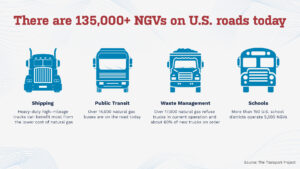
Most people don’t realize that there are already thousands—more than 135,000 to be exact—natural gas vehicles (NGVs) on U.S. roads today. And, there are more than 23 million NGVs in use worldwide. According to the U.S Department Of Energy’s Alternative Fuels Data Center, “The advantages of natural gas as a transportation fuel include its domestic availability, widespread distribution infrastructure, and reduced greenhouse gas emissions over conventional gasoline and diesel fuels.” 

Many of these vehicles are part of government and private fleets, with natural gas powering vehicles like buses and garbage trucks. Just a few examples of organizations that have already embraced NGVs: 

  • In 2023, Walmart debuted five new tractor trailers with compressed natural gas (CNG) engines built by Cummins.
  • In 2020, UPS announced it would purchase more than 6,000 natural gas-powered trucks. A year later, they took even greater advantage of the clean and affordable NGVs by committing to buy 250 million gallons of renewable natural gas (RNG) to power their NGVs. 
  • Waste Management has spent at least $2.5 billion building a CNG fleet and another $300 million to build fueling stations around the county. The company even runs some of its trucks on RNG collected from its own landfills. 
  • Dallas-Fort Worth International Airport became North America’s first carbon neutral airport by converting 95% of its fleet—shuttles, trucks, sedans and other equipment vehicles—to natural gas. 

The advantages are the greatest for long-haul trucks that can benefit from the lower cost of natural gas to travel their extensive shipping routes. 

The real clean and green.

As the Dallas-Fort Worth International Airport success story shows, if you truly want to go green and clean, natural gas is the answer. Natural gas is already the reason that the U.S. is a world leader in lowering emissions. Increased use of natural gas for electricity generation is the top reason for U.S. power sector emissions reductions over the past 17 years—almost double the impact compared to renewable power generation. With NGVs, we could achieve the same victory in the transportation sector. 

In the U.S., transportation is the largest contributor to greenhouse gas (GHG) emissions accounting for 28% of the emission produced in 2022. And, 23% of those emissions came from medium- and heavy-duty trucks. But, NGVs cut those emissions exponentially compared to gasoline, diesel and even electric vehicles (when you take into account their full life-cycle of emissions). 

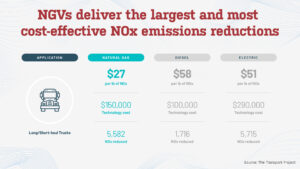
According to the U.S Department Of Energy’s Alternative Fuels Data Center, “The U.S. Environmental Protection Agency (EPA) requires all fuels and vehicle types to meet increasingly lower, near zero, thresholds for tailpipe emissions of air pollutants and particulate matter. One advantage to natural gas vehicles (NGVs) is their ability to meet these stringent standards with less complicated emissions controls.” Take the pollutant nitrogen oxide (Nox) as an example. According to The Transport Project, a group that advocates for more NGV use, NGVs provide the largest and most cost-effective reduction of NOx emissions. “The newest natural gas engines with Near-Zero – or Zero Emissions Equivalent – technology exceed stringent new federal NOx emissions standards.”  

We can do better than EVs. 

The climate hysteria crowd would have you believe the only environmentally-friendly transportation technology out there is electric. But, much like the failed solar installations that were supposed to revolutionize our electrical grid or supposed climate-destroying effects of importing LNG that weren’t (see our last ATEA for more on that), EVs increasingly seem to be a green pipe dream. 

Electric vehicle prices remain out-of-reach for many American families and individuals. The average price of an EV in March was $59,205—nearly $12,000 more than their gas-powered counterparts. And, despite years of promises and government subsidies, the EV charging infrastructure still just isn’t there to make electric practical for drivers around most of the United States. On the commercial side, as The Transport Project puts it: “As battery electric heavy-duty trucks come to market, their per unit cost is often double the natural gas alternative…too prohibitive for most end users. Even more, the cost to build out needed on-site fast charging infrastructure makes full scale battery electric vehicle deployment financially out of reach for most commercial fleets.” 

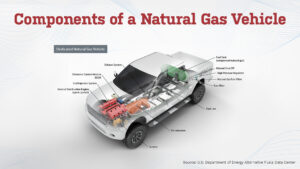
The transition from gasoline-powered vehicles to NGVs is potentially much simpler and more appealing to consumer than the failed push toward EVs. NGVs use many of the parts as those in a traditional gasoline-powered car. Horsepower, acceleration, and cruise speed in an NGV are all comparable to traditional vehicles. In fact, conversion of gasoline-powered vehicles to NGVs is already an option. If we truly wanted to make our American transportation system not only clean but also practically affordable for everyday Americans, a look at mass-production of passenger NGVs would be more realistic than EVs.

According to the U.S Department Of Energy’s Alternative Fuels Data Center, “The upfront costs to convert fleet vehicles to natural gas can be offset by lower operating and maintenance costs over the lifespan of the vehicles. The payback period depends on the fleet’s average distance traveled, required fueling infrastructure costs, and other considerations.”’ Those same cost-savings could be applied to regular passenger cars and trucks. 

Build, baby, build, but make it transportation.

At TEA, we’ve been preaching the “build, baby, build” mantra for some time now. And, yes, we usually mean energy infrastructure like pipelines, refineries and transmission lines. But, we can also apply the “build, baby, build” principles to the way Americans move around our great nation. At a time when we are focusing on reshoring American manufacturing, NGVs offer an obvious opportunity that’s already been tested and tried by some of our toughest vehicles. Unlike what we’ve seen with the failed transition to electric vehicles, we could easily develop and build NGVs for America’s drivers in the same plants where we build gasoline-vehicles, without the headaches of training workers on new skills and acquiring resources from unfriendly trading partners like China. 

The American auto industry was one of the manufacturing victories that built this great nation into the powerhouse we are today. Rather than letting that victory dwindle, a transition to NGVs could be the change the industry needs to get back to its roots while also providing Americans with the affordable, reliable and clean transportation choice of the future. 

https://empoweringamerica.org/gas-up-emissions-down-the-future-of-transportation/