Search This Blog

Friday, May 9, 2025

Why AARP Supports Insurers Over Seniors

 The year 2024 exposed the lie behind the misnamed “Inflation Reduction Act.” Last summer, the Biden Administration announced a “premium stabilization demonstration”—a bailout of questionable legality—because otherwise seniors’ premiums for Medicare Part D prescription drug coverage would go through the roof. Instead of admitting the flaws of the law Democrats rammed through in 2022, the Biden Administration decided to use additional taxpayer funds to pay insurers an average of $100 million each, undermining Medicare’s financial stability.

Why would AARP, which claims to advocate on behalf of seniors, continue to support a law whose costs to the Medicare program are set to exceed original estimates by $10 billion-$20 billion this year alone? The organization has nearly ten billion—that’s billion with a “B”—reasons to do so.
As I outline in a new report for American Commitment, AARP has become financially beholden to UnitedHealth Group. Since 2007, the organization has received nearly $10 billion in tax-free revenue from that company. What’s more, AARP’s estimated revenues from UnitedHealth have grown every single year over that period, making the organization more and more dependent upon the nation’s largest health insurer as time goes by.
That dependence helps to explain why AARP has endorsed policies that hurt seniors. It supports the IRA’s price controls, which will cut off access to innovative cures and treatments, but just so happen to give UnitedHealth greater control over its drug costs. It supports the law’s raid on Medicare by hundreds of billions of dollars, which just so happened to finance enhanced Obamacare subsidies benefiting UnitedHealth. Likewise, it continues to support the IRA notwithstanding the law’s recent bailouts and cost overruns, which will just so happen to go to the bottom line of insurers like UnitedHealth.
And the policies AARP endorses don’t just harm seniors—so do its business practices. The lucrative Medigap supplemental coverage AARP sells via UnitedHealth imposes a 4.95% “royalty fee,” all of which goes directly to AARP’s bottom line. Rather than aligning its financial interests with those of its members, AARP’s “royalty” scheme gives the organization an incentive to sell insurance policies seniors may not want, need, or be able to afford—because AARP makes more money for every additional premium dollar seniors pay.
The fact is, AARP has done about as great a job controlling costs for seniors as the “Inflation Reduction Act” itself. AARP overcharges seniors for insurance, with the amount of its health care earnings rapidly approaching $1 billion per year. These “royalty fees” help fund AARP’s lavish headquarters and extravagant salaries—according to its most recent IRS filing, the average AARP employee received $184,519.38 in total compensation from the organization in 2023. But overcharging seniors struggling to afford food and medicines represents neither good policy nor something a supposed seniors advocacy organization should be proud of.
Seniors deserve better than to get overcharged for health coverage by a “non-profit” organization. They also deserve better than an entity financially compromised by its dependence on an insurer under investigation for its Medicare billing practices. If AARP cannot or will not reform its business practices, Congress, the new Department of Government Efficiency, or both, should investigate. Because this new report provides billions of pieces of evidence: Seniors deserve better than AARP.
Mr. Jacobs is Founder and CEO of Juniper Research Group, and author of the book The Case Against Single Payer

Texas secures $1.38 billion settlement with Google over data privacy

 Google has agreed to pay $1.375 billion in a settlement in principle reached with the state of Texas over allegations the company violated users' data privacy, Texas Attorney General Ken Paxton said on Friday.

The agreement settles two lawsuits that covered three products for allegedly violating Texas consumer protection laws.

“In Texas, Big Tech is not above the law. For years, Google secretly tracked people’s movements, private searches and even their voiceprints and facial geometry through their products and services. I fought back and won,” said Paxton in a statement.

Details of the settlement were not disclosed.

The Texas attorney general did not say how the money would be used.

Google said the agreement settles claims encompassing Incognito, Location History and biometrics-related allegations. The company did not admit any wrongdoing.

“This settles a raft of old claims, many of which have already been resolved elsewhere, concerning product policies we have long since changed," said a statement from José Castañeda, a Google spokesperson. "We are pleased to put them behind us, and we will continue to build robust privacy controls into our services.”

Paxton sued Google twice in 2022, alleging that it had collected from Texas residents records of their face geometry and voiceprints without obtaining proper consent. He also alleged the company tracked users' location even when they thought they had disabled the feature and misled users about Incognito mode, which is meant to provide private browsing.

The settlement does not require product changes, according to a Google spokesperson.

Meta Platforms , the owner of Facebook and Instagram, agreed last year to pay $1.4 billion to settle with Paxton over allegations it unlawfully collected and used facial recognition data.

https://www.aol.com/news/texas-says-secures-1-38-224921144.html

Economist Judy Shelton has a useful proposal on how to Biden-proof our country's long-term finances


As President Trump kicks into his second presidency, it's growing more and more obvious that the U.S. dodged a bullet with the Biden administration.

Laws meant nothing. Spending was out of control. The bureaucracy was obese and growing. Waste and fraud were the order of the day. Wokesterism reigned rampant. No one knew who was in charge. And rule of law meant nothing.

How can that have happened? Not everyone agrees on the origin, but everyone agrees that it must not ever happen again.

Which brings us to a very impressive idea by longtime monetary economist Judy Shelton, who actually studied with Milton Friedman.

Gold-backed Treasury bonds.

According to Fox News:

Market uncertainty doesn’t phase Judy Shelton, the former Treasury Department lead advisor for the first Trump administration transition.

The monetary economist has taken a bullish stance when it comes to a "dependable" U.S. dollar and the rising price of gold – and offers a unique pitch to ensure their fiscal stability.

"I'm skeptical when people doubt the future of the dollar or the role of U.S. currency as a world's dominant reserve currency. I think the dollar has a great future ahead of it," Shelton, Independent Institute senior fellow and author of "Good as Gold: How to Unleash the Power of Sound Money," told Fox News Digital.


"I think that we need to be true to our founding principles and redouble our efforts to restore sound finances and sound money," she continued.

A "very smart thing" for America’s economy would be for the Treasury to issue a 50-year, gold convertible security which, at maturity, could be exchanged for a fixed amount of gold. Shelton hopes to see this done on July 4, 2026, on the 250th anniversary of the signing of the Declaration of Independence.

She notes that America is the world’s largest holder of official gold reserves, with the Treasury owning 261 million ounces carried at a book value of $42. On Friday morning, the price of gold hovered around $3,340.

No other country has that kind of gold. It's sitting in a hole, unused, when it could be put to work drawing in capital to strengthen the government. That's important in an era when President Trump seeks to decouple the U.S. from the world economy and make the U.S. self-sufficient in all things.

What's more, anything backed by gold is an automatic hedge against inflation.

"It would be a good way to ensure that nobody in the following administrations between now and then gets the bright idea to sell off those gold reserves. Let's use them to warehouse, to serve as collateral for this long-term gold bond," Shelton explained.

"And then the gold bond would become a barometer of whether or not the U.S., under people in the White House, under Congress, under people at the Federal Reserve, can really make progress toward balancing the budget, toward achieving sound money."

Hugo Chavez, recall, sold off his country's gold reserves to finance his government, once he blew out Venezuela's oil earnings. Now that country has nothing.

This measure would keep the U.S. from suffering the same fate, if god forbid, another Biden -- or Bernie Sanders, AOC, Kamala Harris, or another leftist lunatic ever gets elected. Their hands would be tied and they would have to live with a balanced budget, spending within their means, a concept which is completely foreign to them.

Something like this would work well with Trump's agenda of Making America Great Again, because in the glory years he's thinking of ... America did have a gold standard.

Shelton is right: Bring it back. The bond concept is a good one. And make her chief of the Fed.

https://www.americanthinker.com/blog/2025/05/economist_judy_shelton_has_a_useful_proposal_on_how_to_biden_proof_our_country_s_long_term_finances.html

Warsh Suggests Fed’s Tariff Remarks Imply Impaired Credibility


Kevin Warsh, who is seen as a possible contender to be the next Federal Reserve chair, suggested the US central bank would be at fault if it cannot prevent tariff-related price hikes from leading to a persistent rise in inflation.

https://www.bloomberg.com/news/articles/2025-05-09/warsh-suggests-fed-s-tariff-remarks-imply-impaired-credibility

CVRx stock downgraded at J.P. Morgan on Q1 miss

 CVRx (CVRX) stock falls as the company's Q1 2025 results fall short of growth targets, leading to a downgrade at J.P. Morgan.

https://seekingalpha.com/news/4445997-cvrx-stock-downgraded-jp-morgan-on-q1-miss

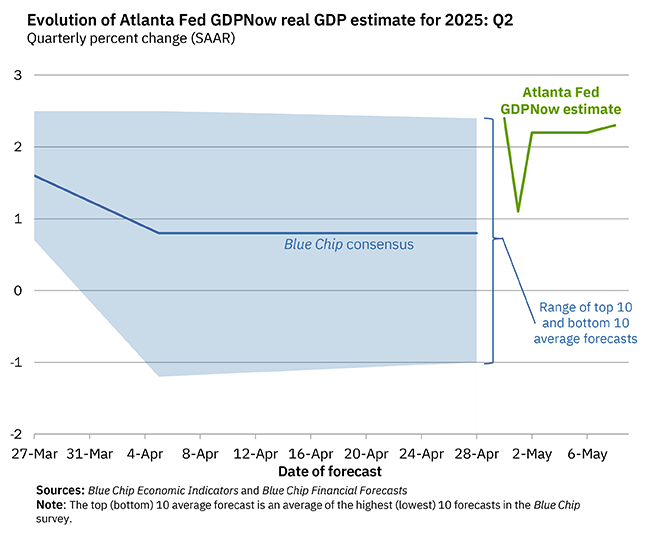
Q2 GDP Tracking: Around 2%

 Plenty of data next week!  Note that the Blue Chip consensus is wide - and currently around 1%.


From the Atlanta Fed:GDPNow

The GDPNow model estimate for real GDP growth (seasonally adjusted annual rate) in the second quarter of 2025 is 2.3 percent on May 8, up from 2.2 percent on May 6. After this morning’s wholesale trade report from the US Census Bureau, the nowcast of the contribution of inventory investment to annualized second-quarter real GDP growth increased from -0.46 percentage points to -0.43 percentage points. [May 8th estimate]

China Auto Part Makers All Of A Sudden Triple In Thailand

 Chinese auto parts makers have tripled their presence in Thailand with the arrival of BYD and other car brands, transforming the country into a key supply base for Asian markets, according to Nikkei.

And we can't help but notice the timing - with tariffs on goods coming from China through the roof - seems to be...coincidentally beneficial for Chinese corporations.

In the Eastern Economic Corridor, about two hours from Bangkok, new factories are rapidly rising. Battery maker Sunwoda Electronic is investing over $1 billion to build a lithium-ion battery plant, with mass production set for 2025. Battery cells will be made locally, and a Thai official noted it’s likely to become Southeast Asia’s first plant producing batteries from cells.

More than 20 Chinese auto brands, including BYD and Great Wall Motor, have entered Thailand.

BYD’s factory, which began production in July 2024, is becoming the hub of a growing supply chain. Alongside Sunwoda, battery makers CALB, Gotion, and SVOLT have started local production, while CATL is building a joint venture plant with Thailand’s state-owned PTT.

However it may not all be tariff related. Nikkei writes that Chinese manufacturers began accelerating their investments in Thailand around 2018, amid rising U.S.-China trade tensions.

As of March, Chinese-invested auto parts companies in Thailand reached 165—over triple the number from the end of 2017. Across Southeast Asia, Chinese companies established more than 7,000 firms by 2023, with direct investment topping a record $25 billion that year.

This growth is expected to continue. In April, Ningbo Tuopu Group announced plans to invest up to $300 million in a Thai factory, saying the move would help it “win more orders and strengthen support for important foreign customers.”

Nikkei writes that Japanese automakers, dominant in Thailand since the 1960s, have built a network of about 1,400 local suppliers through joint ventures and vertically integrated operations. In contrast, Chinese carmakers are building independent supply chains, often excluding Japanese-linked suppliers.

Chinese parts are nearly 30% cheaper than those from Japanese firms, and Chinese companies typically produce core components like batteries in-house or source them from affiliated suppliers. “Thai suppliers will not be able to fully benefit from the Chinese push into the country,” Sompol said.

A Thai Summit Group executive noted that Japanese automakers may eventually switch to lower-cost Chinese parts, which could force Japanese suppliers in Thailand to downsize or exit the market. Although Toyota and Honda still hold over 70% of Thailand’s new car market, their lead is shrinking under Chinese pressure, the report concludes. 

https://www.zerohedge.com/markets/china-auto-part-makers-all-sudden-triple-thailand