Search This Blog

Wednesday, May 14, 2025

Trump Admin Targets Nature Medicine's “Proximal Origin” Paper Dismissing Possible Wuhan Lab Accident

 by Paul Thacker

A brief flurry of media reports last month criticized letters sent to medical journals by Edward R. Martin Jr., the former interim U.S. attorney for the District of Columbia, who questioned whether journals have become “partisans in various scientific debates.” One liberal academic called the letters “fascist tactics” designed “to intimidate academic journals” triggering similar allegations across the media.

“Experts worry this will have a chilling effect on publications,” reported the New York Times, noting that an obscure journal called CHEST had been targeted.

“DOJ questions science journal about bias, triggering free-speech concerns,” reported the Washington Post, adding that three major publishers of medical journals, including the New England Journal of Medicine and Health Affairs, said they had not received letters, while publisher Springer Nature chose not to comment. NPR reported last week that the New England Journal of Medicine had in fact received a letter as had the American Medical Association’s journal JAMA.

The DisInformation Chronicle has learned that the actual target of Martin’s letters is the Nature Springer journal Nature Medicine, publisher of a highly controversial paper “Proximal Origin” which has faced charges of corruption and calls for retraction. A source inside the Department of Health and Human Services said Trump officials suspect the paper is a quid pro quo, written by the authors to dismiss the possibility of a lab accident and who then received a large grant months later from Tony Fauci.

The existence of the Nature Medicine letter has not been previously reported and is being made public for the first time. After Martin lost support among Republicans to be confirmed as U.S. attorney for the District of Columbia, President Trump picked him to head a new Weaponization Working Group inside the Justice Department.

Follow the science

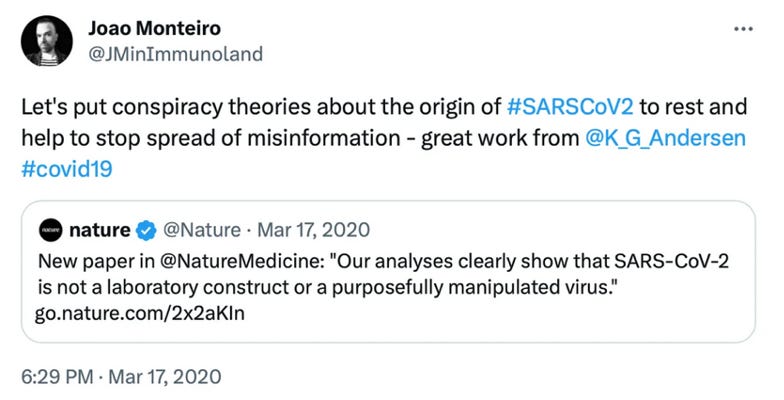
Published in the third month of the COVID pandemic and arguing “we do not believe that any type of laboratory-based scenario is plausible,” the “Proximal Origin” paper became a handy tool for NIH officials and virologists attempting to dismiss as a “conspiracy theory” claims that the pandemic could have started in a Wuhan lab funded by Fauci. Nature Medicine’s editor-in-chief, Joao Monteiro, tweeted that the paper “put conspiracy theories” about the pandemic’s possible lab origin to rest.
NIH Director Francis Collins promoted the “Proximal Origin” paper weeks after Nature Medicine published it on his March 2020 NIH Director's Blog, and Fauci then seized upon the paper during a televised White House briefing a month afterwards.

“There was a study recently that we can make available to you,” Fauci said during the White House briefing, “where a group of highly qualified evolutionary virologists look at the sequences there and the sequences in bats as they evolve and the mutations that it took to get to the point where it is now is totally consistent with a jump of species from an animal to a human.”

The paper would go on to become one of the most heavily cited scientific papers in 2020. The Nation reported in 2023 that “Proximal Origin” had been accessed online more than 5.7 million times and more than 2,000 media outlets had cited it. ABC News, for instance, ran an article titled “Sorry, Conspiracy Theorists. Study Concludes Covid-19 ‘Is Not a Laboratory Construct.’”

But by then, cracks had already appeared.

Follow the money, follow the documents

Emails made public through freedom of information act requests and by congressional investigators in 2022 showed that the papers’ authors had run it past funders—Francis Collins and Tony Fauci at the NIH, as well as with Jeremy Farrar, who was then at the Wellcome Trust. In one example, lead author Kristian Andersen with the Scripps Research Institute emailed the three funders thanking them for their “advice and leadership” and offering them a right to comment and give suggestions.
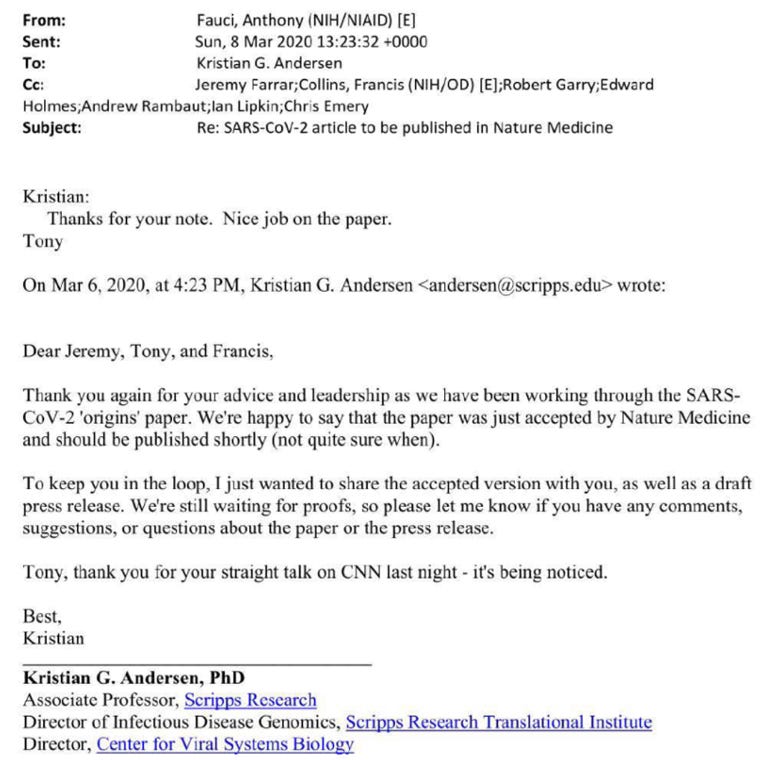
Further emails and internal slack discussions calling into question the credibility of “Proximal Origin” became public in the summer of 2023 following a congressional hearing. During the hearing, Republicans charged that Tony Fauci had helped orchestrate the paper’s publication. However, Democrats countered by releasing a report that found Wellcome Trust’s Jeremy Farrar helped “organize and facilitate” and “led the drafting process of the paper.”

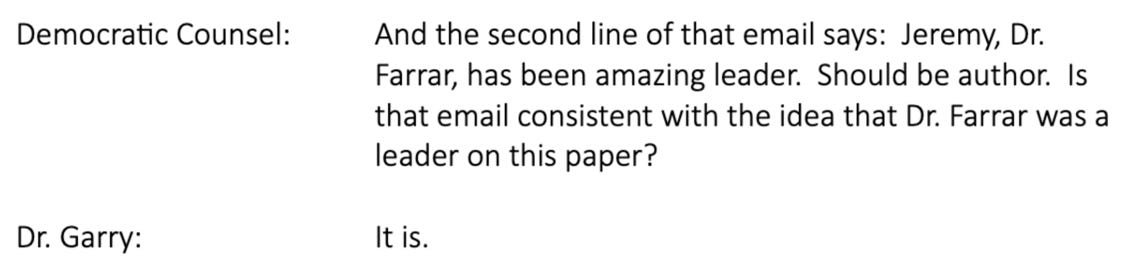
“Jeremy, Dr. Farrar has been an amazing leader,” wrote “Proximal Origin” co-author Robert Garry of Tulane University in an email released by House Democrats. “Should be author.”

When questioned about his email during a House deposition, Garry agreed that Farrar should have been listed as an author.
According to Nature’s editorial policy, “A specific role for the funder in the conceptualization, design, data collection, analysis, decision to publish, or preparation of the manuscript, should be disclosed.” However, the paper failed to note the involvement of either Fauci or Farrar, and Nature Medicine has refused to follow its own ethics guidelines.

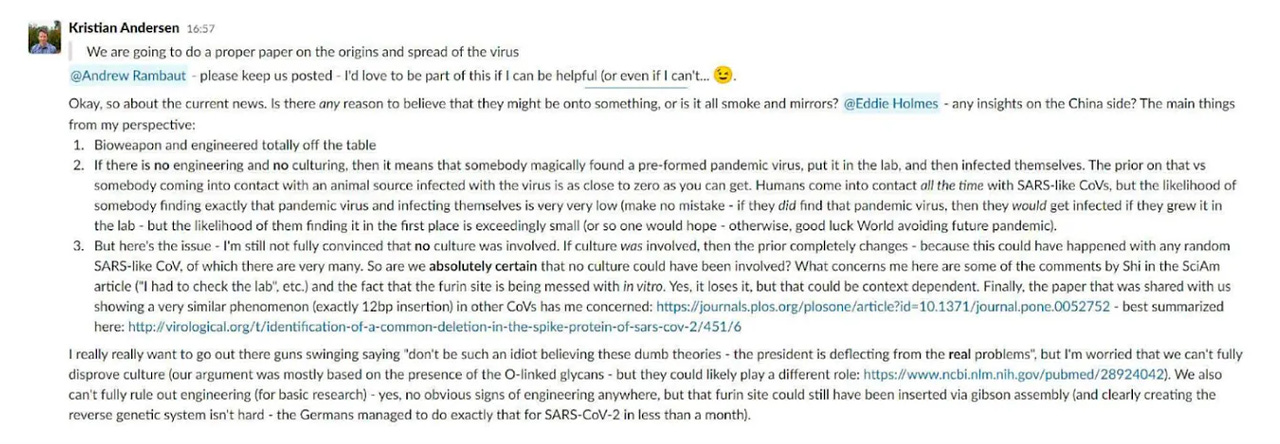
News sites the Racket and Public co-published a slack message Andersen sent to his “Proximal Origin” co-authors on April 16, 2020, a month after Nature Medicine published the paper in March 2020.

“I’m still not fully convinced that no culture was involved,” Andersen wrote his co-authors, a month after publishing the paper that concluded the virus was not a laboratory construct. “We also can't fully rule out engineering (for basic research).”
Days after the congressional hearing, the group BioSafety Now wrote a letter to Nature Medicine, signed by over 50 scientists, demanding retraction of “Proximal Origin.” The letter cited an investigation published by The Nation reporting on internal emails by the “Proximal Origin” authors that showed they didn’t even believe what they wrote in the paper.

“The main issue is that accidental release is in fact highly likely,” the Nation reported that Andersen wrote in a message to co-authors some weeks before Nature Medicine published the paper. An online campaign by BioSafety Now has since garnered over 5,700 signatures petitioning Nature Medicine to retract the paper.

In his letter to Nature Medicine, Martin wrote that he has been told that some journals “have a position for which they are advocating due to advertisement (under postal code) or sponsorship (under relevant fraud regulations).”

The letter also asks, “How do you clearly articulate to the public when you have certain viewpoints that are influenced by your ongoing relations with supporters, funders, advertisers, and others?”
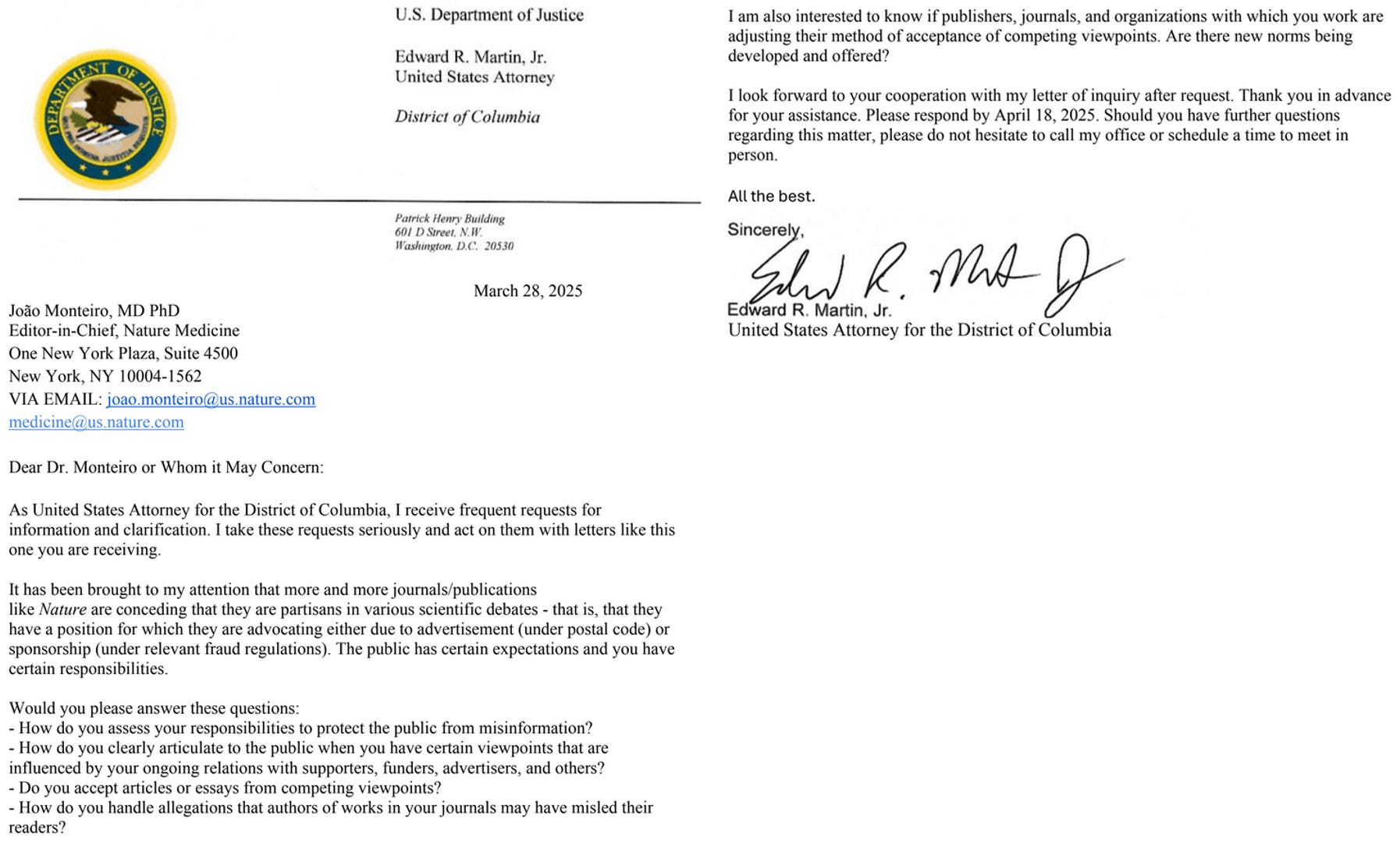
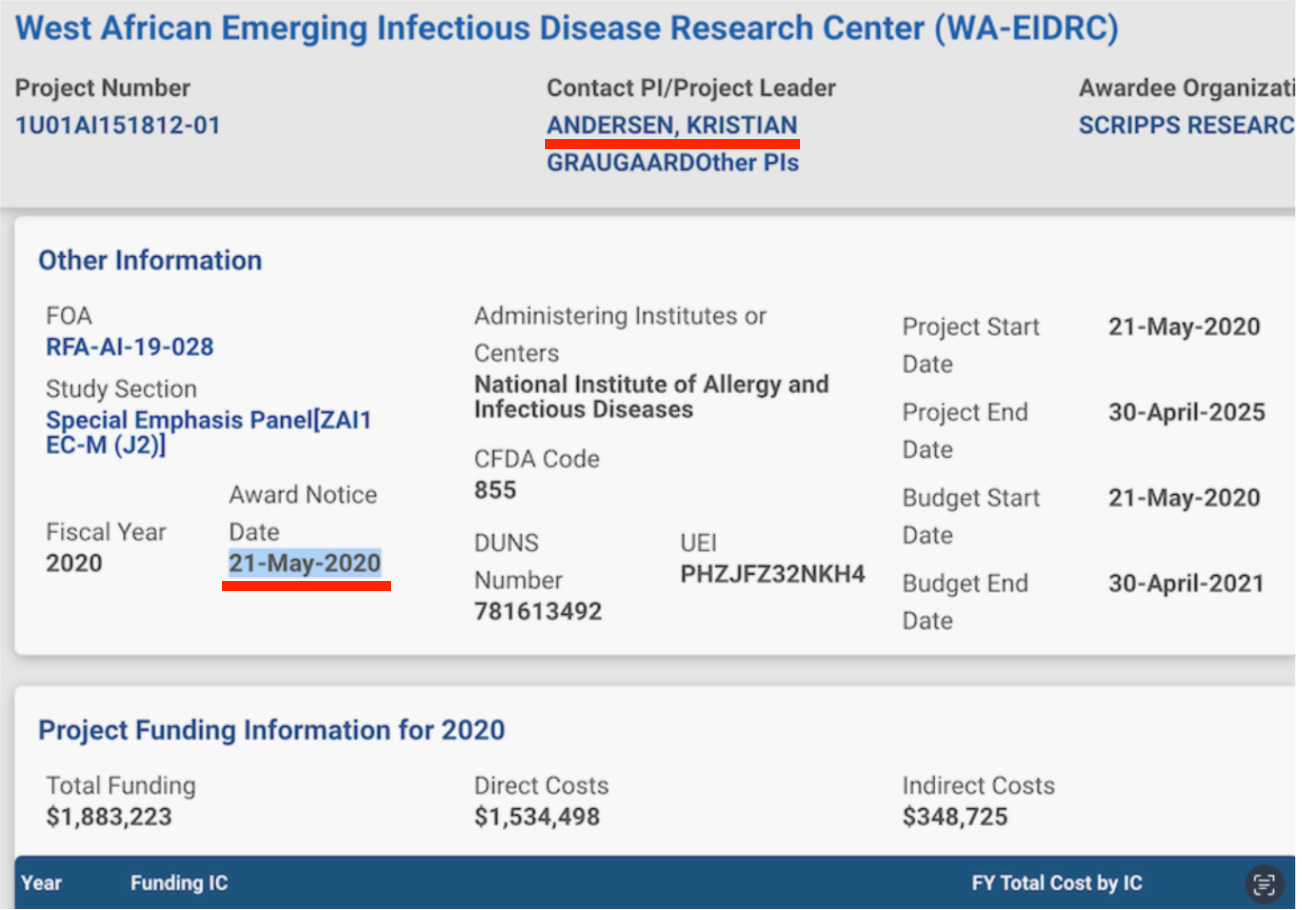
A source close to the investigation said this question pertains to a grant Fauci awarded Andersen and Garry several months after they published “Proximal Origin” dismissing the possibility of a lab accident. Allegations that this grant was a bribe from Fauci have dogged Andersen for several years, accusations which he dismissed under oath during the July 2023 congressional hearing.

“There is no connection between the grant and the conclusions we reached about the origin of the pandemic,” Andersen wrote in sworn testimony to Congress. “We applied for this grant in June 2019, and it was scored and reviewed by independent experts in November 2019.”

The Intercept later reported that Andersen “knew that was false.” NIH records show the grant to Andersen wasn’t finalized until May 21, 2020, two months after Andersen published “Proximal Origin” in Nature Medicine.
In a guest essay earlier this month for The DisInformation Chronicle, an NIH infectious disease researcher wrote that the “Proximal Origin” authors left a gaping hole in their analysis by failing to account for a common method to manipulate viruses called “serial passaging.”

“And because they didn’t discuss this very common laboratory practice, they did not ‘disprove’ a laboratory origin for the virus,” the NIH research official wrote. “I have no idea how ignoring something so obvious could make it pass peer review and get published in a prestigious journal like Nature Medicine.”

https://disinformationchronicle.substack.com/p/exclusive-trump-administration-targets

They Were Public Health Heretics. Now They Are America’s Public Health Czars

 Readers of The Free Press will be familiar with the names of the doctors just appointed to high positions overseeing the nation’s public health. Jay Bhattacharya is now the director of the National Institutes of Health; Marty Makary is the commissioner of the Food and Drug Administration; and Vinay Prasad has just been named director of the Center for Biologics Evaluation and Research—making him the nation’s top vaccine regulator.

You will recognize their names because they have been writing for The FP since The FP began.

Their voices helped set a standard for much of what we seek to do: present information and insights readers are not getting elsewhere, backed by evidence and rigorous reporting. Bhattacharya, Makary, and Prasad all raised serious questions about the lockdowns, shuttered schools, and vaccine mandates that Americans were subjected to during the Covid pandemic years.

They demanded transparency, reliable data, and common sense in policy making, instead of the fear-mongering, obfuscation, and draconian crackdowns on normal life that characterized the actions of our public health officials. For this, all three were variously disparaged and maligned. Their views were not only attacked, but suppressed by the government and social media.

Bhattacharya wrote for us about his role in creating the Great Barrington Declaration, which called for a “focused” approach to protecting those most vulnerable to Covid, while allowing normal life to go on. For this, he wrote, “I found myself smeared for my supposed political views, and my views about Covid policy and epidemiology were removed from the public square on all manner of social networks.” He became part of a lawsuit against government censorship.

Makary’s first piece for us expressed outrage at college students being treated like prisoners during Covid, and called out how unnecessary it all was: “Universities are supposed to be bastions of critical thinking, reason, and logic. But the Covid policies they have adopted—policies that have derailed two years of students’ education and threaten to upend the upcoming spring semester—have exposed them as nonsensical, anti-scientific, and often downright cruel. Some of America’s most prestigious universities are leading the charge.”

Prasad wrote a piece for us in 2022 that presciently described some of the decisions he will be making in his new job. He wrote about the folly and consequences of pushing unnecessary Covid vaccines on children: “In an effort to encourage Covid-19 vaccination, the Centers for Disease Control and Prevention may wind up lowering vaccination rates for polio and measles. Why? Because by adding Covid-19 shots to the schedule, the CDC is tacitly implying that this new vaccine is as important to kids as the combination MMR one. This is absolutely false.”

Now these three have the opportunity to see their vision enacted—one that encourages honesty with the public instead of condescension, and that takes seriously the conviction that a scientific culture that encourages dissent will have a better chance of arriving at the truth than one that squelches it.

Carrying this out won’t be easy. We have deep concerns that this administration’s approach to reform often uses a hacksaw when a scalpel is called for. But we know that these accomplished scientists will take with great seriousness their mandate to restore our trust in public health.

Jay Bhattacharya, Marty Makary, and Vinay Prasad together wrote or were mentioned in almost three dozen Free Press stories over the years, in addition to their various appearances on Honestly or in our community-wide conversations.

We’re proud to present this compendium [MORE]

https://www.thefp.com/p/ahead-of-the-curve

China Suspends Export Controls, Sanctions Over US Entities


China will suspend export controls and sanctions called the unreliable entity list over US entities, which were announced in April, as part of the trade agreements made by the world’s two biggest economies.

The suspensions start Wednesday and will last for 90 days.

https://www.bloomberg.com/news/articles/2025-05-14/china-suspends-export-controls-sanctions-over-us-entities

Animal Spirits

 By Benjamin Picton, Senior Market Strategist At Rabobank

Animal Spirits

The NASDAQ and S&P500 pumped higher yesterday as trade war détente and a lower-than-expected US CPI print fuelled optimism. The S&P500 is now in the black year-to-date and the NASDAQ is in bull market territory, despite the index remaining south of where it was on January 1st. Crude oil extended gains for a fourth-straight session, rising 2.57%, and yields on 10-year Treasuries finished mostly unchanged after trading in a 6bp range.

US April CPI came in at 0.2% M-o-M for both the headline and core measurements. This takes year-on-year CPI down to 2.3%, versus an expected reading of 2.4%. Core services (shelter, principally) was the main driver of price rises, followed by energy as a ~$10/bbl fall in crude over the course of the month was more than offset by rising electricity and natural gas prices. Core goods barely registered and food prices declined. Egg prices fell by 12.7%, the largest monthly fall since 1984, which will no doubt please a President who has elevated the price of eggs as an indicator of economic policy competence.scr

Digging through the entrails, there were some hints of potential tariff impacts on prices. Audio equipment experienced its largest-ever monthly rise (8.8%) and price rises for home furnishings were up 1% after remaining flat in March. On the flip side, apparel prices actually fell during the month despite sharp falls in the Dollar spot index over the course of both March and April. Taken together with tariffs, a weaker Dollar would usually be suggestive of higher prices for imported goods.

It's hard to separate the signal from the noise here because there are a lot of uncertainties at play. Consumer prices for products sold in April likely relate to stock that was brought into the country during the import surge before Liberation Day. This means that the cost basis of many of these products will not include the April tariff impact. Additionally, the influence of a weaker US Dollar over the course of March and April may be mitigated to some degree by importers forward-hedging foreign exchange exposures. There is also the possibility of both exporters and importers “eating” some of the impact of the tariffs through lower export prices and lower importer margins. Trump and Bessent have both claimed that it would be the exporters who wear the brunt of tariff impacts, but this will ultimately depend on the price elasticity of demand for individual goods.

OIS futures are now pricing 53bps worth of easing in the Fed Funds rate by year end compared to 66.5bps at the end of last week. That was before the 90-day reduction in tariffs was agreed between the United States and China. The September FOMC meeting remains the first meeting that is fully-priced for a cut, but pricing has declined from -35.3bps on Friday to -25.8bps as of this morning. Clearly, while equity markets are welcoming the better than expected CPI result, the vagaries of trade policy are a more important influence on the path of the Fed Funds rate.

That brings us back to the point that economics and markets cannot be taken as an abstraction from everything else that is going on, because we actually live in a world of political economy. On that score, President Trump arrived in Riyadh yesterday and swiftly announced that Saudi Arabia will be investing $1 trillion in the United States. The real figure is disputed and might be $600 billion (as announced by the White House) or as low as $300 billion. According to a White House fact sheet the deal includes a $142 billion defence sales agreement that will see new aerospace and missile defence equipment sold to Saudi Arabia.

Trump also announced during the visit that the United States will be lifting sanctions on Syria, apparently at the urging of Saudi Crown Prince Mohammed Bin Salman and Turkish President Erdogan. Saudi Arabia and Turkey had been two of the parties backing Syrian rebels (along with Qatar, who are gifting the USA a luxury jet) against the Iran and Russia-backed Assad regime. Is the United States now encouraging development to fill a regional power vacuum in a similar vein to what it did post-WWII? Is it a coincidence that the US Treasury Department just announced sanctions on more than 20 companies it claims have been involved in shipping Iranian crude oil to China (a key backer of both Iran and Russia)?

This comes as China criticizes the terms of the recent trade agreement struck between the United Kingdom and the United States. Much has been made of the agreement’s limited impact in economic terms, but China’s Foreign Ministry seems to think that the agreement is substantive from a geopolitical perspective, and freezes China out from investment and trade opportunities in the UK.

So, the question now is: has the UK signed up for the worst trade deal in the history of trade deals? Or will other countries end up signing similar agreements that likewise seek to isolate Chinese trade and supply chain interests?
Animal spirits may be back as markets rejoice at trade détente for the time being, but all of the elements that led to trade conflict in the first place are still present.
