Search This Blog

Thursday, May 15, 2025

Zenas BioPharma May 2025 slides: key data readouts expected by year-end


Introduction & Market Context

Zenas BioPharma (NASDAQ:ZBIO) presented its corporate overview on May 15, 2025, highlighting progress on its lead candidate Obexelimab, a novel B cell inhibitor being developed for multiple autoimmune indications. The company’s stock closed at $8.68, down 4.51% on the day, with a 52-week range of $5.83-$26.25, suggesting investor caution despite the promising pipeline developments.

Executive Summary

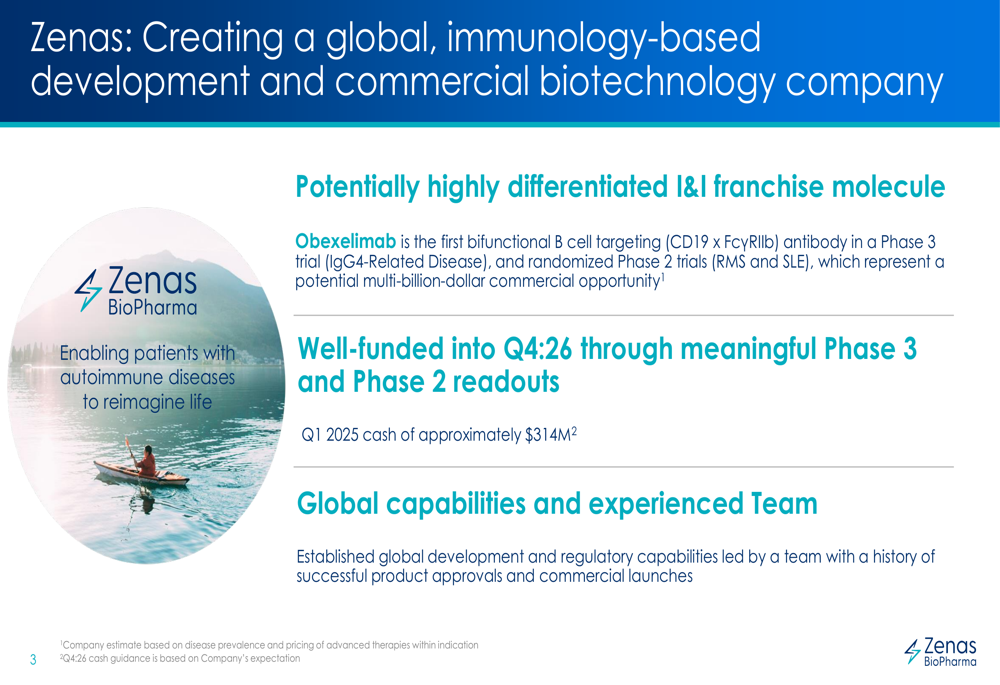
Zenas positions itself as a global, immunology-focused biotechnology company with a differentiated approach to treating autoimmune diseases. The company’s lead asset, Obexelimab, is a bifunctional antibody targeting CD19 and FcγRIIb on B cells, designed to inhibit rather than deplete these cells. With approximately $314 million in cash as of Q1 2025, Zenas reports being funded through Q4 2026, covering all planned clinical readouts.

As shown in the following company overview slide, Zenas highlights Obexelimab’s potential as a franchise molecule across multiple indications:
Strategic Initiatives: Novel B Cell Inhibition Approach

Zenas’s core strategy centers on Obexelimab’s differentiated mechanism of action. Unlike current B cell therapies that deplete cells through CD20 or CD19 targeting, Obexelimab inhibits B cell function through co-engagement of CD19 and FcγRIIb, potentially offering improved efficacy in tissues and a better safety profile.

The following comparison table illustrates Obexelimab’s potential advantages over existing therapies:
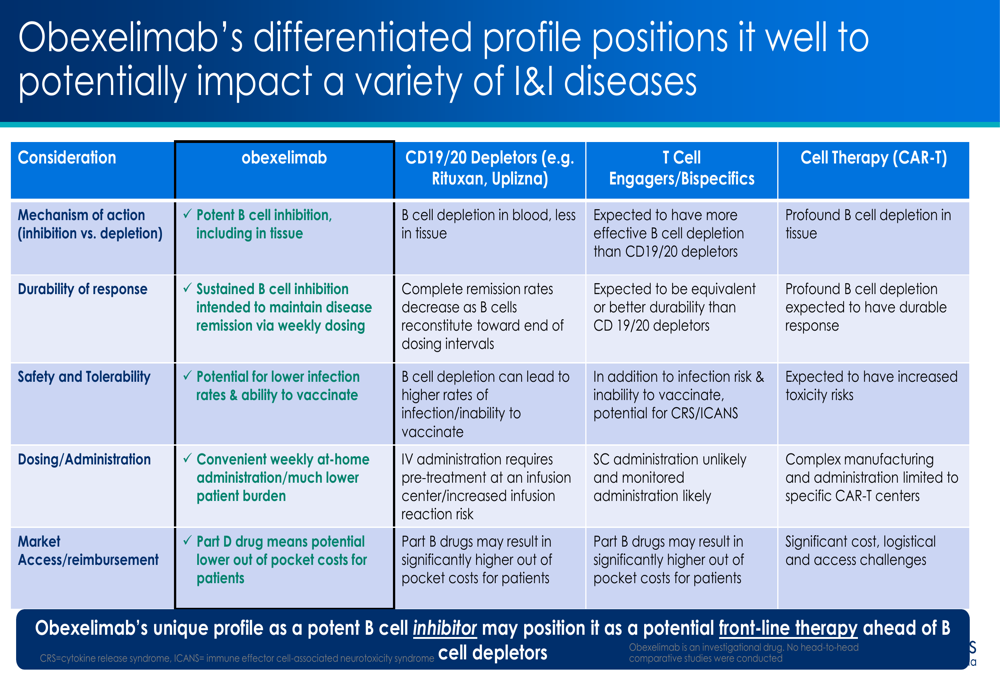
This differentiated profile could position Obexelimab as a front-line therapy ahead of B cell depletors in multiple indications. The company emphasizes that Obexelimab’s weekly subcutaneous self-administration offers convenience advantages over intravenous therapies, while potentially maintaining effective disease control with a favorable safety profile.

Detailed Pipeline Analysis

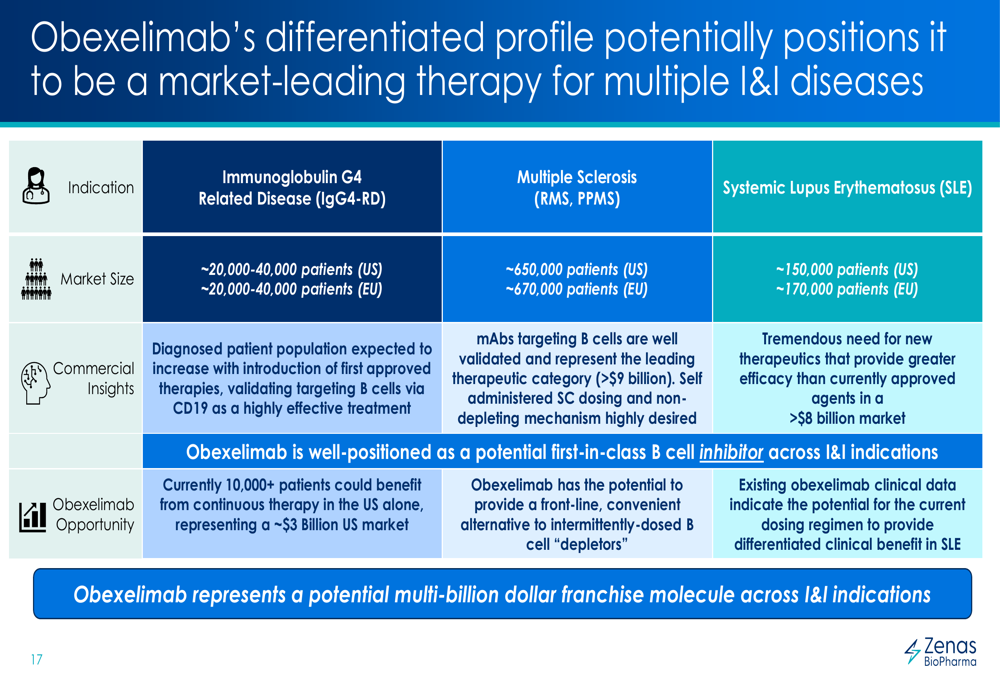
Zenas is pursuing a three-pronged development strategy for Obexelimab, targeting IgG4-Related Disease (IgG4-RD) as a fast-to-market orphan indication, while simultaneously advancing into larger markets with Multiple Sclerosis (MS) and Systemic Lupus Erythematosus (SLE).

The market potential across these indications is substantial, as illustrated in this market overview:
IgG4-Related Disease (IgG4-RD)

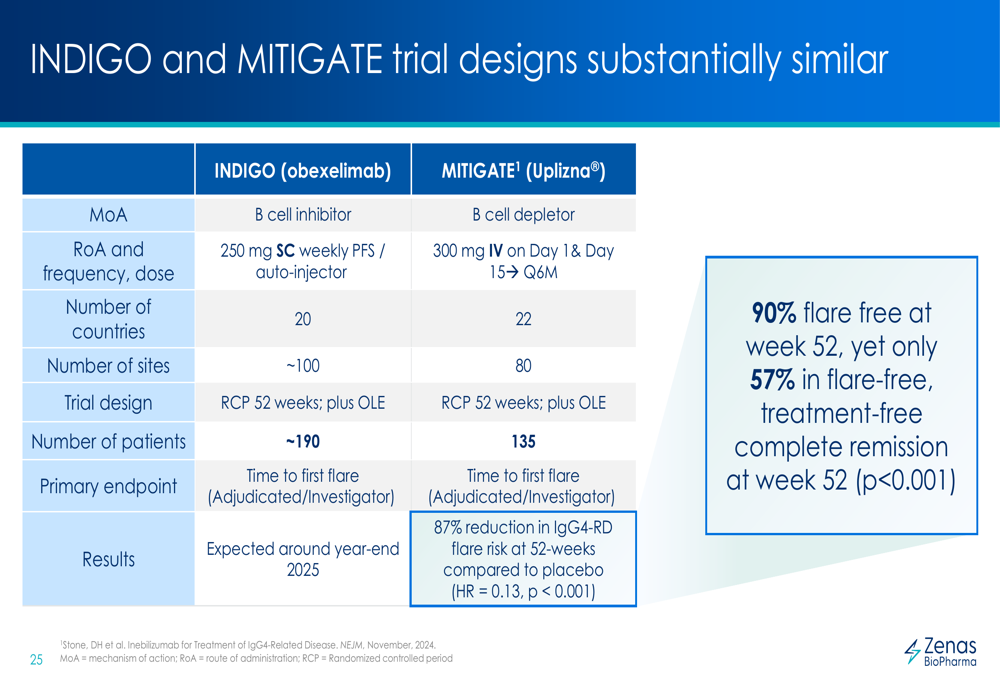
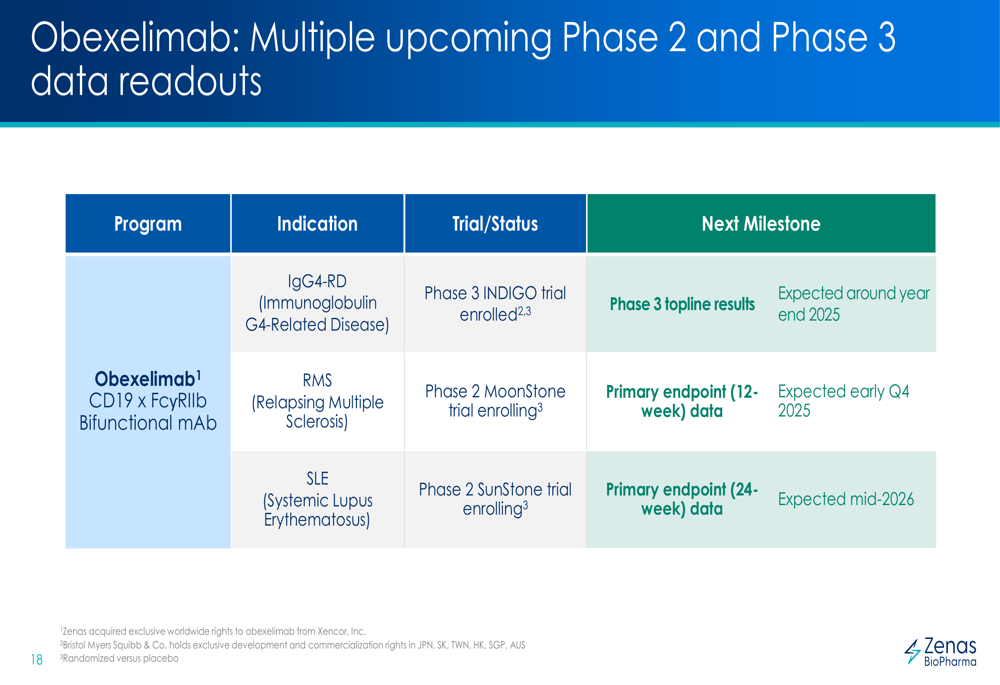
The Phase 3 INDIGO trial for IgG4-RD has completed enrollment, with topline results expected around year-end 2025. This pivotal trial follows encouraging Phase 2 results where 100% of patients who completed the trial met the primary endpoint, with 93% showing ongoing response at the end of the trial.

The INDIGO trial design is being compared to the recently completed MITIGATE trial of a competing therapy:
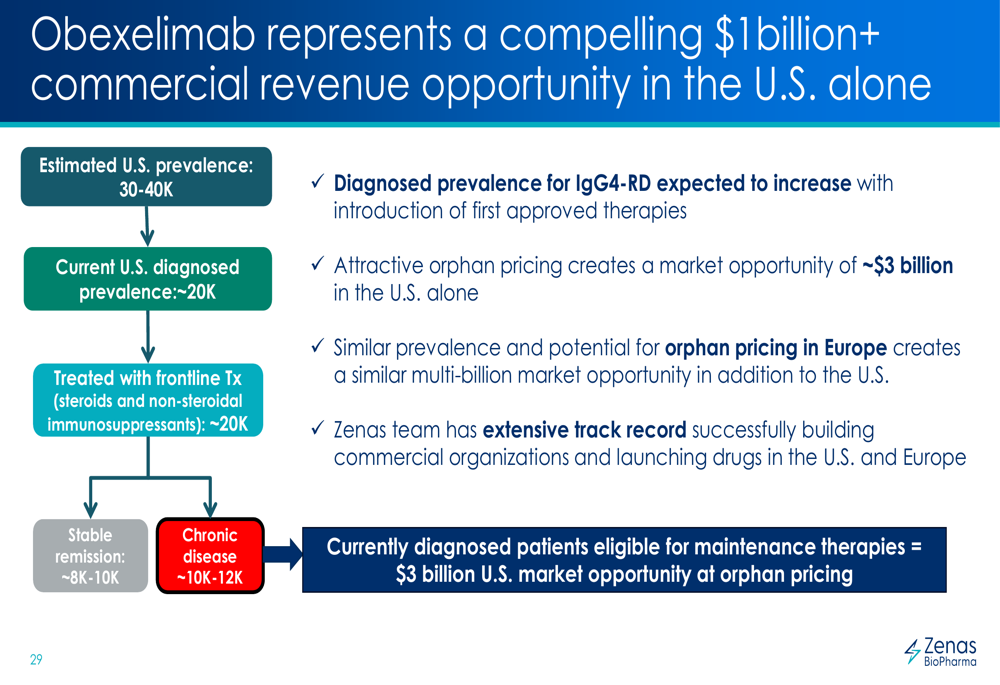
Zenas estimates the U.S. IgG4-RD market opportunity at approximately $3 billion, based on orphan pricing and a diagnosed prevalence of around 20,000 patients, with similar potential in Europe.
Multiple Sclerosis (MS)

For MS, Obexelimab is being positioned to compete in a market dominated by B cell-targeting therapies that collectively generate over $9 billion in annual sales. The Phase 2 MoonStone trial is currently enrolling patients with relapsing MS, with results expected in early Q4 2025.

Systemic Lupus Erythematosus (SLE)

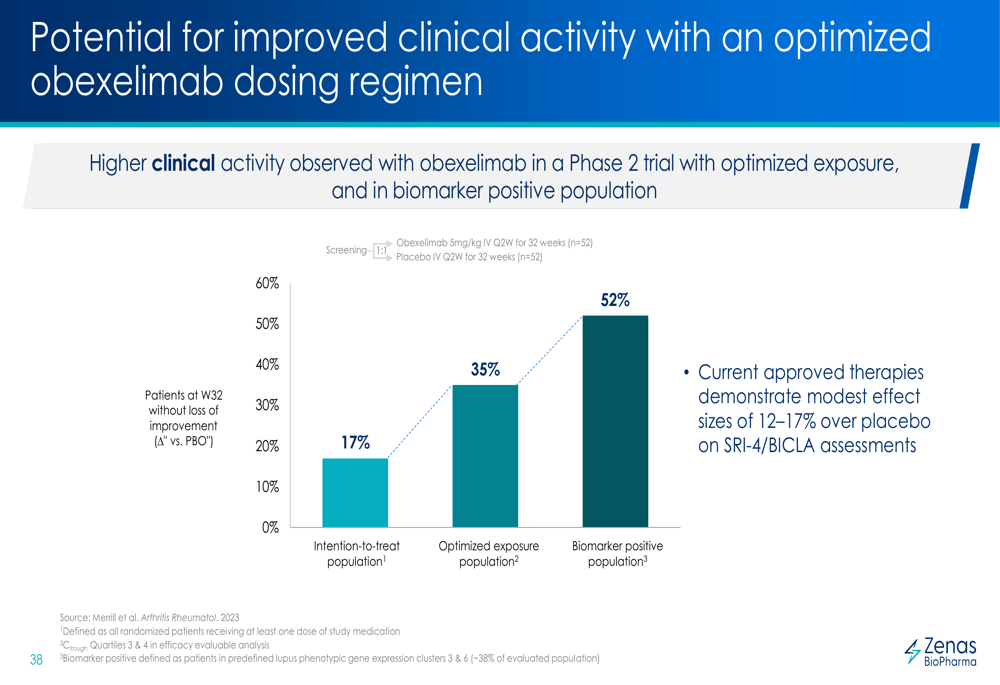
The Phase 2 SunStone trial in SLE is also enrolling, with results expected by mid-2026. Previous Phase 2 data showed promising results, particularly in biomarker-positive populations:

Forward-Looking Statements

Zenas has outlined a clear timeline for upcoming clinical readouts across its pipeline:
These data readouts represent significant potential catalysts for the company over the next 12-18 months. Additionally, Zenas has secured a strategic collaboration with Bristol Myers (NYSE:BMY) Squibb, which includes rights to develop and commercialize Obexelimab in Japan, South Korea, Taiwan, Singapore, Hong Kong, and Australia, along with $50 million upfront and a $20 million equity investment.

Competitive Industry Position

Zenas’s management team brings substantial industry experience, with collective involvement in over 70 IND filings, 30+ BLA/NDA filings, and 30+ commercial product launches.

[MORE}

https://www.investing.com/news/company-news/zenas-biopharma-may-2025-slides-key-data-readouts-expected-by-yearend-93CH-4048123

'Bayer (BAYZF) Faces Potential R&D Impact Amid Tariff Concerns'


Potential Impact of Tariffs on Bayer's R&D

Bayer (BAYZF) has recently highlighted concerns regarding the proposed tariffs on pharmaceuticals, emphasizing their potential to dramatically affect the company's research and development (R&D) budget. The pharmaceutical giant underscores that for every dollar allocated to tariffs, there is a corresponding reduction in funding available for innovation, a critical component of Bayer's growth strategy.

Looking Beyond 2026: Strategic Preparation

Although Bayer does not anticipate immediate repercussions from these tariffs, the company is not resting on its laurels. Instead, it is gearing up for possible challenges that could emerge beyond 2026. To this end, Bayer is making strategic adjustments to its supply chain, aiming to mitigate the future risks associated with these proposed tariffs.

By proactively managing their supply chain and financial strategies, Bayer is taking deliberate steps to safeguard their innovation pipeline and ensure long-term stability. Investors should watch how effectively Bayer navigates these potential hurdles, which could ultimately influence the company's market performance.

https://www.gurufocus.com/news/2867333/bayer-bayzf-faces-potential-rd-impact-amid-tariff-concerns

Walmart stock drops as it signals price hikes due to 'magnitude' of Trump tariffs

Walmart (WMT) posted a mixed quarterly print Thursday morning as it navigates President Trump's tariffs.

Its Q1 revenue jumped 2.5% to $165.6 billion, missing Wall Street expectations of $166.02 billion. Adjusted earnings per share grew 1.7% year over year to $0.61, beating estimates of $0.58. US same-store sales also beat expectations with a 4.5% increase, led by health and wellness, and groceries.


But Walmart stock dropped 5% in early trading as it signaled more pain ahead.

"We will do our best to keep our prices as low as possible, but given the magnitude of the tariffs, even at the reduced levels announced this week, we aren't able to absorb all the pressure given the reality of narrow retail margins," Walmart CEO Doug McMillon said in the release. He added on the earnings call that tariffs have already led to price increases in April and May.


McMillon said the "reset of costs" will continue throughout the year, adding for an "imported item, you pay the tariff at the time it comes through customs ... even if the tariff rate comes down later, the cost has been elevated."

Robert Ohmes of Bank of America estimates Walmart imports roughly 15% of its US sales from China. Around 60% of the US sales are groceries, which are largely tariff-exempt if they're produced domestically or in Mexico and Canada.

McMillon said that "tariffs on countries like Costa Rica, Peru, and Colombia are pressuring imported items like bananas, avocados, coffee, and roses."


He added that the company is trying to "keep food prices as low as possible," and hopes it can get help from policy changes.

In the quarter, adjusted operating income growth of 2.8% beat its guidance of 0.5% to 2%, though it had walked that range down last month. Prior to Trump's "Liberation Day" announcement, Walmart had guided to annual adjusted operating profit growth of 3.5% to 5.5% on a Feb. 20 earnings release.


The company expects net sales for the second quarter to increase 3.5% to 4.5%. It did not provide guidance for adjusted earnings or operating income, as "the dynamic nature of the backdrop" makes it "exceedingly wide and difficult to predict," Rainey said in the release.

For the full year, the company reiterated its conservative 2026 fiscal year guidance. It projects net sales to increase between 3% and 4%, in line with a target of 4% annual sales growth it laid out years ago.

Telsey Advisory Group's Joe Feldman wrote in a note to clients that the retailer is expected to "weather the pressure better than most."


Prior to earnings, Walmart stock was up 7.3% year to date and up more than 4% in the last month as investors have sought out safe havens. That's compared to the S&P 500 (^GSPC) remaining flat year to date and a 30% drop for Target (TGT).

https://finance.yahoo.com/news/walmart-stock-drops-as-it-signals-price-hikes-due-to-magnitude-of-trump-tariffs-110354897.html

"A Modest Request": The Supreme Court Hears Challenge To National Or Universal Injunctions

 by Jonathan Turley,

Today, the United States Supreme Court will hear three consolidated cases in Trump v. CASA on the growing use of national or universal injunctions. This is a matter submitted on the “shadow docket” and the underlying cases concern the controversy over “birthright citizenship.” However, the merits of those claims are not at issue. Instead, the Trump Administration has made a “modest request” for the Court to limit the scope of lower-court injunctions to their immediate districts and parties, challenging the right of such courts to bind an Administration across the nation

The case is the consolidation of three matters: Trump v. CASA out of  Maryland; Trump v. Washington out of Washington State, and Trump v. New Jersey, out of Massachusetts. These cases also present standing issues since the Administration challenges the argument that there is a cognizable “injury” to individuals who may travel to the states bringing the actions.

However, the main question is the scope of injunctions.

As I have previously written, district court judges have issued a record number of injunctions in the first 100 days of the Trump Administration. 

Under President George W. Bush, there were only six such injunctions, which increased to 12 under Obama. 

However, when Trump came to office, he faced 64 such orders in his first term.

When Biden and the Democrats returned to office, it fell back to 14

That was not due to more modest measures. 

Biden did precisely what Trump did in seeking to negate virtually all of his predecessors’ orders and then seek sweeping new legal reforms. He was repeatedly found to have violated the Constitution, but there was no torrent of preliminary injunctions at the start of his term.

Yet, when Trump returned to office, the number of national injunctions soared again in the first 100 days and surpassed the number for the entirety of Biden’s term.

This is a rare argument. 

First, it is a shadow docket filing that usually results in summary decisions without oral argument. Moreover, this matter came after what is commonly viewed as the final day for oral arguments. The Court granted a rare late oral argument, reflecting that multiple justices view this matter sufficiently serious to warrant a break from standard operating procedures.

Rather than arguing a “question presented” on birthright citizenship, the Administration is solely looking for limits on the district courts as appeals continue on the “important constitutional questions” raised by birthright citizenship.

The Administration argues that the Constitution does not give judges the power to issue universal injunctions and that courts are limited to addressing the cases before them in a given district. The Administration acknowledges that class actions can create the basis for universal injunctions, offering a moderate resolution to the Court. In such cases, if the parties can meet the standard for a national class, they can seek a national or universal injunction.

In today’s arguments (which I will be covering for Fox and on X), we can expect to hear from justices who have previously been critical of universal injunctions, including Justice Clarence Thomas, who, in his concurring opinion in Trump v. Hawaii, called them “legally and historically dubious.”

Likewise, Justices Gorsuch and Alito have criticized such injunctions. In a prior dissent to an emergency filing in Department of State v. AIDS Vaccine Advocacy Coalition, Alito was joined by Thomas, Gorsuch, and Kavanaugh in stating that the government “has a strong argument that the District Court’s order violates the principle that a federal court may not issue an equitable remedy that is ‘more burdensome than necessary to’ redress the plaintiff’s injuries.”

Many of us will be watching three members the most closely: Chief Justice John Roberts and Associate Justices Elena Kagan and Amy Coney Barrett. Roberts is the ultimate institutionalist, and we should see in his argument how he views the impact of such injunctions on the court system as a whole. He is very protective of the courts’ inherent authority but may also have misgivings about the scope of these orders.

During the Biden Administration, Justice Kagan has previously criticized universal injunctions. In an interview at Northwestern University Law School, Kagan flagged the “forum shopping” by litigants in filing cases before favorable courts:

“You look at something like that and you think, that can’t be right. In the Trump years, people used to go to the Northern District of California, and in the Biden years, they go to Texas. It just can’t be right that one district judge can stop a nationwide policy in its tracks and leave it stopped for the years that it takes to go through the normal process.”

Justice Barrett previously joined with Kavanaugh in stating that the power of district courts to enter a universal injunction “is an important question that could warrant our review in the future.”

The argument today will start at 10 am and I will be doing a running review of the arguments on X.

U.S. Solicitor General D. John Sauer will argue the government’s case.

Jeremy Feigenbaum, New Jersey’s solicitor general, will argue for the state and local governments and  Kelsi Corkran, the Supreme Court director at Georgetown’s Institute for Constitutional Advocacy and Protection, will argue for the private individuals and groups.

Jonathan Turley is the Shapiro Professor of Public Interest Law at George Washington University where he teaches a course on the Supreme Court and the Constitution.

https://www.zerohedge.com/political/modest-request-supreme-court-hears-challenge-national-or-universal-injunctions

Coinbase Hacked After Attackers Bribed Company's Own Employees To Leak Customer Data

 Coinbase, the world’s third-largest cryptocurrency exchange, was hit by a $20 million extortion attempt after cybercriminals recruited "multiple contractors or employees working in support roles outside the United States to collect information from internal Coinbase systems to which they had access", and to leak user data, the company said according to CoinTelegraph.

According to a May 15 blog post and an 8K filing with the SEC, Coinbase said a group of external actors bribed and coordinated with several customer support contractors to access internal systems and steal limited user account data.

“These insiders abused their access to customer support systems to steal the account data for a small subset of customers,” Coinbase said. In an email to clients, the exchange said that the leaked information "did not include your password, seed phrase, private keys, or any other information that would allow someone to directly access your account or your funds and Coinbase Prime was untouched"; but the hack could have included information like:

  • Personal identifiers (e.g., name, date of birth, masked social security numbers (last 4 digits), masked bank account numbers and some bank account identifiers, address, phone number, email address)
  • Images of Government identification information (e.g., driver’s license number, passport number, national identity card number)
  • Account information (e.g., transaction history, balance, transfers, date you opened your account)
Less than 1% of Coinbase’s monthly transacting users’ data was affected by the attack, the company said.

After stealing the data, the attackers attempted to extort $20 million worth of Bitcoin from Coinbase in exchange for not disclosing the breach. Coinbase refused the demand. Instead, the company offered a $20 million reward for information leading to the arrest and conviction of those responsible for the scheme.

In 2024, Coinbase was the most impersonated cryptocurrency brand by scammers.

Coinbase said it will reimburse users who were tricked into sending cryptocurrency to phishing scammers, with expected remediation and reimbursement expenses ranging from $180 million to $400 million.

The crypto exchange disclosed the estimate in an 8-K filing with the US Securities and Exchange Commission on May 15, noting the expenses relate to “voluntary customer reimbursements” and other remediation efforts.

    The attackers have been approaching the exchange’s overseas customer support agents for months, aiming to “bribe” them in exchange for customer information, said Coinbase co-founder and CEO Brian Armstrong in a May 15 X post.

    The exchange said that following the attack it would strengthen its internal data management processes and relocate some of its customer support operations to avoid similar incidents.

    Social engineering schemes are a growing concern for Coinbase users. Blockchain security analyst ZachXBT estimated that users lost around $45 million to phishing schemes in the week leading up to May 7.

    The blockchain security analyst previously claimed that social engineering scams cost Coinbase users over $300 million annually, Cointelegraph reported on Feb. 4.

    https://www.zerohedge.com/markets/coinbase-hacked-after-attackers-bribed-companys-own-employees-leak-customer-data

    White House Has Presented Iran With Written Nuke Deal Proposal In Huge First

     Update(10:30ET): With President Trump and his envoy having arrived in the United Arab Emirates (UAE) for the last leg of the president's Gulf tour, new details of behind the scenes US-Iran negotiations have come to light on Thursday.

    In a huge first, the Trump White House has sent Iran a written proposal toward forging a new nuclear deal. White House envoy Steve Witkoff has led several rounds of talks, and Axios has revealed that the communication was issued to Tehran last Sunday.

    "Iranian Foreign Minister Abbas Araghchi took the proposal back to Tehran for consultations with Supreme Leader Ali Khamenei, President Masoud Pezeshkian and other top officials," writes Axios.

    It was the Iranian side which initiated the swap of written proposals first, as the talks which have been on since April went from 'indirect' to more 'direct':

    • During the third round of talks in late April, Araghchi gave Witkoff an updated document with Iranian ideas for a nuclear deal. This time, Witkoff took the document.
    • A U.S. team of experts studied it and sent the Iranians a list of questions and requests for clarification. The Iranians replied and added questions of their own, two sources said.
    • Meanwhile, Witkoff and his team prepared a U.S. proposal laying out the Trump administration's parameters for an Iranian civilian nuclear program and requirements for monitoring and verification, the sources said.

    It appears that thus far both sides have received the other's written proposals positively, and that's what was driving President Trump's "olive branch" comments on Tuesday. He had stressed while speaking in Saudi Arabia that "this is not an offer that will last forever. The time is right now for them to choose."

    President Trump followed up on Thursday by saying from Qatar,  "We're in very serious negotiations with Iran for long-term peace," according to AFP.

    He said, "We're getting close to maybe doing a deal without having to do this... there (are) two steps to doing this, there is a very, very nice step and there is the violent step, but I don't want to do it the second."

    Trump's comments followed an NBC News interview with Ali Shamkhani, a top political, military and nuclear adviser to Iranian Supreme Leader Ayatollah Ali Khamenei, who said Tehran is prepared to sign a nuclear deal—provided key conditions are met—in exchange for the lifting of U.S. economic sanctions. 

    NBC News pointed out that Shamkhani's comments "appear to be the clearest public statement yet on Iran's expectations and willingness to reach a deal from the supreme leader's inner circle." 

    And the fact that written proposals have already been exchanged is yet further confirmation of this positive trend towards peace. Trump has emphasized that Iran can never have a nuclear bomb, but Tehran itself has long said it's not pursuing a nuke, and that its program is only for peaceful domestic energy purposes.

    * * *

    Brent crude prices fell on Thursday as geopolitical risk premiums eased following President Trump's comments during his Gulf tour, where he signaled that the U.S. is nearing a nuclear deal with Iran. Unlike earlier headlines on AI, defense, and aviation deals with Saudi Arabia and Qatar, Trump's comments suggested a potential breakthrough in U.S.-Iran nuclear talks.

    "We're in very serious negotiations with Iran for long-term peace," Trump told reporters in a press pool that AFP News first reported. 

    Speaking in Doha, Qatar, during his Middle East trip, the president said, "We're getting close to maybe doing a deal without having to do this... there (are) two steps to doing this, there is a very, very nice step and there is the violent step, but I don't want to do it the second way."

    An Iranian source told Reuters that negotiations with Trump administration officials still needed to bridge some gaps before a final deal could be reached. 

    Trump's comments followed an NBC News interview with Ali Shamkhani, a top political, military and nuclear adviser to Iranian Supreme Leader Ayatollah Ali Khamenei, who said Tehran is prepared to sign a nuclear deal—provided key conditions are met—in exchange for the lifting of U.S. economic sanctions. 

    NBC News pointed out that Shamkhani's comments "appear to be the clearest public statement yet on Iran's expectations and willingness to reach a deal from the supreme leader's inner circle." 

    Trump has offered "an olive branch" to Tehran after a multi-month maximum-pressure campaign, including economic sanctions and deploying long-range stealth bombers to America's "unsinkable aircraft carrier" - located in the Indian Ocean - ready to be deployed at a moment's notice.

    However, last week, ahead of Trump's Gulf tour, we spotted at least one of these stealth bombers returning to the U.S. We suggested this may have been an act of goodwill ahead of talks by the U.S. or possibly just a routine flight.  

    On Thursday, Brent crude futures fell 3% to $60 a barrel on expectations that a U.S.-Iran nuclear deal would ease sanctions and increase crude oil on international markets.

    "The overnight development of a possible nuclear deal is the sole reason for the morning's weakness. If an agreement is reached, Iran agrees to halt enriching weapon grade uranium and the deal is effectively enforced, which is hard to believe, then the Persian Gulf country's crude oil exports can rise by as much as 1 [million barrels per day]," PVM analyst Tamas Varga told CNBC in an emailed statement. 

    "It sounds price negative, but its impact will possibly be mitigated by OPEC+ rolling back on its plan to release barrels back to the market faster than originally planned," he added.

    Goldman trader Rich Privorotsky commented on the development: 

    Staying with geopolitics there are some rather positive stories emanating out of Iran. "Iran is ready to sign a nuclear deal with certain conditions with President Donald Trump in exchange for lifting economic sanctions, a top adviser to Iran's supreme leader told NBC News on Wednesday." Unclear if the U.S. will agree to the terms but they seem fairly broad: "He said Iran would commit to never making nuclear weapons, getting rid of its stockpiles of highly enriched uranium which can be weaponized, agree to only enrich uranium to the lower levels needed for civilian use, and allow international inspectors to supervise the process, in exchange for the immediate lifting of all economic sanctions on Iran." (NBC news) If confirmed I think oil could eventually end up heading back to the recent lows and I would continue to express any cyclical concerns in this space.

    Here's the latest commentary from UBS traders:

    Oil Equity Resilience Amid Oil Price Drop Oil prices are down, mainly because of a potential deal with Iran. That could mean up to 500kb/d increased supply coming to market very quickly. Oil equities, however, are already underweight for generalists and specialists have already de-grossed, following the OPEC+ surprises so far this year - hence oil equities are proving to be relatively resilient even though the oil price is down.

    If Trump secures a nuclear deal with Tehran, it would cap off a week of landmark agreements with Gulf nations—collectively worth trillions—and add to an already bullish news cycle for the president. Also, this would mean continued easing of geopolitical risk premiums in the region, in other words, lower energy prices for Trump to pursue his 'America First' agenda.