Search This Blog

Tuesday, June 17, 2025

New analysis projects Social Security's COLA for 2026 will be higher than previous estimates

 A new analysis projects the Social Security Administration's (SSA) cost-of-living adjustment (COLA) for next year will be higher than previously projected.

The Senior Citizens League (TSCL) released its estimate for the 2026 COLA based on May inflation data and projected that it will be 2.5%, up from the prior month's estimate of 2.4% and the March estimate of 2.3%. That marks the fourth consecutive month the TSCL model showed a higher COLA for next year.

The SSA adjusts the benefits paid to beneficiaries every year to account for the effect of inflation on consumer prices. The higher inflation, the larger the benefit increase.

The COLA for 2025 was 2.5%, which was the lowest annual increase since 2021, when an inflationary cycle began that peaked at a 40-year high in June 2022 before easing in the years that followed. That 2.5% increase boosted the average monthly Social Security benefit by $48, TSCL found at the time

TSCL's analysis also cited a recent report by The Wall Street Journal that found the Bureau of Labor Statistics (BLS), which collects monthly inflation data for its consumer price index (CPI), informed outside economists that a hiring freeze at the agency prompted the BLS to reduce the number of businesses where it checks consumer prices for its CPI report.

As a result, the agency has used a less proven method for guessing price changes more extensively than in the past, which prompted economists to raise concerns about the quality of the data in recent and forthcoming inflation reports. Less accurate data could have broader implications for the economy.

TSCL wrote that "any erosion in the CPI's reliability presents big risks to seniors' livelihoods" and affects future COLA and inflation predictions.

"While streamlining the federal government is a good thing, that shouldn't involve cutting back on our ability to measure how our economy is changing," said TSCL Executive Director Shannon Benton. "Inaccurate or unreliable data in the CPI dramatically increases the likelihood that seniors receive a COLA that's lower than actual inflation, which can cost seniors thousands of dollars over the course of their retirement.

"Seniors should be concerned as inflation continues to tick upward," Benton added, noting that TSCL's research shows a disconnect between official inflation data and the inflation seniors experience on a daily basis as they participate in the economy. 

"If the government tells us that prices are rising faster, it's likely that seniors are already feeling the crunch."

The BLS CPI data for May showed inflation ticked slightly higher on an annual basis last month, rising 2.4% compared with a year ago. That figure was cooler than the 2.5% estimated by economists polled by LSEG, though it was still higher than the 2.3% figure in April.

https://www.foxbusiness.com/economy/new-analysis-projects-social-securitys-cola-2026-higher-than-previous-estimates

15-ton mega bomb needed to destroy Iran’s last nuke facility – why Israel can’t deliver

 Israel needs a 15-ton ‘bunker buster’ bomb to destroy the last untouched nuclear facility in Iran, but only the US has one.

Such a powerful weapon – the largest non-nuclear bomb in the US arsenal – is needed because the target, Fordow Fuel Enrichment Plant, is built some 300 feet inside a mountain near the city of Qom, two hours south of Tehran.

The heavyweight explosive is known as a GBU-57A/B Massive Ordnance Penetrator and was designed by Boeing for the United States Air Force.

Its huge weight means it can only be delivered with a B-2 Spirit stealth bomber – a jet Israel’s air force does not possess.

The above illustration shows how bunker busters penetrate concrete before exploding inside.Merrill Sherman / NY Post Design
John Spencer was in proximity to a bunker buster much smaller than than the one that may be used in Iran. He described the experience as “teeth rattling.”Courtesy of John Spencer
“The United States controls the bomber and the bomb,” John Spencer, chair of urban warfare studies at the Modern War Institute at West Point military academy, told The Post. “It would be an American plane and an American munition.”

The missile cost over $500 million for the US Army to develop, and was built to specifications which would allow it to penetrate deep enough into the Fordow plant to destroy the nuclear centrifuges in the complex, according to a 2013 article in the Wall Street Journal, which said at that time 20 of the bombs had been manufactured for the US military.

If the US does opt to help Israel with this extraordinarily powerful weapon, it will almost certainly turn the nuclear facility, protected by layers of granite and steel, to rubble.

An early prototype of the GBU-57A/B Massive Ordnance Penetrator bomb in a picture released by the Department of Defense.
A GBU-57 bomb, the very thing that may drop in Iran, at Whiteman Air Base in Missouri.AP
A different type of “Bunker Buster” bomb, the 5000-pound GBU-37 being inspected by a soldier at a US air force base.REUTERS

“By weight and kinetic force, the GBU-57A/B Massive Ordnance Penetrator is designed to penetrate a certain amount of distance into the ground before it blows,” said Spencer.

“That’s why these bunker busters are called Penetrators. They penetrate the ground before they explode. The explosion is strategically delayed.”

Although the US has sold less powerful bunker buster weapons to Israel, they have declined to share the Massive Ordnance Penetrator with any of its allies, partly to ensure it retains an upper hand, according to various reports.

As to what an explosion from a Massive Ordnance Penetrator would feel like, Spencer can only guess. “I’ve seen 500 pounders, and they’ll shake your teeth when they go off. It’s like an earthquake. This will be much more than that.”

However, minimizing the likelihood of a nuclear explosion or leak, said Spencer, “this [explosion] is pretty contained,” He explained that since the bunker buster explodes so far underground, under such strong armor, it is unlikely to cause a nuclear reaction. Instead of breaking through the surface, rubble would cave in. “The risk is for leakage, not an explosion.”

A B-2 Spirit, the stealth jet that carries state-of-the-art bunker busters.REUTERS

US intelligence has long agreed Fordow is strategic to disabling the Iranian nuclear program.

“If you don’t get Fordow, you haven’t eliminated their ability to produce weapons-grade material,” Brett McGurk, who served as Middle East coordinator for several American presidents of both parties, recently told the New York Times.

In a less than ideal scenario, a state-of-the-art bunker buster is not the only solution.

It’s also possible, said Spencer, that, without help from the US, Israel could do a jerry rigged attack on Fordow.

“Israel has cornered the market on what they call drilling,” said Spencer. “They drop one bomb that reaches a certain depth, then another and another, at different angles, within seconds, to get to where they want to go. But you put multiple people and multiple aircraft at risk. The GBU is one and done.”

Considering that option, Spencer concluded, “There are many ways to destroy the nuclear program in Iran. But this is the effective and efficient one. It gets to the objective quicker and is the perfect solution.”

https://nypost.com/2025/06/17/world-news/the-15-ton-bunker-buster-which-could-destroy-irans-last-nuclear-facility/

Central banks see further gold accumulation, de-dollarization: WGC survey

 Central banks around the world continue to hold favourable expectations for gold, with most looking to add to their reserves over the coming months and even years, an annual survey by the World Gold Council (WGC) showed.

Central banks have been aggressively buying gold, accumulating over 1,000 tonnes in each of the past three years versus an average of 400-500 tonnes in the preceding decade.

These purchases coincided with a blistering gold rally during that period, which saw prices nearly doubling from around $1,800/oz. to the current $3,400 level. This year alone, gold has gained more than 26% and set multiple records, including a new high of $3,500 in mid-April.

Driving the acceleration in central bank purchases and soaring gold prices was an unstable geopolitical landscape — beginning with Russia’s invasion of Ukraine in 2022 — that clouded the overall economic outlook.

Geopolitics a recurring theme

The new WGC survey sheds light on central banks’ decision-making process during turbulent times.

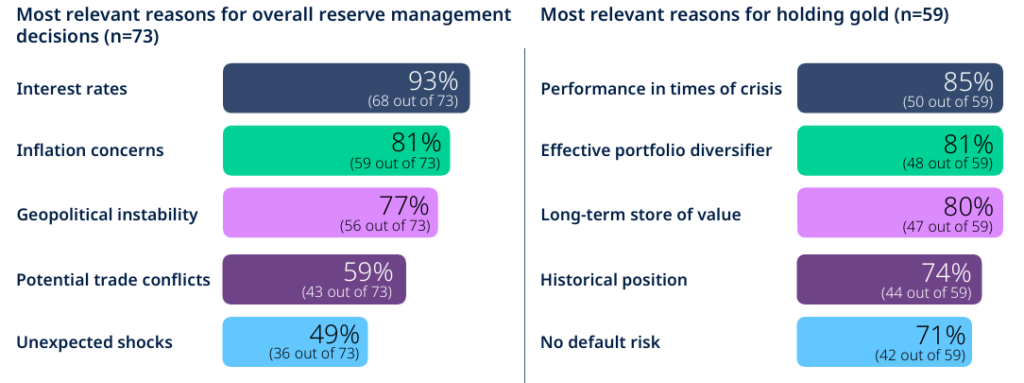
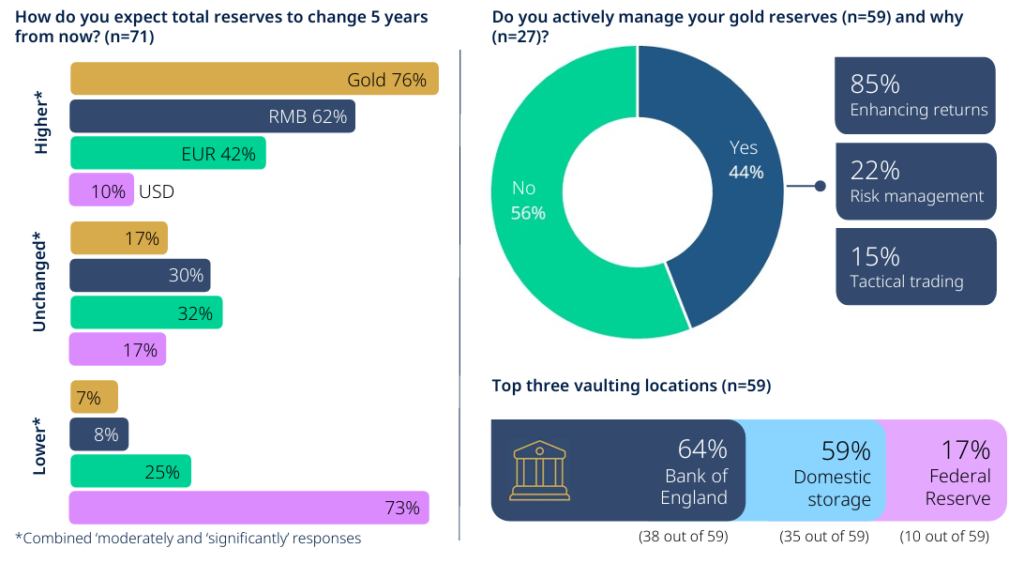
The 2025 edition of the Central Bank Gold Reserves (CBGR) survey drew a total of 73 respondents, the most since the Council began the survey eight years ago. The survey also saw a record-high number of respondents who actively manage their gold reserves at 44%.

Credit: World Gold Council

According to the survey results, central banks continue to view economic and geopolitical uncertainty as a key factor influencing their decision to accumulate gold, just behind interest rate levels and inflation concerns. Also high on the banks’ list of considerations are tariffs and unexpected shocks.

Most of the respondents cited the precious metal’s performance during times of crisis, alongside its role as a store of value, as the main reasons for adding more gold, the survey showed.

“Gold’s performance during times of crisis, portfolio diversification and inflation hedging are some key themes driving plans to accumulate more gold over the coming year,” the WGC stated.

More gold buying ahead

With that in mind, an overwhelming number of central banks (95%) said they see official gold reserves continuing to rise over the next 12 months, compared to 81% the last survey. Importantly, nearly half (43%) of them now believe their own gold reserves will also increase over the same period, more than any in previous surveys.

Over a longer horizon, about three-quarters of the banks (76%) expect their gold holdings to be higher in five years, an increase from 69% seen last year.

At the same time, about the same number of banks (73%) are prepared to see moderate or significantly lower US dollar holdings within their global reserves.

In terms of vaulting locations, the Bank of England remains the most popular amongst respondents (64%).

Credit: World Gold Council

“The trends uncovered in our survey suggest that central banks continue to recognize the benefits of an allocation to gold, and indicate that their demand for gold will likely remain healthy for the foreseeable future,” the Council said.

https://www.mining.com/central-banks-see-further-gold-accumulation-de-dollarization-wgc-survey/

Iron Ore Prices Tumble To 9-Month Low, Citi & Goldman Ratchet Down Price Target

 Iron ore, widely seen as a real-time barometer of China's economic pulse, is flashing fresh warning signs. Prices slid for a fourth straight session in Singapore, dropping below $93 a ton and hitting their lowest level in nine months.

China, the world's largest consumer of iron ore, imports more than 70% of globally traded volumes. That gives iron ore prices an outsized role as a proxy for Chinese economic momentum, and the latest trade data suggests the world's second-largest economy is still struggling to gain momentumremaining mired in deflation.

At the start of the week, figures from China showed that nationwide steel output in May declined on a daily basis compared to April. Output was down about 7% from a year ago, marking the weakest May since 2018.

"Steel demand in China is likely to remain weak over the coming months over the upcoming seasonal lull," Citigroup analysts wrote in a note, slashing iron ore forecasts.

They noted that China's property market weakness has yet to show a meaningful turnaround while manufacturing continues to face headwinds. As a result, their three-month price forecast was lowered to $90 a ton from $100, and the six-to-twelve-month target was revised down to $85 from $90.

In a separate note, Goldman analyst James McGeoch provided a gloomy outlook for iron ore by ratcheting down price targets...

Not taking a lot of lead, notable that China has been a very very quiet tape, waiting, watching….. clearly Iron ore at $93.00 stands out, when I talk to trading they suggest the most convincing trade is further curve flattening out on back of mounted physical selling pressure in front months and continuous consumer hedging in the back end of the curve, Both miners and phys traders are selling tonnes aggressively, yes there is a flat price call that you can play the $90-95 range, however it's a downward sloping trend. Recall start o year we kind of liked this $100-110 range (china infra seen as supportive and property policy creating a trough), that became $95-105, which became $90-100 (as infra in particular didn't see the post winter pickup we expected) and its now $90-95 range.

McGeoch pointed to sliding steel prices in China. 

China's steel exports remain elevated. 

The key takeaway is that China's subdued iron ore market reflects the broader economic downturn, with persistent weakness in the property sector and no meaningful signs of recovery.

https://www.zerohedge.com/commodities/iron-ore-prices-tumble-9-month-low-citi-ratchets-downs-price-target

Kraft Heinz Will No Longer Launch Products In US With Artificial Colors

 by Naveen Athrappully via The Epoch Times,

Kraft Heinz said on Tuesday that it will not launch any new products with artificial colors in the United States and will remove the additives from its existing product portfolio by the end of 2027.

The company added that, by net sales, nearly 90 percent of its U.S. products are already free of food, drug, and cosmetic (FD&C) colors.

For the remaining products, the company will remove colors “not critical to the consumer experience,” replace them with natural alternatives, or create new colors and shades when alternatives are not available.

The company’s June 17 announcement follows a call by the Department of Health and Human Services (HHS), along with the Food and Drug Administration (FDA), to phase out all petroleum-based synthetic dyes from the nation’s food supply.

“For too long, some food producers have been feeding Americans petroleum-based chemicals without their knowledge or consent,” HHS Secretary Robert F. Kennedy Jr. said in an April 22 statement.

Kennedy said that the “poisonous compounds” offered no nutritional benefits and adversely impacted children’s health and development. He said the department was working with the industry to get rid of the “toxic dyes” from the food supply.

FDA Commissioner Marty Makary said that the agency asked food companies to substitute artificial colors with “natural ingredients for American children as they already do in Europe and Canada,” citing an epidemic of childhood diabetes, obesity, depression, and ADHD.

In Tuesday’s statement, Heinz said the company had used FD&C colors since it had a “longstanding history of approval” from the FDA.

Kraft Heinz North America President Pedro Navio said that most of his company’s products use natural or no colors.

“In fact, we removed artificial colors, preservatives, and flavors from our beloved Kraft Mac & Cheese back in 2016,” Navio said. “Our iconic Heinz Tomato Ketchup has never had artificial dyes – the red color comes simply from the world’s best tomatoes. Above all, we are focused on providing nutritious, affordable, and great-tasting food for Americans and this is a privilege we don’t take lightly.”

Companies, including cereal manufacturer WK Kellogg, meatpacker Tyson Foods, and Walmart’s Sam’s Club, have announced plans to remove artificial food dyes from their product lines following the HHS announcement.

Dye Ban Opposition

The Consumer Brands Association, which represents manufacturers, said food colors have been widely used in the supply chain because they were deemed safe.

“The ingredients used in America’s food supply have been rigorously studied following an objective science and risk-based evaluation process and have been demonstrated to be safe,” the association said in an April 22 statement in response to the HHS decision to ban food dyes. “As we increase the use of alternative ingredients, food and beverage companies will not sacrifice science or the safety of our products.”

The association also asked the HHS and FDA to develop a coordinated set of rules when setting food regulations.

“A state patchwork of differing laws creates confusion for consumers, limits access to everyday goods, deters innovation, and increases costs at the grocery store,” it said.

The International Association of Color Manufacturers (IACM), representing the interests of the color additives industry, said in a statement that “despite common misconceptions, synthetic (FD&C) colors are approved and continue to be used worldwide, including in Europe.”

The IACM’s website lists Fast Green No. 3 as approved for use in the United States but not authorized for food use in the European Union or the UK.

FD&C Red No. 40, Yellow No. 5, Yellow No. 6, Quinoline Yellow, Azorubine (Carmoisine), and Ponceau 4R (Cochineal Red A) are listed as being subject to a warning on European labels.

Proposing reformulation within 2026 “ignores scientific evidence and underestimates the complexity of food production. This process is neither simple nor immediate, and the resulting supply disruptions will limit access to familiar, affordable grocery items. IACM and its members remain committed to science-based dialogue on color additives,” the IACM said.

According to the HHS, authorization for two synthetic food colorings—Citrus Red No. 2 and Orange B—will be revoked within the coming months.

Six dyes—FD&C Green No. 3, FD&C Red No. 40, FD&C Yellow No. 5, FD&C Yellow No. 6, FD&C Blue No. 1, and FD&C Blue No. 2—will be eliminated from the food supply by the end of next year. FD&C Red No. 3 will also be removed.

Four new natural color additives will be authorized soon, and the agency has partnered with the National Institutes of Health to conduct comprehensive research on how food additives impact children’s health and development.

Health officials said the administration had not yet made a formal deal with corporations on food dyes.

“There are a lot of tools at our disposal,” Makary said. “Let’s start in a friendly way.”

https://www.zerohedge.com/food/kraft-heinz-will-no-longer-launch-products-us-artificial-colors