Many Americans support key parts of Health and Human Services Secretary Robert F. Kennedy Jr.'s desire to "make America healthy again," according to new Axios/Ipsos survey results.
Many said the government should do more to make food safe and that foods containing chemicals or unsafe additives are health risks, the Axios/Ipsos American Health Index results found.
Nearly nine in 10 said it should be easier for the average American to understand food safety guidelines.
A similar number said the government should do more to make sure food is safe, such as updating nutritional guidelines, adding labels to foods with artificial dyes or reducing exposure to pesticides.
The survey found that 56% of respondents said chemicals or unsafe additives in foods are a large or moderate risk to their health, but only 41% said they feel the same about eating or drinking things with food dye.
As for foods containing pesticides or artificial food dyes, 67% said they do not think the foods are safe to eat, even if they've been approved by the U.S. Food and Drug Administration.
That belief is shared by a majority of Republicans (71%), Democrats (66%) and independents (65%).
A plurality (38%) of Americans said the U.S. government should remove all artificial dyes from foods, even if it makes food cost more by using natural dyes.
One in 5 (22%) support requiring the removal of some artificial dyes from foods if the cost and look of foods can stay mostly the same, while 20% say the government should allow artificial dyes in foods but require added labels for people to make their own choices.
Only 2% said the government should allow artificial dyes in foods and not change anything about the packaging.
Last month, a commission led by RFK Jr. issued a report that said processed food, chemicals, stress, and overprescription of medications and vaccines may be factors behind chronic illness in American children.
Kennedy said the commission's report was a "clarion call to do something with utmost urgency to end this crisis" of increasing rates of childhood obesity, diabetes, cancer, mental health disorders, allergies, and neurodevelopmental disorders like autism.
This Axios/Ipsos Poll was conducted June 13-16 by Ipsos' KnowledgePanel® and has a margin of sampling error of ±3.3 percentage points at the 95% confidence level. This poll is based on a nationally representative probability sample of 1,104 general population adults 18 or older.
Teachers’ union boss Randi Weingarten publicly resigned from the Democratic National Committee (DNC) this weekend and the overwhelming response seems to be one of surprise that she was on the committee at all. How is it that education reporters and the media at large rarely, if ever, mentioned that she served as an at-large member of the DNC for 23 years and held a seat on its Rules and Bylaws Committee from 2009-2022? She has also been a delegate to each of the Democratic conventions since 1992.
Seems like more than an oversight.
As president of the 1.8-million-member strong American Federation of Teachers (AFT), Randi holds a powerful position in American education and politics. The more than two decades she spent with a formal role within one of our two major political parties adds another layer of significance to her influence. That role isn't just symbolic—DNC members help shape party platforms, set rules, and exert tremendous influence over elected officials in the party, including the president of the United States.
News media stories about Weingarten since the 1990s have framed her solely as a union leader or advocate for teachers. In recent years, they frequently mentioned her clashes with Republicans or the outsized role she played during COVID-era school closures, but they never noted her formal position within the DNC. That pattern of omission painted her as more of a public-sector labor representative than a partisan political operative.
One must wonder why there was a near blackout on this significant detail about a teachers’ union boss, and how that blackout continued during the coverage of the extended school closures and mask mandates that she lobbied for during COVID? It is well documented that she had a significant influence on CDC guidance for schools, but nobody thought to mention her role within the DNC?
Was it journalistic malpractice? Perhaps many journalists and editors sympathize or align with Randi’s positions and see no need to disclose her formal ties to the party.
Was it incompetence? Maybe education beat reporters and tv producers didn’t know she had a formal role with the DNC, or didn't realize the significance of her DNC role.
Was it narrative control? Maybe reporters, editors, and producers felt that pretending she was an impartial advocate “for teachers” was simpler and more palatable than acknowledging she was also a highly influential party insider.
My sense is that all three explanations apply.
It is understandable that the AFT deliberately avoided emphasizing or drawing attention to their leader’s DNC status. Doing so would have undermined their claim to represent all members regardless of political affiliation and strengthened the argument that public sector unions are way too entangled with party politics.
If the AFT hid Randi’s DNC role from its members, that’s bad and reveals a lack of transparency to the people who pay their bills. But, unlike the press, the union doesn’t have an obligation to inform the larger public about its boss’s dual roles. On the other hand, education reporters and the media do have that obligation, and yet failed so consistently for more than two decades that it took Weingarten’s resignation from the DNC for us to learn that she had a formal role within the DNC.
There is no excuse for that.
While we’re on the topic —I bet you didn't know that Becky Pringle, the president of the National Education Association (NEA), the largest teachers union in the country, is also a member of the DNC. She hasn't resigned.
Israelis overwhelmingly back their country’s military campaign against Iran, even as they duck daily missile barrages and hope for decisive intervention by the United States, according to a new survey of wartime public opinion.
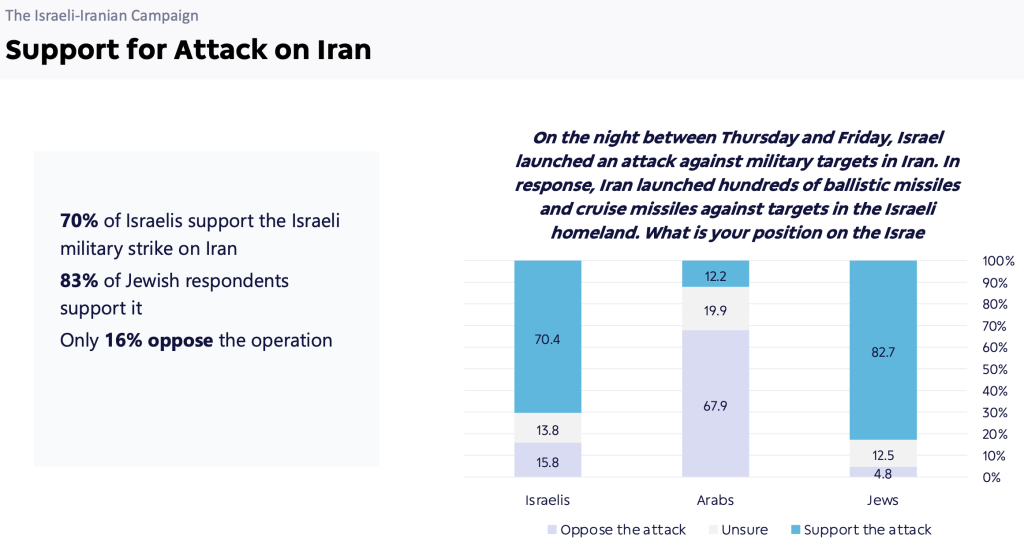
The poll, conducted by researchers at Agam Labs and the Hebrew University of Jerusalem, found that 83 percent of Israeli Jews and 70 percent of the overall public support the campaign to take out Iran’s nuclear and missile capabilities, which Israel launched by surprise overnight on Friday. One percent of Jews and 16 percent of all Israelis would have preferred continued nuclear diplomacy with Iran.
(Agam Labs)
Airstrikes on Iran’s nuclear facilities are even more popular, with more than 90 percent of the public in support, according to the poll. Almost half of the public, including 54 percent of Jews, says Israel should continue bombing the sites even if the United States and other allies stop helping to intercept Iranian barrages. But two-thirds of Israelis describe the Israel-United States alliance as "critical" to national security and only 30 percent would want Israel to defy a theoretical demand by President Donald Trump to end the war in favor of a deal.
The results of the poll—which surveyed 1,057 Israelis on Sunday and Monday and has a margin of error of plus or minus 4.2 percent—suggest Israelis are ready to go it alone to confront what they see as an existential threat from Iran—at least up to a point.
"There is a very broad consensus that we had to attack Iran and that we must continue," said Nimrod Nir, the CEO of Agam Labs. "It says a lot that half the public would keep going without U.S. backing even though many of those people are not sure we can finish the job alone."
The public sentiment mirrors Israel’s official position on the war. Prime Minister Benjamin Netanyahu has projected confidence that Israel can achieve its goals alone if necessary. At the same time, current and former Israeli officials have conceded that only U.S. bunker-buster bombs can quickly destroy the Iranian nuclear program from the air—and have called on Trump to deliver a decisive blow to Iran.
The campaign has taken a toll on Israelis, already beleaguered by more than 20 months of war with Iran and its regional axis of terrorist groups. Iranian ballistic missile and drone strikes on Israeli cities over the past week have killed two dozen people, injured hundreds, and displaced thousands, while forcing schools and businesses to close and throwing daily life for millions into chaos.
But pride and hope have prevailed over fear and despair, with nearly twice as many Israelis citing the former as their dominant feelings about the latest phase of the war, according to the poll. The public has "very high" trust in the air force and the Mossad foreign intelligence agency, which have been on the frontlines in Iran, and "high" trust in the military and emergency services.
Bar Shalev Nathan, a 34-year-old marketing analyst in the West Bank town Tzofim, said she, her husband, and their three young children have been sharing a public shelter with four neighboring families who also do not have a safe room at home. Each night, they have slept on thin mattresses in the concrete structure, which she said is hot and buggy.
Still, she said, "I really don’t mind spending another 30 or 60 nights sleeping on the floor in a shelter, if this means we will eliminate the Iranian threat. … I’m not hopeful. I’m confident. I’m so sure we’ve got this, and it’s going to be sweet in the end."
Military officials told reporters on Tuesday that Israel will achieve its objectives against Iran’s nuclear program within a week or two.
Yuval Shamir, a 35-year-old engineer in Tel Aviv, described Iran's retaliation as underwhelming, even though two missiles have struck buildings near his apartment in recent days. Just before an air raid siren interrupted him, he said that no number of missile impacts would dissuade him from backing the campaign.
"It doesn't matter how many of us they kill now," he said. "If we let them get the bomb, they will kill us all."
Israelis are roughly evenly split over whether the ultimate goal of the campaign should be military victory or a stronger deal and whether Israel can independently finish off Iran's nuclear program, according to the poll. But given the perceived stakes, most see little choice but to keep fighting.
A poll by the Israel Democracy Institute, which largely matched Agam Labs's findings, found that 69 percent of Jews and 63 percent of all Israelis believe Israel was right to launch the campaign, even while assuming that "Iran’s nuclear capabilities cannot be destroyed without help from the United States."
Shalev Nathan said Israel needs to "eliminate all the ballistic missile capability that Iran currently has, and of course, demolish every part of the nuclear program." Or, she said, quoting Trump, Iran could agree to "unconditional surrender."
"I think we can definitely succeed even without U.S. help," she said. "I think it will be much harder and probably take much longer, but we can and we definitely should do it."
Shamir said analysts who claim Israel cannot reach Iran's most heavily fortified nuclear sites, like the Fordow enrichment facility, "don't know what they're talking about."
"We have ways to do it ourselves, even if it takes many bombs or soldiers on the ground," he said. "I'm sure we have a plan."
Eyal Barad, a 42-year-old engineer in the Negev city of Kiryat Gat, said he doubted Israel can penetrate Fordow without the help of U.S. bunker-busters. In any case, he predicted, Iran's ruling mullahs will seek to rebuild the nuclear program, even if they eventually agree to a deal saying otherwise. Only regime change—an outcome Israel has increasingly seemed to embrace—could potentially end Iran's decades-long genocidal crusade against the Jewish state, he said.
"Changing the regime in a different country usually doesn't end well," Barad acknowledged. "But if we leave the regime in place, we will only have succeeded to hurt their pride, and five years from now, they will attack us without warning," he said.
According to Barad, Israel should learn from its experience with Hamas, an Iran-backed terrorist group in the Gaza Strip. Israel tolerated Hamas's rule in Gaza for the better part of two decades, until the Iran-backed terrorist group burst out of the strip on Oct. 7, 2023, and carried out the deadliest-ever attack on the country. Kibbutz Nir Oz, where Barad lived at the time with his wife and their three children, was one of the hardest-hit communities on that day.
Barad expressed hope that Israel's campaign against Iran would also weaken Hamas and create the conditions for an agreement to end the war and free the remaining hostages held in Gaza, including four of his fellow former kibbutz members who are believed to be alive. Agam Labs found that 75 percent of Israelis support such a deal, almost the inverse of the nation’s hawkish attitude toward Iran.
"There's no need to keep fighting in Gaza," Barad said. "Just finish it—especially now that it looks like the Iranians will not be able to continue backing and funding Hamas. It will be harder for Hamas to get stronger again."
Last month, as Republicans debated Medicaid reform, media outletsreportedon astriking academic working paper. Authored by Angela Wyse of Dartmouth and Bruce Meyer of the University of Chicago, the study claimed that Obamacare’s Medicaid expansion saved thousands of low-income Americans’ lives.
But last week, the Coalition for Evidence-Based Policy posted an assessment of the paper. Its “No-Spin Evidence Review” contended that the researchers had deviated from their own “preanalysis plan”—a document in which researchers spell out how they plan to assess their data—and that the findings should be viewed as tentative and preliminary.
While Wyse and Meyer should have explicitly discussed the changes in their paper, there’s a reasonable case that their adjustments were justified. The episode should prompt conservatives to think carefully about how to reform Medicaid—and how best to make the case for those reforms.
Medicaid is a federal program that provides health insurance to poorer Americans. Traditionally, Washington has required participating states to cover “core” groups, such as the disabled and poor children, while allowing flexibility to cover some additional low-income people. The federal government covers at least half of each state’s Medicaid spending, with poorer states receiving a higher matching rate. Still, wealthier states have often been more aggressive in expanding coverage to draw down more federal dollars.
Obamacare’s Medicaid expansion, launched in 2014, encouraged states to cover all adults earning up to 138 percent of the poverty level. Rather than applying the standard matching rates, Washington initially covered the full cost for this new population, gradually reducing its share to 90 percent. As a result, most states received far more generous funding to cover the less-vulnerable expansion population than for the core groups Medicaid was originally designed to serve. Many states eagerly accepted the funds—a few had already expanded coverage on their own—though some, mostly Republican-led, chose to hold out.
In their paper, Wyse and Meyer combine several highly sensitive datasets to assess the impact of the Medicaid expansion. They use IRS records to track income, administrative data to measure Medicaid enrollment, and Social Security Administration (SSA) data to determine who is living and who has died, among other sources.
Their analysis is relatively straightforward. The researchers examined non-disabled adults aged 19–59 with incomes below 138 percent of the poverty level—the group targeted by the Medicaid expansion—and compared mortality trends in states that expanded Medicaid with those that did not. They found a 2.5 percent decline in mortality in expansion states relative to non-expansion states, amounting to roughly 27,000 lives saved through mid-2022. Unfortunately, they are not able to say which specific causes of death declined, because SSA data does not contain that information.
To confirm their findings, the researchers compared mortality rates in the expansion population with those of individuals who initially had higher incomes. If expansion states had coincidentally experienced some unrelated, positive health trend when the policy took effect, it would likely have benefited both groups. As expected, the higher-income group saw only a slight uptick in Medicaid enrollment—likely due to some earning less over time—and no measurable decline in mortality.
So, what’s the problem? Buckle in for a bit of statistical minutiae.
If someone analyzes two variables—say, temperature and ice cream sales—and reports that the correlation is “statistically significant at the 5 percent level,” it means there’s only a 5 percent (or one-in-20) chance that such a strong relationship would occur randomly. This is a key concept in social science, but it becomes less meaningful when researchers run multiple analyses on datasets with many variables. If I run 20 different tests and one yields a result that would occur by chance only one in 20 times, that’s not especially impressive—it’s exactly what you’d expect.
Scientists have become increasingly aware of this problem in recent years, and one common solution is to pre-register their analysis plan. By stating in advance exactly how they intend to analyze the data, researchers offer reassurance that they didn’t run 19 other versions and simply publish the one with results they liked.
In Wyse and Meyer’s pre-analysis plan, they stated that their “base sample” would include all low-income adults 19-59—not just the non-disabled. They listed disability, instead, among other types of “subgroups,” such as race and income categories, that they also planned to analyze. Of course, if the non-disabled subgroup is just one in a sea of analyzed groups, rather than the main target of the study, the evidentiary value of statistically significant findings associated with that group becomes more tentative.
Seen in this light, one might focus first on the results for the full sample—where the mortality reduction was smaller and only borderline significant, hovering around the 10 percent level rather than the stricter 5 percent threshold—and view the stronger findings for the non-disabled subsample as less definitive. According to the “No-Spin Evidence Review,” the authors should have written that:
The mortality reduction approached, but fell short of, statistical significance, and is therefore best viewed as tentative. We found larger mortality reductions among the subgroup of low-income adults without disabilities, and a possible mortality increase among the subgroup with disabilities. These subgroup findings should be considered preliminary until confirmed in future research, as they could have appeared by chance given the multiple subgroups examined.
But there’s a reasonable counterargument: the disabled were already eligible for public health insurance before the Medicaid expansion and thus weren’t actually affected by the policy. The researchers should have excluded them from the outset—and erred in failing to do so in their pre-analysis plan. At the very least, the non-disabled shouldn’t be treated as just one subgroup among many. Excluding individuals who weren’t affected by the policy being studied is fundamentally different from, say, exploring whether results vary by race.
I reached out to Wyse and Meyer for their response to these criticisms, and they replied, in part:
To answer your question of why the non-disabled sample became the main sample, we were new to pre-analysis plans. Neither [of us] had done one before (or since) and we were not as careful as we should have been. We quickly realized that it did not make sense to be looking at the effect of expanding Medicaid for people who already had Medicaid or Medicare (disabled was determined in our data by receipt of [Supplemental Security Income] or Social Security Disability insurance which come with Medicaid or Medicare). We thus did all our analyses with the non-disabled sample for whom it was possible to gain public health insurance coverage under the expansions. Nevertheless, we felt bound to also report the full sample because we listed it in our pre-analysis plan.
As for the possible increase in mortality among the disabled—implied by the gap between the full-sample and non-disabled results—the researchers noted that they did not analyze the disabled group separately. Running analyses on such a large dataset is time-consuming, they explained, and all published results must pass privacy screening by the Census Bureau. They added, “We suspect the confidence intervals would be wide and that you shouldn’t conclude that Medicaid significantly increased mortality for the disabled.”
Nonetheless, critics have sometimes contended that expanding Medicaid could undermine care for the original “core” population. Further study of this possibility is warranted.
Where does all this fit into the broader debate over Medicaid reform, once again raging on Capitol Hill?
Conservatives have long sought to downplay the significance of Medicaid coverage, citing, for example, an experiment in Oregon finding the program offers limited health benefits. They’ve also rightly noted that, for many, the alternative to Medicaid isn’t dying in the street but receiving uncompensated care—ultimately covered by charity or taxpayer-funded hospital subsidies.
The political reality, however, is that Medicaid isn’t going anywhere—especially now that Republicans draw more support from working-class voters. Whatever its impact on mortality and health outcomes, the program provides basic coverage to roughly one-fifth of Americans and serves as a crucial funding source for hospitals.
President Trump himself recently warned Congress not to “f*** around with Medicaid.” Even as House Republicans’ tax bill would impose work requirements on able-bodied enrollees, it would leave Obamacare’s expansion of the program in place. Some in the Senate are leery of any reform that could cut benefits or harm rural hospitals.
The strongest case for Medicaid reform isn’t that the program serves no purpose. It’s that the current funding system is dysfunctional, unfair, and excessively costly, with many states gaming the rules to maximize their share at others’ expense.
The federal government shouldn’t subsidize able-bodied adults more generously than the disabled, nor should wealthy, high-spending states enjoy unlimited access to matching federal funds. Even if Medicaid saves lives, it must be run fairly—and cost-effectively.
I am old enough to remember when the left attacked conservatives and populists as “culture warriors.” The left’s rationales for the allegation were as numerous as they were duplicitous, voiced solely for political advantage.
Their incessant projection—the ascribing of their own vices unto their victims, their ideological rigidity, and their political and social insularity result in a delusional sense of moral and intellectual superiority that has, despite all evidence, both rendered the left the “culture warriors” and prevented them from realizing and admitting it.
As is often noted, the left’s default smear involves projecting their sins upon their victims. For example, even as the left erects and imposes the elitist, bureaucratic Administrative Leviathan upon a decreasingly sovereign citizenry, that same left claims it is their opponents destroying “our democracy.” In their disordered, distorted view, the left feels no compunction to reconcile their actions with their allegations as they accrue more power into their anti-democratic hands.
Moreover, the core aim of the left remains the eradication of traditional societal norms and practices, which they believe to be intrinsically and systemically evil. Viewed in their puerile prism of “oppressor vs. oppressed,” the left employs the language of “liberation” to justify their attacks upon verities and virtues. It also allows the left to rationalize—indeed, justify—their patent hatred of the supporters of traditional society and the permanent things as an act of “love.”
As a result, it is exceedingly arduous to penetrate a progressive’s ideological and emotional cocoon of unearned self-esteem and, ergo, make them aware that they are not supremely enlightened. Their hive minds persist in routinely and cavalierly using their fellow citizens as props in their onanistic virtue signaling needed to feed their addiction to external validation from the collective.
By concealing their aim of destroying traditional society by proffering new “rights” and, thus, couching its radical agenda in the language of “license” and “love,” the practical political purpose is patent: the luring of non-leftists into supporting the left’s vision. Yet, such new rights are little consolation when, after attaining power, the left revokes longstanding, God-given, constitutionally recognized rights.
Consider the left’s ideological rigidity in the instance of abortion, which the left assiduously promotes as a question of “conscience,” one that cannot be impaired by another. Nonetheless, the left routinely infringes upon the conscience and religious beliefs of pro-life Americans by compelling them to condone, subsidize, and even perform abortions. Those who dissent against abortion are targeted to be silenced, often being compared to domestic terrorists.
In sum, then, the left has prioritized abortion over the freedom of conscience. Thus does the left’s siren song of “liberation” fall flat: for where there is no freedom of conscience, there is no freedom at all.
Those who point out the left’s dangerous duplicity and hypocrisy are derisively and falsely accused of being “culture warriors” who spew the insidious rhetoric rending American society. Consequently, abetted by their cohorts in the corporate media, the left has cast the defenders of traditional society as the aggressors in the Culture War—and dehumanized them to boot.
In fact, little can reveal more about the left’s hypocrisy than the hateful, neurotic epithets they hurl at their opponents and their efforts to silence all dissent against their own radical agenda. The left’s epithets containing “-phobic” and “-ism” are designed to question not the arguments of their opponents but their mental soundness and craft the narrative that there can be no rational opposition to the left’s insanity.
It needs to be noted, as well, that the left can be ecumenical in its casting of calumnies and “cancellations” upon Democrats who dissent from any part of the radical leftist agenda. To wit: “Transphobic,” which suggests that only hate can compel someone to oppose a child’s genital mutilation done in the service of an insane, inhuman ideology. Be it a MAGA member or a long-time supporter of gay rights (or both), they will be reviled for drawing the line at transitioning children.
The success of the left in branding the right as the “culture warriors” has hopefully reached its zenith. One good indicator is the dwindling number of “Republicans” who claim to be “fiscally conservative but socially liberal.” Perhaps the right has finally grasped that the left’s long march through the institutions to foster cultural Marxism was precisely to create the conditions for the ultimate imposition of socialism. It remains a stunningly naïve illusion among such “socially moderate” Republicans how a left that has replaced God, motherhood, and apple pie with secularism, abortion, and globalism is not hellbent upon replacing capitalism with socialism… Freedom with serfdom.
Ignore the catcalls and cling to the truth, defenders of the permanent things of faith, family, community, and country. There is a republic to be saved!
***
An American Greatness contributor, the Hon. Thaddeus G. McCotter (M.C., Ret.) served Michigan’s 11th Congressional District from 2003-2012, he served as Chair of the Republican House Policy Committee; and as a member of the Financial Services, Joint Economic, Budget, Small Business, and International Relations Committees. Not a lobbyist, he is also a contributor to Chronicles; a frequent public speaker and moderator for public policy seminars; and a co-host of “John Batchelor: Eye on the World” on CBS radio, among sundry media appearances.
The Los Angeles Dodgershave pledged $1 million to aid families impacted by the immigration arrests, a move that comes one day after the organization claimed it had denied U.S. Immigrations and Customs Enforcement (ICE) agents entry to the grounds of the ballpark.
The team released a statement Friday announcing the commitment, adding that the money will go "toward direct financial assistance for families of immigrants impacted by recent events in the region."
"What’s happening in Los Angeles has reverberated among thousands upon thousands of people, and we have heard the calls for us to take a leading role on behalf of those affected," Dodgers president and CEO Stan Kasten said in a statement.
"We believe that by committing resources and taking action, we will continue to support and uplift the communities of Greater Los Angeles."
Los Angeles Mayor Karen Bass thanked the MLB team for its support following the arrests, which she said "have sent shockwaves of fear rippling through every neighborhood."
"My message to all Angelenos is clear: We will stick together during this time and we will not turn our backs on one another — that's what makes this the greatest city in the world," Bass’ statement continued.
The pledge followed a disputed claim from the Dodgers’ on Thursday, when the team claimed to have turned down ICE agents’ request to enter Dodger Stadium’s parking lot before a game.
ICE quickly denied the claim in a post on social media, saying "False. We were never there."
Law enforcement was spotted outside of Dodger Stadium earlier Thursday that was initially believed to be ICE, which prompted protesters at the site. But in a statement of their own after ICE's denial, the U.S. Customs and Border Protection (CBP) said that "CBP vehicles were in the stadium parking lot very briefly," and it "had nothing to do with the Dodgers."
Officials were spotted outside Dodger Stadium on Thursday.(KTTV)
The vehicles on stadium grounds were "unrelated to any operation or enforcement," a CBP spokesperson said in a statement.