Search This Blog

Tuesday, August 26, 2025

Venezuela to Deploy Ships to Oil Exporting Hub After US Move


Venezuela will deploy vessels to a key oil-exporting hub near Colombia in response to the US’s decision to send warships to the southern Caribbean.

Venezuela’s ships, which will be larger than “patrolling” vessels, are headed north of Lake Maracaibo and the Gulf of Venezuela, Defense Minister Vladimir Padrino said on social media. The vessels will be positioned in Venezuela’s oil cradle in a port key to both Chevron Corp.’s shipments to the US and PDVSA’s exports to China.

https://www.bloomberg.com/news/articles/2025-08-26/venezuela-to-deploy-ships-to-oil-exporting-hub-after-us-move

Brazil’s Most Disruptive Stock

 by Adam Sharp

Here at the Daily Reckoning, we love contrarian investments.

Back in February, we highlighted an idea that fits the bill nicely: buying Brazilian stocks.

Specifically, we mentioned the iShares Brazil ETF (EWZ), which was yielding around 8% at the time, and Nubank (NU), a fast-growing digital bank.

Brazil had been in a slump since its stock market peaked in 2008. The country’s stock market is heavily tilted towards banks and commodities (especially oil and iron ore). Its currency has been volatile and generally fallen in value versus the dollar. So most investors have steered clear of the country.

But this is starting to turn around. The largest Brazilian ETF, EWZ, is up around 10% since February and looking good. It remains dirt cheap with fat yields. The plan is to hold this one for many years, and possibly decades, to come. Let the magic of compounding do its work.

But today we’re going to focus on Nubank, which at the time was a small position in my portfolio. Since that time, I’ve learned a lot more about Nubank (and bought more). And the outlook for this company is bright.

Let’s dig into this remarkable growth story.

Nubank: The Bull Case

Nubank is a fully-digital bank based in Brazil. It boasts a remarkable 122 million customers, nearly all of which use its popular mobile app. It offers checking and savings accounts, credit cards, personal loans, investment accounts, and more.

The company just reported Q2 2025 results, and they handily beat expectations.

  • Revenue grew 40% year-over-year to $3.7 billion
  • Net income rose 42% to $637 million
  • Deposits soared 41% YoY to $36.6 billion
  • 83% of customers are active on a monthly basis (solid engagement)

This company’s growth has been wildly consistent. Since 2020, they’ve grown from around 20 million active customers to more than 102 million:
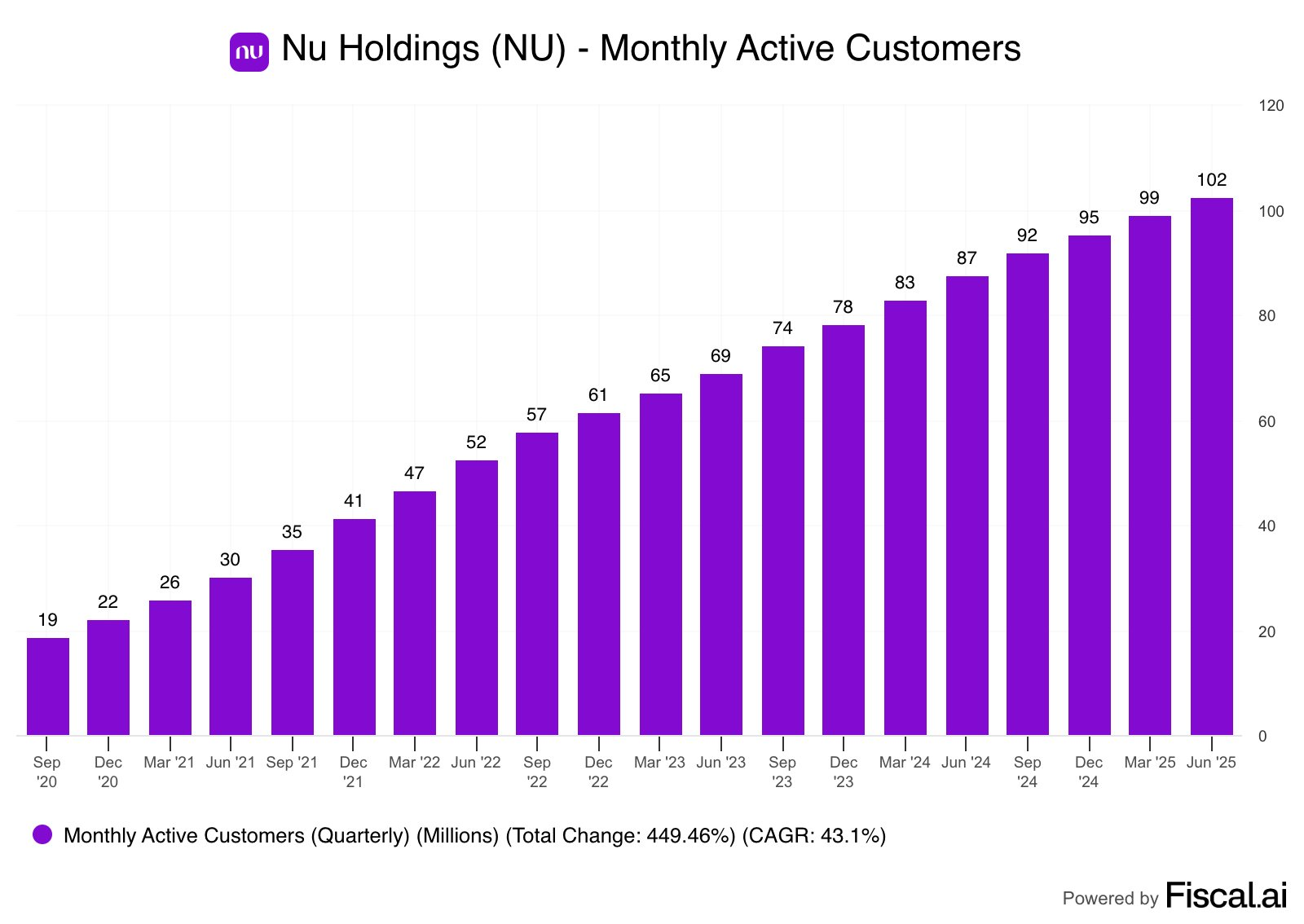
image 1

Source: Fiscal.ai

When we first highlighted Nubank back on February 25, 2025, shares were trading around $11.20.

Today NU is up 23% to $14.20. But I don’t plan to sell anytime soon. This growth story looks to still be in its early stages.

A Powerful Growth Engine

Nubank is currently used by around 60% of Brazilian adults, a remarkable achievement. Management has been focused on further monetizing these customers with loans, investment services, crypto offerings, insurance, business lending, and more.

Nubank has many ways to further monetize its growing Brazilian user base.

But the company is also expanding into Mexico and Colombia, with significant progress so far. In Mexico, Nubank has 12 million customers representing 13% of the total population. In Colombia, the company has 3.4 million customers, or nearly 10% of that country’s total population.

It seems likely that Nubank will continue expanding across Latin America. Its digital banking model is low cost, with no physical locations or real estate expenses. The model is beautiful and Nubank has the potential to gobble up market share from existing banks across Latam (and possibly beyond).

The Brazil Discount

Brazil has been in an economic slump for a while now. Innovative growth stories like Nubank are few and far between. So the market generally pays less for Brazilian stocks than they do for American equivalents.

Today Nubank trades at a trailing P/E ratio of around 30. For a company growing revenue and earnings around 40%, that’s a very fair price.

If Nubank were an American firm, I can’t even imagine how high its valuation would be. Suffice to say 4x higher might be on the low side.

On the whole, I think Nubank is trading at an extremely fair price today and don’t plan to sell anytime soon.

Of course, NU is still an emerging market investment. If Brazil were to go through a currency or banking crisis, Nubank would almost certainly take a big hit in the short-term (along with everything else). Still, it’s a risk I’m willing to take in order to access the potential upside.

We’ll keep readers updated on Nubank and the larger Brazil investment theme.

https://dailyreckoning.com/betting-on-brazils-most-disruptive-stock/

Southwest Airlines ripped over controversial new plus-size passenger policy

 This change didn’t sit well with some.

Southwest Airlines’ popular “pick your own” seat perk isn’t the only policy on the chopping block. The budget carrier announced a new measure that may require plus-size passengers to fork over extra dough.

Starting Jan. 27, 2026, flyers who “encroach upon the neighboring seat” will be required to purchase an extra seat in advance, CBS News reported.

“To ensure space, we are communicating to Customers who have previously used the extra seat policy that they should purchase it at booking,” reps for the the low-cost airline said in a statement.

Starting Jan. 27, 2026, Southwest Airlines flyers who “encroach upon the neighboring seat” will be required to purchase an extra seat in advance and potentially without getting their money back.AP
“I think it’s going to make the flying experience worse for everybody,” seconded Jason Vaughn, an Orlando travel agent who shares travel tips for plus-size tourists on his website, Fat Travel Tested.AP
Those who don’t purchase one ahead of time will be required to buy one at the airport.

This marks a major change from the current policy, in which plus-size passengers can proactively purchase an additional seat with the option of being refunded later, or request a free extra seat at the airport.

Under the new mandate, the second seat is nonrefundable unless the flight isn’t fully booked at the time of departure, and if both of the passenger’s tickets are booked in the same fare class. However, the passenger needs to request their money back within 90 days of the flight.

Critics have ripped Southwest for ending the policies and programs that differentiated the airline from other carriers.AP

If the flight is fully-booked, the flyer will be rebooked onto a new flight.

Critics were quick to rip Southwest, which has long been seen as a haven for plus-size passengers.

Tigress Osborn, the executive director of the National Association to Advance Fat Acceptance, deemed the overhaul changes “devastating” for plus-size flyers.

“Southwest was the only beacon of hope for many fat people who otherwise wouldn’t have been flying,” she lamented, per the New York Times. “And now that beacon has gone out.”

“I think it’s going to make the flying experience worse for everybody,” seconded Jason Vaughn, an Orlando travel agent who shares travel tips for plus-size tourists on his website Fat Travel Tested.

“To ensure space, we are communicating to Customers who have previously used the extra seat policy that they should purchase it at booking,” reps for the the low-cost airline said in a statement.Gado via Getty Images

He analogized the makeover to Cracker Barrel’s much-maligned logo makeover.

“They have no idea anymore who their customer is,” the Southwest loyalist lamented. “They have no identity left.”

The seating policy follows a string of controversial changes that the Texas-based airline rolled out as a way to bolster revenue and ward off advances from activist investors.

These included scrapping the popular “first come first serve” seating policy that allowed customers to select their own seats upon boarding.

Starting January 27 — the same day as the plus-size seating policy goes into effect — flyers will be assigned seats in advance.

In May, the airline also bagged the decades-old “bags fly free” policy, whereby passengers were allowed two complimentary checked pieces of luggage regardless of their ticket fare.

Critics claimed that ending these policies was the wrong move as they distinguished the airline from other carriers.

Even the airline’s own executives ripped the complimentary luggage program overhaul, claiming that they could garner up to $1.5 billion from baggage fees, but that they’d lose $1.8 billion in market share from people who flew the airline because of the perk.

https://nypost.com/2025/08/26/lifestyle/southwest-airlines-ripped-over-controversial-new-plus-size-passenger-policy-worse-for-everybody/

Google launches LLM evaluation tool for health data

 Google has developed a new evaluation framework to help health systems assess large language models more efficiently and reliably. 

The framework, called Adaptive Precise Boolean rubrics, converts complex evaluation tasks into yes-or-no questions tailored to each query. It aims to reduce dependence on expert reviews while improving scoring consistency, according to an Aug. 26 news release from the company. The approach was tested in metabolic health use cases, including diabetes, cardiovascular disease and obesity.

Compared to traditional Likert scales, the tool improved inter-rater reliability and cut evaluation time by more than 50%. It also showed stronger sensitivity to subtle changes in response quality, including scenarios in which patient data was deliberately omitted from LLM prompts, the release said.

In a study using de-identified data from 141 participants with metabolic conditions, the rubric method reliably flagged quality drops in responses missing key personal data. Evaluations using Likert scales did not consistently detect those differences, the company said. 

An automated version of the rubric classifier achieved an accuracy of 0.77 and an F1 score of 0.83, allowing health systems to scale evaluations without full human review. The auto-adapted rubrics performed comparably to human-curated versions.

Google said the tool is not tied to any product and is intended for controlled research. The company said the framework could support scalable, safety focused evaluations across clinical decision support, patient education and other LLM use cases in healthcare.

https://www.beckershospitalreview.com/disruptors/google-launches-llm-evaluation-tool-for-health-data/

Don’t Let Dems Use “Blue Slip” to Veto Constitutionalist Judges and Tough-on-Crime Prosecutors

 Democrats have weaponized a 100-year-old Senate tradition known as the “blue slip” to block constitutionalist judges and tough-on-crime prosecutors and prevent President Donald Trump from fulfilling his constitutional duty of filling vacancies in the judicial system. Senate Republicans shouldn’t let well-intentioned but misguided efforts to preserve this outdated practice get in the way of delivering on the mandate Americans handed them last November.

The Senate blue slip dates back to 1917, when the Senate Judiciary Committee first introduced it as a courtesy to home-state senators. The committee would send senators a literal blue piece of paper on which they could indicate approval, disapproval, or neutrality regarding a judicial nominee from their state.

The practice was designed to give senators – who presumably knew their state’s legal community best – special power in the confirmation process over nominees from their home state, while also reinforcing the Senate’s constitutional “advice and consent” role.

The power of the blue slip, however, has never been uniform. Some Judiciary Committee chairs have treated a missing or negative slip as an outright veto, while others have viewed it as only advisory. In modern times, the tradition has been applied most strictly to district court nominees, since their jurisdiction is confined to one state, while appellate court nominees have increasingly moved forward even if blue slips are withheld.

The blue slip is in the news now because Democrats are abusing the practice to block scores of Trump’s nominees.

The most high-profile case is that of Alina Habba, Trump’s former personal attorney, whom he tapped to be a federal prosecutor in New Jersey. That state’s two Democrat senators, Cory Booker and Andy Kim, declined to turn in their blue slips on her nomination. Senate Judiciary Committee Chairman Chuck Grassley (R-IA), honoring the blue slip tradition, refused to schedule a hearing for Habba, killing her nomination.

In doing so, Grassley effectively handed Booker and Kim a veto over one of Trump’s nominees, despite the fact that American voters elected Trump to install tough-on-crime figures like Habba in prosecutorial roles.

In response to pressure from the White House to limit or outright abolish the blue slip practice, Grassley pointed out that blue slips also allowed Republicans to block some of Biden’s nominees. “The 100 yr old “blue slip” allows home state senators 2 hv input on US attys & district court judges In Biden admin Republicans kept 30 LIBERALS OFF BENCH THAT PRES TRUMP CAN NOW FILL W CONSERVATIVES,” the 91-year-old senator posted on X.

But Grassley would do well to heed his own advice from eight years ago and not be so gullible as to believe that Democrats are acting in good faith now. “We should not allow home-state senators to abuse this courtesy by attempting to block committee proceedings for political or ideological reasons,” he said back in 2017.

That comment came in response to a Democrat push to allow just a single senator’s unreturned or negative blue slip to block the Judiciary Committee from even holding a hearing on a nominee. At the time, Grassley’s office published a memo which pointed out that “since the blue slip courtesy was created in 1917, only two chairmen (Sens. James Eastland and Patrick Leahy) had strict policies requiring two positive blue slips from home-state senators before the Judiciary Committee would consider a nomination.”

Perhaps even more importantly, given the present context, the memo notes that “in 25 of the 36 years before Senator Grassley became Chairman, chairmen have allowed hearings on nominees despite negative or unreturned blue slips.”

In other words, Grassley himself has acknowledged that the blue slip is not a hard and fast rule, that holding a hearing for Habba wouldn’t be out of step with how prior chairs have treated an unreturned blue slip, and that allowing Democrats to abuse the blue slip courtesy to advance their own partisan agenda is a dangerous precedent to set.

Grassley should also recognize that this is precisely what Democrats are doing now – which is why Trump was able to appoint and confirm 234 federal judges in his first term, while he has confirmed only five in the first seven months of his second term.

Democrats showed last year that there is no length to which they will not go to block Trump’s agenda. The same politicians and pundits whining about “partisan” judges and U.S. Attorneys just spent four years weaponizing the entire American legal system against their top political rival in Donald Trump, from launching FBI raids on his Florida home to dragging him and the entire country through a sham trial in New York City so they could brand him a “convicted felon.” Are we really to believe now that Senate Democrats are truly worried about “decorum” and “institutional norms” when it comes to blue slips?

Grassley and others who defend the blue slip are well-intentioned, and in a better world, their faith in Senate tradition would be admirable. It would be refreshing if senators truly exercised that courtesy with their states’ best interests in mind.

But that is not the world we live in. Time and again, Democrats have proven that they know only one language: power. The days of bipartisan consensus and mutual respect for Senate norms are long gone. Republicans cannot afford to cling to outdated courtesies while Democrats weaponize them to stop a duly elected president from implementing the agenda that the American people elected him to pursue.

https://amac.us/newsline/politics/trump-is-right-dont-let-democrats-use-blue-slip-to-veto-constitutionalist-judges-and-tough-on-crime-prosecutors/

Human screwworm case poses no risk to agriculture, says USDA official

The human case of screwworm reported this week by U.S. health officials is the country's only one so far this year and poses no risk to the farm sector, a U.S. Department of Agriculture official said on Tuesday.

Screwworm, a flesh-eating parasite that eats its hosts alive, has moved northward through Central America and southern Mexico, putting the U.S. cattle industry on high alert.

A screwworm infestation can be fatal to livestock if untreated. An outbreak could cost the economy of Texas, the top cattle-producing state, nearly $2 billion, according to U.S. estimates.

The human case in a person who had traveled from El Salvador to Maryland was confirmed by the U.S. Centers for Disease Control and Prevention on August 4, but the agency did not publicly disclose it until Reuters exclusively reported on the case on August 24. The affected person fully recovered and there was no sign of spread to other people or animals, Maryland state health officials told Reuters.

In the USDA's first remarks on the subject, Deputy Secretary Stephen Vaden said on Tuesday at the Farm Progress Show in Decatur, Illinois, that the agency had only recently learned of the case.

"I don’t know the exact date that she learned about it, but we found out about it I think it was over the weekend," he said, referring to Agriculture Secretary Brooke Rollins.

When asked why the case was not announced sooner, Vaden said he was not familiar with the CDC's notification process and added that the human case poses no risk to U.S. agriculture.

Following Vaden's comments, the USDA released a statement late on Tuesday, saying the CDC has been leading the response to the human case. In support of that response, the USDA initiated targeted screwworm surveillance in a 20-mile (32 km) radius including parts of Washington, D.C., Maryland and Virginia, which had so far not detected the pest.

The release did not clarify when the agency learned of the human case or initiated its surveillance. The USDA did not immediately respond to a request to clarify the sequence of events or whether Rollins has communicated with CDC about the case.

The release also said the risk to U.S. public health from the human case is very low and that there have been previous travel-associated human cases of screwworm. The USDA has not detected screwworm in livestock or other animals since 2017, the release said.

Conservation and cattle groups previously told Reuters that the CDC's delay in publicly reporting the case erodes trust between producers and government agencies.

The USDA is investing $750 million to build a Texas facility that would produce and distribute sterile flies to mate with the wild screwworm population and drive down their numbers.

Vaden said the plant will open in about 18 months. Rollins previously said it could take two to three years for such a facility to come online.

Animal health experts have told Reuters that a number exponentially greater than the current supply of sterile flies would be needed to stop the spread of screwworm.

The USDA has also been working closely with Mexican officials to combat the spread of the pest, though the U.S. decision to keep its border mostly closed to Mexican cattle imports since May has injected some fresh tension into the countries' ongoing trade deal negotiations.

There is still no timeline to reopen the border, and the USDA is sending a team to Mexico in two weeks to verify that Mexico is following protocol to prevent screwworm's northern spread, Vaden said.

https://ca.news.yahoo.com/human-screwworm-case-poses-no-205104475.html