Search This Blog

Thursday, October 9, 2025

'Most Republicans Aren’t Keen on Extending Obamacare Subsidies'

For weeks now, Democrats have been demanding that Republicans negotiate an extension of expiring COVID-19-era premium health care tax credits in exchange for their votes to reopen the federal government.

But most Republicans, many of whom would like to see further reforms to Obamacare, do not appear keen on extending the COVID-19-era policy.

Prominent Senate Democrats have presented the extension of the health care cost assistance as an urgent matter, as insurance companies—which have received billions from the enhanced tax credits—are announcing potential premium increases if they expire. The expanded subsidies are set to expire at the end of the year, at which they would return to pre-COVID-19 levels.

“Even a majority of Trump supporters by nearly 60% support an extension,” Senate Minority Leader Chuck Schumer, D-N.Y., said last Friday. “People are learning about this issue, and they’re aghast that their premiums could go up so much.”

But Republicans and conservatives in Washington tend not to speak of the tax break so glowingly, pointing to the fact that the credits often function as direct payments to insurance companies.

“These are expanded Obamacare tax credits. And frankly, they’re not tax credits, really, at all. For the most part, they’re direct subsidies to insurance companies,” Senate Majority Leader John Thune, R-S.D., told reporters shortly after Democrats first voted against stopgap funding of the government. “So it needs to be reformed.”

Recipients of the premium tax credit can elect to have the credit advanced before filing their taxes, a process in which the subsidy actually flows directly to the insurance provider on behalf of the recipient.

Even if Republican leadership in both chambers decided to throw Democrats a bone in the matter, many conservatives in the House are altogether opposed to extending what is an expansion of Obamacare—a law they abhor to begin with. Passing a clean extension of the tax credits would be difficult, giving the House’s large conservative Republican faction.

“Look, they want to continue a COVID-era insurance company giveaway scheme,” House Freedom Caucus Chairman Andy Harris, R-Md., told The Daily Signal a day before Democrats voted against funding the government. “There’s no reason to [extend] it. COVID is over. The insurance companies have made billions of dollars off the enhanced tax credits. It’s about time to return to the pre-COVID level of tax credits with the original [Affordable Care Act] tax credits.”

Within the conservative orbit, the expanded credits—which were passed in a 2021 Democrat budget bill that received zero Republican votes—have never been popular.

The Heritage Foundation has argued that the Obamacare tax credits have increased federal spending by making it go up with increasing premiums. “As premiums rise, so do the subsidies,” reads a 2023 report urging a repeal of the tax subsidies.

To be sure, it is entirely possible that Republicans could yet extend the tax credits, although it remains unclear what sort of reforms might be put in place, or how long an extension could be.

A bipartisan group in the House of Representatives has proposed a clean, one-year extension of the subsidies to punt on the matter. Additionally, Sen. Josh Hawley, R-Mo., has said he’s “willing to talk about” extending the tax credit, and is open to suggestions on how long the extension could be and whether or not to place an income cap on them.

Speaker of the House Mike Johnson, R-La., who has not ruled out a reformed extension of the credits, has said there are “535 members in the entire House and Senate, and there’s probably 400 different ideas on how to fix” the issue, so “vigorous, deliberate debates” are needed.

But in general, Republicans appear to be seeking to restructure Obamacare, rather than double down on it.

Sen. Cynthia Lummis, R-Wyo., argues that to extend the subsidies would be to put more resources into a program that has not yielded results for Americans.

“COVID is over, so it’s time to resume lower levels of spending,” she told reporters last week. “We probably should be looking at Obamacare on a more holistic basis, because it’s not a success, and it’s going to have to require expensive Band-Aids to hold it together. So, it’s probably time to take a more serious look at it.”

That’s a major reason why Republicans say they do not want to negotiate the subsidies in the midst of a shutdown—because, in their view, Obamacare is a fundamentally flawed piece of legislation. As such, they see little reason to rush into pumping more money into it as part of a deal to temporarily reopen the government.

“The president says that he wants to make it better,” Sen. Markwayne Mullin, R-Okla., an ally of Senate leadership, recently told reporters. 

He added that President Donald Trump “wants to make health care affordable for everybody. Right now, we know Obamacare isn’t working. I mean, it’s skyrocketing prescription drugs, skyrocketing premiums. They have to have a premium tax to offset the cost of it. So, what the president is wanting to do is, ‘Let’s talk.‘ Let’s work it out. Let’s figure out how to get the free market going again and get it where it actually works for the American people.”

Democrats and Republicans are on very different pages on the health care issue.

While Democrats have presented an alternative funding bill that would repeal every cost-saving health care provision in the July budget reconciliation bill, top Republicans say they’re just getting started on their work on health care.

“We have more reforms coming to try to fix Obamacare, which is not working for the people,” Johnson said last week.

https://www.dailysignal.com/2025/10/08/most-republicans-arent-keen-extend-obamacare-subsidies/

Obamacare’s Collapse

 If anything good has come out of the budget shutdown, it is the revelation that Obamacare is, was, and always will be a financial sham.  That’s ironic because Obama and his supporters say the health law was his “greatest achievement.”

The Affordable Care Act was supposed to expand health coverage and lower costs.

Here is the trend of American health care spending before and after Obamacare.  So you be the judge.  Is it more “affordable?”

Now we are told by Chuck Schumer and his shutdown associates that if those heartless conservatives won’t pour hundreds of billions more into Obamacare taxpayer subsidies, millions more Americans will lose health insurance and costs will soar again.

Meanwhile, NPR just reported: “The average enrollee will see their premium costs increase 75%, according to an analysis of insurance filings by the nonpartisan health research organization KFF. For many people, those increases will be even higher.”

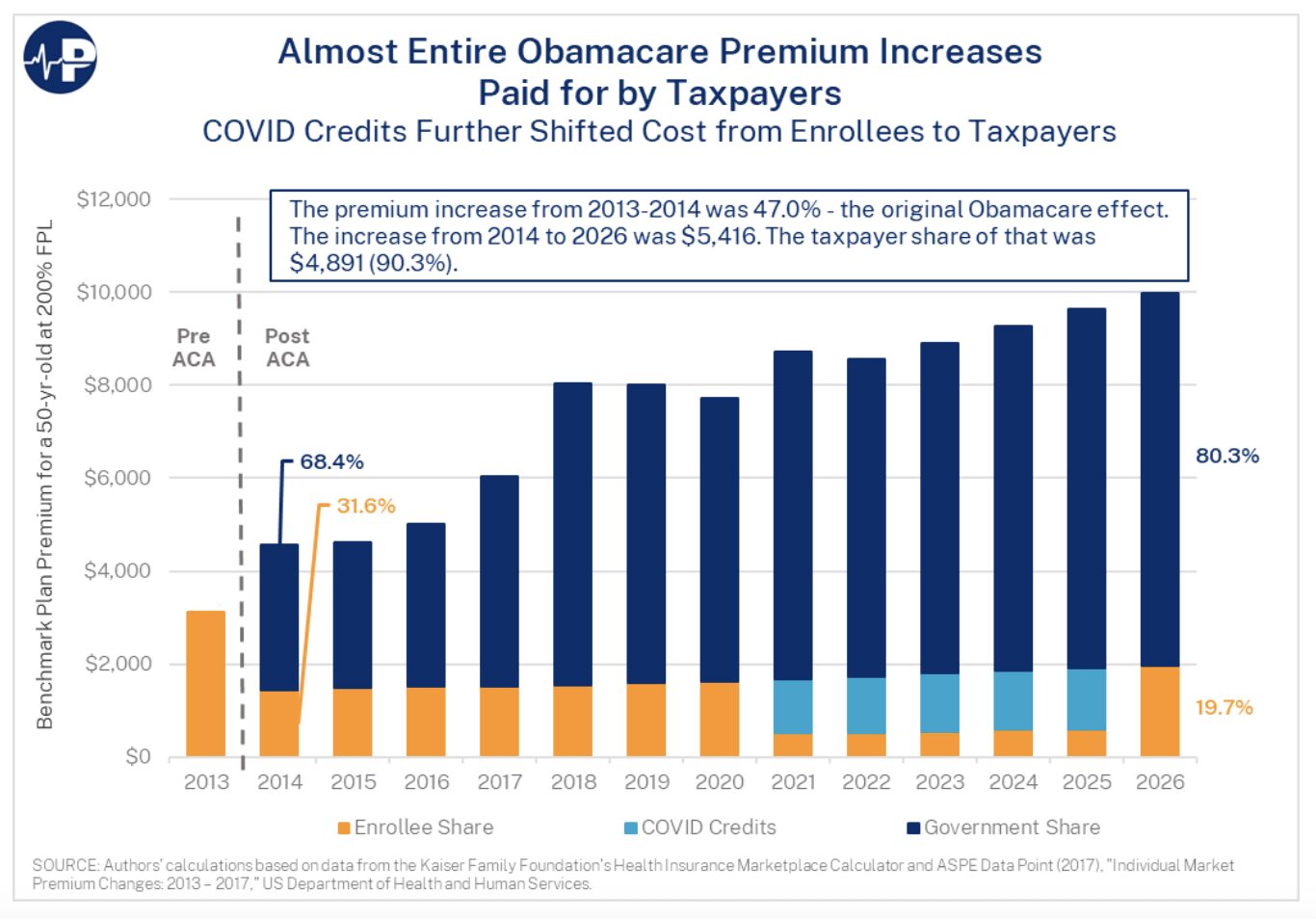
They mean taxpayers will pick up “only” 80% of the tab instead of 93% if Obamacare’s “temporary” supersized subsidies from the COVID emergency aren’t extended to Americans who make up $500,000 a year!

Obamacare was always a classic bait and switch: provide government-subsidized health care, then when the costs explode, demand even more subsidies and let the vicious cycle keep repeating. Obamacare was always a racket and the Left knew it all along.

Now we all do.

Here’s a good chart from EPIC showing how the scam works:

https://committeetounleashprosperity.com/hotlines/obamacares-collapse/

US Bailout Of Argentina Begins: Bessent Purchases Pesos, Finalizes $20BN Currency Swap

 With the Argentine Peso imploding in recent weeks - but not as fast as it would have had the Milei government not backstopped it with relentless central bank interventions which quickly drained the country's dollar reserves - and the country's bond market in freefall, the Latin American country was facing a full-blown market collapse if it didn't get quick and generous access to a source of USD funding. It did just that moments ago when US Treasury Secretary Scott Bessent said he had "finalized a $20 billion currency swap framework with Argentina’s central bank" adding that the U.S. Treasury "is prepared, immediately, to take whatever exceptional measures are warranted to provide stability to markets." That much was expected, and was already discssed previously. More importantly, Bessent noted that today the US "directly purchased Argentine pesos" which will likely spark outrage among those wondering how bailing out Argentina is part of the "America First" agenda, especially when Argentina had been quietly exporting soybeans to China while US farmers are stuck nursing huge losses, now that China is no longer a key customer, and is instead purchasing from such countries rescued by the US as... Argentina. 

This is what Bessent wrote moments ago on X:

The @USTreasury has concluded 4 days of intensive meetings with Minister @LuisCaputoAR and his team in DC. We discussed Argentina’s strong economic fundamentals, including structural changes already underway that will generate significant dollar-denominated exports and foreign exchange reserves.

Argentina faces a moment of acute illiquidity. The international community – including @IMFNews  – is unified behind Argentina and its prudent fiscal strategy, but only the United States can act swiftly.  And act we will.

To that end, today we directly purchased Argentine pesos.

Additionally, we have finalized a $20 billion currency swap framework with Argentina’s central bank. The U.S. Treasury is prepared, immediately, to take whatever exceptional measures are warranted to provide stability to markets.

I emphasized to Minister Caputo that @POTUS @realDonaldTrump’s America First economic leadership is committed to strengthening our allies who welcome fair trade and American investment.

I continue to hear from American business leaders who, thanks to President Milei’s leadership, are eager to tie the American and Argentine economies more closely together. The Trump administration is resolute in our support for allies of the United States, and to that end we also discussed Argentina’s investment incentives, and U.S. tools to powerfully support investment in our strategic partners.

Minister Caputo informed me of his close coordination with the IMF on Argentina’s commitments under its program. Argentina’s policies, when anchored on fiscal discipline, are sound. Its exchange rate band remains fit for purpose.

We reviewed the broad political consensus in Argentina for the second half of President @JMilei’s term. I was encouraged by their focus on achieving fiscally sound economic freedom for the people of Argentina via lower taxes, higher investment, private sector job creation, and partnering with allies. As Argentina lifts the dead weight of the state and stops spending into inflation, great things are possible.

The success of Argentina’s reform agenda is of systemic importance, and a strong, stable Argentina which helps anchor a prosperous Western Hemisphere is in the strategic interest of the United States. Their success should be a bipartisan priority.

I look forward to the meeting between President Trump and President Milei on October 14, and to seeing Minister Caputo again on the margins of the IMF Annual Meetings.

In kneejerk response, Argentine dollar bonds extended earlier gains on Thursday, with notes rising more than 4 cents across the curve. Sovereign bonds due in 2035 rose gained 4.3 cents on the dollar to trade above 60 cents, the highest levels in two weeks.

Of course, Argentina was delighted with the outcome and minister Caputo promptly thanked Bessent for his "unwavering support."

While Trump's decision to bailout Argentina makes geopolitical sense - the country is the last bastion of Anti-Chinese sentiment in Latin America, a continent which is now almost entirely pro-Beijing - Trump is about to get an earful from both sides of the aisle why he is bailing out Argentine farmers (who are exporting soybeans to China) while neglecting to do the same with US farmers. 

As a reminder, with silos full and exports drying up, Beijing - fromerly the biggest buyer of US soybeans - has not purchased any this season, diverting orders to Brazil and Argentina instead. In retaliation for Trump’s tariffs on Chinese goods, China imposed a 25% levy on American soybeans in April, further eroding their price competitiveness.

Beyond Beijing, top importers of US soybeans include Mexico, the European Union, Japan and Indonesia. Yet Trump’s team is pushing into untested markets such as India, already burdened by tariffs, as American farmers hunt for buyers from Vietnam to Nigeria.

https://www.zerohedge.com/markets/us-bailout-argentina-begins-bessent-purchases-pesos-finalizes-20bn-currency-swap

The Real Deal

 By Michael Every of Rabobank

The Real Deal

Right now, the focus shouldn’t be on the little data we have. German industrial production figures were shockingly bad and take output to the lowest level since 2005, but that was an obvious trend years ago to those who wanted to see it.

Neither should it be on the Fed. The FOMC minutes said they are minded to cut rates further this year, after being adamant that wasn’t necessary a few weeks ago (i.e., why listen to them?), but are still worried about inflation risks – in sharp contrast to the RBNZ, for example.

Rather, it needs to be on the deals that are underway – and I don’t mean the circular investment/logic/firing squad(?) that we are seeing in US AI.

Against a backdrop of Israel denying a Politico report saying Qatar had dictated the telephone apology PM Netanyahu offered to the country for its attack in Doha, Israeli negotiators and Hamas signed Trump’s peace deal. All living hostages could be home by Saturday, the two-year anniversary of their kidnapping in the Jewish calendar, and an Israeli withdrawal begin. President Trump may fly to Israel to address the Knesset (and the Nobel Peace Prize committee) shortly.

If this proceeds, with all the usual caveats, expect the Middle East to start to change rapidly, and in the US’ favor. For just one example, there are reports Qatari-owned Al Jazeera, which runs anti-Israel/US stories, has seen a change of editorial staff to tone down its (English-language) rhetoric. Far more significant shifts in investment and logistics are likely to follow. As they say, ‘watch this space’. Which is what Europe will be doing – just watching.

On Europe-Russia, Denmark is to allocate billions of Euros for new US fighter jets as well as a Greenland military HQ - to protect it from the US or others, and Greenland itself or the Northern Passage from China to Europe via the Arctic? That’s as Polish PM Tusk announced he won’t follow the German extradition request for a Ukrainian national wanted by EU authorities for suspected involvement in the Nord Stream 1 & 2 explosions; and as Russia accused Ukraine of supporting terrorism in the Sahel.

Severe delays have also developed along one of Russia’s key overland supply routes from China, as Kazakhstan has intensified customs inspections at its border crossings looking for military- or dual-use goods subject to sanctions: some 7,500 trucks are reportedly stuck there. Welcome to how economic statecraft can work if countries choose not to keep exporting as normal via look-the-other-way transshipment – albeit at an economic cost.

After China stopped buying Aussie iron ore, demanding it pay in CNY not USD, its new alternative source of iron ore supply in Guinea suffered an explosion: coincidence or sabotage? Despite the market largely ignoring it, what *may* have transpired there could be a template for other supply chains in the current geopolitical environment: in fact, make me the argument for why it wouldn’t be the case without saying, “because markets”.

That’s as the Pentagon has begun receiving shipments of tungsten via Trinity Metals, in which it now holds a stake, straight from Rwanda: no more private commodity trade on that front. Expect that trend, which had been predicted here, to accelerate.

Nikkei Asia says US chip plant capex will outpace China, Taiwan and South Korea from 2027, with global chipmakers expected to spend nearly $400bn on advanced equipment.

“As expected, Labor has spent more than A$500bn of public money adding Glencore’s Mount Isa copper smelter and Townsville refinery to its growing list of manufacturing bailouts” (AFR), which argues: “If the ALP insists on underwriting fading relics rather than pioneering areas of strategic gain, it will risk not just burning more taxpayer cash but consuming Australia’s future competitiveness.” Strategic areas like… like… like…. Look! House prices are going up again!

Mexican officials are planning to push back against new US 25% tariffs on heavy trucks planned to start on 1 November, but talks are ongoing. Canada still isn’t buckling to Trump yet, But Bloomberg notes that millions of Canadians’ jobs are at stake, which underlines which way the decision is ultimately likely to go.

The EU “sees new US trade demands hollowing out deal struck by Trump,” says Bloomberg, with Europe unhappy that steel and aluminium tariffs apply proportionately to imported items using those metals… as the EU’s own steel tariffs were apparently already considering adding exactly the same feature ahead.

Moreover, the US is demanding the EU exempt its firms from its green rules. Doesn’t the EU get to regulate their own economy? Yet this is also Europe regulating US firms to their disadvantage. there is a cost involved with compliance here. despite pledging to rebalance trade through various mechanisms. Europe risks security, energy, trade, and Eurodollar crises if it walks away over the green issue; or a massive compromise in its principles --and the competitiveness of its own firms vis-à-vis the US-- if it bends. But realpolitik deals are about power, not technocratic committee win-wins.  

Meanwhile, as Politico puts it, ‘Socialists cave to centre-right demons to slash EU green rules’, while @JavierBlas notes the “Spanish grid asks for urgent measures (to be implemented in 5 days) to stabilise the electricity network as voltage swings again sharply (the situation is similar in early autumn to spring during the blackout). It warns the grid’s safety is at risk.”

In politics, French President Macron has promised to name a new French PM by Friday as outgoing Lecornu said the prospect of a snap parliamentary election is receding - so who has compromised on what in that tranche of realpolitik? Again, please answer assuming it does not involve “because markets.”

In Japan, talks between LDP leader Takaichi and Komeito leader Saito have failed to produce a deal, with the possibility of a breakdown in the 26-year relationship between the two political parties rising, further muddying the waters on where Japan, and JPY, goes from here.

That’s as Argentina sees its rates exceed 80% as a Peso crisis is sparking a cash crunch, according to Bloomberg: the US Monroe Doctrine carrot of a $20bn swapline was not enough, it seems. How much larger does it then need to get? Pick a number… or dollarisation? Who knows in this geopolitical climate!

On top of that, Bloomberg notes ‘US Stablecoin Dream Is a Nightmare for China’ - and not only China: Europe and others will all have to deal with it. Their argument is that “The US is shaping dollar stablecoins as a means to carry America's influence around the world, which is seen as a new front of geopolitical competition.” Indeed: we wrote on that topic and angle recently at a time when most in markets were either asking “Who is stablecoin?” or talking about how it just meant ‘buy all the things’, not who would be buying whose things.

It’s the latter that matters: that’s the real deal being played out, contested market by market and geography by geography

https://www.zerohedge.com/markets/real-deal

Senate Votes Down Resolution Seeking To Halt Trump's Use Of Military Force Against Cartel Boats

 by Melanie Sun via The Epoch Times,

The U.S. Senate has voted against legislation seeking to direct the withdrawal of the U.S. military from hostilities that have not been authorized by Congress.

The proposal was a direct challenge to President Donald Trump’s decision as commander in chief to use military force against drug cartels operating in waters around the United States.

The 48-51 vote on Wednesday was mostly split along party lines, although Sen. Rand Paul (R-Ky.) and Lisa Murkowski (R-Maine) crossed the floor to support the Democrat-led resolution, while Sen. John Fetterman (D-Pa.) crossed the floor to join the majority of Republicans to reject it.

Sen. Adam Schiff (D-Calif.) and Sen. Tim Kaine (D-Va.) sponsored the measure, which was filed under the War Powers Act of 1973.

The resolution bill sought to direct the removal of the United States military from hostilities that Congress has not authorized. The bill came in response to U.S. military hits on four vessels linked to the Venezuelan gang Tren de Aragua. U.S. officials said the ships were involved in smuggling drugs into the United States. At least 21 people have been killed in these military operations.

The resolution said that drug trafficking could not be considered an armed attack or an imminent threat justifying military action, and that designating an organization as a foreign terrorist group did not authorize such use of force. It noted the United States retains the right to act in self-defense against an armed attack.

Schiff and Kaine noted that Congress supports efforts to stop narcotics from reaching the United States, but that intelligence, law enforcement, and diplomatic tools should be prioritized.

The White House formally notified Congress of the use of military force against the cartels per the War Powers Act on Sept. 4. It confirmed in early October in public statements that the United States was engaged in a “non-international armed conflict.”

Several cartels, including Venezuela’s Tren de Aragua, were designated by the United States as foreign terrorist organizations earlier this year.

The first strike on Sept. 2 targeted a Tren de Aragua drug-carrying boat from Venezuela and was “taken in defense of vital U.S. national interests,” the White House said. Trump wrote on the same day on Truth Social that “The strike occurred while the terrorists were at sea in International waters transporting illegal narcotics, heading to the United States.”

The president accused Tren de Aragua of operating with the support and direction of Venezuelan leader Nicolás Maduro.

Those supporting the bill said that notification from the president is not enough, and want the president to have to gain authorization from Congress for such military operations.

Democratic lawmakers criticized the White House over the handling of the attacks, saying they have not received key details, including who was on board, the cargo, and the legal basis for lethal force.

Kaine also criticized the Trump administration for failing to explain why standard interdiction methods were not used.

The Trump administration said that the vessels were carrying narcotics bound for the United States, calling them a direct threat to U.S. national security and vital interests. In his letter notifying Congress of the military action, Trump noted the cartel’s “paramilitary capabilities” and “significant losses of life” suffered by “friendly foreign nations” in their efforts against the drug trafficking cartels.

Trump has said the vessels were carrying narcotics bound for the United States, calling them a direct threat to U.S. national security and vital interests.

The War Powers Act of 1973 currently states that the U.S. military cannot continue fighting beyond 60 days without congressional authorization for the use of force or a declaration of war. Unless Congress grants more time, only 30 days is then allowed for the withdrawal of troops. The president is also required to regularly consult with Congress throughout any military engagement.

After the vote, Sen. Patty Murray (D-Wash.) said, “We are not at war with Venezuela, and Americans do not want to be dragged into a war with Venezuela because this White House wrongly believes they can kill anyone they want, without regard for the law or Congress.”

Rand said in a post on X, “Blowing up boats without due process could risk unintended escalation and trigger regime change efforts—an approach history has repeatedly shown to fail.”

https://www.zerohedge.com/geopolitical/senate-votes-down-resolution-seeking-halt-trumps-use-military-force-against-cartel

Paramount Skydance Chief sees `lots of options' for media deals

 Paramount CEO David Ellison dodged talk of the company's reported plans to submit a bid for all of Warner Bros. Discovery on Thursday. But he does see "a lot" of "actionable" M&A possibilities as the media giant looks to transform itself following Skydance's $8 billion acquisition.

"The way we approach everything is first and foremost, what's good for the talent community, what's good for our shareholders and value creation and what's good for basically, storytelling at large," Ellison told Bloomberg's Screentime conference on Thursday. "I actually do think there's a lot of options out there in terms of what actually might be actionable in the near future. We would approach that through the lens of wanting to make more, not less."

When asked what those "actionable" opportunities might be, Ellison declined to comment.

His comments on M&A come after Paramount acquired Bari Weiss' The Free Press earlier this week for $150 million in a cash and stock deal. Ellison said The Free Press' values "align" with Paramount and would be crucial to CBS News' digital strategy and help the news network "get back into the trust business."

It also comes as Warner Bros. Discovery CEO David Zaslav has long warned that Hollywood is headed for consolidation. For now, WBD is headed in the opposite direction, with the company on track to split its studios & streaming business and linear networks business into two standalone companies, Warner Bros. and Discovery Global, in 2026.

In the nine weeks since closing the Paramount-Skydance merger, the company has made a string of new executive hires, including Josh Silverman to lead the company's global products & experiences business, Dane Glasgow as chief product officer, Makan Delrahim as chief legal officer and Jay Askinasi as chief revenue officer.

It has also struck new media rights deals with the UFC and Zuffa Boxing, greenlit new series such as Jeremy Strong's "9/12" and Nicole Kidman and Elle Fanning's "Discretion," renewed its deal with "South Park" creators Trey Parker and Matt Stone, and struck new deals with creative talent like the The Duffer Brothers and James Mangold.

Looking ahead, Paramount is aiming to exceed $2 billion in cost savings, which is expected to include thousands of job cuts and a review of its real estate portfolio. It will also look to drive efficiencies in areas including technology by putting Paramount+, Pluto TV and BET+ on the same backend infrastructure and scale Skydance and Oracle's Studio in the Cloud partnership across Paramount.

Ellison is expected to detail more of Paramount's plans and vision for the future during the company's earnings call in November. Shares of Paramount are up 53.9% in the past six months and year to date and 18% in the past month.

https://www.msn.com/en-us/movies/other/paramount-ceo-david-ellison-dodges-wbd-bid-talk-says-there-s-a-lot-of-actionable-m-a-options/ar-AA1Oa8RX

U.S. stocks decline as Powell passes on policy outlook commentary, tech struggles

 Wall Street's major indexes struggled to keep up momentum on Thursday, after the S&P 500 (SP500) and the Nasdaq (COMP:IND) hit new intraday highs earlier, as Federal Reserve Chair Jerome Powell did not comment on the economic outlook or monetary policy at a Fed event.

The benchmark S&P 500 (SP500) was last -0.4% in afternoon trade, while the Nasdaq Composite (COMP:IND) was -0.3%, and the Dow (DJI) was -0.7%.

Among Thursday's decliners, AppLovin (APP) shares were -4.2% after reports on Monday that the SEC was potentially probing them over data collection processes. Dell (DELL) -5.3% is also among the top decliners, as its CEO said that clients appear to be constrained by their ability to access enough energy to power data center demands.

Within commodities, gold (XAUUSD:CUR) officially surpassed the $4,000 level on Wednesday, while the Silver spot silver also hit a historic $50/oz as investors piled into precious metals.

“Could this trigger a fresh wave of buying as retail investors rush to join the latest gold rush? It’s certainly possible, although such interest is likely to be in coins, jewelry and bullion. Nevertheless, every little helps. It looks as if gold may be consolidating after two months of relentless gains,” said David Morrison, senior market analyst at Trade Nation.

“All recent attempts at a retracement have been short-lived, with every dip quickly met by aggressive buying interest. This persistent demand underscores the depth of conviction among market participants, even at such high price levels,” he added.

In other news, Fed Chair Jerome Powell gave welcome remarks before the Community Bank Conference, however, he did not mention anything about the monetary policy or the economy. In addition, Fed Governor Michael Barr said he's skeptical that the FOMC should "fully 'look through' higher inflation from import tariffs."

Also, due to the ongoing U.S. government shutdown, there are no economic data releases slated on Thursday.

“Last night saw the release of the minutes from the Federal Reserve’s September FOMC meeting… Despite this lack of clarity, the probability of two further rates cuts this year has risen, according to the CME’s FedWatch Tool, and this has helped to underpin U.S. equities. Overall, investors took the minutes in their stride, viewing them as neither overly dovish nor hawkish,” Morrison said.

Over in the bond market, yields were lower. The 10-year Treasury yield (US10Y) was 3 basis points higher at 4.15%, while the 2-year yield (US2Y) rose 2 basis points to 3.61%. A $22B, 30-Year Bond Auction tailed.

The Fed balance sheet will land later in the day. 

On geopolitics, Israel and Hamas have agreed to a ceasefire and hostage deal as part of the first phase of a peace plan advanced by U.S. President Donald Trump to end the war in Gaza.

Wall Street’s major averages ended higher on Wednesday, with the Nasdaq Composite and S&P 500 tagging new record closes, all while gold (XAUUSD:CUR) topped $4,000/oz and FOMC minutes landed.

https://www.msn.com/en-us/money/markets/u-s-stocks-decline-as-powell-passes-on-policy-outlook-commentary/ar-AA1O9vwg