by Bob Goldberg
Editor’s Note: The UN’s famine declaration in Gaza is not neutral data but the latest mutation of an old slander — the blood libel — repackaged as journalism, sanctified by NGOs, and weaponized in the court of public opinion.
By now, you’ve heard the ritual incantations, chanted with liturgical precision. “Famine confirmed.” “Failure of humanity.” The UN’s preferred adjectives arrive on schedule, as if sorrow were a press release with an embargo. On August 22, the UN-backed IPC declared famine in and around Gaza City, complete with the familiar triad of thresholds and the requisite denunciations of Israel. The wires obliged; the condemnations rolled in.
For months, Israel’s COGAT has published a running ledger of trucks, tonnage, and routes. The UN, meanwhile, tallied a fraction of those flows because it excluded non-UN channels—state-to-state shipments, private deliveries, airdrops, and GHF consignments. **Cooking the Numbers**
That gap isn’t a rounding error; it’s the engine of a narrative. Between May and August 2025, COGAT says ~9,200 trucks entered Gaza; the UN publicly counted 3,553. That’s a shortfall of almost 6,000 trucks—an undercount large enough to move headlines, policy, and, yes, famine models.
This isn’t arcana. The UN’s dashboards became the de facto “single source of truth” for journalists, diplomats, and prosecutors crafting talking points and, in some cases, arrest warrants. But when your truth omits entire pipelines, you stop measuring reality and start manufacturing it. (COGAT’s public dossier walks through the discrepancies—worth a read even for those who disagree with Jerusalem’s politics.)
Now to the famine call itself. If you’re experiencing déjà vu, it’s because we’ve been here before—in reverse. In mid-2024, the IPC’s Famine Review Committee reviewed earlier “famine is here” claims and found that, at that moment, famine was not yet occurring, while warning that risk remained high if the war and access constraints persisted; in other words, not denial, but caution. The rhetoric outran the data. ()
Fast-forward to August 2025, and the IPC says the famine thresholds are now met in Gaza City. Many outlets repeat the classic criteria—extreme food scarcity for >20% of households, child acute malnutrition >30%, and two deaths per 10,000/day. Critics counter that the IPC introduced MUAC (mid-upper arm circumference) at 15% for child malnutrition in this context—an easier-to-collect but less precise measure—effectively lowering one of the goalposts. That dispute isn’t academic; it’s the difference between “crisis,” “emergency,” and “famine” on the world’s front pages. The IPC and UN agencies stand by the call; skeptics say the standard was bent to fit the verdict. Both can’t be right.
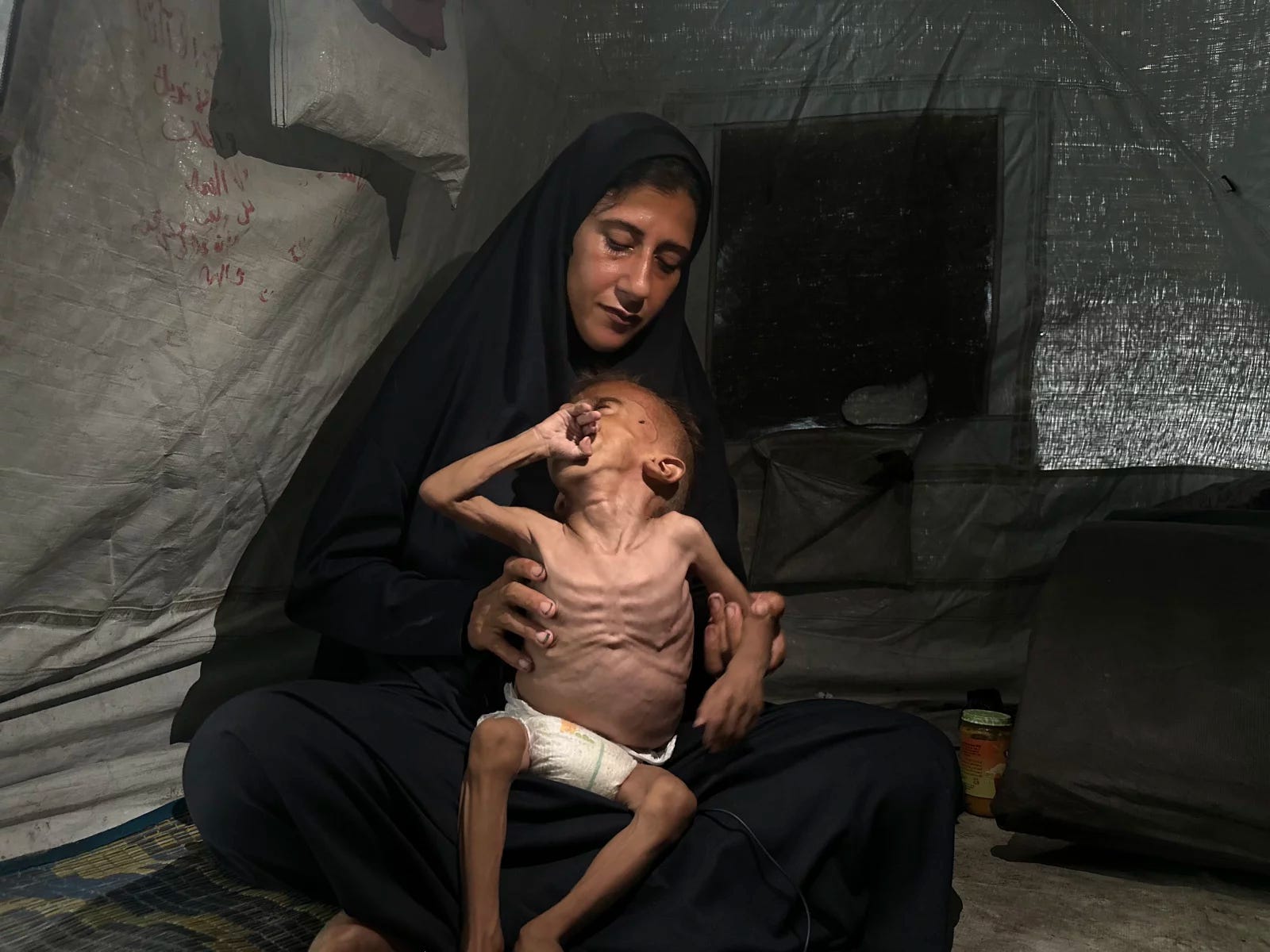
Enter the NGOs, stage left. A constellation of groups—some with long records, others with long agendas—pushed “starvation as a weapon” claims within days of October 7, marching affidavits and open letters from press rooms to prosecutors’ desks. That drumbeat helped propel the ICC from applications (May 2024) to warrants (November 2024) against Israeli leaders—extraordinary steps that now orbit every discussion of Gaza like a legal moon. One may applaud or abhor that trajectory; one cannot pretend it happened in a data vacuum.
So what, exactly, do we know—and what’s been artfully constructed?
We know a UN-backed body has declared famine in Gaza City. We know Israel disputes the finding and accuses the UN of under-counting aid by thousands of trucks—an omission the UN treats as a “tracking issue,” not a distortion. We know the methodology fight over child malnutrition (MUAC vs. weight-for-height; 15% vs. 30%) now sits at the heart of a geopolitical morality play. And we know that when institutions turn contested inputs into absolute pronouncements, policy follows the loudest spreadsheet. (Reuters, ynetnews, COGAT, FDD)
And if you think this is accidental, you haven’t been paying attention. The real achievement here is narrative diversion—smothering the facts that Hamas manufactures misery and the UN launders it—so that flaccid Western democracies legitimize turning Israel, the subject of genocide, into an agent of genocide.
We have seen this show before. Where nations turn Jews as a people into the evil other. We watched a nation turn into a pack, stalking humans as prey, tearing off civilization’s restraints and unleashing sadism. Sebastian Haffner (pseudonym of Raimund Pretzel) was a German journalist and historian. In his memoir Defying Hitler, he detailed the gradual erosion of the rights and safety of Germany's Jews under the Nazi regime, and the reactions of the German populace to these changes. An "Aryan" with many Jewish friends and a Jewish fiancée, Haffner witnessed and wrote about the increasing persecution firsthand.
Haffner saw that the Nazis were not the first in history “to deny humans the solidarity of every species that enables it to survive; to turn human predatory instincts, that are normally directed against other animals, against members of their own species, and to make a whole nation into a pack of hunting hounds.”
Instead, the Nazi’s innovation was to use all forms to repackage narratives constructed by journalists and historians that turned around anti-Judaism into a debate not about their hate, but about the so-called 'Jewish question.' Haffner wrote, “By publicly threatening a person, an ethnic group, a nation, or a region with death and destruction, they provoke a general discussion not about their own existence, but about the right of their victims to exist.” Haffner reported.
The Arabs in Palestine learned this lesson well from both the Nazis and the Soviets. What is different today is, as David Nirenberg observed, the types of media don’t merely disseminate knowledge in new ways; they also generate forms of knowledge.
This was as true of the printing press as it is in our age of social media: the complicity of historians in the transformation of the blood libel from superstition into scholarship or journalism, in this case.
The “genocidal Israel” narrative hasn’t triumphed by force of evidence but by ease of replication. Journalists, academics, and influencers adopt the frame, repeat the language, and cite each other until provenance evaporates and only the aura of authority remains.
Yesterday’s blood libel needed news reels and broadsheets; today it needs Canva, a Substack, a blue check, and a feedback loop. Within a news cycle, it hardens into ideology—then into policy: classroom dogma, NGO reports, parliamentary motions, sanctions talk, even indictments. The slander returns wearing endnotes—and drafts the memo.
Why have these ways of thinking about the world in terms of Jews as a malign force whose very existence is called into question proved so persistent, so adaptable, and so capable of dissemination across historical periods and cultures, even into our own era? Regardless of the historical context in which they may have originated, what has given logics of conspiracy the ability to draw renewed life from the technologies, disciplines, and communications techniques of every subsequent age, including our own? As the effort to accuse Israel of starving Gazans as part of a genocidal campaign shows, the trail blazed by the Blood Libel has not yet reached its end. Indeed, it may be reaching its apotheosis.
https://thenewzionisttimes.substack.com/p/famine-as-blood-libel-journalisms

No comments:
Post a Comment
Note: Only a member of this blog may post a comment.