The machines continue to rise.
Researchers used artificial intelligence (AI) to train a robotic program to do parts of a gallbladder removal surgery, or a cholecystectomy. The robotic surgeon successfully performed its surgical tasks on eight pig cadavers, according to a new study published in Science Robotics.
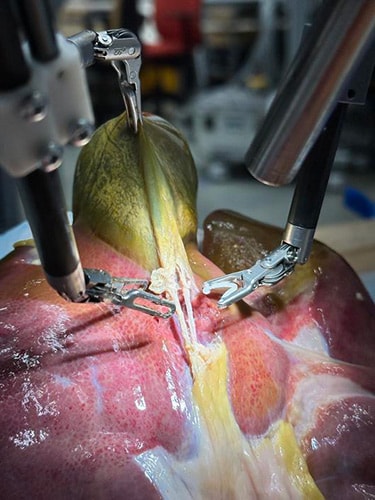
Gallbladder surgery was the first to be performed fully laparoscopically — meaning using a thin, flexible tube with a camera and a light at the end along with other small instruments inserted through several small cuts — back in 1985. More than 700,000 of these procedures are performed each year in the US.
“So to be able to automate such surgery that everybody knows, I thought could be surprising,” said lead author Ji Woong “Brian” Kim, PhD, a former postdoctoral researcher at Johns Hopkins University, Baltimore, who’s now at Stanford University, Stanford, California.
How They Did It
The approach, called Surgical Robot Transformer-Hierarchy (SRT-H), uses a “hierarchical framework” program, which breaks down the surgical procedure into manageable parts. It’s kind of like a human surgeon delegating tasks: A computerized chief surgeon gives high-level instructions, and a robotic resident translates these instructions into precise, low-level movements.

Daniel Herron, MD, chief of Bariatric Surgery for the Mount Sinai Health System, explained the technology simply: “Like ChatGPT that’s been revised to work with images and robotic arms.” (Herron was not involved in the study).
The SRT-H program was trained on videos of real gallbladder surgeries. When it’s doing surgery itself, it uses stereoscopic images collected from the robot on both the laparoscope and the wrist of the instruments.
The robot had to complete 17 tasks in order to identify the cystic duct and artery, place clips on each, and then cut them. Initially, the robot also needed to incorporate voice commands like “move right arm to the right” from those supervising, but it learned from these commands and was eventually able to do the tasks without voice intervention.
“It was very flexible and also very reliable,” Kim said of SRT-H. “Our work shows that AI models can be made reliable enough for surgical autonomy — something that once felt far-off but is now demonstrably viable.”
Impressive Tech, but Still Early
“It’s a first step, it’s an early step, but it’s a whole heck of a lot different from performing a full cholecystectomy,” noted Herron. “What we surgeons like to say is that the easiest case I ever did was a gallbladder, and the hardest case I ever did was a gallbladder, and therein lies the problem.”
This was done in an ex vivo model, said Herron, which means most of the surgical challenges of an actual procedure weren’t present. “There’s no bleeding, there’s no heartbeat that’s making everything oscillate, there’s no breathing, there’s no diaphragm pushing the gallbladder back and forth.” In a real scenario, the robot may have to successfully contend with blood obscuring the surgical field or smoke from cautery devices that interferes with your vision.

Further testing will involve more complex challenges, but for now Kim noted that each pig had slight differences and the robot was able to respond to “the variety of organs, the morphologies, the shapes, the environments.”
Building on Rapidly-Advancing Tech
Computerized surgeries already exist, of course, such as CyberKnife, which uses a robotic arm to precisely deliver targeted doses of radiation to destroy tumors in the brain, spine, and other parts of the body. LASIK, or Laser-Assisted In Situ Keratomileusis, uses a computer-controlled laser to reshape the cornea to correct vision problems like nearsightedness, farsightedness, and astigmatism.
For surgeons, there’s also a DaVinci robot system that allows a surgeon to perform complex procedures with enhanced precision and control through tiny incisions. But in that case, the human surgeon is operating the robotic arms from a console.
And while people might be reluctant to have an AI-driven robot perform surgery, Kim said in emergency scenarios when there’s no surgeon available, a highly trained and tested robot could be better than no care.
Using this kind of technology for emergencies, once it can really do it, makes sense to Herron. He likened it to an airplane’s ability to fly autonomously. “Are you willing to let a fancy robot land the plane in an emergency? That’s a different question than saying, ‘hey, are you willing to get into an airplane that has no pilot aboard and let the computer fly it completely autonomously?’”
Given how fast AI is moving, it’s possible to see this technology progress significantly in the next few years, however there’s more work to do before robots can perform a whole surgery on their own. “We’re trying to make the model much bigger with much larger training data,” said Kim. “That’s kind of the key to unlocking very good intelligence in the model.”

No comments:
Post a Comment
Note: Only a member of this blog may post a comment.