Search This Blog

Friday, May 25, 2018

Looking at Nanotechnology in Biotechnology


For some time, the difference between a biotechnology company and a pharmaceutical company was straightforward. A biotechnology focused on developing drugs with a biological basis. Pharmaceutical companies focused on drugs with a chemical basis.
It was sort of an artificial distinction, and is even more so now because pharmaceutical companies haven’t excluded biologics from their portfolios. At one time there were even distinctions in the definitions related to small molecules versus large molecules, but those are largely in the dustbin of biopharma vocabulary. It’s one reason why “biopharma” itself is a useful word to bridge the two, and really, biotech and pharma are largely interchangeable.
Nanotechnology Versus Biotechnology
But what about nanotechnology? Is that biotechnology?
The answer to that seems to be … yes and no.
Nanotechnology typically refers to technology that is less than 100 nanometers in size. Although not horribly useful for differentiating things on the microscopic—or smaller—scale, there are 25,400,000 nanometers in an inch. So … small. Really small.
Wouldn’t that refer to many drugs? Yes, probably. But nanotechnology typically refers to tech made of manmade and inorganic materials in that size range. Again, the key word is “typically.”
There is overlap.  Liji Thomas, writing for Azo Nano, says, “Nanobiotechnology deals with technology which incorporates nanomolecules into biological systems, or which miniaturizes biotechnology solutions to nanometer size to achieve greater reach and efficacy…. Bionanotechnology, on the other hand, deals with new nanostructures that are created for synthetic applications, the difference being that these are based upon biomolecules.”
Clear? Probably not. Here are some examples of biotechnology companies utilizing nanotechnology, along with whatever tools they need to develop their compounds.
PEEL Therapeutics. PEEL Therapeutics is a small biotech company, largely in stealth mode, founded by Joshua Schiffman, an associate professor of Pediatrics at the University of Utahand Avi Schroeder, an assistant professor of chemical engineering at the Technion-Israel Institute of Technology. Schiffman was doing work on a tumor suppressor gene, p53, which shows up at very high numbers in elephants. Elephants have significantly lower rates of cancer than humans, who normally have two normal copies of p53. Humans with a disease called Li-Fraumeni Syndrome, have only one, and they have a 100 percent change of getting cancer, or very close to it.
What PEEL is attempting to do is build a synthetic version of p53 and insert them into a novel drug delivery system using nanotechnology. “Peel,” by the way, is the phonetic spelling of the Hebrew word for elephants. eP53 has been successfully encapsulated in nanoparticles, and at least in petri dishes, has demonstrated proof of concept. Elephants are not being experimented upon.
Exicure. Based in Skokie, Illinois, Exicure (formerly known as AuraSense) is a clinical stage biotechnology company that’s working on a new class of immunomodulatory and gene regulating drugs that uses proprietary three-dimensional, spherical nucleic acid architecture. The SNA technology came out of the laboratory of Chad Mirkin at the Northwestern University International Institute for Nanotechnology.
The company has received financing from the likes of Microsoft’s Bill Gates, Aon founder Pat Ryan, David Walt, co-founder of Illumina, and Boon Hwee Koh, director of Agilent Technologies.
The technology platform is complex, but it is essentially various single and double-stranded nucleic acids stuck on the outside of a nanosphere. They are able to easily penetrate cells, which then trigger immune responses.
SpyBiotech. Headquartered in Oxford, UK, SpyBiotech focuses on the so-called “super glue” that combines two parts of the bacteria that causes strep throat. It was spun out of Oxford University, and was based on research performed by its Department of Biochemistry and the Jenner Institute. When the bacteria that cause step throat are separated, they are attracted to each other and attempt to reattach.
The company is working to use this principle to develop vaccines that, instead of using virus-causing bacteria, will bind onto viral infections. One of the bacteria that can cause strep throat, impetigo and other infections, Streptococcus pyogenes, is often shortened to Spy, hence the name of the company. When Spy is split into a peptide (SpyTag) and its protein partner (SpyCatcher), they are attracted to each other. The researchers isolated the “glue” that creates the attraction, and believe it can be used to bond vaccines together.
The company has backing from GV, formerly Google Ventures, the venture fund backed by Alphabet/Google.
One of the company’s founders is Mark Howarth, professor of Protein Nanotechnology at the University of Oxford. The fact that he’s working on protein nanotechnology undercuts a traditional definition of nanotechnology as not using biological materials. On his website,Howarth notes that SpyTag and SpyCatcher “is the strongest protein interaction yet measured and is being applied around the world for diverse areas of basic research and biotechnology. We are extending this new class of protein interaction, to create novel possibilities for synthetic biology.”
Ultimately, when researchers are developing drugs, they are using whatever tools are necessary to find effective treatments for diseases. Biotechnology may more accurately be thought of as a set of tools and a philosophical approach to solving biological problems, compared to pharmaceuticals, and nanotechnology is yet another tool. In the wider world of drug discovery and development, there is also increasing use of artificial intelligence, data science and computational algorithms as well. And who knows what will be used tomorrow.

Quest becomes in-network lab for UnitedHealth


Mizuho analyst Ann Hynes reiterates a Buy rating on Quest Diagnostics (DGX) and Neutral rating on LabCorp (LH) after UnitedHealth (UNH) announced that both companies will participate as national providers of laboratory services for the company effective January 1, 2019. LabCorp will lose its national exclusivity, but remains in-network, as UnitedHealth’s national laboratory provider while Quest will be in-network for all plan participants beginning January 1, Hynes tells investors in a research note. She believes the move will enable Quest to reach the high-end of its previously provided long-term outlook range. For LabCorp, the news is disappointing but likely expected and now an overhang has been removed, Haynes contends.

Veeva target upped by Needham


Veeva price target raised to $90 from $70 at Needham. Needham analyst Scott Berg raised his price target on Veeva to $90 after its “very good” Q1 results driven by outperforming professional services revenues and billings. Berg also says the management elaborated on its latest Nitro product release, adding that he is “intrigued” with its sales opportunities as it could replace the existing party analytics tools. The analyst keeps his Buy rating on Veeva, noting the company can increase its R&D investments in FY19 which could support its subscription growth above the 20% annual goal through 2020.

Herbalife hit by Icahn share tender


Icahn Enterprises (IEP), Herbalife’s (HLF) largest shareholder and one of the company’s longest-standing shareholders, reported that yesterday IEP tendered its Herbalife shares into the company’s self-tender offer. Of the shares tendered, at most only 11.4M could possibly be purchased in the tender, which would still leave Icahn Enterprises as the company’s largest shareholder with at least 34.3M shares, Icahn stated. Carl Icahn added: “For almost six years, we have been one of Herbalife’s strongest, most loyal supporters; we stood by the Company through a half-decade long short-selling campaign; and we never sold a share, even after our investment doubled. But, given that our Herbalife investment has become an outsized position, representing approximately 24% exposure to total NAV, it is only prudent for IEP to reduce its exposure. IEP’s investment in Herbalife is a quintessential example of our activist investment strategy…We are very proud of our activism at Herbalife and the value we have created for all shareholders. From our first Herbalife share purchase in late 2012 through yesterday, almost $7 billion of value has been created for all Herbalife shareholders. We believe Herbalife’s business is stable, the short-sellers have largely exited, and the Company is well-positioned for the future. On behalf of all shareholders, I congratulate Michael Johnson, John DeSimone, Rich Goudis and all the other members of management, all the employees and all the distributors who have stood by, and steered, this Company so effectively over the past six years.” Following the announcement, Herbalife shares are down $4.17, or 7.75%, to $49.66 in pre-market trading.

BrainStorm says currently assessing ‘Right-To-Try’ legislation


BrainStorm Cell Therapeutics issues a statement following Congress passing the Federal “Right-to-Try” bill. The “Right-to-Try” bill will enable terminally ill patients who do not meet clinical trial criteria to seek out experimental therapies that do not yet have approval by the US Food and Drug Administration. Chaim Lebovits, president and CEO, said,”BrainStorm understands the serious unmet medical need and urgency of people living with ALS. We have received countless inquiries after the passing of Federal ‘Right-to-Try’ legislation about patient access to NurOwn. We have been, and will continue to, be engaged and collaborate with people with ALS, their families and caregivers, and legislators and government agencies to ensure that the voices of these groups are heard in this important discussion. Brainstorm is currently assessing the legislation and its potential implications, and when signed into law, will issue a formal policy on ‘Right-to-Try’ in early June. BrainStorm remains focused and fully committed to completing the Phase 3 clinical trial of NurOwn as quickly as possible. While we continually evaluate ways to provide access to NurOwn outside of the current Phase 3 trial to the many patients who can’t wait, the most expedient way to make NurOwn available to all is by completing the necessary clinical trial data collection and endpoint analyses, and submitting the required marketing applications without delay to regulatory agencies, including the FDA.”

Dermira buy maintained, target cut by Needham post analyst day


Dermira price target lowered to $16 from $19 at Needham. Needham analyst Serge Belanger lowered his price target on Dermira to $16 after the company’s inaugural analyst day which focused on the commercial launch strategy for DRM04 to reflect the higher than anticipated launch costs for the program. The analyst keeps his Buy rating however, saying his expectations for FDA approval of DRM04 are high given the “solid” phase 3 data, forecasting the treatment to have a significant role in the hyperhidrosis market which currently has few effective alternatives. Belanger adds that the stock price “undervalues DRM04’s potential and largely ignores the lebrikizumab program”

GDPR: US news sites unavailable to EU users over data protection rules

A number of high-profile US news websites are temporarily unavailable in Europe after new European Union rules on data protection came into effect.
The Chicago Tribune and LA Times were among those posting messages saying they were currently unavailable in most European countries.
The General Data Protection Regulation (GDPR) gives EU citizens more rights over how their information is used.
The measure is an effort by EU lawmakers to limit tech firms’ powers.
Under the rules, companies working in the EU – or any association or club in the bloc – must get express consent to collect personal information, or face hefty fines.

Which sites are unavailable?

News sites within the Tronc and Lee Enterprises media publishing groups were affected.
Tronc’s high-profile sites include the New York Daily News, Chicago Tribune, LA Times, Orlando Sentinel and Baltimore Sun.
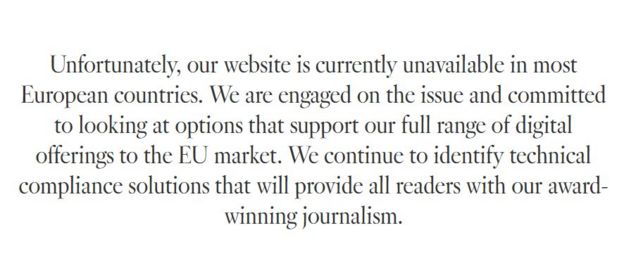
Its message read: “Unfortunately, our website is currently unavailable in most European countries. We are engaged on the issue and committed to looking at options that support our full range of digital offerings to the EU market.”
Lee Enterprises publishes 46 daily newspapers across 21 states.
Its statement read: “We’re sorry. This site is temporarily unavailable. We recognise you are attempting to access this website from a country belonging to the European Economic Area (EEA) including the EU which enforces the General Data Protection Regulation (GDPR) and therefore cannot grant you access at this time.”
What the LA Times says when you click on its site from certain European countriesImage copyrightLA TIMES
Image captionWhat the LA Times says when you click on its site from certain European countries
CNN and the New York Times were among those not affected. The Washington Post and Time were among those requiring EU users to agree to new terms.

What is GDPR?

Lawmakers in Brussels passed the new legislation in April 2016, and the full text of the regulation has been published online.
Misusing or carelessly handling personal information will bring fines of up to 20 millions euros ($23.4m;£17.5m), or 4% of a company’s global turnover.
Facebook founder Mark Zuckerberg on a television during his testimony to EU lawmakers May 2018Image copyrightAFP/GETTY
Image captionFacebook founder Mark Zuckerberg recently testified to European MPs about data privacy
In the UK, which is due to leave the EU in 2019, a new Data Protection Act will incorporate the provisions of the GDPR, with some minor changes.
All EU citizens now have the right to see what information companies have about them, and to have that information deleted.
Companies must be more active in gaining consent to collect and use data too, in theory spelling an end to simple “I agree with terms and conditions” tick boxes.
Companies must also tell all affected users about any data breach, and tell the overseeing authority within 72 hours.
Each EU member state must set up a supervisory authority, and these authorities will work together across borders to ensure companies comply.
The new chair of the European Data Protection Board, Andrea Jelinek, told the FT they expected cases to be filed “imminently”.
“If the complainants come, we will be ready,” she said.
Ireland’s data regulator Helen Dixon also spoke to the newspaper, saying the country was ready to use “the full toolkit” against non-compliant companies.
Both Facebook and Twitter have their EU headquarters in Ireland.
The new rules come amid growing scrutiny about how major tech companies like Google and Facebook collect and use people’s personal information.
Facebook founder Mark Zuckerberg faced questions from MEPs earlier this week about his company’s collection of data.
Presentational grey line

A data headache

Millions of email inboxes all over Europe filled in recent weeks with messages from anxious companies seeking explicit permission to continue sending marketing material to and collecting personal data from their customers and contacts.
The new rules govern not just the collection and storage but its sale and exploitation for marketing – some companies based in the United States have decided to stop trading in the European Union at least temporarily rather than risk falling foul of the new law.
Members of the European Parliament (MEPs) see themselves as global leaders in a battle to reduce the power of giant internet technology companies and restore a degree of control to citizens and their elected representatives.