Piper Jaffray analyst Edward Tenthoff reiterated an Overweight rating and $25 price target for Array BioPharma following the company’s Q4 results, telling investors in a research note that he is “surprised” to see shares trading lower today on a “perceived” revenue miss. Tenthoff, who notes that revenues in Q4 were only reimbursement and milestones from partners, says he is a buyer for the Braftovi and Mektovi launch in BRAF-mutant melanoma, which occurred the week of July 2, and projects initial sales of $17.2M in calendar 2018 and $71.5M in calendar 2019.
Tuesday, August 14, 2018

Alphabet Makes Another $375M Bet on Obamacare Startup Oscar

Alphabet has invested $375 million in Oscar Health, a six-year-old health insurance start-up co-founded by Joshua Kushner, the brother of Donald Trump adviser Jared Kushner.
The new funding comes only a few months after two other subsidiaries of Alphabet — venture firm Capital G and life sciences division Verily — participated in a $165 million round that sources familiar say valued Oscar at $3.2 billion. Wired reports that Alphabet now owns roughly ten percent of the start-up, which has created a technology platform to better process insurance claims.
Oscar, which ranked No. 12 on CNBC’s 2018 Disruptor 50 List, uses a mix of technology, provider partnerships and member experience to try to make health insurance pricing clearer for patients, while giving doctors more flexible payment models.
As part of the strategic investment, early Google employee and former YouTube CEO Salar Kamangar is joining Oscar’s board. Oscar CEO Mario Schlosser said in a statement that Alphabet’s investment will help bring Oscar’s product to more cities and allow it to start selling to seniors through Medicare Advantage by 2020.
Alphabet and Oscar have had a close relationship for years: CNBC reported in February that in 2016 Oscar and Verily mulled putting in a joint proposal to manage care for thousands of low-income Rhode Island residents on Medicaid. Although the bid never materialized, Verily is still interested in the insurance sector.
Investors Pile Into Health to Shield Holdings From Trade War
Equity investors are flocking to health care in the wake of escalating geopolitical tensions and a waning appetite for technology stocks.
The S&P 500 Health Care Index is the best-performing sector so far this quarter with a 7.8 percent gain, outperforming a 4.5 percent rise in the broader benchmark. Pharmaceutical and biotech stocks are among the biggest outperformers as they rebound from earlier concerns about failed clinical trials and scrutiny on drug pricing in Washington. The momentum has accelerated as investors seek havens from a potential trade war.
“It was time for the group to catch up a little,” said Andrew Hilgenbrink, who helps manage more than $1 billion in health-care assets at Highland Capital Management, said in a telephone interview. “Tariffs are kind of a non-event for the health-care space. Furthermore, valuations have become very attractive in large-cap pharma and biotech.”
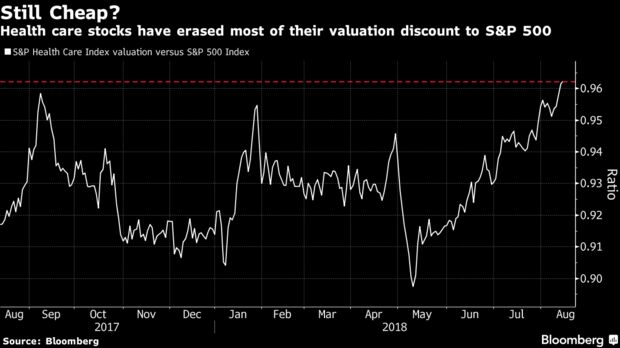
Since health stocks continue to trade at a discount to the overall market, Hilgenbrink says “there’s still additional room to go” in the recent rally. HCA Healthcare Inc., Nektar Therapeutics, Iqvia Holdings Inc. and Eli Lilly & Co. are the sector’s best performers so far in the third quarter.
Drugmakers including Johnson & Johnson say that U.S. tariffs on Chinese imports haven’t hurt their results so far, beyond the effect of a stronger dollar. That concurs with an analysis from Evercore ISI that U.S. medicines won’t see much impact from tariffs because raw bulk materials imported from China are mainly antibiotics.
The three largest exchange-traded funds tracking health care took in more than $1 billion in July. The $8 billion Vanguard Health Care ETF, known by its ticker VHT, added $47 million last week, its highest weekly inflows in more than a year.
This “is the beginning of reallocation of assets from the most popular sectors” like tech, said Bill Smead, who oversees about $2.2 billion at Smead Capital Management, in a phone interview.
Despite a rocky July, tech is still the best-performing sector this year, as it was in 2017. And health-care investors have reason to remain cautious about the recent gains. The next test for the sector is looming with the midterm elections less than three months away. President Donald Trump will need the new Congress’s backing to advance his plans to lower medical costs.
The threat to control drug prices “is not going away,” said Ying Huang, a biotech analyst with Bank of America Merrill Lynch, in a telephone interview. With more clarity in Washington, “we might see generalists coming back to the sector.”
Pot Stocks Tumble as Ontario Delays Rollout of Stores to 2019
Canadian pot stocks retreated Tuesday after the country’s largest province said it will delay the launch of bricks-and-mortar cannabis stores until six months after legalization.
Canopy Growth Corp. fell 5.7 percent, Aphria Inc. lost 5.3 percent and Aurora Cannabis Inc. slid 4.7 percent at 10 a.m. in Toronto. The BI Canada Cannabis Competitive Peers index fell 1.5 percent to the lowest since November, bringing its total loss this year to 44 percent.
Ontario’s Progressive Conservative government said Monday it will start cannabis sales with an online-only retail model when marijuana is legalized on Oct. 17, followed by private retail sales on April 1. This is an abrupt policy change from the former Liberal government, which planned to sell cannabis in government run stores, starting with 40 in 2018.
The move represents “short-term pain, long-term gain” for Canadian cannabis companies, said Canaccord Genuity analyst Matt Bottomley.
“We believe a shift to a private-sector model will likely further complicate an already challenging process and result in a slower ramp for rec sales in Ontario,” Bottomley wrote in a note to clients, adding that the April 1 date may not be realistic. However, should Canadian companies be included in the consultation process, they could achieve higher margins over the long term as they benefit from a vertically integrated business model.
Higher Margins?
The private retail model will require new legislation, creating uncertainty around the structure and timing of the rollout, said GMP Securities analyst Martin Landry.
“A delay of six to nine months in the opening of retail stores is likely to dampen recreational cannabis sales at the onset in Ontario,” Landry wrote. “Longer term, private retail could be more effective than a government monopoly to capture black-market share, and could result in more locations.”
Landry said Cronos Group Inc., Canopy and Aurora are likely to be some of the biggest beneficiaries of the private retail model.
Ontario is one of the last provinces to announce a plan for pot sales as Canada becomes the first Group of Seven country to legalize recreational use nationally. Models vary, with Alberta approving privately run stores and Quebec selling through its government alcohol agency. In Ontario, the government-run Ontario Cannabis Store will provide the online platform for retail sales and will also be the wholesaler once private stores open.
Legal sales are expected to reach $4.9 billion by 2022, according to a report by U.S. cannabis research firms Arcview Market Research and BDS Analytics.
Aveo new drug application for esophageal cancer med accepted in China
IND acceptance triggers $2M milestone payment from CANbridge to AVEO –
AVEO Oncology (Nasdaq: AVEO) today announced that the China National Drug Administration (CNDA) has accepted CANbridge Life Sciences’ Investigational New Drug (IND) Application for a Phase Ib/III clinical trial of CAN017 (AV-203), AVEO’s clinical-stage ErbB3 (HER3) inhibitory antibody candidate, in esophageal squamous cell cancer (ESCC).
Under the terms of a March 2016 agreement, the acceptance of this IND triggers a $2 million milestone payment to AVEO from CANbridge Life Sciences. CANbridge licensed worldwide rights, excluding the United States, Canada, and Mexico, to AV-203 from AVEO and AVEO is eligible to receive up to $40 million in potential additional development and regulatory milestone payments and up to $90 million in potential commercial milestone payments, assuming the successful achievement of specified development, regulatory and commercialization objectives.
“CANbridge continues to make progress in advancing CAN017, and we look forward to the initiation of a Phase Ib/extension clinical trial in ESCC, a large unmet medical need globally with a particularly acute need in Asia,” said Michael Bailey, president and chief executive officer of AVEO. “Together with ficlatuzumab, our partnered oncology programs allow us to retain meaningful rights to a promising pipeline and advance it at little or no cost to AVEO, allowing us to focus resources on our tivozanib strategy, including U.S. registration for kidney cancer as well as combinations with immunotherapy.”
AVEO previously completed a Phase 1, open-label, dose-escalation study of AV-203 (CAN017) in patients with advanced solid tumors. In this study, AV-203 was found to be generally safe and well-tolerated, with an early signal of activity consistent with preclinical data showing the potential for heregulin or neuregulin, the only known ligand for ErbB3, to serve as a biomarker predictive of AV-203 anti-tumor activity.
AVEO will pay percentage of the milestone payment to Biogen Idec International GmbH as a sublicensing fee.
Novartis recruits new compliance head from Siemens after ethics stumbles
Novartis has recruited a new chief ethics officer from Siemens after costly bribery scandals and a disputed $1.2 million (938,673.3 pounds) contract with President Donald Trump’s former lawyer that the Swiss drugmaker now calls a mistake.
Novartis said on Tuesday it had hired Klaus Moosmayer, 49, from Siemens, where he spent more than a decade helping oversee the German engineering company’s efforts to build its compliance system after several of its own bribery scandals.
Novartis Chief Executive Vas Narasimhan, promoted on Feb. 1 to lead the Basel-based company, has promised to boost its reputation following settlements or fines in corruption cases in China, South Korea and the United States.
He has also faced U.S. lawmakers’ criticism over the contract with former Trump lawyer Michael Cohen, something Narasimhan called a “mistake” that exposed Novartis to accusations it paid to gain influence within the administration.
Moosmayer, a German, replaces Shannon Thyme Klinger, who was appointed as Novartis’s general counsel when Felix Ehrat resigned in May to take responsibility for the Cohen agreement.
“We must hold ourselves to (the) highest ethical standards and always aim to win and maintain the trust of society and our many stakeholders,” Narasimhan said in a statement, while lauding Moosmayer’s extensive experience in compliance matters.
Novartis has said neither Narasimhan nor Klinger knew of the contract with Cohen when it was signed in early 2017, shortly after Trump’s inauguration.
In recent years, Novartis has paid hundreds of millions of dollars to resolve cases where employees were accused of flouting the law to accelerate sales. Units remain under scrutiny in Greece, Asia and Russia, and a trial is scheduled next year in another U.S. federal lawsuit.
SHORTCOMINGS
Novartis has acknowledged shortcomings amid what ex-CEO Joe Jimenez called a “results-oriented” culture, while insisting the Greek probe includes “many sensational and unfounded claims”.
Moosmayer, a Siemens lawyer since 2000, played a central role in building up the company’s policies governing internal investigations, disciplinary sanctions, remediation and compliance risk assessment.
In 2008, Siemens paid about $1.6 billion to resolve U.S. and European allegations it bribed officials around the world in exchange for business.
At Siemens, one of Moosmayer’s main duties was to handle the remainder of what the company dubbed a “compliance crisis” that had once put the group’s future in doubt.
His brief also included helping manage Siemens’s response to the diversion of four turbines to Crimea, in breach of EU sanctions imposed after Russia annexed the region from Ukraine in 2014. Siemens’s efforts to seize the turbines have been rejected by a Russian court.
Moosmayer, who joins the Novartis executive committee, said he hopes to build on Novartis’s personal accountability focus.
“Society has high expectations of the pharmaceutical industry and rightfully so,” Moosmayer said.
OptiNose hit after Q2 report
Thinly traded OptiNose (OPTN -23.3%) slumps on almost triple normal volume after it posted better-than-expected Q2 results earlier today.
The culprit may be management’s commentary on revenue and average selling price (ASP) for XHANCE (fluticasone propionate) Nasal Spray, approved by the FDA almost a year ago for the treatment of nasal polyps. The company expects higher gross-to-net deductions on the price due to most units being sold through its Xperience program (slide #14), designed to accelerate demand. July subscriptions, however, showed a slight downtrend (slide #12), implying a potentially tougher slog to penetrate the market than originally planned.
Q3 ASP should be on par with Q2 which was significantly less than Q1 (due to Xperience).
Revenues: $1.3M; net loss: ($24.6M).
Cash and equivalents at quarter-end were $245M.
XHANCE for chronic sinusitis clinical program to launch in Q4.
Subscribe to:
Posts (Atom)