Search This Blog

Monday, August 20, 2018

America’s Invisible Pot Addicts


The proliferation of retail boutiques in California did not really bother him, Evan told me, but the billboards did. Advertisements for delivery, advertisements promoting the substance for relaxation, for fun, for health. “Shop. It’s legal.” “Hello marijuana, goodbye hangover.” “It’s not a trigger,” he told me. “But it is in your face.”
When we spoke, he had been sober for a hard-fought seven weeks: seven weeks of sleepless nights, intermittent nausea, irritability, trouble focusing, and psychological turmoil. There were upsides, he said, in terms of reduced mental fog, a fatter wallet, and a growing sense of confidence that he could quit. “I don’t think it’s a ‘can’ as much as a ‘must,’” he said.
Evan, who asked that his full name not be used for fear of professional repercussions, has a self-described cannabis-use disorder. If not necessarily because of legalization, but alongside legalization, such problems are becoming more common: The share of adults with one has doubled since the early aughts, as the share of cannabis users who consume it daily or near-daily has jumped nearly 50 percent—all “in the context of increasingly permissive cannabis legislation, attitudes, and lower risk perception,” as the National Institutes of Health put it.
Public-health experts worry about the increasingly potent options available, and the striking number of constant users. “Cannabis is potentially a real public-health problem,” said Mark A. R. Kleiman, a professor of public policy at New York University. “It wasn’t obvious to me 25 years ago, when 9 percent of self-reported cannabis users over the last month reported daily or near-daily use. I always was prepared to say, ‘No, it’s not a very abusable drug. Nine percent of anybody will do something stupid.’ But that number is now [something like] 40 percent.” They argue that state and local governments are setting up legal regimes without sufficient public-health protection, with some even warning that the country is replacing one form of reefer madness with another, careening from treating cannabis as if it were as dangerous as heroin to treating it as if it were as benign as kombucha.
But cannabis is not benign, even if it is relatively benign, compared with alcohol, opiates, and cigarettes, among other substances. Thousands of Americans are finding their own use problematic in a climate where pot products are getting more potent, more socially acceptable to use, and yet easier to come by, not that it was particularly hard before.
For Keith Humphreys, a professor of psychiatry and behavioral sciences at Stanford University, the most compelling evidence of the deleterious effects comes from users themselves. “In large national surveys, about one in 10 people who smoke it say they have a lot of problems. They say things like, ‘I have trouble quitting. I think a lot about quitting and I can’t do it. I smoked more than I intended to. I neglect responsibilities.’ There are plenty of people who have problems with it, in terms of things like concentration, short-term memory, and motivation,” he said. “People will say, ‘Oh, that’s just you fuddy-duddy doctors.’ Actually, no. It’s millions of people who use the drug who say that it causes problems.”
Users or former users I spoke with described lost jobs, lost marriages, lost houses, lost money, lost time. Foreclosures and divorces. Weight gain and mental-health problems. And one other thing: the problem of convincing other people that what they were experiencing was real. A few mentioned jokes about Doritos, and comments implying that the real issue was that they were lazy stoners. Others mentioned the common belief that you can be “psychologically” addicted to pot, but not “physically” or “really” addicted. The condition remains misunderstood, discounted, and strangely invisible, even as legalization and white-marketization pitches ahead.
The country is in the midst of a volte-face on marijuana. The federal government still classifies cannabis as a Schedule I drug, with no accepted medical use. (Meth and PCP, among other drugs, are Schedule II.) Politicians still argue it is a gateway to the use of things like heroin and cocaine. The country still spends billions of dollars fighting it in a bloody and futile drug war, and still arrests more people for offenses related to cannabis than it does for all violent crimes combined.
Yet dozens of states have pushed ahead with legalization for medical or recreational purposes, given that for decades physicians have argued that marijuana’s health risks have been overstated and its medical uses overlooked; activists have stressed prohibition’s tremendous fiscal cost and far worse human cost; and researchers have convincingly argued that cannabis is far less dangerous than alcohol. A solid majority of Americans support legalizationnowadays.
Academics and public-health officials, though, have raised the concern that cannabis’s real risks have been overlooked or underplayed—perhaps as part of a counter-reaction to federal prohibition, and perhaps because millions and millions of cannabis users have no problems controlling their use. “Part of how legalization was sold was with this assumption that there was no harm, in reaction to the message that everyone has smoked marijuana was going to ruin their whole life,” Humphreys told me. It was a point Kleiman agreed with. “I do think that not legalization, but the legalization movement, does have a lot on its conscience now,” he said. “The mantra about how this is a harmless, natural, and non-addictive substance—it’s now known by everybody. And it’s a lie.”
Thousands of businesses, as well as local governments earning tax money off of sales, are now literally invested in that lie. “The liquor companies are salivating,” Matt Karnes of GreenWave Advisors told me. “They can’t wait to come in full force.” He added that Big Pharma was targeting the medical market, with Wall Street, Silicon Valley, food businesses, and tobacco companies aiming at the recreational market.
Sellers are targeting broad swaths of the consumer market—soccer moms, recent retirees, folks looking to replace their nightly glass of chardonnay with a precisely dosed, low-calorie, and hangover-free mint. Many have consciously played up cannabis as a lifestyle product, a gift to give yourself, like a nice crystal or an antioxidant face cream. “This is not about marijuana,” one executive at the California retailer MedMen recently argued. “This is about the people who use cannabis for all the reasons people have used cannabis for hundreds of years. Yes, for recreation, just like alcohol, but also for wellness.”
Evan started off smoking with his friends when they were playing sports or video games, lighting up to chill out after his nine-to-five as a paralegal at a law office. But that soon became couch-lock, and he lost interest in working out, going out, doing anything with his roommates. Then came a lack of motivation and the slow erosion of ambition, and law school moving further out of reach. He started smoking before work and after work. Eventually, he realized it was impossible to get through the day without it. “I was smoking anytime I had to do anything boring, and it took a long time before I realized that I wasn’t doing anything without getting stoned,” he said.
His first attempts to reduce his use went miserably, as the consequences on his health and his life piled up. He gained nearly 40 pounds, he said, when he stopped working out and cooking his own food at home. He recognized that he was just barely getting by at work, and was continually worried about getting fired. Worse, his friends were unsympathetic to the idea that he was struggling and needed help. “[You have to] try to convince someone that something that is hurting you is hurting you,” he said.
Other people who found their use problematic or had managed to quit, none of whom wanted to use their names, described similar struggles and consequences. “I was running two companies at the time, and fitting smoking in between running those companies. Then, we sold those companies and I had a whole lot of time on my hands,” one other former cannabis user told me. “I just started sitting around smoking all the time. And things just came to a halt. I was in terrible shape. I was depressed.”
Lax regulatory standards and aggressive commercialization in some states have compounded some existing public-health risks, raised new ones, and failed to tamp down on others, experts argue. In terms of compounding risks, many cite the availability of hyper-potent marijuana products. “We’re seeing these increases in the strength of cannabis, as we are also seeing an emergence of new types of products,” such as edibles, tinctures, vape pens, sublingual sprays, and concentrates, Ziva Cooper, an associate professor of clinical neurobiology in the Department of Psychiatry at Columbia University Medical Center, told me. “A lot of these concentrates can have up to 90 percent THC,” she said, whereas the kind of flower you could get 30 years ago was far, far weaker. Scientists are not sure how such high-octane products affect people’s bodies, she said, but worry that they might have more potential for raising tolerance, introducing brain damage, and inculcating dependence.
As for new risks: In many stores, budtenders are providing medical advice with no licensing or training whatsoever. “I’m most scared of the advice to smoke marijuana during pregnancy for cramps,” said Humphreys, arguing that sellers were providing recommendations with no scientific backing, good or bad, at all.
In terms of long-standing risks, the lack of federal involvement in legalization has meant that marijuana products are not being safety-tested like pharmaceuticals; measured and dosed like food products; subjected to agricultural-safety and pesticide standards like crops; and held to labeling standards like alcohol. (Different states have different rules and testing regimes, complicating things further.)
Health experts also cited an uncomfortable truth about allowing a vice product to be widely available, loosely regulated, and fully commercialized: Heavy users will make up a huge share of sales, with businesses wanting them to buy more and spend more and use more, despite any health consequences.
“The reckless way that we are legalizing marijuana so far is mind-boggling from a public-health perspective,” Kevin Sabet, an Obama administration official and a founder of the nonprofit Smart Approaches to Marijuana, told me. “The issue now is that we have lobbyists, special interests, and people whose motivation is to make money that are writing all of these laws and taking control of the conversation.”
This is not to say that prohibition is a more attractive policy, or that legalization has proven to be a public-health disaster. “The big-picture view is that the vast majority of people who use cannabis are not going to be problematic users,” said Jolene Forman, an attorney at the Drug Policy Alliance. “They’re not going to have a cannabis-use disorder. They’re going to have a healthy relationship with it. And criminalization actually increases the harms related to cannabis, and so having a strictly regulated market where there can be limits on advertising, where only adults can purchase cannabis, and where you’re going to get a wide variety of products makes sense.”
Still, strictly regulated might mean more strictly regulated than today, at least in some places, drug-policy experts argue. “Here, what we’ve done is we’ve copied the alcohol industry fully formed, and then on steroids with very minimal regulation,” Humphreys said. “The oversight boards of a number of states are the industry themselves. We’ve learned enough about capitalism to know that’s very dangerous.”
A number of policy reforms might tamp down on problem use and protect consumers, without quashing the legal market or pivoting back to prohibition and all its harms. One extreme option would be to require markets to be noncommercial: The District of Columbia, for instance, does not allow recreational sales, but does allow home cultivation and the gifting of marijuana products among adults. “If I got to pick a policy, that would probably be it,” Kleiman told me. “That would be a fine place to be if we were starting from prohibition, but we are starting from patchwork legalization. As the Vermont farmer says, I don’t think you can get there from here. I fear its time has passed. It’s generally true that the drug warriors have never missed an opportunity to miss an opportunity.”
There’s no shortage of other reasonable proposals, many already in place or under consideration in some states. The government could run marijuana stores, as in Canada. States could require budtenders to have some training or to refrain from making medical claims. They could ask users to set a monthly THC purchase cap and remain under it. They could cap the amount of THC in products, and bar producers from making edibles that are attractive to kids, like candies. A ban or limits on marijuana advertising are also options, as is requiring cannabis dispensaries to post public-health information.
Then, there are THC taxes, designed to hit heavy users the hardest. Some drug-policy experts argue that such levies would just push people from marijuana to alcohol, with dangerous health consequences. “It would be like saying, ‘Let’s let the beef and pork industries market and do whatever they wish, but let’s have much tougher restrictions on tofu and seitan,’” said Mason Tvert of the Marijuana Policy Project. “In light of the current system, where alcohol is so prevalent and is a more harmful substance, it is bad policy to steer people toward that.” Yet reducing the commercial appeal of all vice products—cigarettes, alcohol, marijuana—is an option, if not necessarily a popular one.
Perhaps most important might be reintroducing some reasonable skepticism about cannabis, especially until scientists have a better sense of the health effects of high-potency products, used frequently. Until then, listening to and believing the hundreds of thousands of users who argue marijuana is not always benign might be a good start.

Consumer genomics will change your life, whether you get tested or not


With more than 10 million genotyped customers, the consumer genomics industry is maturing and becoming a mainstream phenomenon. At last, innovations and applications, some unforeseen, are being brought to the masses.

Introduction

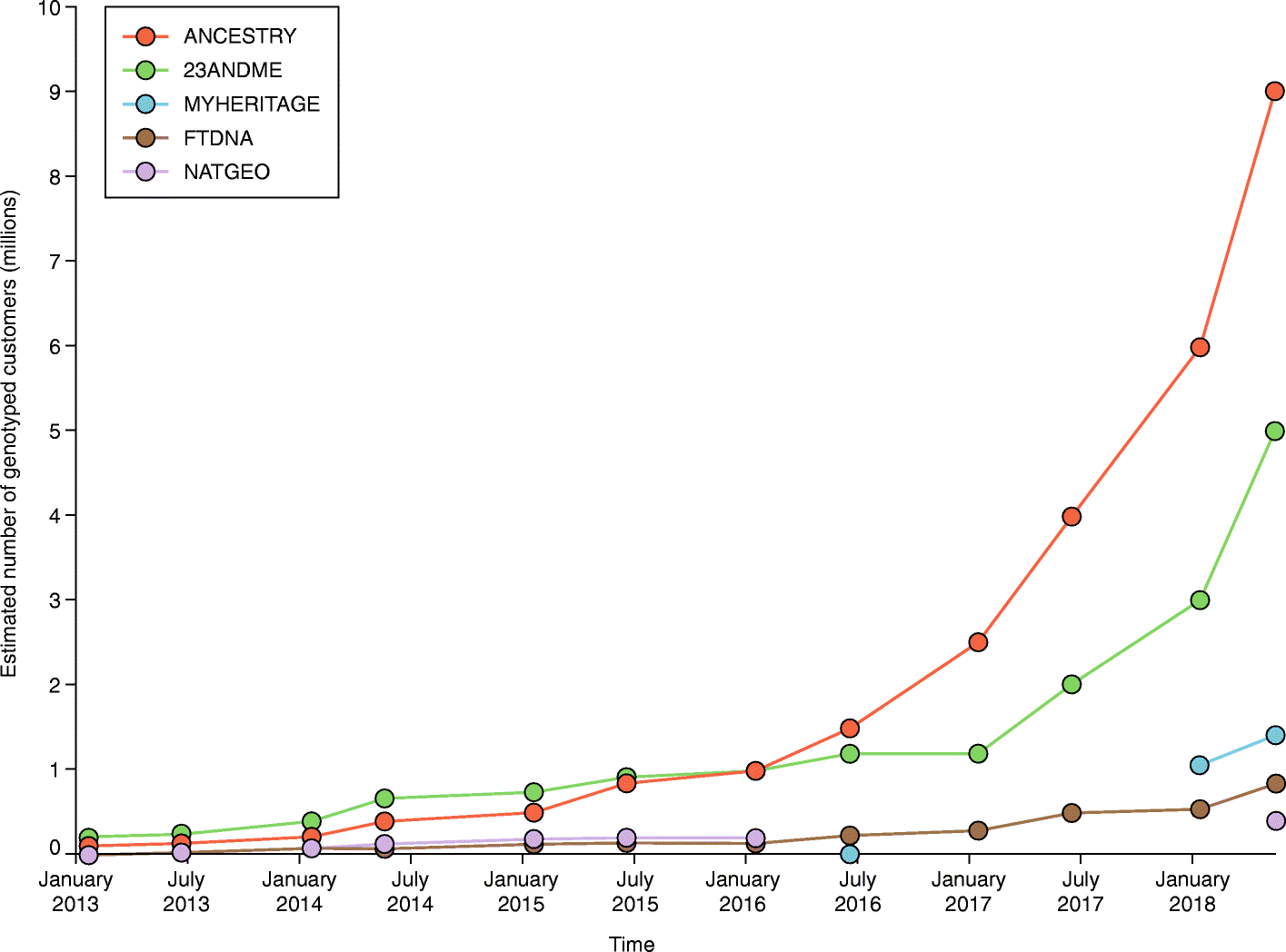
At the start of this year, the direct-to-consumer personal genomics industry surpassed 10 million genotyped consumers [12], a ten-fold increase since our last comment in Genome Biology on the state of consumer genomics [3]. Between the end of 2013 and 2016 there was steady growth in consumer numbers, but after 2016 the sector began to grow exponentially (Fig. 1). Looking forward, we could project another ten-fold increase by 2021, with upwards of 100 million genotyped individuals. It is likely that the growth rate will exceed these projections because of increased advertising spend from market leaders and decreasing genotyping and sequencing costs. In the next few years, more companies will enter the direct-to-consumer (retail) market for genomics. We are a long way from saturation on the S-shaped growth curve, especially with the realization of new market opportunities, which span prediction of medical risks, precise genealogical reconstructions, and even crime solving.
Fig. 1
Fig. 1
Consumer genomics is in the exponential growth phase. The estimated number (in millions) of genotyped customers from various consumer genomics companies over the past 5 years. These estimates were pulled from the ISOGG Autosomal DNA Testing Comparison Wiki (https://isogg.org/wiki/Autosomal_DNA_testing_comparison_chart), following an approach similar to that first used by Leah Larkin. These estimates are also consistent with another recent report by Yaniv Erlich et al. [2]
These enormous numbers of genotyped consumers will generate massive returns on scale, allowing for greater innovation and insight. If hundreds of millions of consumers contribute to genetic databases, then the power of genealogical algorithms to infer matches will increase, until the likelihood of matching a relative, if you have close relatives (at least in the United States), will converge upon total certainty [4]. Public databases such as GEDMatch now include data from one million samples, sufficient to predict a 90% chance of finding at least one third-cousin relative. Even with this ‘small’ database, consumers will almost certainly find relatives, and many of them. Genealogy has proved itself to be a sector with an affluent and passionate consumer base, as evidenced by the multibillion dollar valuation of the Ancestry online database thanks to millions of discretionary subscriptions [5].
The huge numbers of genotypes provided by consumers are valuable for genealogy, but as the numbers of genotypes increase into the millions, the data become even more valuable for trait prediction and medical applications. The large sample sizes allow for greater statistical power to detect genome-wide associations, which may be useful in linking genomic markers to functional traits and clinical phenotypes. 23andMe, for example, has amassed a database with sample numbers in the millions with which they are now working to obtain genotype–phenotype associations [6]. The analysis of rare variations becomes immensely powerful when sample sizes approach a hundred million genotypes, and medicine could be truly personalized when such massive information reservoirs are available. We simply do not know what we might be able to do until we hit those sample sizes, as that is still unexplored territory.

New technology platforms will help us to get more from consumer genomics

All this brings us to emerging improvements in analysis technologies and platforms for consumer genomics. One of the new entrants is Helix, a consumer-focused genomics startup backed by Illumina. Utilizing exome sequencing, supplemented with single nucleotide polymorphism (SNP) positions that span the genome, Helix aims to go beyond the SNP-chip paradigm championed by current market leaders such as Ancestry and 23andMe. Meanwhile, Veritas Genetics, a well-funded Cambridge, MA, startup aims to take whole-genome sequencing (WGS) to the public. Fifteen years after the Human Genome Project, which cost about $3 billion dollars, Veritas is commercializing a retail product that provides a high-quality sequence for $1000. Gencove, a startup based in New York City, takes a middle ground between SNP arrays and full genome sequencing. Gencove has developed an affordable low-coverage WGS assay that represents an improvement over current SNP array technology, with coverage under 1×. The low-coverage sequencing assay is paired with imputation to deliver a product that is not only competitive but has advantages over SNP arrays in terms of cost and avoidance of ascertainment bias. We suspect that the SNP array era of the 2010s will be superseded by the sequencing decade of the 2020s.
Although the number of genotyped and sequenced consumers has increased greatly, the services and products offered to make sense of their data remain curiously limited. This deficit might be a function of the late 2013 Food and Drug Administration (FDA) debacle with 23andMe, which cast a pall over the whole sector. Prior to the end of 2013, 23andMe had been providing a wide array of medically relevant analyses. In 2013, the FDA told the company that they could no longer do this, as these were unapproved ‘medical tests’. The firm could only provide information on ancestry and nonmedical traits to their future customers. Fortunately, over the past few years, 23andMe has established an avenue of communication with the FDA and, more importantly, a path for FDA approval for its tests [7]. 23andMe’s carrier screening markers are now FDA approved. The future looks bright, if still not totally certain.
Smaller companies such as Promethease, which leverage raw data generated by 23andMe, Ancestry, and others, continue to occupy a niche in analyzing genetic information. Using public data and stitching it together in a rough and basic user interface, Promethease and other such companies aim to eliminate the intermediaries between the consumer and the data. Instead of an institution or geneticist serving as a guide, these companies aim to educate the public in a raw and direct fashion, albeit with some controversy.
Helix and Gencove take a third approach. Instead of providing the full stack of services or leveraging the raw data provided by third parties, these two companies want to be technology platforms for other independent players and foster an ecosystem of analysis applications for consumers. Helix seems to be modeling its ecosystems on the iTunes store, where Apple hosts and approves applications for consumers who already trust their brand and utilize their hardware platform. The difference here is that Helix is not an established brand and does not yet have a dedicated customer base. Remember that when the iTunes Store debuted in 2008, Apple was not a new company; it had sold more than 5 million computers and more than 50 million iPods.
The need for a strong brand is probably one reason why Helix partnered with National Geographic, whose legacy reaches back over a century. In addition, it is partnering with blue-chip institutions such as the Mayo Clinic and with innovative companies such as Invitae. However, establishing a brand and a customer base are only part of the challenge of growing a successful app store. There are near infinite things you can do with a mobile computer, a camera, and a variety of sensors. There are far fewer apps that can be built on top of a genetic sequence, at least at present. Although the genomics space is in some ways less flexible than the applied engineering that drove innovation in Silicon Valley, it is also uncharted territory. There are still many variants to be discovered, structural features in the genome to be mapped, and parts of a genuinely complete human genome to be sequenced [8]. As these uncertainties are resolved, new applications will undoubtedly appear. After all, applied science depends on discovery in basic science. Perhaps the most exciting aspect is the possibility of discovering whole new applications that were unanticipated.

Growth of consumer genomics has yielded new and emerging applications

To date, the existing consumer genomics companies have apps that naturally segment into three classes: ancestry, entertainment, and medical. Medical applications often have the upside of being actionable, but they are also subject to regulatory oversight. Furthermore, there are limited medical insights to be gained today through genotyping or sequencing alone. Entertainment, ancestry, and genealogy are more loosely regulated, but they suffer from a perception that they are not an essential aspect of a person’s lifestyle. Entertainment apps often seem trivial or frivolous. But entertainment is important to allow us to flourish and for establishing connections. It is a something people are willing to spend money on because it is deeply rewarding. The key is not to undermine the credibility of the hard science while creating something fun and engaging. Not all apps have to provide a genome interpretation. Apps that leverage genetics can result in an efflorescence of cultural and entertainment possibilities previously not imaginable. For example, clothing and apparel that signals one’s genetic status or lineage is becoming more common. The ‘Haplotee’ offered by DNAGeeks.com is an example of genetics-inspired apparel. The shirt features your Y-DNA or MT-DNA haplogroup, along with a map of the related ‘Out of Africa’ migration pattern for the haplogroup. Furthermore, the Helix App Store has additional apparel items, including personalized scarves that allow customers to showcase their individuality through clothing and accessories [9].
Most recently, the arrest of the alleged Golden State serial killer in California using the methods of genetic genealogy shows how surprising and novel outcomes can be the product of disparate technological movements occurring in parallel [10]. Now that the law enforcement community is aware of the possibilities, we are likely to see a major rise in the success resolution of criminal cases in the near future.

Final thoughts

We see the future through a dark mirror, but the current prediction for WGS is that 60 million Americans will be sequenced by 2025. Alongside the SNP array data, this sequencing will contribute to an enormous database that one can utilize to provide value to consumers. Until then, the next four years will see the SNP array and exome-based companies expand their markets at least geometrically, and perhaps even exponentially if there is more technological innovation. These certainties determine the parameters of the American and international market. But what sells and what does not; well, that is to be determined. The products and services that consumer genomics firms seeded in the SNP array era are likely to be the foundations of the WGS revolution that will come out into the open in the 2020s.

Abbreviations

FDA: 
Food and Drug Administration

SNP: 
Single nucleotide polymorphism
WGS: 
Whole-genome sequencing

Declarations

Acknowledgements

The authors would like to thank John Wilson, Steve Lockess, John Fondon, and Gareth Highnam for helpful comments and discussion.

Authors’ contribution

Both authors read and approved the final manuscript.

Competing interests

RK is employed by Insitome. RK and DM are cofounders of DNAGeeks.com.

On heels of $150M raise, Ascentage is latest rush biotech IPO in jittery HK


When I spoke to Ascentage CEO Dajun Yang last month about their $150 million raise, he dodged my question about the prospects for an IPO. As it turned out, we didn’t have to wait long for the answer.
The fast-growing biotech posted their application on the Hong Kong stock exchange Monday, marking the 10th biopharma company to line up their IPO pitch — all debuts except for BeiGene — since the city opened up to pre-revenue biotechs in April.

At 8 years old, Ascentage is a well-known name in the Chinese biotech circle that, in the lead-up to HKEX’s official rule change, stoked the enthusiasm by putting word out that they are dropping original plans to list on the Nasdaq in favor of the Hong Kong public markets.
As is familiar practice by now, Ascentage heavily redacted the filing and did not give away the exact amount they are looking to raise. But we do know that whatever money they collect will fund their first potential marketed product: While HQP1351 is still very early in Phase II/III trials for chronic myeloid leukemia, the company singled it out as the only asset with money allocated for commercialization.
The rest of Ascentage pipeline, chiefly built on their work on a form of programmed cell death known as apoptosis, is also getting some love.
One of them is a c-Met receptor tyrosine kinase inhibitor licensed from Merck that — as we now know from the filing — Ascentage paid $500,000 upfront for. The milestones for a first indication would cost up to $8 million.
Another is APG1252, the subject of a licensing deal where anti-aging upstart Unity Biotechnology paid for rights to develop the Bcl-2/Bcl-XL inhibitor for non-oncology uses. Ascentage stands to earn $38 million in stock and cash in this pact.
If that sounds like a lot of programs to keep track of, it is. Yang told me that their $150 million Series C will allow the team to push six programs into Phase II multicenter trials by the end of the year.
To keep up with the pace — with work taking place in China, the US and Australia — Ascentage plans to build the team up to 300 in the coming six months, and reach 400 by the end of next year. Then there are the R&D center and manufacturing facility it’s planning to construct in its China base of Suzhou, which are expected to be completed by 2019 and 2020, respectively. The IPO will foot some of those bills, too.
Have the shaky performances of BeiGene and Ascletis, the first biotechs to test the waters at HKEX (and, to be sure, reaped huge amounts), affected his expectations for Ascentage’s float? Stay tuned.

Facebook, NYU School of Medicine launch research collaboration to improve MRI


Facebook and NYU School of Medicine’s Department of Radiology announced fastMRI, a new collaborative research project that will investigate the use of artificial intelligence to make magnetic resonance imaging scans up to 10 times faster. If this effort is successful, it will make MRI technology available to more people, expanding access to this key diagnostic tool. This project will initially focus on changing how MRI machines operate. Currently, scanners work by gathering raw numerical data in a series of sequential views and turning the data into cross-sectional images of internal body structures that doctors then use to evaluate a patient’s health. The larger the data set to be gathered, the longer the scan will take. Though this project will initially focus on MRI technology, its long-term impact could extend to many other medical imaging applications. For example, the improvements afforded by AI have the potential to revolutionize CT scans as well. Advanced image reconstruction might enable ultra-low-dose CT scans suitable for vulnerable populations, such as pediatric patients. Such improvements would not only help transform the experience and effectiveness of medical imaging, but they’d also help equalize access to an indispensable element of medical care.

Amazon said to hire well-known cardiologist amid push into health


Amazon has hired well-known cardiologist Maulik Majmudar for a new role, as the e-commerce giants looks to move into the $3T health care sector, according to CNBC. Majmudar announced his new role on his Twitter account but did not disclose the specific team he would be joining at Amazon, the publication added.

Next-gen insect repellents to combat mosquito-borne diseases


Nearly 700 million people suffer from mosquito-borne diseases — such as malaria, West Nile, Zika and dengue fever — each year, resulting in more than 1 million deaths. Increasingly, many species of mosquitoes have become resistant to the popular pyrethroid-based insecticides. Today, researchers report a new class of mosquito repellents based on naturally occurring compounds that are effective in repelling mosquitoes with potentially fewer environmental side effects than existing repellents.
The scientists will present their research today at the 256th National Meeting & Exposition of the American Chemical Society (ACS).
“Our new repellents are based on how nature already works,” Joel R. Coats, Ph.D., says. “For example, citronella, a spatial repellent that comes from lemongrass, contains naturally occurring essential oils that have been used for centuries to repel mosquitoes. But citronella doesn’t last long and blows away easily. Our new, next-generation spatial repellents are variations of natural products that are longer-lasting and have greater repellency.”
Coats and graduate students James S. Klimavicz and Caleb L. Corona at Iowa State University in Ames have been synthesizing and testing hundreds of compounds against mosquitoes. They knew that sesquiterpenoids, which are found in many plants, are effective insect repellents, but these large molecules are difficult to isolate from plants and hard to make and purify in the laboratory.
Because of the challenges of synthesizing sesquiterpenoids, Coats’ team designed their repellents using smaller, less complex, easily obtainable molecules — monoterpenoids and phenylpropanoid alcohols with known, short-term repellent activities against insects. By modifying these compounds chemically, they produced new potential repellents with higher molecular weights, making them less volatile and longer-lasting. Klimavicz has synthesized more than 300 compounds, the most effective of which are α-terpinyl isovalerate (a natural compound), citronellyl cyclobutanecarboxylate and citronellyl 3,3-difluorocyclobutanecarboxylate.
To determine the compounds’ effectiveness as repellents against mosquitoes, Corona tests them in a tubular chamber developed in the Coats laboratory. The chamber has filter papers at either end. One filter paper has nothing on it; the other has the synthesized repellent applied. Then mosquitoes — raised in the Iowa State University medical entomology lab — are introduced into the chamber. Corona uses time-lapse photography and in-person monitoring over 2.5 hours to document whether the mosquitoes migrate away from the candidate repellents. The researchers are currently exploring computer tracking of mosquitoes using video footage to gain a better understanding of mosquito repellency and behavior when exposed to these compounds.
With this method, the researchers tested the repellents with Culex pipiens, the northern house mosquito, which is most closely linked to West Nile transmission in the Midwestern U.S.; Aedes aegypti, the yellow fever mosquito which is also known to transmit the Zika and dengue viruses; and Anopheles gambiae, which transmits malaria.
“We think the mechanism of our terpene-based repellents, which try to mimic what nature does, is different from that of the pyrethroids,” which many mosquito species have become resistant to, Coats says. “We believe these ‘next-gen’ spatial repellents are new tools that could provide additional protection against mosquitoes in treated yards, parks, campgrounds, horse stables and livestock facilities. Our next step is to understand more precisely how the repellents biologically affect the mosquitoes.”
A video on the research is available at https://www.youtube.com/watch?v=F61vXlrGsXk
Story Source:
Materials provided by American Chemical SocietyNote: Content may be edited for style and length.

HHS chief says agency has power to eliminate drug rebates


U.S. Health and Human Services Secretary Alex Azar said it was within his agency’s power to eliminate rebates on prescription drug purchases, a key element of the Trump administration’s plan to lower prescription medicine costs.
Such rebates are negotiated in the United States by pharmacy benefits managers (PBMs) to lower the cost of medicines for their clients, including large employers and health plans that cover tens of millions of Americans.
Drugmakers say they are under pressure to provide rebates to the few PBMs that dominate the market and that those payers do not pass on enough of those savings to patients – a contention the PBMs dispute. The drugmakers say the rebates force them to raise the price of their therapies over time to preserve their business.
The Trump administration has been receptive to that argument. Azar, in an interview with Reuters on Friday, said rebates created a perverse incentive to continuously raise drug prices.
Azar, a former top executive at drugmaker Eli Lilly & Co, is trying to deliver on President Donald Trump’s promises to lower the cost of prescription drugs for Americans, which Trump made a major priority during his 2016 presidential campaign.
The Department of Health and Human Services last month proposed regulations that would scale back protections for rebates that might otherwise be illegal under a federal anti-kickback law.
The PBM industry has challenged that move, saying HHS cannot eliminate rebates on its own and would need Congress to change the federal statute. The ultimate responsibility for high drug prices, those companies say, lies with the manufacturers who set those prices.
Azar contends that the current rebates are a product of previous HHS regulation. “What one has created by regulation, one could address by regulation,” he added.
He did not say when such new regulations, which are being reviewed by the Office of Management and Budget, might take effect. “The question of rebates may very well be fundamental to the issue of how you reverse these constant incentives to higher list prices (for medicines).”

CAMPAIGN ISSUE

The cost of healthcare, and prescription drugs specifically, is expected to be a major campaign issue ahead of November elections, in which Democrats are seeking to take control of the U.S. House of Representatives and Senate from Trump’s Republicans.
In May, Trump unveiled a “blueprint” comprising dozens of proposed policies to give the government greater leverage over drug prices, but did not support changes to give the federal government’s Medicare health plan for seniors direct negotiating power with drugmakers. Critics say that has spared the pharmaceutical industry any real challenge to its pricing practices.
Azar defended the administration’s actions, noting that more than a dozen leading drugmakers, including Pfizer Inc (PFE.N), Merck & Co (MRK.N) and Celgene Corp (CELG.O), had pledged to hold off on further price increases this year.
“They are seeing where this is going, they are seeing that we are ticking off the blueprint items one by one,” Azar said. “We are not dependent on the voluntary action of pharmaceutical companies. We are not counting on their goodwill or their altruism. … They’re just changing because they see that’s the future.”
Critics say the drug price pledges by major drugmakers are largely window dressing.
Since May, HHS has given Medicare Advantage health plans, which are administered by private-sector health insurers, new tools to lower prescription drug costs.
The agency’s Food and Drug Administration has unveiled a plan to boost the use of biosimilars, which are cheaper versions of expensive biotech medicines. Azar has directed the FDA to establish a working group to study how to import drugs safely from other countries if a drugmaker dramatically raises prices.
The actions have already sparked concerns. Last week, a leading group of rheumatologists met with Azar to discuss changes to Medicare Advantage that could force some patients to try a less effective, cheaper medication for a period of time before their health plan would cover a more expensive therapy.
HHS said Azar emphasized the agency’s interest in lowering drug prices but expressed openness to alleviating burdens that could be placed on physicians as a result of the new rule.
PFE.NNEW YORK STOCK EXCHANGE
+0.37(+0.88%)
PFE.N
  • PFE.N
  • MRK.N
  • CELG.O
Azar said he spoke with Trump every few days, either in person or over the phone and that in every conversation, the president wanted to hear about progress on lowering prescription medicine costs.
“I have never once had a meeting or phone call with the president where we have not talked about drug pricing,” Azar said.