Search This Blog

Saturday, July 13, 2019

Alzheimer’s Biomarkers, Trials, Technology at AAIC 2019

The Alzheimer’s Association International Conference (AAIC) will move dementia science forward with a record number of abstracts this year.
Roughly 3,000 scientific presentations will be featured at the meeting here from July 14 to 18, with about 6,000 people from more than 70 countries expected to attend, said Rebecca Edelmayer, PhD, Director of Scientific Engagement at the Alzheimer’s Association.
“We’re convening scientists from all across the ecosystem,” Edelmayer told MedPage Today.“They’re coming in from academia, government, industry, and health care.”
Presentations will focus on both basic science and emerging research, she added: “We will see some on innovative practice techniques, clinical trials, biomarker advances, technology, and late-breaking developing topics.”
“We’re seeing a lot of conversations between the next-generation investigators and people who’ve been working in the field for many years,” Edelmayer noted. “We’re seeing this also across the care research community as well. They’re sharing discoveries that hopefully will lead to new methods of prevention and treatment and improve diagnosis and care for people living with Alzheimer’s.”
Over the years, ideas about Alzheimer’s disease have shifted considerably and new research reflects that, noted Zaven Khachaturian, PhD, editor-in-chief of Alzheimer’s & Dementia.
“One idea is that the disease doesn’t start at the point where the clinical features start; it starts many, many years before,” Khachaturian told MedPage Today. “That’s a very important conceptual change. Quite a few papers now are driven by the realization that we need to be able to identify the disease in early stages.”
Earlier models about the disease have proven to be inadequate for therapy development, he observed. “Although amyloid and tau are part of the disease, they may not be crucial for the development of the clinical features, on the basis that trials so far have not worked,” he said. “We may be very successful in eliminating these abnormal proteins. The real crux of the matter is whether we can eliminate the dementia.”
“The idea that we are going to find a single factor or molecule that will cure or treat Alzheimer’s doesn’t seem to be in the cards, simply because we need to learn that the data is complex,” Khachaturian added. “The complexity does not result from a single factor, but the combination or the coincidence of complex interactions between various components. The field hasn’t come to grips with that.”
Throughout AAIC 2019, new data about drugs in the dementia pipeline — including the amyloid targeting drug BAN2401 and the BACE1 inhibitor elenbecestat — as well as developing research about gingipain inhibitors, intranasal insulin, ketogenesis approaches, and other investigational therapies will be featured in poster and oral presentations.
Nine plenary sessions will be presented throughout the week, with themes ranging from sleep and cognition to the cellular phase of Alzheimer’s disease to precision medicine. And daily symposium sessions will cover topics like disparities in care, markers of inflammation, rare genetic variants, and delirium in dementia.
Missing from AAIC will be data about the failed 3,000-person phase III aducanumab trials that ended earlier this year. Biogen and Eisai had planned to present information about the anti-amyloid drug at the meeting, but announced several weeks ago that details aren’t ready to be shared with the public.
But despite the aducanumab setback — and the failure of two pivotal trials of the BACE1 inhibitor umibecestat this week — the overall outlook is positive, Edelmayer observed.
“We have seen an unprecedented increase in the amount of funding that is now going into Alzheimer’s and related dementia science, not only through our national institutions like the NIH but also from the Alzheimer’s Association,” she pointed out.
This year, National Institutes of Health funding for Alzheimer’s and dementia-related research reached a record $2.4 billion. “With that increased funding, we will expect to see faster and more proportional progress in finding treatments, and better ways to detect and diagnose the disease in the future,” Edelmayer said.

Low-Quality Care Common in Chronic Kidney Disease

Quality of care for patients with chronic kidney disease (CKD) remains suboptimal, even among primary care and specialty physicians aware of the patient’s diagnosis, researchers found.
The analysis of data from approximately 7,000 U.S. office visits showed that the prevalence of uncontrolled hypertension among patients with CKD was 46% in 2006-2008 and 48% in 2012-2014 (P=0.50), reported Sri Lekha Tummalapalli, MD, of the University of California, San Francisco, and colleagues.
Writing online in the Clinical Journal of the American Society of Nephrologythey noted that the prevalence of uncontrolled diabetes (defined as a glycated hemoglobin greater than 7%) was 40% in 2012-2014, the only time period for which data was available.
Statin use among CKD patients ages 50 and older was low and remained essentially unchanged from 29% in 2006-2008 to 31% in 2012-2014 (P=0.92), the data showed. Angiotensin-converting enzyme inhibitor (ACEi) or angiotensin receptor blocker (ARB) use decreased from 45% to 36% during the same time period, but the trend did not reach statistical significance (P=0.07), the researchers found.
“Despite the introduction of multiple national quality reporting programs and CKD-specific guidelines during our study period, we did not see improvement in quality of CKD care over time. Of note, our study describes the quality of CKD care nationally using diagnosis codes rather than laboratory values, capturing patients who were known to have CKD by their physicians and who may have later-stage CKD,” Tummalapalli and co-authors wrote.
“Patients with CKD had a high prevalence of uncontrolled hypertension, which did not decrease over time,” the team continued. “Despite strong evidence for the efficacy of ACEi/ARB treatment for patients with CKD in reducing progression to end-stage renal disease, we found that ACEi/ARB use declined over time. We found that statins are extremely underused in patients with CKD, despite guideline recommendations and evidence that statins significantly reduce cardiovascular events and mortality in patients with CKD.”
For the study, Tummalapalli’s group analyzed data from the National Ambulatory Medical Care Survey (NAMCS) from 2006 to 2014. This annual survey, performed by the CDC’s National Center for Health Statistics, gathers information on office-based ambulatory care visits in the U.S., excluding federal, military, and institutional facilities. The survey includes information from primary care physicians such as family practitioners, gynecologists, and internists; specialists including cardiologists, dermatologists, and oncologists; and surgeons. Nephrologists are also included, although the analysis could not separate them out, the researchers noted.
Potential reasons for the suboptimal care found, the team said, include the following:
  • Lack of dedicated CKD-specific quality metrics
  • Low rates of referral to nephrologists
  • Limited time, competing demands, and difficulties obtaining and using data among primary care physicians
“The majority of CKD is treated in primary care settings, and therefore, efforts toward improved CKD management must involve primary care physicians as a central component of multispecialty care teams,” Tummalapalli and co-authors stated. “New initiatives, such as the National Kidney Foundation’s CKDintercept, may enable improved CKD management in primary care.”
Actions for Improving Care
Asked for his perspective, Joseph Vassalotti, MD, chief medical officer at the National Kidney Foundation (NKF), who was not involved in the study, discussed some of these new initiatives as well as strategies for improving patient care: “The big picture opportunities for CKD interventions are population health and quality improvement. A major challenge for population health is the dearth of urine testing for CKD,” he told MedPage Today via email.
Vassalotti noted that one of the study limitations mentioned by the authors is the inability to assess albuminuria or the urinary albumin-creatinine ratio (uACR), and that other data suggest that people with diabetes at risk for CKD are tested for uACR only about 40% annually, even though clinical practice guidelines from the NKF, the American Diabetes Association, the Kidney Disease Outcomes Quality Initiative, and the Kidney Disease Improving Global Outcomes recommend annual testing.
He added that the CKDintercept initiative is addressing this issue with a Laboratory Engagement Plan and a Kidney Health Evaluation Measure. In addition, NKF’s CKD Change Package provides a list of suggested process improvements that ambulatory care physicians can use to improve CKD screening, recognition, and management.
“An area not addressed by Tummalapalli et al because of the study period is sodium-glucose cotransporter-2 inhibitors (SGLT-2i),” Vassalotti continued. “Recent randomized controlled trials support broad implementation of SGLT-2i in type 2 diabetes and particularly type 2 diabetes with CKD, because of improvements in CKD progression as well as reductions in cardiovascular events and death. The implementation of this new drug class and the assessment at a population level demand further effort.”
“Lastly,” he said, “there are many hopeful signs. An Indian Health Service population health CKD intervention of adults with type 2 diabetes showed a remarkable 54% reduction in incident end-stage renal disease from 1996 to 2013. A TRANSLATE CKD studyimplemented the CKD metrics of Tummalapalli et al with two clinical decision support approaches, showing small but significant improvements in diabetes control and CKD trajectory.”
Other study limitations, Tummalapalli and co-authors wrote, were that the NAMCS dataset did not contain creatinine or urine albumin-to-creatinine ratio measurements, and that lack of laboratory data made it impossible to assess the appropriateness of prescribing ACE inhibitors or ARBs for proteinuria. Finally, the researchers said, the NAMCS sample represents only patients routinely seen in office-based ambulatory medical care, and therefore, may exclude patients who visit a hospital-based outpatient facility and does not represent veterans or those in institutionalized settings.
The study was supported by the National Institute of Diabetes and Digestive and Kidney Diseases.
Tummalapalli and co-authors reported having no conflicts of interest.
Vassalotti reported having no conflicts of interest.

ICER Duchenne update lifts Exondys 51, Emflaza estimates before July review

Increasingly influential drug cost-effectiveness watchdog ICER still doesn’t think that the drugs approved to treat Duchenne muscular dystrophy have so far proved their value to patients. On Thursday, they used significantly higher price estimates for two therapies in their models, making them look even less attractive — and acknowledged that the estimates used in their draft report in May were incorrect.
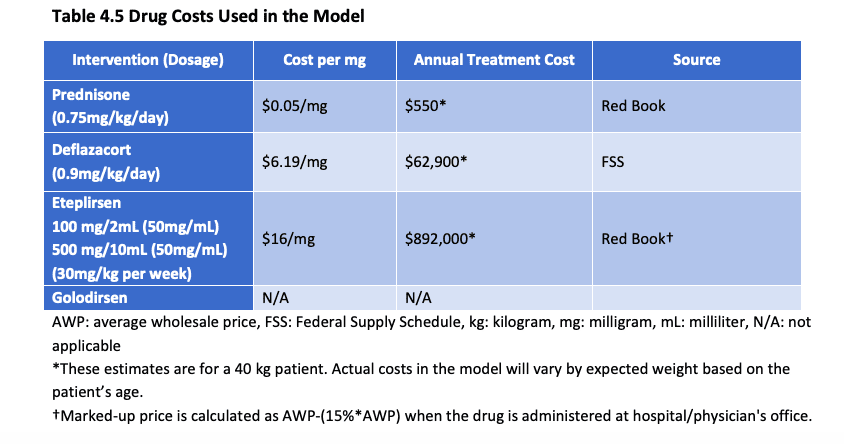
ICER’s updated report on PTC Therapeutics’ $PTCT steroid deflazacort and Sarepta’s $SRPT Exondys 51 arrives ahead of a meeting of experts that will discuss the body of evidence underlying the landscape of existing and incoming Duchenne muscular dystrophy (DMD) therapies. In their analysis, ICER has used a price that exceeds $1 million a year for Exondys 51 and $81,400 for Emflaza — an old corticosteroid that many families once imported from overseas at a cost of about $1,000 a year.
In the United States, roughly 6,000 young boys suffer from the muscle wasting disease — caused by the absence of dystrophin, a protein that helps keep muscle cells intact. Symptoms tend to kick in and progressively worsen between the ages of 3 to 5, typically causing the patient to become wheelchair-bound by their early teens. Eventually, patients succumb to the disease by their 30s. Corticosteroids, which work by diminishing inflammation and limiting the immune system’s activity, are commonly used to treat DMD.
ICER evaluated the efficacy, safety and cost-effectiveness of four treatments in its evidence report. It looked at the steroids deflazacort (sold as Emflaza) and prednisone — as well as the exon-skipping drugs: the approved eteplirsen (marketed as Exondys 51) and the experimental golodirsen (both come from Sarepta, and each treatment is designed to treat a different subset of DMD patients). As it concluded in its draft report in May, ICER reiterated that the evidence supporting each of the four treatments is lacking, and their impact on patients unclear.
In the evidence report published on Thursday — which precedes an advisory panel meeting that will make its recommendations to ICER on July 25 — used higher annual cost estimates for Exondys 51 and Emflaza to conduct various cost-effectiveness calculations.
DMD drug dosing is based on weight, which typically varies among patients. Akin to its May report, ICER used annual cost estimates for a 40 kg patient to calculate cost-effectiveness in its latest update, putting a fresh spotlight on the existing controversy surrounding DMD drugs.
In the evidence report, ICER presented this chart:
Source: ICER, July 2019

In May, when ICER published its draft report, the non-profit presented this chart:
Source: ICER, May 2019

“We do not know what factors ICER used in their modeling. We have not raised the price of the drug since launch and are not planning any price increases,” a Sarepta spokesperson told Endpoints News.
PTC concurred. There has been no change in Emflaza’s pricing or discounts, a spokesperson told Endpoints News.
Later on Friday, a spokesperson for ICER clarified that the table in the earlier draft report displayed incorrect annual costs for both Emflaza and Exondys 51. ICER’s final report is expected in August.

J&J trial: Okla. pain management doctor hits state workers comp law

All the testimony and evidence are now in, and closing arguments are scheduled for Monday in a nationally watched trial where Oklahoma has accused opioid manufacturer Johnson & Johnson and its subsidiaries of helping cause the state’s opioid crisis through false and deceptive marketing.
Terrell Phillips, president of the Oklahoma Pain Society, was among the final witnesses to testify Friday.
Testifying for Johnson & Johnson, Phillips blamed Oklahoma’s workers’ compensation laws for driving doctors to prescribe opioids in some cases where they might prefer other treatment options for their patients.
When a workers’ compensation chronic pain patient has been placed on continued medical maintenance, the law only allows doctors to be reimbursed for “reasonable and necessary” treatment and that specifically excludes diagnostic tests, surgery, injections, counseling and physical therapy, Phillips said.
That only leaves “pills,” Phillips said. “This has got me handcuffed.”
In a hallway interview after testimony concluded, Attorney General Mike Hunter said the Oklahoma Commission on Opioid Abuse that he founded has not been asked to look into that portion of the workers’ compensation law, but said he would be happy to look into it in the context of policy at a later time.
Phillips said other forms of insurance also limit the options physicians have for treating chronic pain patients.
Phillips acknowledged having numerous interactions with sales representatives for Janssen Pharmaceuticals, a subsidiary of Johnson & Johnson, but insisted they have never influenced his prescribing habits or told him a particular drug was more beneficial or less dangerous than he has found it to be.
“No, I’m not influenced by the sales representatives,” he said. “What influences my decision is the patient in front of me.”
Phillips also said he would not call Oklahoma’s opioid crisis an “epidemic.”
Under cross-examination, however, an attorney for the state played a video of a continuing education presentation Dr. Phillips made to the Oklahoma State Medical Association in October 2016.
“We’ve got an epidemic,” Phillips stated during that earlier presentation. “It’s time to talk serious about how we take care of pain medical management patients.”
“Everyone here knows how we got in this situation,” Phillips said during that earlier educational presentation. “They told us we were underprescribing, we need to prescribe more, it’s the patients’ rights to have pain medicine so we all got on board, and when someone said they were hurting we said ‘OK, we are gonna give you something.’ Now it’s just the opposite, not everyone deserves pain medicine.”
Phillips said he stood by what he said in the presentation as well as what he said in court.
Phillips said the drug companies were paying him $10,000 a day to testify and from $350 an hour to $450 an hour for his preparation work, but said that wasn’t why he was testifying.
The south Oklahoma City pain management specialist said he thought it was important for the court to hear from someone who has treated pain for 30 years and represents the tens of thousands of patients who suffer from chronic pain.
Phillips testified he takes a cautious approach to prescribing opioid pain medicine and outlined numerous steps he takes to try to minimize risks to patients.
More than 6,100 Oklahomans suffered prescription opioid-related deaths from 2000-2017. The state has blamed opioid manufacturers for the causing the crises, alleging they engaged in elaborate, multifaceted marketing campaigns that understated the addictive and overdose risks of opioids while overstating their therapeutic benefits.
The state is asking Cleveland County District Judge Thad Balkman to order the drug companies to pay more than $17.5 billion to abate the problem.
After the closing testimony, Hunter said he believes the state accomplished its goal of presenting its case against the opioid makers in a “comprehensive and decisive way.”
John Sparks, one of Johnson & Johnson’sOklahoma attorneys, countered by issuing a prepared statement claiming the state’s case was “built on misstatements and distortions.”
Opioid manufacturers on Friday once again asked Judge Balkman to dismiss the case, contending the state had not met its burden of proof.
The judge, who denied a similar request earlier, took the latest request under advisement.
Balkman told both sides they each would be given two hours to present their closing arguments Monday, with the state going first at 9 a.m. and the defense presenting its arguments beginning early Monday afternoon. The state will be able to reserve some of its time for rebuttal if it chooses.
The judge indicated he planned to give each side time to present written proposed findings of fact and conclusions of law before he makes his final ruling. The state and drug companies likely will be given two weeks to file those documents, the judge said. A ruling would be expected sometime later, unless the judge were to grant the defense’s request to dismiss the case earlier.
Oklahoma’s opioid lawsuit has been drawing national attention because hundreds of cities, counties, states and American Indian tribes have filed lawsuits against opioid manufacturers and others in the distribution chain, but the Oklahoma case is the first one to make it to trial.
More than 1,700 of the other lawsuits have been consolidated in a major federal court action pending in Ohio.
Oklahoma’s lawsuit originally named two other groups of pharmaceutical companies as additional defendants, but they approved settlement agreements with the state. A group headed by Purdue Pharma agreed to pay $270 million, while a group headed by Teva Pharmaceuticals USA, Inc., agreed to pay $85 million.

Mirum Pharmaceuticals IPO: What You Need To Know

A late-stage biotech, which was spun-off from Shire, is testing the IPO market.

The IPO Terms

Foster City, California-based Mirum Pharmaceuticals is planning a 5-million share IPO at an estimated price range of $14-$16, according to an amended prospectus filed with the SEC July 8.
At the midpoint of the estimated price range, the size of the offering is $75 million.
It has applied for listing its shares on the Nasdaq under the ticker symbol MIRM.
The company said in the filing that certain of its shareholders, directors and their affiliated entities, have expressed interest in purchasing an aggregate of up to about $35 million worth of shares.
Citigroup, Evercore ISI and Guggenheim Securities are the lead underwriters for the offering.

The Company

Mirum is a biopharma company, which focuses on developing novel therapies for debilitating liver diseases. The company’s pipeline consists of two clinical-stage product candidates having potential utility across a wide range of orphan liver diseases.
Maralixibat, a Phase 3 asset, is being evaluated in pediatric patients with progressive familial intrahepatic cholestasis, or PFIC and Alagille syndrome. Enrollment of patients in a Phase 3 trial has commenced in the second quarter for the former indication, while a Phase 3 trial for the latter indication is planned for the first half of 2020. Top-line data readout from the Phase 3 trial in PFIC is expected in late-2020.
Mirum is also developing volixibat for treating adult patients with cholestatic liver diseases, with the Phase 2 trials set to start in 2020 and clinical data expected in 2022.

The Finances

Mirum is yet to turn in revenues. For the three months ended March 31, the company reported a net loss of $5.98 million.

Friday, July 12, 2019

Bayer won’t get new trial in $80M Roundup case

A U.S. District Judge has rejected Bayer’s (OTCPK:BAYRY) request for a new trial in the case of a California man who was awarded $80M by a jury after it found exposure to the company’s Roundup weedkiller caused his cancer.
Judge Chhabria, who is expected to issue a second ruling Monday on whether to reduce the damages in the case, ruled the plaintiff presented “sufficient admissible evidence” to the jury that exposure to Roundup caused his cancer.
The judge is handling the collection of hundreds of federal lawsuits involving Roundup.

Indivior loses appeal to block generic Suboxone opioid treatments

A divided federal appeals court on Friday ruled against Indivior Plc in its bid to stop Dr. Reddy’s Laboratories Ltd and Alvogen from selling generic versions of its opioid addiction treatment Suboxone film that infringed its patents.
The U.S. Federal Circuit Court of Appeals in Washington, which oversees many intellectual property cases, upheld lower court rulings that Dr. Reddy’s did not infringe two Indivior patents related to Suboxone, and Alvogen did not infringe one of those patents.
Suboxone film is applied below a patient’s tongue, where it dissolves to release two active ingredients, buprenorphine and naloxone.
It had accounted for about 80 percent of Indivior’s revenue, but the London-based company forecast declines after the U.S. Supreme Court in February allowed sales of generic equivalents, including by India-based Dr. Reddy’s.
Circuit Judge Alan Lourie wrote for a 2-1 majority that while Indivior’s patents should not be voided, it failed to show that they covered Dr. Reddy’s and Alvogen’s drying processes for their products, or a polymer that Dr. Reddy’s used.
The court also said another generic drugmaker, Teva Pharmaceutical Industries Ltd, did not show that the patent concerning the drying process should be voided.

Indivior launched the first buprenorphine-based product to treat opioid dependence in 1996. It had sought damages, as well as injunctions against the U.S. sale of infringing products, in lawsuits underlying Friday’s decision.
The dissent said Indivior’s patents should have been voided because they described methods to produce sublingual films that were already known, and were therefore “obvious.”
Indivior’s lawyers did not immediately respond to requests for comment.
Kevin Martin, a lawyer for Dr. Reddy’s, said in an email: “We’re glad that the Federal Circuit has again concluded that Dr. Reddy’s generic films are non-infringing, which will keep this low-cost treatment option on the market.”
Alvogen spokesman Halldor Kristmannsson said the company, which has offices in New Jersey, was also pleased. Teva’s lawyers did not immediately respond to requests for comment.
Indivior was separately indicted in April by a federal grand jury in Virginia for allegedly scheming to boost Suboxone film sales. The U.S. government wants Indivior to forfeit at least $3 billion.

On Thursday, Reckitt Benckiser Group Plc, which spun off Indivior in 2014, agreed with U.S. regulators to pay up to $1.4 billion to settle similar claims. Indivior said that settlement was separate from its own case.
The case is Indivior Inc et al v Dr. Reddy’s Laboratories SA et al, U.S. Federal Circuit Court of Appeals, No. 17-2587.