Search This Blog

Sunday, July 28, 2019

Neurocrine Biosciences Q2 2019 Earnings Preview

Neurocrine Biosciences (NASDAQ:NBIX) is scheduled to announce Q2 earnings results on Monday, July 29th, after market close.
The consensus EPS Estimate is $0.20 (+385.7% Y/Y) and the consensus Revenue Estimate is $161.79M (+66.9% Y/Y).
Over the last 2 years, NBIX has beaten EPS estimates 50% of the time and has beaten revenue estimates 75% of the time.
Over the last 3 months, EPS estimates have seen 3 upward revisions and 1 downward. Revenue estimates have seen 7 upward revisions and 5 downward.

Sanofi Q2 2019 Earnings Preview

Sanofi (NASDAQ:SNY) is scheduled to announce Q2 earnings results on Monday, July 29th, before market open.
The consensus EPS Estimate is $0.72 and the consensus Revenue Estimate is $9.37B
Over the last 3 months, EPS estimates have seen 0 upward revisions and 1 downward. Revenue estimates have seen 4 upward revisions and 2 downward.

Illumina Q2 Earnings Preview

Illumina (NASDAQ:ILMN) is scheduled to announce Q2 earnings results on Monday, July 29th, after market close.
The consensus EPS Estimate is $1.34 (-6.3% Y/Y) and the consensus Revenue Estimate is $835.12M (+0.6% Y/Y).
Over the last 2 years, ilmn has beaten EPS estimates 88% of the time and has beaten revenue estimates 100% of the time.

Novartis: Restrictions on $2 Million Drug Highlight Challenge for Gene Therapies

Isaac Olthoff, 10 months old, lacks a gene crucial for muscle control. He can’t sit up and may never be able to stand independently.
A cutting-edge treatment that could prevent his disease from worsening went on sale in May. But at $2.1 million a patient, Zolgensma is the world’s most expensive drug and his insurer has refused to pay for the gene therapy.
The treatment for spinal muscular atrophy, or SMA, is posing a dilemma for insurers: it promises to halt the progressive disease in one dose but isn’t yet proven to work in all cases. That uncertainty is making some wary of parting with such a steep sum.
That is bad news for patients looking for a cure and for Zolgensma-maker Novartis AG, which hopes the drug will generate billions of dollars in sales. It also underscores the challenge facing a slew of other drugmakers planning to launch gene therapies in the coming years, which will also likely come to market with big price tags and limited trial data.
Such therapies provide a working copy of a defective gene, potentially curing diseases that are rare and difficult to treat in one shot. That promise means the Food and Drug Administration is often willing to accept small clinical trials to speed up the development process.
For Zolgensma, the two main sticking points for insurers are age and the severity of disease. The only clinical-trial evidence so far is limited to children aged six months and under with the most severe form of the disease. Novartis is still testing the treatment in older children with less severe SMA.
Zolgensma works by providing a working version of a gene called SMN1 that is crucial for muscle control. Babies with SMA lack that gene, but have varying levels of a backup gene. Those with just one or two copies of the backup gene show symptoms of SMA very young and have the most severe disease. The more copies of the backup gene they have, the later their symptoms kick in and the less severe the disease.
Isaac’s insurer, Aetna Inc., restricts Zolgensma to babies under nine months of age with the most severe form of SMA. A spokesman said in an email that criteria was “based on the most recent published science, which we continuously evaluate.”
Instead, it has agreed to pay for another treatment called Spinraza that works by strengthening the backup gene. But Isaac’s mother Michelle said she would much prefer Zolgensma because it involves just a single infusion. Spinraza is given every four months over the lifetime of the patient.
Mrs. Olthoff, who lives in Colombia, Mo., said she was surprised because the FDA in May gave its blessing for Zolgensma to be used in children up to two years old, regardless of severity.
“There is a legitimate issue that the FDA’s label exceeds the population studied,” said Michael Sherman, chief medical officer at insurer Harvard Pilgrim Healthcare, which is still deciding its coverage policy for Zolgensma. He said it was likely that insurers would expand their coverage as more evidence became available.
An FDA spokeswoman said the approval was based on the “compelling evidence” in younger babies with the most severe form, adding that the underlying cause is the same for all types of SMA.
Isaac isn’t alone. Jackson Schultheis in Evansville, Ind., 18 months, was denied Zolgensma on the basis of age. Tora Patgiri in Columbus, Ohio, also 10 months old, got the treatment only on appeal. All three also have a less severe form of SMA than the trial babies.
Maisie Forrest in Grand Junction, Colo., 19 months old, has the most severe form and was initially deemed too old for the treatment. MaKenzie Burleson in Hammond, La., who turns 2 in September, also has the most severe form of SMA and was initially turned down because her condition is worse than that of the clinical trial babies. Both got Zolgensma after their families appealed. The insurance for 3-month-old Duke Stanger of Monroe, Ohio, doesn’t cover gene therapies.
“At the end of the day this is about the price,” said Sanford C. Bernstein & Co. analyst Ronny Gal, who found that so far nearly half of the top 30 insurers have committed to covering Zolgensma, though most have placed restrictions on their policies based on age or severity of disease. He said the drug isn’t getting the benefit of the doubt for the “very likely scenario” that it works in older patients.
Novartis has defended the drug’s $2.1 million price tag partly on the grounds that it costs less than Spinraza in the long term. The competing drug, a multidose treatment made by Biogen Inc., costs $750,000 for the first year and then $375,000 for each year after that.
To allay concerns over the cost, Novartis is offering insurers the option to pay for the treatment in equal annual installments over five years and has pledged to issue partial refunds if the treatment doesn’t work.
Chief Executive Vas Narasimhan said on a recent call with reporters that insurers on the whole were proving willing to pay for Zolgensma, adding that so far plans covering 40% of Americans had agreed to provide it. But he said Novartis was aware of some refusals for patients with less severe forms of the disease. “That’s something we’re going to have to work through,” he said.


New color-changing tattoos monitor glucose, other metabolites in real-time

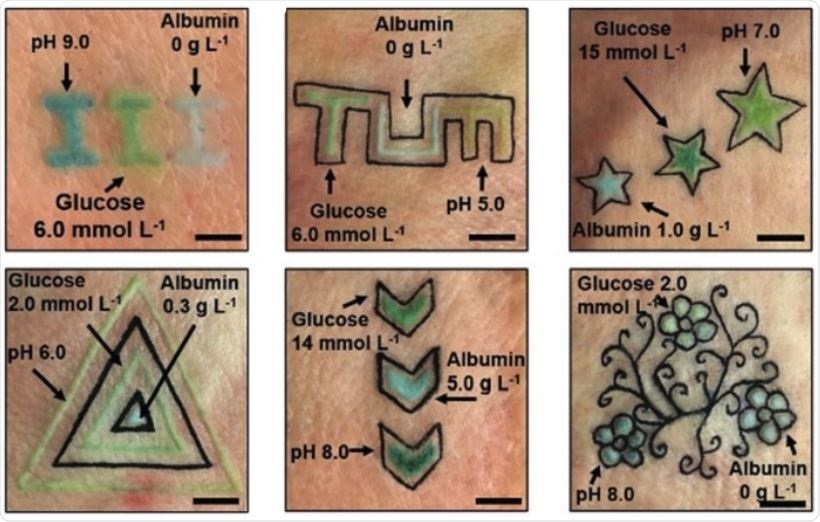
Scientists in Germany have developed an intradermal tattoo that changes color in response to fluctuations in glucose, albumin, and pH levels. Tests on animal skin have shown that the tattoos successfully change color when concentrations of key biomarkers were changed, marking an exciting step in real-time monitoring of chronic diseases like diabetes.
Tattoo artist giving a tattoo to a customer
IvanRiver | Shutterstock
The research, which was published in Angewandte Chemie (International Edition), was led by chemical engineer Ali Yetisen from the Technical University of Munich. Yetisen and his research team identified three colorimetric chemical sensors that changed color in response to differing levels of certain biomarkers.
These sensors included a pH tracker consisting of methyl red dye, bromothymol blue dye, and phenolphthalein dye, which could alert doctors to cases of acidosis (low blood pH) or alkalosis (high blood pH), two conditions that are caused by a range of health problems.
The second and third sensors charted the levels of glucose and albumin (a carrier that transports protein in the blood). As is widely known, high levels of glucose can indicate cases of diabetes, while high levels of albumin can indicate heart problems, and low levels indicating liver or kidney failure.
The glucose sensor was made from the enzymatic reactions of glucose oxidase and peroxidase, and, when glucose levels changed, the color of the sensor changed to dark green or yellow. The albumin sensor, which turned green in response to changes in albumin levels, was made from a yellow dye.
The paper explained the function of these remarkable biosensor tattoos, stating they were “minimally invasive”, and that diagnostic devices that can continuously monitor metabolites in humans will “transform personalized medicine”, with patients living with chronic diseases and elderly people benefiting from continuous monitoring devices in particular.
Glucose-sensing tattoos
Credit: Yetisen et al., Angewandte Chemie International Edition, 2019.
The tattoos have not yet been tested in humans, with the tests being carried out on samples of pig skin. The color changes were evaluated with a smartphone camera and an app, with an algorithm determining biomarker concentrations by comparing chromatic variations of the biosensors to calibration points.
Calibration charts could be used to evaluate the color changes in different light conditions, including brightness, saturation, and shades.
“Body modification by injecting pigments into the dermis layer is a custom more than 4000 years old,” the researchers stated, but they recognized that damaging the epidermis (as is necessary to injecting pigment into the skin) may not always be desirable.
They suggested that microjet injections can pigment the skin without “sacrificing” the epidermal layer by injecting the pigment through electrical- or laser-induced shockwaves.
The authors write:
Here, a functional cosmetic technology was developed by combining tattoo artistry and colorimetric biosensors. Dermal tattoo sensors functioned as diagnostic displays by exhibiting color changes within the visible spectrum in response to variations in pH, glucose, and albumin concentrations.”
“The applications of the sensors can be extended to the detection of electrolytes, proteins, pathogenic microorganisms, gases, and dehydration status,” they continued, also adding that the tattoos may also find use in medical diagnostics to keep track of a “broad range” of metabolites.
Journal reference:
Yetisen, A. K., et al. (2019). Dermal Tattoo Biosensors for Colorimetric Metabolite Detection. Angewandte Chemie (International Edition).https://doi.org/10.1002/anie.201904416.

Retrophin: FDA OKs Coated THIOLA for the Treatment of Cystinuria

Retrophin, Inc. (NASDAQ: RTRX) today announced that the U.S. Food and Drug Administration (FDA) has approved 100 mg and 300 mg tablets of THIOLA® EC (tiopronin), a new enteric-coated formulation of THIOLA® (tiopronin), to be used for the treatment of cystinuria, a rare inherited disorder that causes a buildup of cystine levels in the urine resulting in the formation of recurring cystine kidney stones. THIOLA EC is expected to be available in July 2019.
“The approval of THIOLA EC marks another step in our continued commitment to helping patients with cystinuria manage the threat of recurring cystine stones,” said Eric Dube, Ph.D., chief executive officer of Retrophin. “This new formulation provides patients with the freedom to administer THIOLA EC with or without food, an advancement over the original formulation which has limiting food restrictions, and also provides the potential to reduce the number of tablets necessary to manage cystinuria. We look forward to working with the cystinuria community as we make the new formulation available next month.”
The recommended initial dosage of THIOLA in adult patients is 800 mg per day and in clinical studies the average dose of THIOLA was approximately 1,000 mg, or 10 pills per day. The original formulation of THIOLA 100 mg is recommended to be administered at least one hour before or two hours after meals. THIOLA EC 100 mg and 300 mg tablets are recommended to be administered with or without food.
“THIOLA’s utility as the treatment of choice for cystinuria is well established. However, for certain patients, the challenges of administration one hour before or two hours after meals three times a day, coupled with a high pill burden, have been challenging,” said Dr. David S. Goldfarb, Clinical Chief, Division of Nephrology at NYU Langone Health. “Having a new treatment option with the flexibility of dosing with or without food, as well as one that provides an opportunity for patients to take fewer pills, should meaningfully improve convenience and compliance.”
THIOLA EC tablets were approved through the 505(b)(2) regulatory pathway which allows the FDA to reference previous findings of safety and efficacy for an already-approved product, combined with reviewing findings from further studies of the product.

Heart transplant doctors could help more people by accepting donations from obese

Heart disease is the top cause of death in the U.S. For some people with end-stage heart disease, a heart transplant can save their life.
Unfortunately, there are currently more patients on the heart transplant list than there are suitable donors. As a result, half of the patients on the heart transplant list wait for over a year. Some will die without ever getting a heart.
As doctors who work with patients who desperately need heart transplants, we want to be sure that we are using all of the organs that we can.
One thing that is important in heart transplantation is finding the right size organ for the recipient. A heart that is too small may not support the patient. A heart that is too big may not fit in the patient’s chest. Weight has been used by many transplant centers as a way to ensure a good size match between the donor and recipient.
Today, 40% of Americans can be classified as obese. Almost 8% fall into the category of severe obesity, which is a body mass index greater than 40. These numbers have increased significantly since 2003 and are still going up.
Many heart transplant centers require that heart transplant recipients keep their BMI at 35 or less. As the donor pool becomes increasingly overweight, our concern is that severely obese donors may get overlooked, because of the mismatch between the donor and recipient weights.

Oversized hearts

In our donor heart study, published as an abstract in April, we looked at two questions.
First, what percentage of donor hearts come from super obese donors, with a BMI over 40? Second, what are the outcomes for patients who receive a heart from a donor who is super obese?
To answer our questions, we used the United Network for Organ Sharing database. We looked at all the heart transplants that were done in the U.S. between 2003 and 2017.
Of over 26,000 heart transplants, 3.5% were from donors who had a BMI over 40. Mirroring societal trends, the prevalence of super obese donors increased over time, from 2.2% in 2003 to 5.3% in 2017.
Obese donors were older and were more likely to have other medical problems, including diabetes and hypertension. In two-thirds of the transplants, the donors were considered oversized, at 130% the weight or more of the recipient.
Ordinarily, heart transplant doctors might think that more preexisting medical problems and older donor hearts, as seen in the super obese donor group, would result in more complications for the recipient.
However, in looking at over 10 years of data using these organs, our data suggests that this is not the case. Complications – such as postoperative dialysis, acute rejection or postoperative stroke – were the same for patients who had a super obese heart transplant donor as they were for patients who did not have a super obese heart donor.
People who received hearts from super obese donors also had similar long-term outcomes, including survival, as recipients of hearts from non-super obese donors.

Accepting suitable hearts

As doctors who work with patients that need transplants, we feel that it is important to improve awareness about how to become an organ donor.
It is also important to look critically at the organs that are being donated and make sure that they are being used to their fullest potential. Every year, patients die while waiting for a heart transplant.
This study shows that, for donors with a BMI over 40, it’s safe to use carefully selected hearts – screened for other important criteria examined in all donor hearts, like a history of coronary disease.
This data can potentially serve to expand the number of suitable donors for those patients in need.