Search This Blog

Friday, September 6, 2019

A swifter way towards 3-D-printed organs

Twenty people die every day waiting for an organ transplant in the United States, and while more than 30,000 transplants are now performed annually, there are over 113,000 patients currently on organ waitlists. Artificially grown human organs are seen by many as the “holy grail” for resolving this organ shortage, and advances in 3-D printing have led to a boom in using that technique to build living tissue constructs in the shape of human organs. However, all 3-D-printed human tissues to date lack the cellular density and organ-level functions required for them to be used in organ repair and replacement.
Now, a new technique called SWIFT (sacrificial writing into functional tissue) created by researchers from Harvard’s Wyss Institute for Biologically Inspired Engineering and John A. Paulson School of Engineering and Applied Sciences (SEAS), overcomes that major hurdle by 3-D printing vascular channels into living matrices composed of stem-cell-derived organ building blocks (OBBs), yielding viable, organ-specific tissues with high cell density and function. The research is reported in Science Advances.
“This is an entirely new paradigm for tissue fabrication,” said co-first author Mark Skylar-Scott, Ph.D., a Research Associate at the Wyss Institute. “Rather than trying to 3-D-print an entire organ’s worth of cells, SWIFT focuses on only printing the vessels necessary to support a living tissue construct that contains large quantities of OBBs, which may ultimately be used therapeutically to repair and replace human organs with lab-grown versions containing patients’ own cells.”
SWIFT involves a two-step process that begins with forming hundreds of thousands of stem-cell-derived aggregates into a dense, living matrix of OBBs that contains about 200 million cells per milliliter. Next, a vascular network through which oxygen and other nutrients can be delivered to the cells is embedded within the matrix by writing and removing a sacrificial ink. “Forming a dense matrix from these OBBs kills two birds with one stone: not only does it achieve a high cellular density akin to that of human organs, but the matrix’s viscosity also enables printing of a pervasive network of perfusable channels within it to mimic the blood vessels that support human organs,” said co-first author Sébastien Uzel, Ph.D., a Research Associate at the Wyss Institute and SEAS.
The cellular aggregates used in the SWIFT method are derived from adult induced pluripotent stem cells, which are mixed with a tailored extracellular matrix (ECM) solution to make a living matrix that is compacted via centrifugation. At  (0-4 C), the dense matrix has the consistency of mayonnaise—soft enough to manipulate without damaging the cells, but thick enough to hold its shape—making it the perfect medium for sacrificial 3-D printing. In this technique, a thin nozzle moves through this matrix depositing a strand of gelatin “ink” that pushes cells out of the way without damaging them.
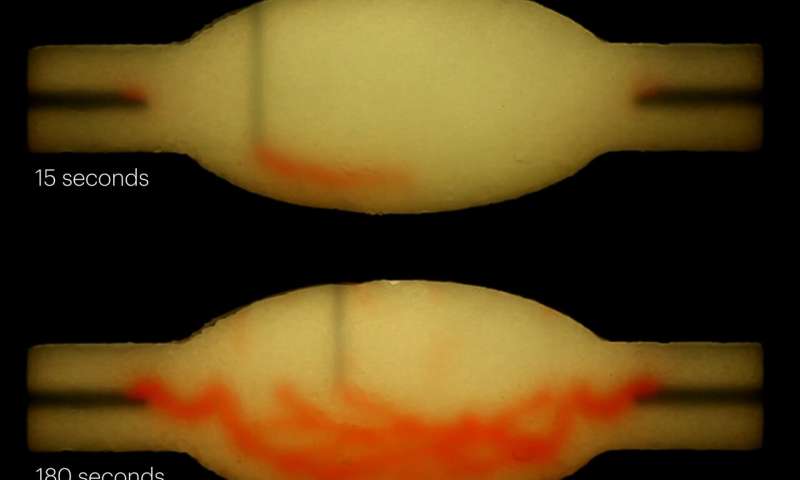
A swifter way towards 3-D-printed organs
This image sequence shows a pervasive, branching network of vascular channels (red) being printed within a densely cellular tissue matrix via SWIFT. Credit: Wyss Institute at Harvard University
When the cold matrix is heated to 37 C, it stiffens to become more solid (like an omelet being cooked) while the gelatin ink melts and can be washed out, leaving behind a network of channels embedded within the tissue construct that can be perfused with oxygenated media to nourish the cells. The researchers were able to vary the diameter of the channels from 400 micrometers to 1 millimeter, and seamlessly connected them to form branching vascular networks within the tissues.
Organ-specific tissues that were printed with embedded vascular channels using SWIFT and perfused in this manner remained viable, while tissues grown without these channels experienced cell death in their cores within 12 hours. To see whether the tissues displayed organ-specific functions, the team printed, evacuated, and perfused a branching channel architecture into a matrix consisting of heart-derived cells and flowed media through the channels for over a week. During that time, the cardiac OBBs fused together to form a more solid cardiac  whose contractions became more synchronous and over 20 times stronger, mimicking key features of a human heart.
“Our SWIFT biomanufacturing method is highly effective at creating organ-specific tissues at scale from OBBs ranging from aggregates of primary cells to stem-cell-derived organoids,” said corresponding author Jennifer Lewis, Sc.D., who is a Core Faculty Member at the Wyss Institute as well as the Hansjörg Wyss Professor of Biologically Inspired Engineering at SEAS. “By integrating recent advances from stem-cell researchers with the bioprinting methods developed by my lab, we believe SWIFT will greatly advance the field of organ engineering around the world.”
Collaborations are underway with Wyss Institute faculty members Chris Chen, M.D., Ph.D. at Boston University and Sangeeta Bhatia, M.D., Ph.D., at MIT to implant these tissues into animal models and explore their host integration, as part of the 3-D Organ Engineering Initiative co-led by Lewis and Chris Chen.
“The ability to support living  with vascular channels is a huge step toward the goal of creating functional  outside of the body,” said Wyss Institute Founding Director Donald Ingber, M.D., Ph.D., who is also the Judah Folkman Professor of Vascular Biology at HMS, the Vascular Biology Program at Boston Children’s Hospital, and Professor of Bioengineering at SEAS. “We continue to be impressed by the achievements in Jennifer’s lab including this research, which ultimately has the potential to dramatically improve both organ engineering and the lifespans of patients whose own organs are failing,”

Explore further

More information: “Biomanufacturing of organ-specific tissues with high cellular density and embedded vascular channels” Science Advances (2019). advances.sciencemag.org/content/5/9eaaw2459

MS Drug Spending Skyrockets Due to Rising Prices

Study Authors: Alvaro San-Juan-Rodriguez, Chester B. Good, et al.; Daniel M. Hartung, Dennis Bourdette
Target Audience and Goal Statement: Neurologists, family physicians, primary care physicians
The goal of this study was to assess how trends in prices, market share, and spending on self-administered disease-modifying therapies (DMTs) for multiple sclerosis (MS) changed in Medicare Part D from 2006 through 2016.
Question Addressed:
How did prices, market share, and spending on self-administered DMTs for MS change in Medicare Part D from 2006 through 2016?
Study Synopsis and Perspective:
List prices of self-administered MS drugs more than quadrupled in 11 years, and Medicare spending for Medicare Part D beneficiaries soared more than 10-fold during the same period, an analysis of claims data showed.

Action Points

  • In an analysis of Medicare beneficiaries, annual treatment costs for self-administered disease-modifying therapies (DMTs) for multiple sclerosis (MS) more than quadrupled over a 10-year period.
  • Note that prices of self-administered DMTs for MS increased dramatically from 2006 to 2016, which resulted in a 7.2-fold increase in patients’ out-of-pocket costs.
Self-administered DMT prices rose from a mean of $18,660 to $75,847 a year from 2006 to 2016, reported Alvaro San-Juan-Rodriguez, PharmD, of the University of Pittsburgh, and co-authors in JAMA Neurology. Medicare spending on these drugs went from $7,794 to $79,411 per 1,000 Medicare beneficiaries during the same period.
Only four self-administered DMTs were approved for MS treatment prior to 2009, including glatiramer acetate (20 mg), interferon beta-1a (30 µg), interferon beta-1a (8.8/22/44 µg), and interferon beta-1b. Several new DMTs entered the market in the ensuing decade and there are now 19 FDA-approved DMTs for MS in 10 different mechanistic classes.
However, looking at Medicare Part D prescription claims from 2006 to 2016 (a period coinciding with the proliferation of more DMTs for MS), researchers found a steep increase in the list prices of MS drugs — the starting point before rebates, coupons, or insurance kicks in — and in the ultimate costs both to Medicare and the consumer.
“This study is the first to evaluate the impact of rising prices of multiple sclerosis drugs on Medicare Part D drug spending and patients’ out-of-pocket spending,” San-Juan-Rodriguez told MedPage Today. “Multiple sclerosis drugs have been well-known for presenting high price increases over the last years. Yet the impact of these high and rising drug prices on Medicare Part D spending and patients’ out-of-pocket spending was unclear,” he said.
“This study is an important contribution because it demonstrates to taxpayers and policymakers that rising prices of multiple sclerosis drugs have resulted in large increases in Medicare spending and patient out-of-pocket costs,” he added.
Many DMTs for MS reduce the frequency and severity of flare-ups, which can involve a variety of disabling neurological symptoms, such as vision loss, pain, fatigue, and muscle weakness.
Annual cost of treatment with each medication (based on Medicare Part D prescription claims gross costs and FDA-approved recommended dosing), market share of each medication (proportion of pharmaceutical spending accounted by every drug), and pharmaceutical spending per 1,000 Medicare beneficiaries for all drugs served as the main outcomes in this analysis of a 5% random sample of Medicare part D beneficiaries (a mean of 2.8 million Medicare beneficiaries per year). Researchers also quantified Medicare catastrophic coverage payments, low-income cost sharing subsidies, patients’ out-of-pocket costs, manufacturers’ coverage gap discounts, and other payments towards pharmaceutical spending.
Over the course of more than a decade, annual cost to the Medicare Part D program for DMTs rose from $396.6 million to $4.4 billion, which equals a more than 10-fold increase per Medicare beneficiary. Annual DMT cost escalation from $18,660 to $75,847, which translated into a mean yearly increase of 12.8%, was the main economic driver. Fingolimod and brand-name glatiramer (20 mg) were at the higher end of the range of annual costs of treatment, and interferon beta-1b and generic glatiramer (20 mg) were at the lower end.
For every 1,000 beneficiaries, pharmaceutical spending and out-of-pocket spending by the consumer during the same period increased 10.2-fold (from $7,794 to $79,411) and 7.2-fold (from $372 to $2,673), respectively.
Across the study period, brand name glatiramer maintained the largest market share per 1,000 beneficiaries, ranging from 32.2% to 48.4%. There was a substantial decrease in market share of platform therapies (interferon beta preparations and glatiramer acetate) from 2006 to 2016, in favor of newer therapies. Prices per 1,000 beneficiaries for fingolimod, teriflunomide, and dimethyl fumarate rose by 7.9%, 9.0%, and 19.2%, respectively.
Relative federal contributions towards pharmaceutical spending increased from $5,335 of $7,794 (68.5%) to $58,620 of $79,411 (73.8%).
“We’re not talking about patients without health insurance here,” said co-author Inmaculada Hernandez, PharmD, PhD, of the University of Pittsburgh, in a press release. “We’re talking about insured patients, under Medicare. Still, they are paying much more for multiple sclerosis drugs than they were 10 years ago.”
Bari Talente, executive vice-president of advocacy for the National MS Society, said in another press release: “Medications can change lives only if they are accessible — a seven-fold increase in out-of-pocket costs is not accessible.”
“People with MS, Medicare and our health care system cannot continue to face these types of increases, where prices more than quadruple over a 10-year period,” she said.
Analyses only included self-administered DMTs and not MS drugs that were administered in physician offices, which are reimbursed under Medicare Part B, the team acknowledged. This limits the generalizability of the data to the Medicare Part D population. Although only glatiramer (20 mg) faced within-molecule competition, economic theory holds that the prices of incumbent agents should decrease after the entry of competitors (even for within-molecule competition).
Source Reference: JAMA Neurology 2019; DOI: 10.1001/jamaneurol.2019.2711
Editorial: JAMA Neurology 2019; DOI: 10.1001/jamaneurol.2019.2445
Study Highlights: Explanation of Findings
Based on an analysis of 2006-2016 Medicare Part D claims data, annual costs of treatment of self-administered DMTs for MS more than quadrupled during the study period. Pharmaceutical spending on these MS drugs increased more than 10-fold and patients’ out-of-pocket costs increased more than seven-fold. While glatiramers occupied the lion’s share of the market, platform therapies experienced a market share drop over time in favor of newer therapies.
“One of the most significant findings was that the prices of these drugs have increased in parallel,” said San-Juan-Rodriguez. “Only a couple exceptions deviate from that general trend.”
Critics may argue that manufacturer rebates and other discounts mean that the MS drug list price does not translate into increased spending; however, the detailed cost breakdown from Medicare claims and study findings counter this argument.
Medicare spends more than three times as much for DMTs for MS than they pay to neurologists for all of the services that they provide, observed Daniel Hartung, PharmD, MPH, and Dennis Bourdette, MD, both of the Oregon Health & Science University in Portland, in an accompanying editorial. Simply put, this study documents the escalating costs that patients, Medicare Part D plans, and ultimately U.S. taxpayers are paying for “irrationally priced therapies,” they noted.
“The pharmaceutical and biotechnology industries claim that the high prices reflect the expense of research and development and need to incentivize continued innovation,” they wrote. But “these claims do not explain the continuous rise in the three drugs originally approved for MS, interferon beta-1b, interferon beta-1a, and glatiramer acetate,” they noted. “These drugs have long since recouped any cost of drug development, yet their prices have continued to rise.”
These three drugs had modest increases in price until 2002, when another interferon beta-1a was introduced at a price approximately 30% higher, initiating “the ever-increasing prices of DMTs for MS,” they pointed out.
San-Juan-Rodriguez and colleagues also noted that the proliferation of MS drug approvals “did not ameliorate and could have even contributed to high inflation rates observed for incumbent drugs.” This pattern serves as a counterexample to the argument that competition leads to lower prices.
Neurologists should “look carefully at their relationships with pharmaceutical and biotechnology companies and call them to task for unreasonable increases in prices,” Hartung and Bourdette wrote. “Remaining silent should not be an option.”
“The development of DMT for MS has been one of the great achievements of neurology in the past 25 years,” they continued. “Neurologists should not allow the unfettered increases in price for these drugs hurt the health care system or patients.”
Reviewed by Robert Jasmer, MD Associate Clinical Professor of Medicine, University of California, San Francisco

NSAID Continuous Infusion for Post-Op Pain Meets Preliminary Target

An investigational, alcohol-free form of the nonsteroidal anti-inflammatory drug (NSAID) ketorolac was well tolerated, according to a phase I study funded by the manufacturer.
Among healthy adults, the continuous infusion formulation, called NTM-001, maintained steady plasma concentrations across 24 hours as was predicted by pharmacokinetic modeling, which also predicted an achieved durable analgesic effect, reported Ilona Steigerwald, MD, of Neumentum in Palo Alto, California, during a poster presentation at the 2019 PAINWeek conference.
It also met safety targets, with no signs of renal injury; only a few mild gastrointestinal events reported in the continuous infusion arm; and no serious events or deaths, she said.
“[With this formulation] you save 20% of the dose, you will have a better analgesia because you don’t have peaks and troughs, and you will probably also have a better safety profile because ketorolac side effects are dose-dependent,” Steigerwald told MedPage Today. “Thus you have an efficacy and safety gain, you have an infusion that is alcohol free and makes no irritation, and I will also say you don’t have to give boli every 6 hours.”
The approved intravenous form of ketorolac (Toradol) is typically administered as a 30-mg bolus every six hours, and results in high peaks and low troughs in plasma concentrations between repeat doses, Steigerwald said. While the high plasma concentration peaks occurring after the therapy is injected can pose safety risks, the troughs may not effectively provide analgesia, she added.
This form was designed to provide more stable pain relief without unnecessary overexposure in postsurgical patients, Steigerwald and her team noted. Administered at a loading dose of 12.5 mg and an infusion rate of 3.5 mg/hour, it also has a reduced total daily dose compared to the traditional form (96.5 mg vs 120 mg).
This novel formulation has the potential to fulfill an “unmet need” for meaningful and durable analgesia, said co-author Joseph Pergolizzi, MD, of NEMA Research in Naples, Florida.
Performance in older patients
The blinded pharmacokinetic study involved 28 adults, half of which were white and female. But the authors also presented another study that examined three cohorts of individuals age 65 and older: those with zero renal impairment (15), mild renal impairment (16), or moderate renal impairment (8).
In these small cohorts, a dose reduction of up to 50% is used in the standard ketorolac therapy, such that 15 mg is administered every 6 hours for patients 65 or older, the authors reported.
The continuous infusion formulation, administered in this more vulnerable population at a 6.25-mg loading dose followed by an immediate continuous infusion of 1.75 mg/hour, also maintained steady plasma levels, with concentrations greater than trough values for the ketorolac bolus dose regardless of renal function and dosing, the authors reported.
As was seen in healthy volunteers, only a few gastrointestinal events of mild intensity occurred with no signs of acute renal injury and no participants in either arm undergoing serum creatinine change of 0.3 or more, or reduction in creatinine clearance of 30% or more within 96 hours. However, moderate fluctuations in hemoglobin were observed in the older patients, though they were not associated with bleeding events, the authors reported.
Drugmaker Neumentum has submitted these findings to the FDA and is moving forward with a phase III study, Steigerwald said.
“We are trying to eliminate co-opioid use and in the phase III that’s coming we’ll be comparing directly to IV morphine to see that we have the opioid-level analgesia and that you hardly need anything else for the vast majority of people,” Steigerwald said. “That’s the goal.”
The study was funded by Neumentum.
Steigerwald is an employee of Neumentum and co-authors reported several relationships with industry.

Healthcare hiring dampened in August by weak ambulatory growth

Hiring in the healthcare industry slipped 21% in August over the prior month, with noteworthy declines in the ambulatory sector.
Healthcare added 23,900 jobs last month, compared with its 30,400 new hires in July, according to the U.S. Bureau of Labor Statistics’ latest jobs report, released Friday. The healthcare sector has added 392,000 jobs over the past 12 months.
Overall employment rose by 130,000 jobs in August, and the unemployment rate was unchanged at 3.7%. Healthcare hiring trailed that of the federal government in August, which made 28,000 new hires last month. Some of the increase was driven by temporary federal government hiring ahead of the 2020 Census.
Within healthcare, ambulatory services made 12,100 new hires in August, down from almost 29,000 in July, a month in which it comprised almost all new healthcare hiring. In August, by contrast, new hires in the ambulatory services sector comprised 51% of healthcare job growth.
Within the ambulatory sector, physicians’ offices added 1,900 last month, down 37% from July. Dentists’ offices added 1,600 jobs, down 58% from July. Home health hiring was down 37% in August compared with the prior month, having added 6,800 jobs.
Offices of other healthcare practitioners saw a particularly noteworthy drop in August, having shed 1,200 jobs, compared with a 7,300 gain in July.
Nursing and residential care facilities added 3,000 jobs in August, down 17% from July.
If there was one winner coming out of August’s healthcare hiring, it was hospitals. They added 8,800 jobs last month, compared with a dismal July, in which they shed 2,100 jobs. Hospital hiring is particularly volatile month-to-month. In June, hospitals made 11,200 new hires.
Professional and business services sector added 37,000 jobs last month, with large gains in computer systems design and related services and in management of companies and enterprises.
Financial activities employment grew by 15,000 jobs in August, with nearly half of that in insurance carriers and related activities.

Frequency Therapeutics readies IPO

Frequency Therapeutics (FREQ) has filed a preliminary prospectus for a $100M IPO.
The Woburn, MA-based biotech develops therapies to repair or reverse damage caused by a range of degenerative diseases based on Progenitor Cell Activation which relies on combinations of small molecules to activate progenitor cells (like stem cells, but more specific) to create functional tissue. Lead candidate is FX-322 to treat the underlying cause of sensorineural hearing loss. A Phase 2a study should launch next quarter.
2019 Financials (6 mo.): Operating Expenses: $12.9M (+50%); Net Loss: ($12.7M) (-48%); Cash Burn: ($10.6M) (-23%).

Biopharma Eyes Wider Acceptance, Use, Reimbursement of Related Diagnostics

It’s been predicted for some time that individuals would get their entire genome sequenced in order to more personalize treatments and to predict diseases. However, it’s been much slower coming, largely because payers are skeptical that there’s real value in widescale use.
What is happening, however, is biopharma companies are working with diagnostic companies to develop companion diagnostic tests to go along with specific therapies, often cancer drugs. One example is the drug Vitrakvi, developed by Eli Lilly and its Loxo Oncology, which is marketed by Bayer. Vitrakvi works on cancers where there’s a rare genetic mutation found in less than 1% of solid tumors—no matter where in the body they are found.
The drug is so effective in this patient population that MD Anderson Cancer Center physicians called it the “Lazarus effect,” for its ability to reverse late-stage cancers that haven’t responded to other treatments.
But identifying those patients has been a challenge.
Lilly recently signed a deal with Thermo Fisher Scientific to develop a companion diagnostic for its experimental drug, LOXO-292. Bayer indicates it plans to invest $70 million to improve patient and physician awareness of rare mutation testing and to lobby regulators for approval of more tests. They also indicate they expect their budget to grow as Vitrakvi is approved in more countries.
The Lilly-Thermo Fisher deal adds RET mutations, the target of Lilly’s LOXOo-292, as well as a drug being developed by Blueprint Medicines Corp., to Thermo’s Oncomine Dx Target Test. The test is used by medical laboratories to identify several genes associated with non-small cell lung cancer (NSCLC).
Thermo’s Oncomine Dx Target Test is already approved by the U.S. Food and Drug Administration (FDA), and CNBC notes that it is a key standard for Medicare coverage.
Brian Alexander, chief medical officer of Roche’s gene testing company Foundation Medicine, told CNBC that approximately 15% of U.S. advanced cancer patients receive comprehensive genomic profiling, with another 2% receiving single-gene testing. A large proportion, he noted, “are not getting any testing at all.”
For example, MD Anderson, which treats 100,000 new cancer patients annually, indicates only about 10,000 have their tumors sequenced.
It’s a trend now, for biopharma companies to develop a companion diagnostic along with a drug, if the drug’s effectiveness is associated with specific genetic mutations. In May, for example, QIAGEN and Inovio Pharmaceuticals partnered to co-develop a companion diagnostic to go along with Inovio’s DNA-based immunotherapy for cervical dysplasia caused by human papillomavirus (HPV). That deal focuses on Inovio’s VGX-3100, a product candidate for HPV 16 and HPV 18 infection and precancerous lesions of the cervix (Phase III) and vulva and anus (Phase II).
And in April, Merck’s checkpoint inhibitor Keytruda (pembrolizumab) was approved for yet another indication, this time as a monotherapy for the first-line treatment of stage III non-small cell lung cancer (NSCLC) in patients who are not candidates for surgical resection or definitive chemoradiation, or metastatic NSCLC, and patients whose tumors express PD-L1 as identified on an FDA-approved companion diagnostic, with no EGFR or ALK genomic tumor aberrations.
Last year, Medicare indicated it would cover FDA-approved tests for advanced cancer patients that test for multiple genetic mutations at once. Usually this kind of endorsement is followed by coverage by private insurers. However, the final regulations eliminated a requirement for the diagnostic test makers to prove the tests were cost-effective and improved patient care.
Jeff Schreier of Diaceutics, a data analytics company, told CNBC this created an “evidence gap” that allowed some insurers to withhold coverage or demand more proof of benefit. “More payers are coming around, but it’s slow.”
Although some of the bigger companies’ companion diagnostics are being reimbursed by Medicare, many laboratories and healthcare institutions have developed their own tests and are not necessarily being reimbursed. Although there are signs of progress, uptake is still slow. The Lilly-Thermo deal and Bayer’s efforts may help speed the process.

FDA OKs Boehringer Ingelheim’s Ofev for rare lung disease

The FDA approves privately held Boehringer Ingelheim’s Ofev (nintedanib) to slow the rate of decline in pulmonary function in adult patients with interstitial lung disease associated with systemic sclerosis, a rare disorder of unknown cause characterized by diffuse scarring and vascular abnormalities in the internal organs, skin and joints, or scleroderma, a chronic connective tissue disorder characterized by the hardening and tightening of the skin and connective tissues.
The agency first approved the kinase inhibitor in October 2014 for ideopathic (unknown cause) pulmonary fibrosis (IPF).
Systemic sclerosis/scleroderma-related tickers: Kadmon (KDMN +1.6%), Corbus Pharmaceuticals (CRBP +4.8%), Galapagos NV (GLPG -0.6%), Roche (OTCQX:RHHBY +1%), Emerald Health Pharmaceuticals (OTCQX:EMHTF +2.6%), Fibrocell Science (FCSC -1.1%)
IPF-related tickers: MediciNova (MNOV -1.1%), Trevi Therapeutics (TRVI +12.9%)