Search This Blog

Wednesday, October 9, 2019

SITC 2019 preview – Nextcure’s time to shine

The biotech calendar’s next key conference gets under way in a month, and a presentation by Nextcure will be a focus for some investors.
With most of the programme for the Society of the Immunotherapy of Cancer conference now revealed, investors have fresh expectations from what has recently become one of the most important meetings of the biotech calendar.
The late-breaking presentations remain under wraps until November 1, but are rumoured to include a slot for Pieris, a stock that has crashed in the past month. In the meantime, those investors who bought into Nextcure, a biotech whose valuation has climbed 40% since it raised $75m in a May flotation, will look to proof of efficacy of NC318, the group’s lead asset.
NC318 inhibits a novel protein called Siglec-15, which is present on immunosuppressive macrophages. The group’s IPO document cited one partial remission in 13 patients, and more will be hoped for at SITC, where phase I data in PD-(L)1-refractory NSCLC subjects are to be presented.
Also out with SITC data in checkpoint blocker-refractory subjects will be Mirati – not with the anti-Kras project MRTX849, which features at this month’s AACR-NCI-EORTC triple meeting, but with the TRK, Ret and DDR inhibitor sitravatinib.
Selected presentations from the 2019 SITC conference
Project Company Detail Trial
Bempegaldesleukin Nektar Opdivo combo in 1st-line melanoma cohort from Pivot-02 NCT02983045
Sitravatinib Mirati Trk, Ret & DDR inhibitor combo with Opdivo in checkpoint-refractory urothelial carcinoma NCT03606174
NC318 Nextcure Single agent anti-tumor activity in PD-1 refractory NSCLC NCT03665285
CDX-1140 +/- CDX-301 Celldex CD40 agonist MAb +/- FLT3 ligand NCT03329950
CPI-006 Corvus Anti-CD73 MAb, phase I data NCT03454451
CV8102 Curevac Single-agent TLR & RIG1 agonist or combo with anti-PD-1 MAbs NCT03291002
AK104 Akeso Biopharma Phase I study of anti-PD-1 x CTLA-4 bispecific NCT03261011
IMA101 Immatics First study of TILs with defined multiple targets NCT02876510
CA-170 Curis Small-molecule Vista antagonist, mesothelioma cohort NCT02812875
RP1 Replimune Phase I data on oncolytic virus +/- Opdivo NCT03767348
ONCOS-102 Targovax Phase I data on oncolytic virus + Keytruda NCT03003676
P-BCMA-ALLO1 Poseida Off-the-shelf multiple myeloma Car-T therapy Preclinical data
AUTO6NG Autolus GD2-targeting Car-T therapy Preclinical data
BT8009 Bicycle Therapeutics Anti-nectin-4/4-1BB bispecific Preclinical data
AMV564 Amphivena Anti-CD33 bispecific ?
Source: SITC.
Combinations will also feature, in particular Curevac’s TLR/Rig1 agonist CV8102 and Nektar’s ill-fated IL-2 asset bempegaldesleukin.
Investors in August did not buy Nektar’s excuse for bempegaldesleukin’s waning efficacy in the Pivot-02 study, and SITC will see data from this trial’s first-line melanoma cohort (Nektar’s call for calm backfires, August 9, 2019).
Another group that has disappointed of late is Bicycle Therapeutics, which presented an underwhelming update concerning its MT1-MMP inhibitor BT1718 at the Esmo congress. At SITC attention turns to the anti-nectin-4/4-1BB bispecific BT8009; Bicycle might want to bask in the reflected glory of Seattle Genetics’ recently filed anti-nectin-4 antibody-drug conjugate, enfortumab vedotin.
There will also be presentations on I-O combinations of oncolytic virus projects from Repligen and Targovax. Cell therapy enthusiasts, meanwhile, will look to early data from Immatics, Iovance, Poseida and Autolus.
That said, the best is yet to come. Pieris, whose stock has nearly halved since unveiling disappointing AZD1402/PRS-060 data in asthma, has according to analysts at Evercore ISI secured an SITC late-breaker for its oncology lead, PRS-343, which is an anti-Her2/4-1BB bispecific.
For the rest of the late-breakers investors will have to wait another three weeks.
The 2019 SITC meeting takes place at National Harbor, Maryland on November 6-10.
https://www.evaluate.com/vantage/articles/events/conferences/sitc-2019-preview-nextcures-time-shine

US pricing watchdog spotlights an old pharma trick

Hiking the price of a drug before generics appear is a long-enshrined practice, a situation that applies to most of the products singled out by Icer.
Any concern that Icer might be compromising its integrity by working closer with pharma companies on cost-effectiveness assessments can surely be put to bed with yesterday’s report. The US pricing watchdog’s first “Unsupported Price Increase Report” baldly points the finger at seven products that have enjoyed substantial price rises over the past couple of years for which little clinical justification could be found.
Unsurprisingly, the companies involved have widely decried the report, which went so far as to put a number on the excessive costs borne by patients, and the US healthcare system more widely. According to Icer this amounted to $5.1bn over 2016-18, a figure that will provide those campaigning for action on drug pricing a new stick with which to beat the pharmaceutical industry.
Icer looked for clinical justifications for the price rises, but other lifecycle considerations will matter just as much to a company deciding how much to charge for a medicine. In reality, factors like patent life or new competition in the field are probably the biggest influences on a company’s pricing strategy, though of course this message does not play as well when it comes to justifying the value of a drug.
But a look at the products highlighted by Icer shows that, in the period that the watchdog assessed, all were facing either an imminent threat to sales from low-cost competitors or newer therapies. And hiking the price of a product ahead of patent expiry is a long-established practice.
Named and shamed… Icer’s naughty list 
Product  Company Q4’16-Q4’18 net price change Increase in spending impact due to net price chg ($m) US sales 2018 ($bn) US sales 2024e ($bn) Note
Humira Abbvie 15.9% 1,857 13.7 10.2 Biosimilars to launch in US in 2023; US sales forecast to peak in 2022
Rituxan Roche 23.6% 806 4.4 1.5 Biosimilars expected to launch late 2019/2020; US sales forecast to peak in 2018
Lyrica Pfizer 22.2% 688 3.6 0.1 Generics launched July 2019; US sales peaked 2018
Truvada Gilead 23.1% 550 2.6 0.2 Generics to launch in Sept 2020; US sales forecast to peak in 2018
Neulasta Amgen 13.4% 489 3.9 1.4 Biosimilar launched June 2018; US sales peaked 2017
Cialis Lilly 32.5% 403 1.1 0.1 Generics launched September 2018; US sales peaked 2016
Tecfidera Biogen 9.8% 313 3.3 1.9 US PTO decision due Feb 2020; US sales forecast to peak in 2019
Total increase in spending over two years 5,106


Revlimid* Celgene 6.5 7.1 Generics expected to launch in 2022; US sales forecast to peak in 2022
Genvoya* Gilead 21.7% 651 3.6 2.3 New HIV quad therapy launched in 2015; US sales peaked 2018
*Drugs with price increases with new clinical evidence, though Icer did not conclude that the evidence justified those price increases. Source: Icer unsupported price increase report, EvaluatePharma for sales figures.
Lilly, for example, was very motivated to eke what it could out of Cialis: the impotence pill felt the pain of generics in 2017 when Viagra copycats reached the market. A year later Cialis itself lost exclusivity.
The biggest offender, Abbvie, has never been afraid of price hikes and so Humira’s presence on this list should not come as a surprise. The company made it clear that, in the wake of an aggressive price cut in Europe to defend market share, Humira’s US price would continue to rise (Abbvie manoeuvres to defend Humira to the last, November 7, 2018).
It should also be noted that Icer’s report identified 26 drugs whose prices fell during this period. The biggest faller, Sanofi’s Lantus, saw its spending impact due to net price change decline $1.3bn.
Generic competition
Celgene is presumably pursuing a similar strategy to Abbvie with Revlimid, which has started to see some generic competition in certain European countries before an expected launch of copycats in the US in 2022.
Amgen too has for years been relying on price hikes to deliver growth in its Neulasta franchise. In a report last year Leerink analyst Geoffrey Porges estimated that between 2014 and 2017 price increases boosted the product’s sales despite falling volumes (Price hikes are dead – long live price hikes, October 11, 2018).
It is also not surprising that Biogen has taken the opportunity to hike Tecfidera while it can. A crucial patent hearing in February next year will rule on the MS drug’s exclusivity, and if the decision goes against the biotech company generics could enter in 2021.
It is unlikely that a robust defence of these price hikes will be heard from those not employed by the pharmaceutical industry, and there seems to be broad consensus in the US that its healthcare system is simply too costly. Whether one agrees with Icer’s methods or not, investigations like these are probably the only way to change pricing practices.
https://www.evaluate.com/vantage/articles/news/policy-and-regulation/us-pricing-watchdog-spotlights-old-pharma-trick

Dermira up on start of late-stage development of lebrikizumab

Dosing is underway in a Phase 3 clinical trial evaluating Dermira’s (NASDAQ:DERM) lebrikizumab, an IL-13 inhibitor, in patients at least 12 years old with moderate-to-severe atopic dermatitis (AD).
The late-stage program will include another identical Phase 3. Total enrollment in the two studies will be ~800 subjects across ~200 sites in the U.S., Europe and Asia.
Topline data from the 16-week induction period should be available in H1 2021.
Almirall S.A. (OTC:LBTSF) owns exclusive rights in Europe under a February 2019 agreement (option exercised in June).
DERM is up 3% premarket on light volume.
https://seekingalpha.com/news/3504710-dermira-3-percent-premarket-start-late-stage-development-lebrikizumab

Employer Coalition Launches to Combat High Prescription Drug Costs

The Pacific Business Group on Health (PBGH), The ERISA Industry Committee (ERIC) and the National Alliance of Healthcare Purchasing Coalitions (National Alliance) have partnered to launch the Employers’ Prescription for Affordable Drugs (EmployersRx), a coalition uniting employers in advocacy for policies that will address our nation’s biggest health care challenge—the high cost of prescription drugs.

“As the largest collective purchaser of health care, businesses have a responsibility to employees and their families to tackle this important issue,” said Elizabeth Mitchell, president and CEO of PBGH. “Employers and patients are tired of bearing the brunt of high costs caused by a gamed system set up by drug manufacturers and pharmacy benefit managers. Employers are doing everything they can to contain costs, but this problem is too big to fix without action from the government.”
The coalition supports policies that would increase transparency by forcing middlemen, such as pharmacy benefit managers (PBMs), to make pricing data available to payers. Additionally, drug companies would be required to report and justify price increases for some drugs. Furthermore, the coalition supports changes that would strengthen competition by prohibiting practices that stifle the development and use of generic drugs and biosimilars, and increase value by ending secretive PBM schemes, like spread pricing.
Spending on prescription drugs in the United States has skyrocketed, growing from $236 billion in 2007 to $333 billion in 2017—a 41% increase. Employers spend 21 cents of every health care dollar on prescription drugs—more than twice the national spending rate on retail drugs. These increases contribute to rising overall insurance rates. Kaiser Family Foundation’s recently released data shows that employer premiums rose five percent from last year to average $20,576.
Funds that could be used by companies to increase employee wages or reinvest in the company are instead being used to underwrite massive profits for drug makers. The Kaiser Family Foundation also released survey results that reported one in four Americans find it difficult to afford medication, and four in five agree that prescription drug costs are unreasonable.
EmployersRx is committed to driving the passage of legislation that supports competition, transparency and value by empowering its members to be effective advocates through policy briefs, training and support. EmployersRx features insights and recommendations informed by case studies from employers, including Albertsons, Caterpillar and the University of Southern California.
https://www.biospace.com/article/releases/employer-coalition-launches-to-combat-high-prescription-drug-costs/

Galderma: Positive Phase 2 Results for Investigational Botulinum Toxin

Galderma, a global leader in skin health focused on developing innovative aesthetic solutions, recently announced the Phase 2 clinical trial results for its novel ready-to-use investigational botulinum toxin, QM1114. The multicenter, randomized, double-blind, placebo-controlled study successfully demonstrated the safety and efficacy of Galderma’s liquid formulation of botulinum toxin type A for the treatment of glabellar lines (frown lines). The Phase 3 clinical trial program will begin soon to support regulatory submissions globally.1

“As a physician, I need to be confident that innovation in aesthetic treatment is the result of scientific rigor. I am encouraged by the results of the Phase 2 QM1114 study, which demonstrated initial safety and efficacy at all doses with high patient satisfaction,” said Dr. Joel Cohen*, Director of AboutSkin Dermatology and DermSurgery in Colorado, and investigator in the Phase 2 clinical trial. “It is exciting to see the development of a new toxin formulation that can offer convenience and the potential to eliminate the need for reconstitution in my practice.”
Derived from Galderma’s proprietary strain of Clostridium botulinum bacteria and manufactured using an animal-origin free process, QM1114 has been designed and developed specifically for use in aesthetics. The QM1114 liquid formulation reduces preparation time needed in clinic and has the potential to increase accuracy, as it is ready-to-use, in contrast with current treatments that require reconstitution before administration. Market research suggests that on average, over 70 percent of injectors do not delegate the reconstitution process because they ‘do not feel comfortable with someone else doing it.’2
Additionally, Galderma recently received a manufacturing license from the Swedish Medical Products Agency (MPA) for a new state-of-the-art manufacturing facility at the Center of Excellence, located in Uppsala, Sweden.3 This new facility, built to the highest quality standards, is designed exclusively to meet the production and safety requirements of QM1114. It will also ensure that Galderma can meet increasing worldwide demand as the company’s innovative aesthetics pipeline grows.
https://www.biospace.com/article/releases/galderma-announces-positive-phase-2-results-for-its-proprietary-liquid-formulation-of-an-investigational-botulinum-toxin-and-approval-of-new-state-of-the-art-manufacturing-facility/

Large Amounts Of Insider Trading In Aprea Therapeutics Following IPO

Aprea Therapeutics Inc APRE 2.53% shares cooled a bit Tuesday after getting off to a hot start on the market following an Oct. 3 IPO. The oncology biotech company, which is conducting Phase III testing, saw its stock shoot as high as $21 last week from its $15 IPO price.

The Trades

On Monday, there were several large insider purchases of Aprea stock. Most of the purchases are options being exercised, resulting in trades executed well below market price. The following are some of the noteworthy insider trades reported Monday.
  • Seizinger Bernd R. (Director) Exercised 527,940 @ Avg Price: 4 cents.
  • Magni Guido (Director) Buys 6,500 @ Avg Price: $15.
  • HENNEMAN JOHN B III (Director) Buys 23,407 @ Avg Price: $3.20.
  • Korbel Gregory Alan (VP of Business Dev’t) Buys 64,822 @ Avg Price: 12 cents.
  • Attar Eyal C. (SVP, Chief Medical Officer) Buys 78,030 @ Avg Price: 8 cents.
  • Coiante Scott M (SVP, Chief Financial Officer) Buys 153,324 @ Avg Price: 24 cents.
  • SCHADE CHRISTIAN S (Director, President & CEO) Buys 317,085 @ Avg Price: 52 cents.

Why It’s Important

Company insiders often have the best sense of where a company and a stock are headed.
While many Americans associate the term “insider trading” with illegal activity, company insiders are free to buy and sell shares of their own company’s stock, provided they follow disclosure laws.
Illicit insider trading occurs when a company insider trades after gaining meaningful non-public information about the company, or if an insider buys or sells shares of stock without disclosing the trades via Securities and Exchange Commission filings.
Company insiders whose compensation includes shares of stock can’t be faulted for selling those shares and raising cash periodically.
Insider buying is typically considered particularly noteworthy, and traders watch closely for changes in patterns or unusual insider trading activity.

Benzinga’s Take

As if small cap biotech stocks weren’t typically volatile enough on their own, the first few months of trading for a biotech IPO can be especially volatile and unpredictable.
Aprea traders should expect plenty of noise and volatility surrounding the initial wave of Wall Street analyst coverage, the company’s first quarterly earnings report and the expiration of its lockup period.
It’s always good to see insiders buying shares of stock, but all of the buys reported on Monday happened at steep discounts to market price. Traders will get their first sense of how company insiders feel about Aprea when the lockup period expires and insider trades start happening at market price.
https://www.benzinga.com/general/biotech/19/10/14563195/large-amounts-of-insider-trading-in-aprea-therapeutics-following-ipo

Vir Biotech IPO: What You Need To Know

A clinical-stage immunology company targeting infectious diseases is planning a public listing this week.

The IPO Terms

San Francisco, California-based Vir Biotechnology, Inc. is seeking to offer 7.143 million shares in an IPO, with the shares expected to be priced between $20 and $22 apiece, the S-1/A filing revealed.
At the midpoint of the estimated price range, the offering is expected to raise about $150 million.
The company has applied for listing its shares on the Nasdaq under the ticker symbol “VIR.”
Goldman Sachs, JP Morgan, Cowen and Barclays are the underwriters for the offering.

The Company

Vir, founded in 2016, is a clinical-stage immunology company, which used a combination of immunologic insights and cutting-edge technology to treat and prevent serious infectious diseases.
Infectious diseases cause hundreds of billions of dollars of economic burden each year, according to the company.
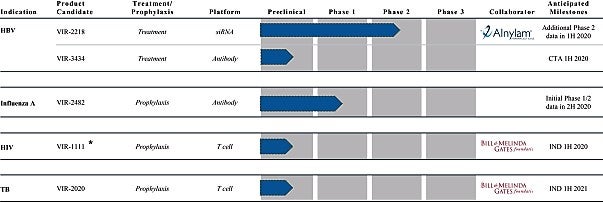
Vir has four technology platforms, focused on antibodies, T cells, innate immunity and small interfering ribonucleic acid or siRNA.
Its product pipeline consists of candidates targeting hepatitis B virus, influenza A, HIV, and tuberculosis.
vir-pipeline.jpg
Source: S-1 filing
Vir expects to use the net proceeds from the offering to fund R&D of its product candidates, including VIR-2218, VIR-3434, VIR-2482.

The Finances

Vir reported revenues of $10.67 million, comprising grant and contract revenues, for fiscal year 2018 compared to $2.71 million a year ago. The net loss, however, widened from $69.85 million in 2017 to $115.88 million in 2018.
For the six months ended June 30, revenues were $5.71 million compared to $4.66 million in the same period last year. The loss for the half-year period widened $56.04 million to $62.60 million.
https://www.benzinga.com/general/biotech/19/10/14562402/vir-biotech-ipo-what-you-need-to-know