Search This Blog

Friday, January 17, 2020

Analysts tip Biogen to file for aducanumab approval within weeks

Analysts at Jefferies expect Biogen to file for approval of aducanumab in Alzheimer’s disease within weeks. Biogen, for its part, is keeping mum about its plans, stating only that it is preparing modules of the common technical document for submission to the FDA.
With Biogen having shared the analyses it thinks will support approval of aducanumab last year, the focus has shifted to the timing of the filing and a search for clues about the FDA’s position. The annual J.P. Morgan Healthcare Conference in San Francisco provided analysts and investors with an opportunity to probe Biogen, but the company gave little away.
Asked about the filing, Biogen Chief Medical Officer Al Sandrock said: “We’ve been constructively engaged with FDA, basically since last June. It’s a matter of preparing all the different modules of the common technical document and submitting them to FDA as rapidly as possible.”
The lack of concrete information from Biogen has left analysts to speculate. Michael Yee and his colleagues at Jefferies said their “best estimate and interpretation” is that Biogen will make the filing “within weeks,” although even that tentative prediction came with the caveat that details “are very much unclear.” Given the tightrope Biogen is walking, its secrecy is explicable.
“[Biogen] is clearly taking a strategic (and perhaps smart) approach to not say anything to jeopardize discussions,” the analysts wrote in a note to investors.
Sandrock and his colleagues are being similarly tight-lipped about other aspects of the effort to get aducanumab to market. Biogen is now in talks with regulators in Europe and Japan but declined to be drawn in on how their views on the data compare to those of the FDA, saying only that the discussions have been “positive.”
The next potential pointer toward regulatory attitudes about the data will come when the FDA decides to put aducanumab in its standard or priority review pathway. Yee expects investors to interpret acceptance of aducanumab for priority review as a positive for the drug’s prospects, making it a stock-moving event.
Asked about how the complexity of the data set may affect the chances of a getting priority review, Sandrock said: “We’re in a very unique situation. I’ve never been in one quite like this. To go from futility to a filing is unique. The level of constructive engagement we’ve had, essentially since the first type C meeting in June, is pretty unusual. I would leave it at that.”

JPM: Pfizer, GSK execs talk contradictory scenarios for hiving off consumer JV

GlaxoSmithKline and Pfizer seem to have contradictory plans for their consumer health joint venture.
During a Tuesday presentation at the J.P. Morgan Healthcare Conference, Pfizer chief Albert Bourla said he believes the JV is heading toward an IPO within three to four years in a move that provides the New York pharma a “clear exit strategy.”
Maybe not, GSK’s chief strategy officer David Redfern said in an interview with Bloomberg the following day.
“Actually we haven’t decided anything,” Redfern was quoted as saying. “When we announced the deal, we said we expect it to separate within three years, but actually up to five years. And it’s entirely our decision.”

In December 2018, when the two companies unveiled the deal to merge their consumer health businesses into one huge JV with 2017 sales of $12.7 billion, GSK said it intended “to separate the joint venture from GSK via a demerger of its equity interest to GSK shareholders” and list it on the U.K. equity market. But it also said it “retained the right” for a straightforward IPO.
As for timing, the agreement specifies that within the first five years, GSK, which owns 68% of the JV, will “have the sole right to decide” a separation path for the JV. But after the fifth anniversary of deal closing, both GSK and Pfizer will have a say.
“We have the control of the timing, for up to five years […] but our intent is to demerge within three,” GSK CEO Emma Wamsley said on a conference call back then.
For the business now, GSK is trying to keep its mind focused on integration and sales growth, Redfern told Bloomberg.
“We don’t want it too distracted right now thinking about capital markets,” he reportedly said. “Whether it’s an IPO or just a straight spin, all options are on the table.”

The ultimate destination is still a separation; that part hasn’t changed. Both Glaxo and Pfizer are looking to focus their energies on higher-margin innovative medicines.
For Pfizer, after striking the consumer deal with GSK, it agreed to offload its off-patent drugs franchise, Upjohn, in a merger with Mylan, leaving only the R&D-heavy pharma portfolio and pipeline.
Meanwhile, GSK is gearing up in oncology under Walmsley. With its $5.1 billion takeover of Tesaro, it snared PARP inhibitor Zejula and “highly skilled employees with deep expertise in oncology,” Walmsley said in her Tuesday JPM presentation.
Those talents, spanning R&D, regulatory, medical affairs and sales, will help with GSK’s three oncology launches expected in 2020. These include Zejula’s potential use in first-line ovarian cancer maintenance, belantamab mafodotin in relapsed/refractory multiple myeloma and dostarlimab in second-line endometrial cancer.

After CES, Twitter exec highlights gadgets, gossip and buzz for pharma

The annual Consumer Electronics Show in Las Vegas hasn’t been a traditional gathering place for pharma. But Twitter’s Lisa Bookwalker thinks that’s changing—and should.
Bookwalker joined Twitter in September as director of client services for health and went to CES for the first time this year. There, she met up with forward-looking pharma marketers scouting new ideas to help them engage patients. And at CES that means technology.
“Social platforms like Twitter are the very intersection of human connectivity powered by technology. All of my discussions with marketers centered around this premise,” Bookwalker said via email. “Instead of shying away from social due to industry regulations, many pharma marketers want to explore the idea first and then figure out how to make it compliant, versus the other way around.”

While Bookwalker spent time at the convention in meetings, she also traversed the vast show floor. On her radar of up-and-coming health tech that might work for pharma were a watch that calculates calories by reading body signals, pajamas that monitor vital signs and gaming technology that helps people rehabilitate after a stroke. The theme underlying all those devices is empowering consumers—something pharma needs to embrace.
And while technology has been important to pharma for some time, Bookwalker pointed out that “the level and speed with which it is driving innovation as it relates to care is unprecedented.”

People across the healthcare value chain, from patients to caregivers to payers to physicians to pharma companies, are adopting technologies that let them access information, foster connections and deliver messaging faster than ever, she noted.
As for Twitter’s role in pharma’s tech evolution? “I think the critical piece here is data—and how can data drive better results for pharma brands,” Bookwalker said. “For example, at Twitter we have incredible data/insights from the hundreds of billions of Tweets on our service. Because of this, pharma marketers look to us to identify trends to inform their marketing and look into how they can better move patients through their patient journey.”

Seneca Biopharma rockets 129% on cell therapy promise

Thinly traded nano cap Seneca Biopharma (SNCA +129%) (formerly Neuralstem) has annihilated short sellers on a whopping 90x surge in volume.
Investors are reacting to its presentation at the Biotech Showcase and Sachs Associates Neuroscience Innovation Forum, both held in San Francisco this week.
The presentation focused on three potential indications of lead candidate NSI-566, a spinal cord-derived stem cell therapy, for amyotrophic lateral sclerosis (ALS), chronic stroke and chronic spinal cord injury.
ALS: Phase 1&2 results showed preliminary clinical benefit versus historical data. A pivotal trial is next up.
Stroke: Phase 1 data showed improvement in motor function from baseline.
Spinal cord injury: Phase 1 results showed some gain in voluntary muscle movement below the injury site.

Genetically engineered mosquitoes halt Dengue spread

A new study published in the journal PLOS Pathogens in January 2020 reports the development of mosquitoes that have been genetically modified to resist infection by several types of the dengue virus. This is the first time ever that all types of the virus have been targeted by the engineering of the mosquito DNA. Covering all virus types is essential to achieve proper disease control.

What is Dengue?

Dengue is a viral disease spread by mosquitoes that is becoming a global problem due to its numerous complications and the fatality rate. It is chiefly transmitted by Aedes aegypti mosquitoes. According to World Health Organization (WHO) statistics, millions of people in subtropical and tropical climate zones fall victim to this often deadly viral infection, which readily attacks those with weakened immunity. Especially poignant is the number of severe illnesses and deaths due to dengue in children in Asia and Latin America.
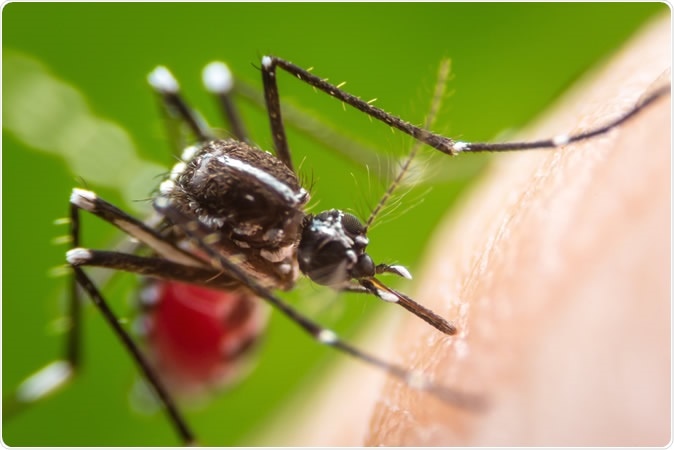
Aedes aegypti mosquito on human skin. Image Credit: Khlungcenter / Shutterstock
Just a short while ago, the highest ever prevalence of dengue in the American continents was reported by the Pan American Health Organization (PAHO). Beginning with high fever and headache, the illness progresses with other flu-like symptoms including rashes. If not controlled in time by the natural immune response, it may cause critical bleeds within the body’s various organs by lowering the platelet count through different mechanisms. Since there is no way to eradicate the virus, prevention requires virus control measures.

The solution

Genetic engineering has made it possible today to generate mosquitoes that cannot play the role of a host to the virus – this is called reducing the vector competence. This modification makes it difficult for mosquitoes to pick up the virus and to transmit it to other hosts.
The study describes the result of changing around certain genes in the Aedes aegypti mosquito in order to render them resistant to many types of the dengue virus. These engineered mosquitoes have a gene that codes for a single-chain bit of a human monoclonal antibody that has a broadly neutralizing effect against the dengue virus. Such an antibody is able to bind all types of dengue virus and not just a particular subtype.
This fragment, called the single-chain variable fragment (scFv) codes for the antibody region which determines which antigen it will bind. The new antibody prevents the infection with or transmission of any of the four dengue virus types in a mosquito that expresses it. This means they can no longer spread the virus to humans. This is the first time an engineered mosquito has been developed to resist all dengue strains.
After identifying the antibody, they inserted it as a payload into the female Aedes mosquitoes. When this engineered mosquito takes in a blood meal, the antigens activate the antibody which is then expressed in the mosquito cells. This is how the mosquito’s immune reaction against the virus is set off. This prevents viral replication and keeps the virus from being able to spread throughout mosquito tissues. By this means, humans can no longer be infected by the virus through a bite from this mosquito.

Advantages

The study thus presents a highly attractive route by which dengue virus control can be achieved with great effectiveness, using a gene-based technique. This may be useful to deactivate the transmission of other viruses related to this organism. The authors also suggest that if this gene strategy is coupled with a gene-drive system, which uses gene editing technologies like CRISPR-Cas9 to insert the desired gene into other mosquitoes, it could enable a dissemination mechanism whereby wild-type mosquitoes, or the type found in nature, can be quickly infected with the modified gene, to completely prevent the dengue virus from being transmitted by mosquitoes.
The best part of this finding is, according to the researchers, the fact that the newly developed mosquito strain cannot act as host to any of the four known types of dengue viruses, allowing it to be a genetic tool to control the spread of dengue through mosquitoes in nature.

Implications

Commenting on the work, researcher James Crowe says, “It is fascinating that we now can transfer genes from the human immune system to confer immunity to mosquitoes. This work opens up a whole new field of biotechnology possibilities to interrupt mosquito-borne diseases of man.” Co-researcher Omar S. Akbari says that in the not-so-distant future dengue could be controlled by field-based methods, reducing the toll of this infection on human health and life. His laboratory has been involved in validating and testing different techniques to prevent mosquito-mediated dengue transmission as well as the spread of many other viruses like the Zika, yellow fever and Chikungunya viruses all at the same time.
Mosquitoes are involved in the spread of multiple serious and even killer diseases including the above illnesses and of malaria. In this way the existence of infectious mosquitoes puts the health of 6.5 billion people around the world at risk. With such a bad reputation, there is little wonder that most research to date has concentrated on eliminating the mosquito vector rather than disarming it. Says global director of the Tata Institute for Genetics and Society (TIGS), Suresh Subramani, “Work from the Akbari lab and at TIGS is aimed at disarming the mosquito instead by preventing it from transmitting diseases, without killing the messenger. This paper shows that it is possible to immunize mosquitoes and prevent their ability to transmit dengue virus, and potentially other mosquito-borne pathogens.”
Journal reference:
Broad dengue neutralization in mosquitoes expressing an engineered antibody Buchman A, Gamez S, Li M, Antoshechkin I, Li HH, et al. (2020) Broad dengue neutralization in mosquitoes expressing an engineered antibody. PLOS Pathogens 16(1): e1008103. https://doi.org/10.1371/journal.ppat.1008103, https://journals.plos.org/plospathogens/article?id=10.1371/journal.ppat.1008103

Mesoblast Presents Commercial Plans at 2020 Biotech Showcase

 Mesoblast Limited (Nasdaq:MESO; ASX:MSB), global leader in allogeneic cellular medicines for inflammatory diseases, today reported that the United States Food and Drug Administration (US FDA) has agreed to the selection of Ryoncil™ as the commercial name for its lead allogeneic cell therapy remestemcel-L in the treatment of pediatric steroid-refractory acute graft versus host disease (aGVHD). Commercial plans for Ryoncil™ were presented at the 2020 Biotech Showcase being held this week in San Francisco, CA.
Mesoblast Chief Executive Dr. Silviu Itescu said: “We begin 2020 with great excitement as we prepare for potential FDA approval and US launch of our lead product candidate Ryoncil™ in pediatric aGVHD, a potentially life-threatening complication of an allogeneic bone marrow transplant. The continued growth in revenues from royalties on sales in Japan of the related product TEMCELL®1 for aGVHD by our licensee provides important insight for our own US commercial plans. Together with our strategic partners, we are also looking forward to readouts of Phase 3 trials for our blockbuster product candidates in advanced chronic heart failure and chronic low back pain due to degenerative disc disease.”
The final module of the rolling Biologics License Application for Ryoncil™ will be filed with the FDA in January, following which the Company will request a priority FDA review of the BLA under the product candidate’s existing Fast Track designation. If approved, Ryoncil™ is planned to be launched in the US in 2020.
A webcast of the presentation is available via https://event.webcasts.com/starthere.jsp?ei=1278810&tp_key=f1494febd2 and as an archived webcast for 90 days on the Investors & Media section of the Company’s website at www.mesoblast.com.

Support for Vaccines Continues Downward Trend in US: Poll

A new Gallup survey shows that support for vaccination in the United States is declining, particularly among parents of young children.
The survey, conducted in December 2019, shows that 84% of Americans feel it’s extremely or very important that parents vaccinate their children. That matches Gallup’s prior reading in 2015, but is down 10% from 2001, when 94% of Americans felt this way.
“Widespread public support for childhood vaccines creates a wall preventing contagious diseases like measles and polio from spreading in the US, but a breach in that wall appeared in 2015 and it has not been repaired,” Gallup said in a news release.
Among parents of children younger than 18 years old, 77% feel vaccination is important in 2019, down from 92% in 2001.
The decline in Americans’ belief in the importance of vaccinating children between 2001 and 2015 occurred among almost all subgroups of the public.
Highly educated Americans with postgraduate degrees is the only group that has maintained its 2001 level of support for vaccines; 90% of this subgroup continues to believe vaccination is important, essentially unchanged from the 92% in 2015 and 2001. Perceptions of the importance of vaccination declined by at least 5 percentage points among all other education subgroups, Gallup reported.

Public Awareness Campaigns Working?

Most Americans say they are aware of the advantages and disadvantages of vaccines. In the latest survey, nearly 9 in 10 (89%) say they have heard “a great deal” or “a fair amount” about the advantages of vaccinations, up from 83% in 2015 and 73% in 2001.
More than three quarters (79%) say they have heard a great deal or a fair amount about the possible disadvantages of vaccines — up modestly from 73% in 2015 but a substantial increase from 39% in 2001.
“Pro-vaccine public awareness campaigns appear to be working to the extent that more Americans — now a majority for the first time — report having heard a lot about the medical advantages of vaccines for children,” Gallup reports.
“However, more have also heard about the disadvantages. While they are not as pervasive and are being exposed as untrue, these counterarguments are still getting through, perhaps explaining why public support for vaccines remains lower than at the start of this century,” they point out.

Uncertainty on Vaccine-Autism Link Persists

Although many Americans who oppose vaccinations argue that they are more dangerous than the diseases they prevent, the vast majority of Americans (86%) continue to disagree. This is unchanged from the 87% who felt that vaccines were less dangerous in 2015 and only modestly lower than the 90% in 2001.
Currently, 11% of US adults think vaccines are more dangerous than the diseases they prevent.
Although the vast majority of Americans see vaccines as less dangerous than the diseases they prevent, only 62% feel the federal government should make all parents get their children vaccinated. In a 1991 Princeton survey, 81% felt the government should require vaccination.
Despite the well-publicized and debunked claim that vaccines cause autism, 10% of US adults still believe that vaccines cause autism in children, marking a modest increase from 6% in 2015. Nearly half (45%) do not think vaccines cause autism, up modestly from 41% who said the same almost 5 years ago, whereas 46% still aren’t sure. In 2001, 94% of Gallup survey respondents were unsure whether vaccines cause autism.
Americans with more formal education were more apt to say vaccines do not cause autism. The figure is 73% among those with postgraduate education, falling to 61% among those with a college degree only, 42% of those with some college, and 28% of those with no college experience.
Lesser-educated Americans were much more likely to have no opinion than to say they believe vaccines do cause autism. The percentage making the causal connection tops out at 12% among Americans with no college education vs 5% of postgraduates.
There was also a partisan split in opinions, with 55% of Democrats saying vaccines do not cause autism, compared with 37% of Republicans, according to Gallup.
The results are based on telephone interviews with a random sample of 1025 adults, aged 18 and older, from all 50 US states and the District of Columbia, with the margin of sampling error of ±4 percentage points.
More information on the survey is available online.