Insider buying can be an encouraging signal for potential investors.
Insiders at some small-cap biotechs have made notable share purchases.
At two of them, the shares were sold in recent secondary offerings.
Conventional wisdom says that insiders and 10% owners really only buy shares of a company for one reason — they believe the stock price will rise and they want to profit. So insider buying can be an encouraging signal for potential investors, particularly with markets near all-time highs and during periods of uncertainty.
The following are a few of significant insider purchases reported last week, all small-cap biotechs. Also note that with earnings season in full swing, buy windows for many insiders are closed.
Aptinyx
A director at Aptinyx IncAPTX 27.78% purchased over 3.33 million shares of this clinical-stage biopharmaceutical company focused on brain and nervous system disorders. At $3 per share, that totaled just shy of $10 million and far outstripped the prior week’s insider purchases in the same common stock offering.
Aptinyx stock saw about a 9% gain in the past week, and shares were last seen trading at $4.60 apiece, above the director’s purchase price and a multimonth high.
The stock still is down more than 12% year-over-year. The consensus analyst recommendation is to buy the shares, and on average they see the share price going to $11.
La Jolla Pharmaceutical
A La Jolla Pharmaceutical CompanyLJPC 2.21% director stepped up to the buy window last week and picked up more than 1.25 million shares of this San Diego-based biopharma company at between $6.01 and $7 each. An executive also purchased 3,000 shares at about $8.23 each. Altogether, that totaled more than $8.37 million.
Kevin Tang of Tang Capital Management recently disclosed a more than 30% stake in La Jolla. The stock closed most recently at $7.73 a share, after starting the year at $3.93. Analysts currently anticipate the share price will go to $12.50 and recommend buying La Jolla stock.
Osmotica Pharmaceuticals
Osmotica Pharmaceuticals PLCOSMT 4.37% reported that two directors and three 10% owners each purchased 1.25 million shares in a public offering of ordinary shares. At $5 per share, that cost each of them $6.25 million. Shares surged on the news of the purchases.
The fourth-quarter earnings report is scheduled for Feb. 13. The shares of this New Jersey-based integrated biopharma company were trading at $5.85 each on last look, above the secondary offering purchase price. The stock has traded as high as $8.45 in the past year, and the consensus price target is $8.25.
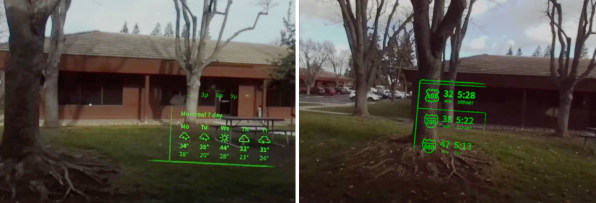
When I looked into the user interface of Mojo Vision’s augmented reality contact lenses, I didn’t see anything at first except the real world in front of me. Only when I peeked over toward the periphery did a small yellow weather icon appear. When I examined it more closely, I could see the local temperature, the current weather, and some forecast information. I looked over to the 9 o’clock position and saw a traffic icon that gave way to a frontal graphic showing potential driving routes on a simple map. At 12 o’clock, I found my calendar and to-do information. At the bottom of my view was a simple music controller.
Rather than wearing Mojo’s contact lenses—which aren’t yet ready to demo—I was looking at a mock-up of a future, consumer version of their interface through a VR headset. But the point was made. Instead of offering the pretty holograms of the Magic Leap and HoloLens headsets, Mojo aims to place useful data and imagery over your world—and boost your natural vision—using tech that can barely be seen. The startup named the lenses “Mojo” because it wants to build something that’s like getting superpowers for your eyes.
Mojo’s display is designed to be useful, not flashy. [Photos: courtesy of Mojo]
This audacious idea is part of a much larger trend. In the coming decade, it’s likely that our computing devices will become more personal and reside closer to—or even inside—our bodies. Our eyes are the logical next stop on the journey. Tech giants such as Apple and Facebook are just now trying to build AR glasses that are svelte enough to wear for extended periods. But Mojo is skipping over the glasses idea entirely, opting for the much more daunting goal of fitting the necessary microcomponents into contact lenses.The company’s been at this since 2015, based on research dating back to 2008. And while it doesn’t expect to bring a finished product to market for another two or three years, some smart people in Silicon Valley venture-capital circles are betting it’ll all work. Mojo Vision has attracted $108 million in venture capital investments from Google’s Gradient Ventures, Stanford’s StartX fund, Khosla Ventures, and New Enterprise Associates (NEA), among others.
Saratoga, Calif.-based Mojo has kept its plans for an AR contact lens under wraps for more than three years. I began meeting with its key executives a year ago, keeping tabs on the evolution of the company’s product and its strategy for bringing it to the world.
Though Mojo still has challenges ahead, it says that it’s already figured out the parts of its creation that might sound, at first blush, most like science fiction. “We’re really confident about this working,” said VP of product and marketing Steve Sinclair, who previously spent seven years at Apple doing product planning for the iPhone. “That’s why we’ve come out of stealth, because we’re seeing all the pieces coming together into a product that does everything we want it to do.”
BAD VISION, BIG IDEA
Mojo Vision was born of the ideas of two men, both Valley veterans who share a deep interest in eye-based tech—and who also both happen to have poor eyesight.
Cofounder and CEO Drew Perkins had already cofounded the optical networking company Infinera, which went public in 2007. He also cofounded and sold three other companies, including a cable network architecture company called Gainspeed. In 2012, when he was Gainspeed’s CEO, he developed cataracts, a common vision ailment where the cornea becomes clouded. Surgery fixed his far-field and near-field vision, but left him with significantly limited midrange vision.
THERE’S GOT TO BE A WAY TO GIVE PEOPLE ADVANCED OR ELEVATED VISION WITHOUT SURGERY.”
The experience got him thinking about using optical technology to correct vision problems, or even to push a person’s sight beyond 20/20. It also led him to muse about how he was investing his time. On the day Perkins dropped his son off for his first year of college in San Diego, he decided to pivot his professional life toward finding out if the “bionic eye” concept might really be possible. He initiated the sale of Gainspeed (it was eventually bought by Nokia) and took a year off.“I thought, ‘How can I give people this kind of super-vision?’” he told me. “There’s got to be a way to give people advanced or elevated vision without surgery.” And the entrepreneurial part of his mind began wondering if there might be a way to make money providing such technology.
Perkins didn’t know it at the time, but an ex-Sun Microsystems senior engineer, Michael Deering, had been thinking about some of the same issues. Before leaving Sun in 2001, Deering had built a reputation as an expert in artificial intelligence, computer vision, 3D graphics, and virtual reality. And he too had poor vision. After Sun, Deering spent a decade working out all the problems of focusing a micro-display—either within a contact lens or implanted in the eye—at the retina. Through his research and simulations, he was able to find answers to the most significant problems—work that was reflected in a steady stream of patents since 2008.
For much of that time, Deering had been consulting with ex-Sun CTO Greg Papadopoulos, who was now a venture capitalist at NEA, on ways to make a product and a business out of his work. NEA had also invested in Gainspeed, and when Perkins came to Papadopoulos in October 2015 to talk about the possibilities of the bionic eye concept, Papadopoulos was interested. At the end of the meeting, he told Perkins about Deering. Since there was obviously some potential synchronicity, the three men met.
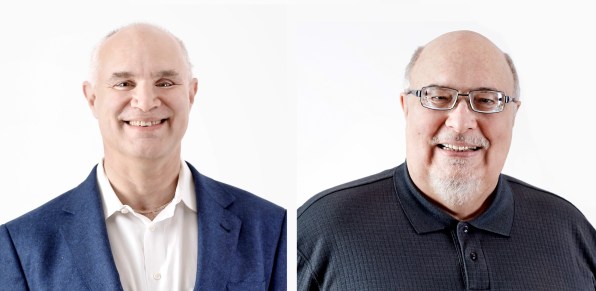
Drew Perkins (left) and Michael Deering [Photos: courtesy of Mojo]
After Deering explained the work he’d been doing, Perkins felt energized. “I remember saying, ‘Wow, he’s figured it out,’” Perkins says. “He was able to unlock the tech that would need to exist for this to work.” Deering would become Mojo Vision’s chief science officer.
With Deering’s decade of science and Perkins’s experience in building optical technology products, the idea now had the critical mass to become a company. Mike Wiemer, a Stanford PhD who had earlier founded a solar cell company, joined as a third cofounder and CTO.
By the fall of 2015, Perkins, Deering, and Wiemer had validated their idea: “We said, ‘Hey, this could work,’” Perkins says. They incorporated under the name “Tectus,” a moniker they would use while in stealth mode. For the next few months, they fleshed out the business plan. When they presented it to NEA, the firm invested $750,000 in seed money. Perkins put in $750,000 of his own.
Papadopoulos told me that until that point, the whole idea of an eye-mounted LED was mostly theoretical. Deering had worked out the mathematical problems and had done some simulations, but building a real product was another story. It would take some special talents to do that. Perkins says he found the first “couple dozen” recruits at places like Apple, Amazon, HP, and Google. They’d be asked to invent something that had never been built before, using technology that Papadopoulos said would have to be “called in from the future.”
WHAT’S IN THE LENS
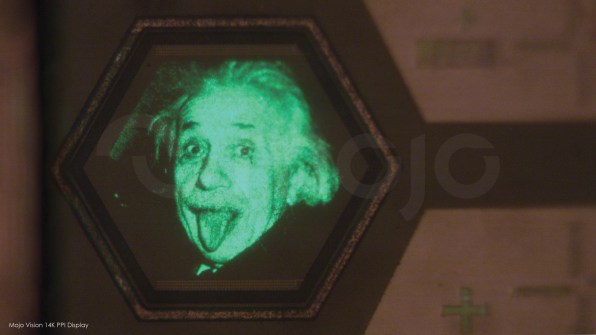
I had no idea that displays not much bigger than a grain of sand even existed. But there it was, under the view of a microscope, displaying an image of Albert Einstein sticking his tongue out at me. Mojo’s newest and smallest display, it squeezes 70,000 pixels into a space that’s less than half a millimeter across.
This display is the centerpiece of the Mojo lens. It’s positioned directly in front of the pupil, so that it projects and focuses light toward a specific area of the retina at the back of the eye. The display is so small and so close that the eye can scarcely see it. At least in the beginning, its quality will be more utilitarian than aesthetically pleasing—you don’t need stunning quality to perform tasks such as display weather information.
Albert Einstein makes a guest appearance on Mojo’s tiny display. [Photo: courtesy of Mojo]
The display focuses its light on a tiny indented area of the retina at the back of the eye called the fovea, which we use to detect the fine details of objects right in front of us. This little indention takes up only about 4% to 5% of the area of the retina, but it contains the vast majority of its nerve endings. It’s thick with photoreceptors that convert light into electrochemical signals, which are then transferred through the optical nerve to various vision centers in the brain. Moving outward from the fovea, the number and density of these photoreceptors decrease rapidly and steadily. We use these lower resolution areas of the retina for our peripheral vision.
All of this ocular science explains why Mojo’s display is practical. It mainlines light directly to the tiny portion of the retina that can see it best. And because there are so many photoreceptors in the fovea, the display needs less power and less light to transmit images.
Along with the display, the Mojo lens will contain a supporting cast of microcomponents. The first versions will include a tiny single-core ARM-based processor and an image sensor. Later versions will add an eye-tracking sensor and a communications chip. At first the lenses will be powered by a tiny thin-film, solid-state battery within the lens. Sinclair says the battery is meant to last all day and will charge in a small case that’s something like an AirPods case. Eventually, the lenses might get their power wirelessly from a thin device that hangs loosely around the neck like a necklace. The lenses will also rely on an internet connection provided by a smartphone or other device for some of their functions, such as sending and receiving data.
PUTTING AR TO WORK
Like any form of augmented reality, what Mojo is working on is only partly about technology. It’s also about finding valuable applications for AR. During a November visit to the company’s offices, I saw something the company is developing for a very specific set of customers: firefighters.
Wearing a VR headset to watch an early prototype demo of this lens experience, I saw a floor plan of the burning building I had just entered. Yellow lines began to form the outlines of tables and chairs within the smoky room. Graphical symbols marked the locations of other firefighters, even when they were separated from me by a wall. Numbers at the top of my view showed my oxygen tank level, communications signal strength, and other data. An alert began flashing, instructing me to get out of the structure.
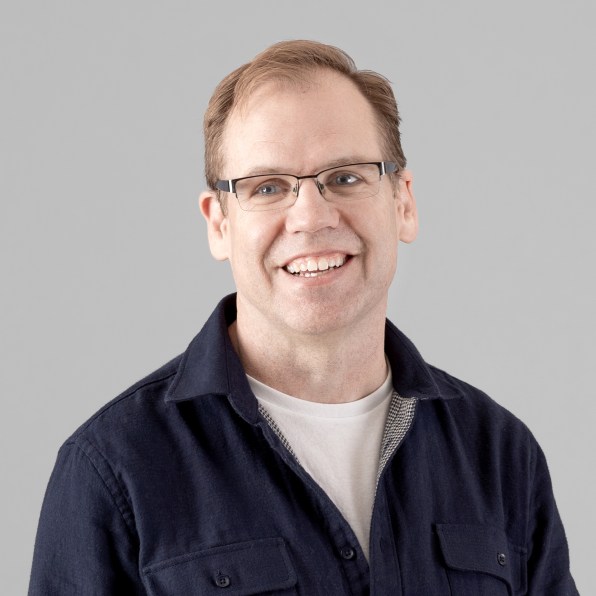
Steve Sinclair [Photo: courtesy of Mojo]
This AR interface “allows a firefighter to see situational things while they’re holding an axe or a hose or some other piece of equipment, and they don’t have time to pull out their phone,” Sinclair told me.Mojo’s interest in building AR contact lenses for first responders grew when it began talking with Motorola Solutions, the dominant provider of communications technology for that market. Mojo has been collaborating with Motorola to define a set of features that might bring crucial information to firefighters and other responders at just the right times. Motorola’s venture fund also invested in Mojo. Sinclair told me that Mojo is talking to the U.S. Department of Defense about some similar scenarios for the military, but didn’t go into details.
Mojo also wants to make lenses for people in service industries. Sinclair describes a use case where a hotel concierge can seamlessly identify and greet incoming guests based on data called up from a database and displayed within the lenses.
But the first version of the Mojo lens, which the company says will ship in two to three years, will most likely be a base model containing a core set of features for people with vision impairments. There are 285 million of them worldwide, according to the World Health Organization.
These lenses could be used by people with various kinds of degeneration of the retina—the light-sensitive layer at the back of the eye—and by people experiencing presbyopia, the normal loss of ability to focus the lens of the eye on small objects that comes with aging. The Mojo lenses, for example, can detect the text on a road sign in the distance and display it clearly. They can magnify objects or project them onto the part of the person’s retina that can still see well. The lenses can help people detect objects in front of them by increasing the contrast between the shades or colors of the objects. The lenses can also superimpose graphic lines over the hard-to-see edges of objects within the wearer’s view.
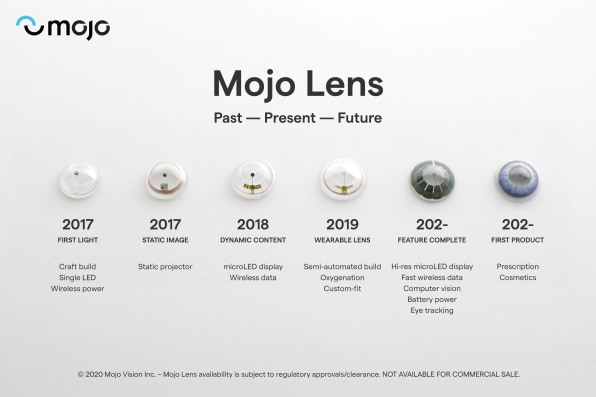
A timeline of Mojo’s progress so far, and what it plans to accomplish next. [Image: courtesy of Mojo]
For some people, this could be life-changing. “We can give them the essential tools they need for mobility,” says Ashley Tuan, Mojo’s VP of medical devices and one of four optometrists working at the company. “They just want to feel that they are normal. They don’t want people to feel pity for them or take advantage of them.”Sinclair told me every pair of Mojo lenses will offer vision-enhancement features, with sets of custom AR features added on to serve the needs of specific vertical markets.
When I first met with Mojo a year ago, it was still very focused on developing the technology in the lenses, and its plans for matching that product with specific markets seemed somewhat fluid. Since then, the company has become more focused on developing the vision assistance features, for good reason: It says that when it presented the lenses to the Food and Drug Administration, it got a warm reception. Because the FDA was excited about the product’s potential for helping the visually impaired, it admitted Mojo into its Breakthrough Devices Program, which offers a development roadmap designed to get the lenses approved as a medical device.
As of now, Mojo still has a long way to go in its process of getting that certification. It’s already begun some of the studies it’ll need to prove the lenses’ safety and effectiveness, but it still needs to test them in real clinical trials. Sinclair says that those tests won’t begin for another couple of years. When I visited the company’s offices in early December, the company had only recently been granted its Institutional Review Board certification, allowing its employees to test the Mojo lenses with their own eyes—so it wasn’t a shocker that it wasn’t ready to let me try them for myself.
LENSES FOR CONSUMERS, EVENTUALLY
Only after Mojo has begun marketing its vision assistance and vertical market lenses does it plan on making lenses for regular consumers. Like the other versions of the lenses, the consumer incarnation will put helpful digital information within the wearer’s view to help them get things done. But the information will be more about life than work. For example, if you’re leaving the airport—perhaps with your hands full of luggage—the lenses might display arrows pointing the way to your car in the parking lot. They might put a pointer over your Uber ride as it arrives, and display the license plate number and other information. If someone rings your doorbell at home, the lenses might display a video of the person standing on the porch.
Whatever the primary purpose for wearing Mojo’s lenses, optometrists will play a key role as a distributor and gatekeeper. They’ll need to measure a would-be wearer’s visual acuity and the shape of their eyeballs, then send the information to Mojo, which will create custom lenses.
IT HAS TO MAINTAIN YOUR PRIVACY, IT NEEDS TO BE SAFE, AND IT NEEDS TO BE TRUSTWORTHY.”
An optometrist’s involvement also helps engender trust in Mojo and the safety of its product, which will be crucial. Mojo, after all, will be asking people to put a technology-laden piece of plastic directly against their eyeballs. An FDA stamp of approval should also go a long way toward that same end.Users will not only be asked to trust Mojo with their eyeballs, but with their data. People will soon realize the lenses potential for collecting information about all the things their eyes rest on, including products, places, political ads, and people. It’ll be on Mojo to assure them that the lenses don’t record that data and share it with advertisers or governments. Sinclair says the only thing the lenses will remember will be human faces they may have to recognize again, but even that data will be stored only for a short time.
Perhaps more problematic is that it’s not just the wearer that needs to be convinced about the privacy of the technology. People with whom the wearer comes in contact may be concerned that they’re being recorded. That was an issue with Google Glass—which other folks could tell you were wearing—and could be even more nettlesome with a technology as invisible as contact lenses.
The public’s opinion on the reasonable expectation of privacy in the digital age is evolving, but Mojo will have a lot of educating and assuring to do when its product finally reaches consumers. Sinclair is keenly aware of this, especially with his background at privacy-obsessed Apple. In fact he was talking about privacy the first time I met him a year ago. “It has to maintain your privacy, it needs to be safe, and it needs to be trustworthy,” he emphasizes.
ENGINEERING HEROICS
Mojo has spent the last three years turning Deering’s foundational work—his mathematical proofs and simulations—into a real physical product. And NEA’s Papadopoulos told me that it took a lot of long days and some real “engineering heroics” to overcome the technical barriers the Mojo people encountered along the way—barriers that could have stopped the development of the lenses cold.
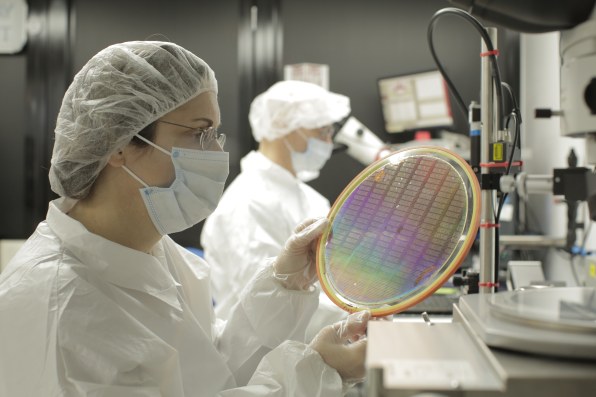
Mojo clean room techs at work. [Photo: courtesy of Mojo]
According to Papadopoulos, early employees struggled to avoid thinking about all the reasons an AR contact lens was impossible and just get to work building it. He now believes that Mojo has emerged from that period and entered one where the road ahead is at least somewhat less treacherous. “It looks locked and loaded,” he says. “You know what you have to do, and there’s really nothing that seems scary.”The main thrust of the engineering effort is now uniting, integrating, and orchestrating the various microcomponents. “We’ve tested pretty much everything outside the lens, and now it’s all getting pulled together in the lens,” says Sinclair.
With the help of the FDA, Mojo’s lenses could become a visual assistance tool that helps a lot of people. But their future as a mainstream AR product may be less certain. Virtually every company building AR or mixed reality hardware is looking to the commercial market—rather than consumers—for early revenue streams. How many of those business customers will see contact lenses as a superior solution to AR glasses remains an unknown. And while consumer AR could end up being the next great personal computing interface after the smartphone, nobody really knows how it will play out.All of which means that Mojo—for all the progress its creators have already made—remains a moonshot. “The fact that a lot of companies are still struggling to do all that in a headset, and that these guys are at least talking about doing it in a contact lens is super interesting,” says IDG analyst Tom Mainelli. “Color me skeptical, but we don’t make leaps without people taking chances like this.” For those who doubt that Mojo can turn its bold concept into reality, only seeing will be believing—once the company is ready to project the proof right onto their retinas.
Wearables player Reliefband Technologies, has announced the unveiling of its new travel and sport therapeutic devices.
Farhan Hussain
The company specialises in technology that aims to prevent and treat nausea and vomiting symptoms, and has received have received U.S. Food and Drug Administration (FDA) expanded indication clearance.
Both of the new devices, which are on show at CES 2020, offer user-controlled therapy for the prevention and treatment of nausea and vomiting associated with anxiety, hangovers, and physician-diagnosed migraines, as well as motion sickness, chemotherapy, morning sickness, and as an adjunct to antiemetics for postoperative surgery.
The over-the-counter transdermal neuromodulation devices are applied to the underside of the wrist. Reliefband works by emitting electrical pulses that stimulate the underlying median nerve. The signals generated on the underside of the wrist then flow to the central nervous system where they work, via the vagus nerve, to normalise stomach rhythms that cause nausea and prevent it.
Rich Ransom, president and CEO of Reliefband Technologies, said: “There are more than 38 million people in the U.S. who suffer migraines and the most common associated symptoms are nausea and vomiting. These newly-cleared indications mark an important step in our mission to mitigate the serious health issues and utter misery associated with nausea. We will continue to innovate our Reliefband technology, providing relief to those who suffer debilitating symptoms stemming from migraines, hangovers, anxiety and more.”
The devices can be used either before or after nausea and vomiting symptoms start and can be left on as long as symptoms subsist.
Reliefband Travel is a limited use wearable device designed for casual travellers who deal with nausea symptoms on a sporadic basis. There are three single-use models which work at a moderate level of intensity for 48 hours, 72 hours, or seven days and can be turned on and off as needs arise. These devices function with an included set of non-replaceable batteries and will be popular options for unsteady flyers, cruise vacationers or others who suffer from motion sickness or travel-related anxiety.
Reliefband Sport is a waterproof device, which includes a built-in rechargeable battery that, when fully charged, will last an extended period of time on the medium intensity level. Six intensity levels can be toggled allowing users to find the precise setting that’s optimal for their needs at any moment.
– Analysis suggested statistically significantly higher lesion clearance with VP-102 compared to vehicle in all regions of the body, including those deemed most sensitive –
– If approved, VP-102 will be marketed in the United States as YCANTH™ (cantharidin 0.7% Topical Solution), and would be the first FDA-approved treatment for molluscum –
Verrica Pharmaceuticals Inc. (“Verrica”) (Nasdaq: VRCA), a dermatology therapeutics company developing medications for viral skin diseases requiring medical interventions, today announced the presentation of positive data from a post-hoc pooled analysis of the pivotal Phase 3 CAMP trials evaluating the safety and efficacy of VP-102 (cantharidin 0.7% topical solution), Verrica’s lead product candidate for the treatment of molluscum contagiosum (molluscum). The new analysis showed that the percentage of patients with complete clearance of all lesions was statistically significantly higher in the VP-102 group than vehicle, across all body regions. Results from this analysis are being presented in a poster on January 18th-22nd at the 17th Annual Winter Clinical Dermatology Conference in Kohala Coast, Hawaii.
“The results of this study are important, as they suggest that this investigational molluscum treatment can potentially bring about complete clearance, regardless of where on the body the lesion is located,” said Lawrence Eichenfield, MD, Chief of Pediatric and Adolescent Dermatology, Rady Children’s Hospital, San Diego, CA, and principal investigator of the VP-102 Phase 3 molluscum program. “If approved, VP-102 may potentially be an important option for physicians, as they can have the option to treat even the most sensitive areas, including the groin, head, and neck.”
More than 250,000 people in the U.S. are currently at the end stages of heart failure, up to 15% of whom are in desperate need of a transplant. A new method of “reanimating” donor hearts from those who have died from cardiac failure is currently being tested in the U.S., and may soon ease that burden.
As part of the new procedure, known as “donation after cardiac death,” or DCD, transplants, organs are retrieved from those who have died because their heart stopped — either naturally or because physicians discontinued life support. That work is made possible by a machine that allows the heart to not only be perfused with warm blood after it has been removed from the donor, keeping the heart functional and “alive” enough to be transported and transplanted several hours after retrieval, but also allows surgeons to assess the heart’s functionality in a way that wasn’t previously possible.
Last month, a team at Duke University was the first in the U.S. to perform the procedure in an adult as part of a multicenter clinical trial. And just last week, Massachusetts General Hospital in Boston and the University of Wisconsin in Madison, which are also a part of the trial, reported their first such transplant.
There are strict rules on how and when organs can be retrieved for transplantation — in the U.S., heart transplant donors can’t have died of circulatory death in some form.
“There’s a tremendous disconnect between people who need a transplant, and the number who actually get it,” said Dr. Jacob Schroder, a thoracic and cardiovascular surgeon who is a part of Duke’s DCD heart transplant team. “[DCD heart transplants] will expand the donor pool by 30%, or 3,400.”
“If proven successful and safe through this study, transplanting DCD hearts on a wider basis would be another great tool in our arsenal to utilize more organs and increase the number of lives saved through transplantation,” said Dr. David Klassen, chief medical officer of the United Network for Organ Sharing, the nonprofit that manages organ transplantation in the U.S.
Ten such heart transplants have already been performed among the three centers in the past month since the trial was initiated. Three other research centers — Vanderbilt, Stanford University, and Emory University — will soon be joining the trial, which is scheduled to run until 2021. In all, 15 sites across the U.S. will be involved.
“If done correctly, a DCD donor heart may outperform a brain dead donor heart [because] the effects of prolonged brain death on the heart is quite jarring,” said Dr. Mandeep Mehra, an advanced cardiovascular specialist at Brigham and Women’s Hospital in Boston, who is not involved in the trial. “This is a necessary addition to our armamentarium for organ donor recovery.”
For years, DCD transplants in U.S. adults have been done with other organs, including the lungs, kidney, and liver. And the very first heart transplant in 1967 could very well have been a DCD transplant, Mehra pointed out, because there was no legal definition of brain death at the time. And at least one team in Colorado has performed a small number of DCD heart transplants in pediatric patients in the U.S., according to Mehra.
But in recent years, and for adults, the heart has been a major exception for DCD transplants because its inability to pump oxygenated blood after death has meant a higher risk for damage, in which heart tissue begins to die or otherwise deteriorate. Traditional cold storage has also not allowed physicians to assess the heart’s function for any signs of damage, since a heart that is injured is less likely to help a prospective transplant recipient. As the need for heart transplants has risen, physicians have looked for ways to overcome the barriers to using DCD hearts.
Other countries, including the U.K. and Australia, have been performing DCD heart transplants for several years now. The procedure was first performed by a group in Sydney’s St. Vincent’s Hospital in July 2014. The Royal Papworth Hospital in the U.K. followed soon after in February 2015. There have been over 100 DCD heart transplants combined at the two locations.
Five of the six hospitals that do heart transplants in the U.K. have used the DCD method, according to Dr. Pedro Catarino, who is part of the DCD heart transplant team at Royal Papworth Hospital. He added that in the next six months, the U.K. will have a national retrieval system for DCD hearts. In contrast, physicians in Australia can perform the procedure, but it’s not covered by the government, said Dr. Kumud Dhital, who performed the first DCD transplant and who is now director of cardiothoracic surgery and transplantation at the Alfred Hospital in Melbourne. Transplants there have thus far have been paid for by philanthropic donations.
The Australia and U.K. groups, like Schroder’s at Duke, have relied on the TransMedics Organ Care System to reanimate the heart and assess its function after it has been removed from a donor.
“With the Organ Care System, time is no longer a limitation,” said Dr. Waleed Hassanein, CEO of TransMedics. “The OCS is always supplied with oxygenated blood and we’ve transplanted organs 21 hours after [they have been placed in the machine],” a feat that he said is not possible with traditional cold storage used to preserve organs. The system has been used for nearly 170 DCD heart transplants worldwide, Hassanein said.
The time it takes to remove the organ from the body, before it’s placed in the TransMedics machine, can be a limiting factor, as is this is the time that can lead to the most injury to the heart. “The longest we have heard of is 40-45 minutes, but we usually expect that time to be around 30 minutes,” Hassanein said. “Even with that limit of 30-45 minutes, you can triple or quadruple the number of heart transplants,” he added.
Importantly, the organ care system also allows transplant surgeons to measure the function of the heart before they transplant it to a recipient, allowing them to assess the organ’s viability. The system “replenishes the energy stores and you can see the heart beating,” Catarino said. “It’s not doing work, but you can measure the heart’s metabolic consumption, if it’s stressed or had coronary artery disease.”
The next step in the U.S. is for the TransMedics system to gain Food and Drug Administration approval for heart preservation — the agency has only signed off so far on its use in lung transplants. Though the company, which is sponsoring the multicenter trial, has worked with the FDA to develop the trial protocol: For every three patients who receive a heart transplant through the current standard for the procedure, one person will receive a DCD heart. The hope, according to Schroder, is to have completed around 50 DCD heart transplants by the end of the trial in 2021, at which point TransMedics will also look to file an application for FDA approval.
The procedure does have risks, including that some patients need to be connected to an external machine that pumps oxygenated blood to the body until the heart recovers its full function. But Hassanein said the company hasn’t heard of risks other than what’s expected with regular transplants, like organ rejection and death.
The results from elsewhere in the world are already promising. The recipient of the first-ever DCD heart in 2014 is “still doing extremely well,” Dhital said. A study published by the Australia group in April 2019 found that the survival rate among DCD heart transplant recipients was the same — or even higher in some cases — than those who received hearts removed from donors who suffered brain deaths.
A 2017 study from the U.K. group compared survival rates of 26 DCD heart recipients to an equal number of patients who received heart transplants via conventional methods. After 90 days, 92% of those who received DCD hearts were still alive, compared to 96% of those who received hearts after donors had died of neurological failure. After one year, those figures were 86% and 88%, respectively.
The teams in the U.S. are hopeful that the trial underway will yield similar results and spur FDA approval.
“Organ transplantation is the most cost-effective treatment for end-stage disease,” Hassanein said. “The DCD heart trial is a big deal and it’s very exciting for the field. It could make heart transplantation more of a reality for all those patients who are on the waiting list.”
More than 1 in 7 adults across all U.S. states and territories are physically inactive, new data from the Centers for Disease Control and Prevention show.
The findings were compiled from 2015-2018 data collected as part of the CDC’s Behavioral Risk Factor Surveillance System, which is a telephone-based survey of people’s health activities, chronic conditions, and use of preventive health services.
To assess the level of physical inactivity among respondents, interviewers asked people: “During the past month, other than your regular job, did you participate in any physical activities or exercises such as running, calisthenics, golf, gardening, or walking for exercise?” If they responded “no,” they were classified as physically inactive.
Colorado ranked lowest, with 17.3% of people physically inactive, compared to Puerto Rico, which had the highest total at 47.7%.
Overall, states in the Pacific Northwest, Colorado, Utah, and Washington, D.C., had the smallest percentage of physically inactive adults. At least 30% of adults in many Southern states, Puerto Rico, and Guam reported not being physically active.
Rates of physical inactivity among U.S. adults, 2015-2018BEHAVIORAL RISK FACTOR SURVEILLANCE SYSTEM/CDC
Starker differences emerge when the data are sorted by race and ethnicity. For instance, among white non-Hispanic adults, fewer than 15% of adults in Colorado, Hawaii, and Washington, D.C., reported physical inactivity. Guam — which had high overall rates of inactivity — falls within the lowest bracket among white adults. In general, white adults were also the least likely of any racial group to be physically inactive.
Rates of physical inactivity among U.S. non-Hispanic white adults, 2015-2018BEHAVIORAL RISK FACTOR SURVEILLANCE SYSTEM/CDC
Among non-white Hispanic adults, 22 states and Puerto Rico have a physical inactivity rate of 30% or higher. And overall, at nearly 32%, Hispanic adults had the highest rate of inactivity among U.S. adults.
Rates of physical inactivity among U.S. Hispanic adults, 2015-2018BEHAVIORAL RISK FACTOR SURVEILLANCE SYSTEM/CDC
About 30% of Black adults across all states and territories are physically inactive. And 23 states and Washington, D.C. had inactivity rates in this population of 30% or higher. Several places, including Idaho, Montana, and Guam didn’t have sufficient data to assess activity among Black adults.
Rates of physical inactivity among U.S. Black adults, 2015-2018BEHAVIORAL RISK FACTOR SURVEILLANCE SYSTEM/CDC
The findings are based on self-reported data, and actual rates of physical inactivity could vary from these figures. Still, the CDC says that physical inactivity can lead to premature death and is associated with $117 billion in annual health care costs. One in 10 premature deaths can be linked to not being physically active, according to the CDC, including around 12% of breast and colorectal cancer cases, and nearly 7% of heart disease cases.
The agency recommends adults get at least 2.5 hours each week of moderate-intensity physical activity, including walking at a rate of 3 miles an hour or faster, and biking at a pace of slower than 10 miles per hour on relatively flat terrain.
Sixty-one percent of millennials familiar with the anti-vaccination movement said they agreed with at least some of its beliefs, according to NBC News, citing a survey released Thursday by the American Academy of Family Physicians (AAFP).
The survey, which polled 1,000 adults, also found that 55 percent of respondents in their 20s and 30s did not receive the flu vaccine this year, although the majority cited lack of time or forgetting as the reason rather than opposition to vaccination.
“I think there’s a missed opportunity to really build trust and communication and encourage millennials to get flu shots,” Dr. Alexa Mieses, a family physician unaffiliated with the survey, told the publication, adding that numerous people in their 20s and 30s lack a relationship with a family physician and frequently seek care through urgent care or telemedicine when sick.
The survey also indicated that parents are receiving misinformation about the flu vaccination, with nearly 60 percent of polled parents saying their child has missed at least one flu shot, 20 percent expressing concerns that the vaccine would give their child the flu and 10 percent expressing doubt the flu was serious enough to warrant vaccination.
A 4-year-old Iowa girl recently lost her sight after her mother, who had gotten her daughter vaccinated for the flu last March, did not get her vaccinated this season. It is not yet known whether she will regain her sight.
The rise of the anti-vaccination movement has led to numerous measles outbreaks in recent years after the disease was considered eradicated.