Search This Blog

Wednesday, June 3, 2020

US seeks ‘onshore’ drug production amid Covid-19. Is pharma even interested?

With the COVID-19 pandemic shining a spotlight on the global pharmaceutical supply chain, U.S. legislators have put forward a raft of legislation that would seek to “onshore” drug manufacturing at the expense of major producers abroad, particularly China.
Guess who’s wary of that proposal? Big Pharma.
Congressional leaders have argued in recent months that U.S. reliance on drugs made or sourced outside the country has created a security issue that could be addressed by erecting parallel supply chains stateside and eliminating reliance on potential bad actors abroad.
Meanwhile, the White House is reportedly working on a “Buy American” executive order that would require government agencies to purchase American-made medical products, and that order could eventually include pharmaceuticals.
But the biggest obstacle to that plan could be the pharmaceutical industry and its lobbyists on Capitol Hill.
With legislation piling up, the Pharmaceutical Research and Manufacturers of America (PhRMA), the industry’s biggest lobbying group, has pushed back against Congressional support for a supply chain shake-up.
The industry’s reasoning isn’t complicated: Manufacturing stateside would likely cost a princely sum compared with the cheaper wages and lower costs abroad, and would upset the balance of pharma’s global supply chain.
“While we support efforts to foster more manufacturing in the United States, moving all manufacturing here is impractical and likely not feasible,” a PhRMA spokesperson said in an email. “Policymakers must take a long-term, more holistic look at global pharmaceutical manufacturing supply chains before jumping to rash proposals that may cause significant disruptions to the U.S. supply of medicines.”

Want an example of how high the bill could go? Just look at the U.S. government’s deal late last month with little-known Phlow Corporation for a $354 million manufacturing plant in Richmond, Virginia to produce generic COVID-19 drugs and active pharmaceutical ingredients (API).
The agreement, funded by the Biomedical Advanced Research and Development Authority (BARDA), can be expanded to up to 10 years and $812 million, making it one of the largest in the drug development agency’s history. The deal will come with the participation of CivicaRx, a generics maker started by hospitals fed up with rising drug prices, and API supplier AMPAC, among others.
The Phlow deal was part of the Trump administration’s “America First” philosophy to bring drug manufacturing back stateside and out of the hands of foreign governments like China and India, two of the largest producers of API in the world.
Another BARDA deal signed this week gave $628 million to Emergent BioSolutions to scale production of targeted COVID-19 vaccine candidates to make “tens to hundreds of millions” of doses available through 2021 at three of its Baltimore-area facilities.

But the extent to which either country has control over the U.S. drug supply isn’t well known––even PhRMA doesn’t have a grasp on exactly where its members source their active ingredients (API) “because this information is generally considered proprietary,” a spokesperson said.
In an October 2019 hearing before the House Committee on Energy and Commerce, FDA Director Janet Woodcock said an estimated 28% of the API in U.S. drugs was produced stateside, a figure that has decreased in recent years.
“While there are many reasons for this shift, underlying factors that are often cited include the fact that most traditional drug production processes require a large factory site, often have environmental liabilities, and can utilize a low-cost labor force,” Woodcock said.
Chinese exports made up an estimated 13% of API used in U.S. drugs while India produced 18%, according to the FDA.
A separate FDA report (PDF) in 2011 found that both China and India had an advantage over the U.S. in terms of labor costs, presenting an attractive offer for U.S. and European drugmakers. In fact, the FDA found that companies headquartered in the U.S. or EU could save between 30% and 40% on manufacturing costs if they outsourced in India.

But for U.S. legislators, the trade numbers––as sketchy as they may be to find––and the industry’s bottom line aren’t the only side to the story.
Chinese and Indian manufacturing facilities are the most frequently cited by the FDA for quality control issues, and the novel coronavirus pandemic and the Trump administration’s ongoing trade war with China have injected geopolitical concerns into the country’s drug supply.
Strident legislation like Arkansas Republican Sen. Tom Cotton’s “Protecting our Pharmaceutical Supply Chain from China Act,” filed earlier this month, would require government payers to phase out reimbursement for drugs made or sourced in China by 2022. Other bills have also directly targeted China’s role in the supply chain as a possible national security issue.

Less punitive bills like Florida Republican Sen. Tim Scott and Georgia Rep. Buddy Carter’s “Manufacturing API, Drugs and Excipients (MADE) Act,” introduced last week, would incentivize the onshoring of drug manufacturing through tax credits granted through federal Opportunity Zones.
“The COVID-19 pandemic has made it more clear than ever that America cannot continue to rely on foreign entities like China for anything, especially when it comes to lifesaving medications,” Carter said in a release. “The reason our pharmaceutical and medical supply chains are dependent on nations like China and India is simple. They can produce cheaper factories, provide lower-cost labor, utility costs and raw materials, impose fewer regulations, and more.”
Scott and Carter’s approach reflects the thinking of advocacy groups like the Association for Affordable Medicines (AAM), the nation’s largest lobbyist for the generics drug industry.
In April, AAM released its “blueprint” (PDF) to onshore generic manufacturers, including identifying a list of essential medicines that should be made in the U.S., creating a network of friendly and reliable manufacturers, and offering several financial incentives, including HHS grants to support facility construction. The result? A more secure U.S. supply of generic medicines with more jobs for U.S. workers, the organization figures.

As far-fetched an idea as that might be, with most of the world’s largest generic makers stationed abroad, it’s not without its merits, according to some analysts.
In a note to investors last week, Bernstein analyst Ronny Gal noted that the BARDA deal with Phlow could drive traditional generic players to pursue U.S. incentives to bring their manufacturing stateside.
Take Amneal Pharmaceuticals, for example: The company is the largest U.S.-based player with API capacity and took a 65.1% majority stake in December in AvKARE, a generic supplier primarily focused on serving the Department of Defense and the Department of Veterans Affairs.
Other companies could use incentive money to upgrade existing onshore facilities if they get aggressive, Gal argued. Mylan has its Morgantown, West Virginia, site; Teva has a campus in Irvine, California; and Pfizer’s Hospira has facilities in North Carolina.
https://www.fiercepharma.com/manufacturing/pharma-pushes-back-u-s-legislation-to-bring-drug-manufacturing-stateside

Time to bring generic drug manufacturing back to the U.S.

In a hearing Tuesday afternoon on Capitol Hill, policymakers will consider repatriating America’s drug supply chain to avoid future shortages like the ones caused by Covid-19. They should think bigger.
Repatriating the American drug supply is key not just to averting shortages but to restoring and preserving the integrity of generic drugs in America. It will also create tens of thousands of high-quality jobs in part of the U.S. that have been hurt by globalization.
Reliable, high-quality generic drugs are the great value proposition of continued biomedical innovation. They are the ultimate price control on branded drugs and a unique phenomenon in all of health care, where nothing else goes generic — not hospitals, not services, not surgery.
Drugs, however, are difficult to manufacture consistently to high-quality standards. Every company making a drug must constantly run tests to make sure that intermediate and final products are exactly right. A company that sells a new, high-priced, branded drug has a strong profit motive to keep quality high, especially as it works to prove to physicians that its new medicine can be trusted.
The same cannot necessarily be said for generic drug companies. Some cut corners and invest in methods to evade being caught instead of investing in quality production. To make matters worse, generics companies overseas are outside of the Food and Drug Administration’s effective oversight. And when all that matters is cost, it just takes one cheater to drive the honest players to quit or also get dirty.
As many doctors and patients have recognized, a generic version of an essential medicine can be more or less potent than the brand or other generics. It might not have the stated amount of an active ingredient, might contain deadly impurities, or might release a day’s worth of drug into the bloodstream all at once. So an infection that could be controlled with a properly made drug might instead turn deadly. Blood pressure or high cholesterol remain unchecked. Or a transplant patient losing a precious new organ to rejection.
There’s a good chance that the generic medicines in your cabinet are made by Indian companies cited by the FDA for drug-quality violations in the last year. Look them up. If a you wanted a drug made in America, your doctor or pharmacist couldn’t guarantee that unless they prescribed the branded drug (which insurance won’t cover). The system is based on the idea that, for a given drug, all generic versions are as effective as one another and the brand, so you simply get the cheapest one.
Americans have no way to demand quality except to support repatriation so the FDA can ensure quality.
Generic drugs made in America are not inherently safer because Americans are more ethical but because they are made on the FDA’s home turf so the leading drug regulator in the world can keep U.S. manufacturers in line with warning letters based on spot inspections: more than 50 in the last 12 months related to drug quality assurance. The violations overseas are extreme and all the worse considering that the FDA typically gives companies several weeks’ notice that its inspectors are coming, giving them time to clean up their operations, or, in some cases, cook their books and coach employees to lie.

Contracting for generics: an opportunity

Even if American-made generics might cost more than the ones we get now, the presence of bad actors makes today’s generics not totally reliable, so whatever low price we pay for them is too high. But we can still be smart about how we get American-made generics.
Repatriating the entire competitive generic drug market as it exists today would be counterproductive. Competition achieves the lowest profit margins possible under free-market principals. But fixed costs for each manufacturer — with plants and corporations to run and executives to pay — stack up. Instead, we can turn to the more cost-effective model used to ensure that America has pandemic flu vaccines and drugs for smallpox: long-term procurement contracts with U.S.-based manufacturers who are capable of upholding quality standards and who will be inspected by FDA.
Long-term contracting can achieve less redundancy, fewer factories for the FDA to inspect, greater consistency, and at a lower cost. Just recently the federal Biomedical Advanced Research and Development Authority awarded a four-year $354 million contract to Phlow, a Virginia-based generics manufacturer, to produce certain essential generics. Now we need to scale such contracts many times over.
Instead of trying to get dozens of different generics manufacturers to compete on price for a widely used drug, the U.S. can negotiate long-term contracts with a few companies, allowing them each to enjoy greater economies of scale and greater absolute profits while Americans pay less overall for the drugs. These contracts can include funding for manufacturing innovation and automation to further reduce costs, all with the FDA ensuring that the end product stays the same.
The contracting model can also help solve another growing problem that Congress has not even begun to contemplate: some drugs cannot go generic under our existing legal, ethical, and regulatory frameworks.
Some new drugs are extraordinarily complex and nearly impossible to copy. I believe that generic manufacturers will never be able to reliably make the antibody-drug conjugates and gene therapies that are on the rise.
Think of the cost of branded drugs that will go generic as finite mortgage payments that America makes towards medicines it will eventually own, like a home your parents paid off and passed on to you. But the costs of drugs that can’t or won’t go generic are rent from day one. Companies that sell such drugs need never worry about patent cliffs or hustle to invent new drugs to replace lost revenues. They just collect the rent indefinitely.
The modern generics era established by the Hatch-Waxman Act in 1984 did not contemplate complex biologic drugs. The Affordable Care Act finally created a pathway for biosimilars, but it is harder to establish cost-saving interchangeability for biologics than for small-molecule drugs (though arguably that is not as easy as we once thought either). We shouldn’t have to hope that a dozen U.S.-based manufacturers figure out how to replicate AbbVie’s blockbuster antibody Humira to finally see an end to mortgage payments, now $15 billion a year, that America has been making since 2002, years after most other drugs have gone generic.
The most reliable manufacturer of any biologic is the company that has been making it for years as a brand. The same mechanism we use to remake America’s generic drug supply can also be used to contract with biopharmaceutical companies to continue to make their biologics at a contracted, low, but still profitable price once their patents expire. Yes, this is a price control. But it’s one even Milton Friedman would approve because it fixes the free market’s failure to achieve the same end through competition.
Without generics, the U.S. would spend hundreds of billions of dollars per year more on branded drugs. Because of generics, the U.S. spends about $271 billion on brands and only $73 billion on generics, although 90% of all scripts are for generics. If all drugs were to go generic, through competition or contract, then if we are still spending $271 billion on branded drugs in 2035 it’s because  the biotechnology industry has invented an entirely new set of branded drugs, all better than the generic drug foundation on which they stand. We’ll leave our kids better off without burdening them with rent.
There might be good arguments against this proposal. Let me dispatch the ones that are clearly untrue: Repatriating generic drug manufacturing is not an assault on free trade — it’s a necessarily response to unreliable trade. It would not be an unprecedented incursion of government price regulations into pharmaceuticals — the government already contracts with drug companies where the free market falls short.
We must think bigger and repatriate most, if not all, of our generic drug supply under contracts. We must always be able to look forward to paying off the mortgage of a drug to take possession of an inexpensive, reliable, public good while innovators move on to the next set of upgrades of our medical armamentarium, which also will someday go generic.
Peter Kolchinsky is a biotechnology investor and scientist, managing partner of RA Capital Management, L.P., and author of The Great American Drug Deal” (Evelexa Press, 2020)
It’s time to bring generic drug manufacturing back to the U.S.

Nearly 8 in 10 small businesses now fully or partially open: poll

Small businesses are starting to recover following the cornavirus shutdowns.
Most small businesses are open in some capacity and are increasingly optimistic about the future, although there are challenges ahead.

That is the findings of a poll released by the U.S. Chamber of Commerce and MetLife.
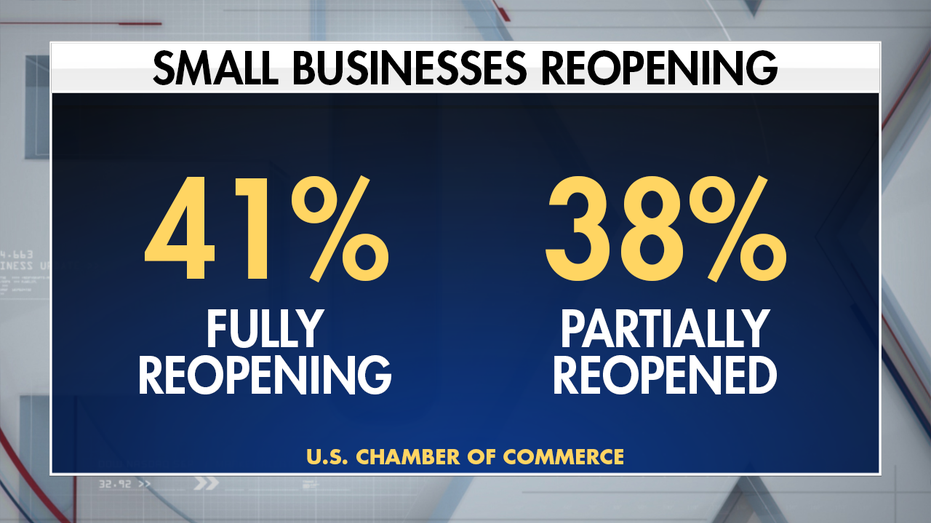
Nearly eight in ten small businesses (79%) are either fully or partially open.
Small businesses that were temporarily closed due to the coronvirus pandemic at some point, 43 percent have reopened. Those still closed are split over if they will open in the next two weeks.
“Businesses across the country are beginning to reopen but see a long road ahead. There is still a need for Congress to pass targeted, temporary, and timely assistance for small businesses,” said Tom Sullivan, vice president of small business policy, U.S. Chamber of Commerce.
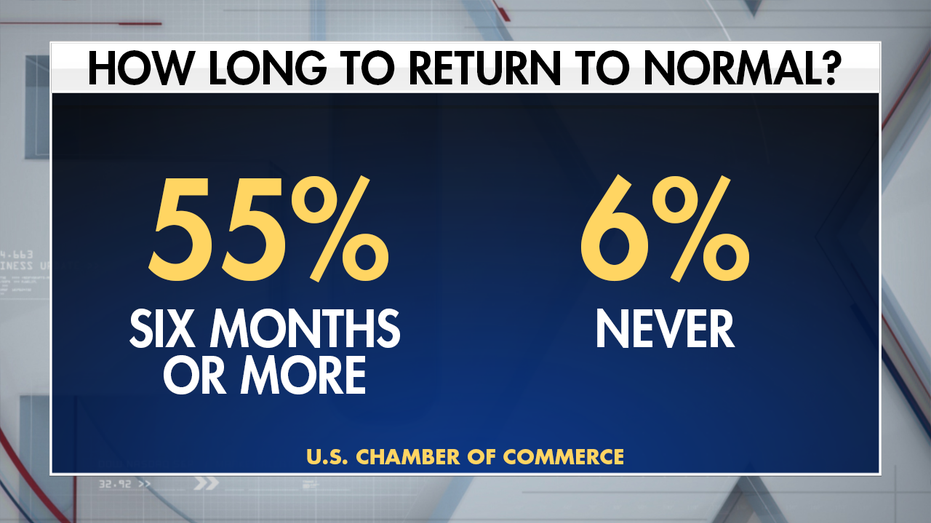
On the question of how long will it take to return to normal, the majority say six months or more. others are more pessimistic.
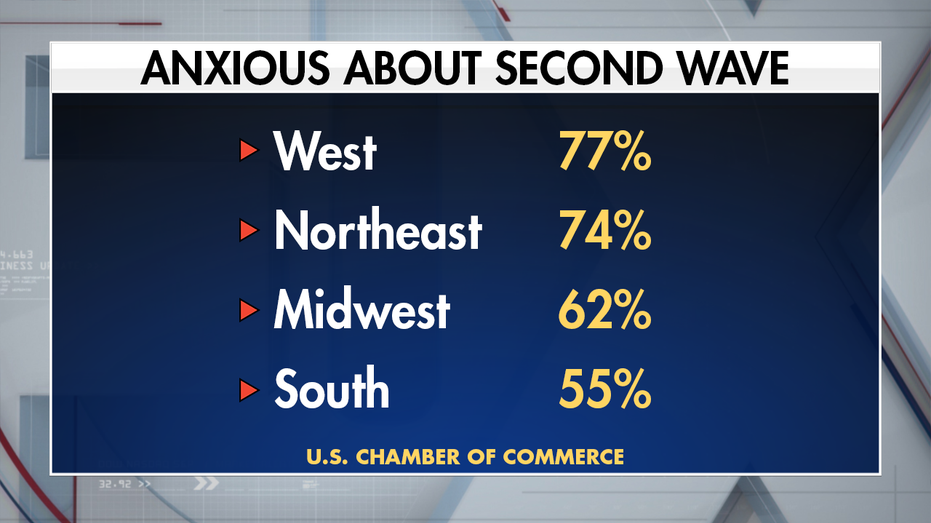
Meanwhile, two-thirds (66 percent) are concerned about having to close again, or stay closed, if there is a second wave of the coronavirus.
The percentages vary in different regions.
On the topic of hiring, most small businesses see rehiring within six months, with 71 percent say they’ll have about the same number of employees they had before the pandemic.
Although 22 percent report having less employees, more than half anticipate rehiring within six months.
Overall, the majority of small businesses say their businesses are in good shape and one in four rate the US. economy as good. Compared to last month, less businesses are saying the economy is poor.
More than eight in ten small businesses report that they are making or planning to make adaptations in response to the coronavirus.
As small businesses adapt to the new environment, three in ten (30 percent) anticipate needing more guidelines on how to keep customers and employees safe and well.

The poll was taken May 21 – 27, 2020, prior to the civil unrest now gripping cities across our country.
https://www.foxbusiness.com/markets/nearly-8-in-10-small-businesses-now-fully-or-partially-open-poll

Pliant Therapeutics prices IPO at $16

Pliant Therapeutics (PLRX) has priced its IPO of 9M common shares at $16.00/share, for expected gross proceeds of $144M.
Underwriters’ over-allotment is an additional 1.35M shares.
Trading kicks off today.
Additionally, Pliant has also agreed to sell an additional 625K common shares in a concurrent private placement at $16.00/share to one of its existing investors, Novartis Institutes for BioMedical Research.
Closing date for both the offerings is June 5.
https://seekingalpha.com/news/3579896-pliant-therapeutics-prices-ipo-16

Replimune lead drug shows benefit in non-melanoma skin cancer

Replimune (NASDAQ:REPL) announces new data from a Phase 1/2 clinical trial evaluating the combination of lead candidate RP1 and Bristol-Myers Squibb’s (NYSE:BMY) Opdivo (nivolumab) in patients with solid tumors.
Preliminary results from the 30-subject non-melanoma skin cancer cohort showed positive action. At data cutoff, the response rate was 86% (n=6/7) including a 57% (n=4/7) complete response rate.
Overall, 36 melanoma patients have been treated. Five have “met the formal criteria for response.” Four of the five failed to respond to prior anti-PD-1 and anti-CTLA-4 therapies.
Its 240-subject Phase 2 study evaluating the combination of RP1 and Regeneron (NASDAQ:REGN) and Sanofi’s (NASDAQ:SNY) Libtayo (cemiplimab-rwlc) in cutaneous squamous cell carcinoma patients, CERPASS, is currently recruiting participants.
RP1 is based on a strain of herpes simplex virus engineered to maximize the anti-cancer effect and activate a systemic anti-tumor immune response.
Management hosted a conference call this morning at 8:00 am ET to discuss the data.
https://seekingalpha.com/news/3579961-replimune-lead-drug-shows-benefit-in-non-melanoma-skin-cancer

BeiGene’s zanubrutinib OK’d in China for blood cancers

Under priority review status, China’s National Medical Products Administration has approved BeiGene’s (NASDAQ:BGNE) Brukinsa (zanubrutinib) for the treatment of adults with chronic lymphocytic leukemia (CLL)/small lymphocytic lymphoma (SLL) who have received at least one prior therapy and adults with mantle cell lymphoma (MCL) who have received at least one prior therapy.
The FDA OK’d the BTK inhibitor in November 2019 for MCL.
https://seekingalpha.com/news/3579967-beigenes-zanubrutinib-okd-in-china-for-blood-cancers

Cassava Sciences rallies on hopes for Alzheimer’s candiate PTI-125

Nano cap Cassava Sciences (NASDAQ:SAVA) jumps 15% premarket on robust volume on the heels of its update on an unsuccessful mid-stage study of PTI-125 in Alzheimer’s disease (AD) patients.
It believes that the trial failed due to the high variability in biomarker levels over 28 days in the control group, in addition to other factors. As such, it plans to reanalyze the cerebrospinal fluid from all subjects.
It also plans to analyze lymphocyte and plasma samples from all participants aimed at generating direct evidence of PTI-125 target engagement.
And lastly, it will assess the effects of PTI-125 on cognition which may provide evidence of at least stabilization of cognitive decline in AD patients.
Results from the relook should be available in H2.
Small molecule PTI-125 targets an altered form of filamin A, a scaffolding protein found throughout the body. A highly toxic form of the protein is present in the brains of AD sufferers which disrupts the normal function of neurons, leading to neurodegeneration and brain inflammation. PTI-125 is designed to restore the normal shape of filamin A in the brain, improving the function of multiple brain receptors and dampening neuroinflammation.
https://seekingalpha.com/news/3579998-cassava-sciences-rallies-on-hopes-for-alzheimers-candiate-ptiminus-125