Search This Blog

Friday, August 14, 2020

Public assessments of the U.S. coronavirus outbreak


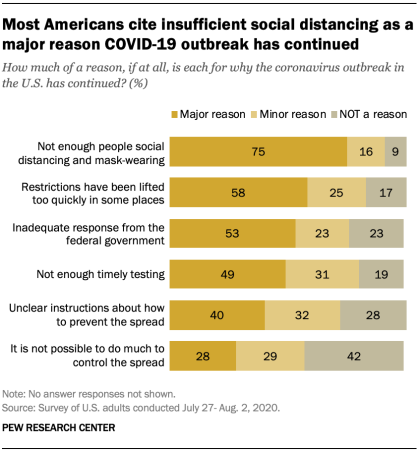
Most Americans cite insufficient social distancing as a major reason COVID-19 outbreak has continued
Three-quarters of Americans say that “not enough people following social distancing and mask-wearing guidelines” is a major reason the coronavirus outbreak has continued in the United States – the most commonly cited major reason among the six asked about in the survey. Roughly six-in-ten (58%) also say a major reason for the continued spread is that “restrictions on businesses and individuals have been lifted too quickly in some places.”
About half of Americans (53%) say an inadequate federal government response is a major reason for the continuation of the outbreak, while nearly as many (49%) point to a lack of timely testing. Four-in-ten say a lack of clarity in instructions for how to prevent the spread is a major reason it has continued. Just 28% of Americans say a major reason is that it is “not possible to do much to control the spread.”
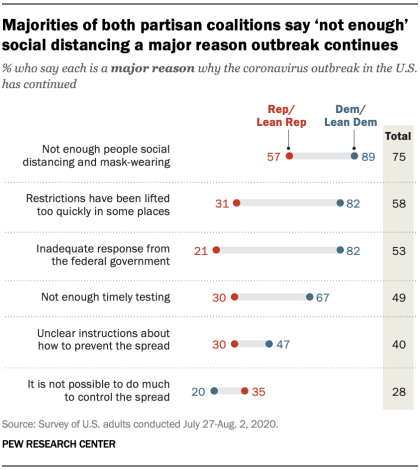
Majorities of both partisan coalitions say ‘not enough’ social distancing a major reason outbreak continues
About nine-in-ten Democrats and Democratic-leaning independents say insufficient adherence to social-distancing and mask-wearing guidelines is a major reason for the continued coronavirus outbreak. This reason also tops the list among Republicans and GOP leaners of the six asked about in the survey, though a narrower majority (57%) considers this a major reason for the continued spread of the virus.
The partisan gap is widest on two other reasons: 82% of Democrats point to some places being too quick to ease restrictions as a major reason for the outbreak continuing, while just 31% of Republicans say this (about the same share of Republicans – 32% – say this is not at all a reason for the continuation of the outbreak). And while 82% of Democrats say an inadequate federal response is why COVID-19 has continued in the U.S., just 21% of Republicans say this (with nearly half – 45% – saying this is not a reason).
Two-thirds of Democrats also say “not enough timely testing” is a major reason for the coronavirus outbreak continuing in the U.S., while fewer than half as many Republicans (30%) say the same.
Republicans are more likely than Democrats to say a major reason for the outbreak continuing is that it isn’t possible to do much to control the spread; still, just 35% of Republicans and 20% of Democrats say this.
In a separate survey conducted earlier this summer, Republicans were more likely than Democrats to say the Chinese government’s initial handling of the outbreak was to blame “a great deal” for the global spread of the coronavirus (73% vs. 38%), though wide majorities in both parties (90% of Republicans, 74% of Democrats) said this.

Partisan divide over primary reason for rise in confirmed COVID-19 cases

By 60% to 39%, most Americans attribute the rise in confirmed coronavirus cases more to rising infections than to a rise in testing, with a wide partisan divide in these views.
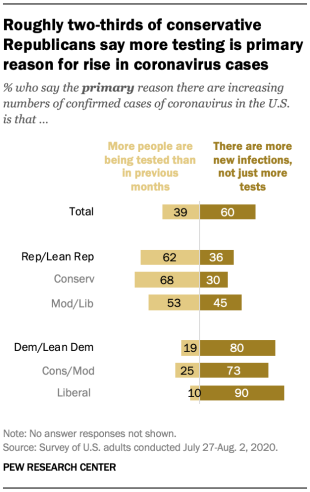
Roughly two-thirds of conservative Republicans say more testing is primary reason for rise in coronavirus cases
A 62% majority of Republicans say that “the increase in confirmed coronavirus cases is primarily a result of more people being tested than in previous months,” with 36% taking the view that “while more people are being tested compared with earlier in the outbreak, the increase in confirmed coronavirus cases is primarily because of more new infections, not just more tests.” About two-thirds of conservative Republicans attribute the growth in confirmed cases mostly to increased testing, while views among moderate and liberal Republicans are more divided (53% say it is mostly because of increased testing, 45% mostly because of increased infections).
By contrast, Democrats overwhelmingly hold the view that increased case counts are mainly the result of increased infections – 80% say this. Although this is the clear majority view across the party, liberal Democrats are more likely than conservative and moderate Democrats to say this (90% vs. 73%).

Public more concerned COVID-19 restrictions on public activity are being eased too quickly rather than too slowly
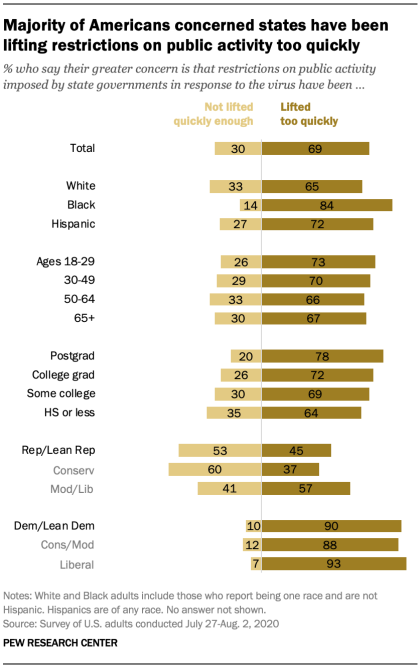

Majority of Americans concerned states have been lifting restrictions on public activity too quickly
With most states having eased restrictions since the early months of the outbreak, nearly seven-in-ten Americans (69%) say they are more concerned that state governments have been lifting restrictions on public activity too quickly; 30% express more concerns that these restrictions have not been lifted quickly enough. This balance of opinion is similar to the public’s concerns in May, when many states were still under stay-at-home orders, about what states would do.
While majorities in most groups say they are concerned that states have been opening up too quickly, there are differences by race and ethnicity, educational status, and partisan affiliation.
About eight-in-ten Black adults (84%) and seven-in-ten Hispanic adults (72%) are more concerned states have been lifting restrictions too quickly. A narrower majority of white adults – still nearly two-thirds (65%) – also express this view.
Overall, adults with higher levels of education are more likely than those with less education to say they are concerned about state governments lifting restrictions too quickly. For example, 78% of adults with a postgraduate degree say they are concerned restrictions are being eased too quickly, compared with 64% adults with a high school diploma or less education.
Republicans are relatively divided on this question, though somewhat more say their greater concern is that restrictions have not been lifted quickly enough (53%) rather than that they have been lifted too quickly (45%). While six-in-ten conservative Republicans say their concern is that state restrictions are not being lifted quickly enough, a similar share of moderate and liberal Republicans (57%) express more concern that restrictions have been lifted too quickly.
Overwhelming shares of both liberal Democrats (93%) and conservative and moderate Democrats (88%) say they are more concerned that state restrictions on public activity have been lifted too quickly.

What is the most effective way to an economic recovery?

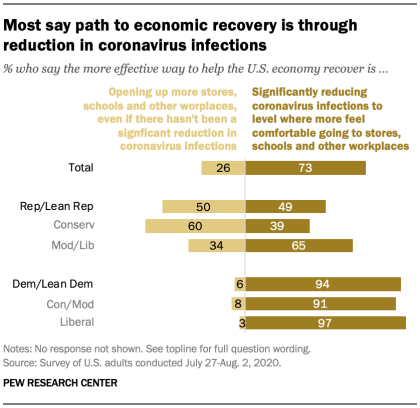
Nearly three-quarters of Americans think that the most effective way to fix the U.S. economy is by reducing coronavirus infections to a level where people feel comfortable returning to stores, schools, restaurants and other workplaces. About a quarter (26%) say the more effective path to economic recovery is by opening up more of these workplaces and businesses even if infections have not yet been reduced.
Democrats overwhelmingly say that the best way for the economy to recover is to reduce the number of coronavirus infections so that the public feels comfortable going to businesses (94% say this).
Most say path to economic recovery is through reduction in coronavirus infections
GOP views are divided: 50% say the more effective path to recovery is by opening up more businesses and workplaces even if infections haven’t been reduced, while about as many (49%) say reducing cases so people feel comfortable going to these places is the more effective path.
About two-thirds of moderate and liberal Republicans (65%) say that reducing coronavirus cases to the point where people are comfortable engaging in in-person work and other economic activity is the more effective path to U.S. economic recovery. By contrast, six-in-ten conservative Republicans say opening up businesses and other workplaces, even if there hasn’t been a reduction in coronavirus infections, is the most effective way to economic recovery.

Public gives the country’s handling of the pandemic negative marks

Americans say U.S. handling of COVID-19 has trailed other wealthy nations
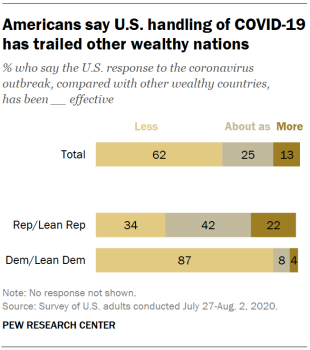
A majority of Americans say the nation’s response to the pandemic compares poorly to how other affluent countries have responded: 62% say the U.S. has been less effective than other wealthy countries in responding to the coronavirus outbreak, a quarter say the U.S. response has been about as effective as these other nations and just 13% of Americans say the U.S. response has been more effective than that of other wealthy countries.
Democrats overwhelmingly say the U.S. has lagged behind other wealthy countries in its response, with 87% saying the nation’s response has been less effective.
Only about a third of Republicans (34%) say the U.S. response has been a less effective than that of other wealthy countries, with a plurality of Republicans saying that the nation’s response has been about as effective as these other countries. About a quarter of Republicans (22%) say the U.S. response has been more effective than that of other wealthy nations.

Partisan divides on COVID-19 attitudes far greater than differences linked to local health impact

As has been the case throughout the coronavirus outbreak, partisan divides in opinions about the pandemic and policies to address it continue to be far wider than the differences in opinion between those who live in the places of the country where the health impacts have been higher and those who live in places that have seen less of an impact.

Partisan differences swamp geographic differences on attitudes about the coronavirus outbreak
For instance, Republicans and Republican leaners living in places that have relatively low death rates and have not seen new deaths rise in recent months are 10 percentage points less likely than Republicans who live in other parts of the country to say that the most effective way forward for the nation’s economy is to reduce infection rates so that people feel comfortable going to stores, restaurants, schools and other workplaces (42% compared with 52%). This geographic difference is far more modest than the differences between Republicans and Democrats in those same areas.
Similarly, when asked about whether the recent increases in reported cases of the coronavirus is mainly the result of growing infections or an increase in testing, Republicans living in these less hard-hit parts of the country are slightly less likely than those living in other areas to say that the increase in cases is due to more infections rather than just more testing (30% compared with 39%). But again, these small geographic differences are overshadowed by partisan differences – at least three-quarters of Democrats, regardless of the COVID-19 impact in their area – attribute the rise in confirmed cases more to rising infections.


EU agrees first COVID-19 vaccine deal with AstraZeneca in WHO blow

The European Union has agreed to buy at least 300 million doses of AstraZeneca’s potential COVID-19 vaccine in its first such advance purchase deal, which could weaken plans led by the World Health Organization (WHO) for a global approach.


The European Commission, which is negotiating on behalf of all 27 EU member states, said the deal included an option to purchase 100 million additional doses from the British drugmaker should its vaccine prove safe and effective.

The EU’s bilateral deal mirrors moves by the United States and other wealthy states, some of which are critical of the WHO’s initiative, and further reduces the potentially available stock in the race to secure effective COVID-19 vaccines.

The move converts into an EU agreement a preliminary deal with AstraZeneca that was reached in June by Europe’s Inclusive Vaccines Alliance (IVA), a group formed by France, Germany, Italy and the Netherlands to secure vaccine doses for all member states.

The Commission declined to disclose the terms of its agreement with AstraZeneca but said its deals are aimed at financing part of the upfront costs to develop vaccines. The funding would be partial downpayments to secure the shots, but actual purchases would be decided at a later stage by each EU state.

“This new agreement will give all EU member states the option to access the vaccine in an equitable manner at no profit during the pandemic,” AstraZeneca said in a statement.

The EU said it has been in advanced talks over the past two weeks with Johnson & Johnson and Sanofi for their vaccines under development.

It is also in talks with Pfizer, Moderna and CureVac for upfront purchases of their potential COVID-19 vaccines, EU officials told Reuters in July.

WHO BLOW?

The EU move could complicate efforts led by the WHO and GAVI, a global alliance for vaccines, to buy shots on behalf of rich and developing countries with a separate scheme.

The Commission has urged EU states to shun the WHO-led initiative because it sees it as too expensive and slow, EU officials told Reuters in July.

Now the Commission is openly saying that vaccines bought from AstraZeneca, and from other vaccine makers, could be donated to poorer states, effectively taking on the very task that the WHO is pursuing with the so-called ACT-Accelerator Hub.

Brussels has publicly said that its purchasing scheme is complementary to the WHO’s, but in private told EU states that there may be legal issues if they joined the WHO programme.

Bruce Aylward, the WHO senior adviser who leads the ACT-Accelerator Hub, downplayed fears that bilateral deals could scuttle the WHO’s multilateral push.

He said late on Thursday that some countries that have reserved vaccines for their populations had also expressed interest in participating in a global rollout.

“You hear a lot of panic about buying, deals, etc. But we have a couple of months to work together as a global community,” he said, adding that pooling risks and buying together was the ideal solution.


Vaccine makers including Moderna must hit U.S. timing goals for full payment

The United States is tying payments for COVID-19 vaccines to timing milestones for production and approval, according to public documents and a Trump administration official, putting pressure on drugmakers including Moderna Inc to meet ambitious targets.


In a deal with Moderna announced this week, federal agencies negotiated a sliding scale of payments. The Cambridge, Massachusetts, biotech’s $1.5-billion deal pays out in full if its vaccine receives regulatory clearance by January 31, 2021, according to filings. It receives $1.2 billion, if it falls short of that timing goal.

Moderna also receives $600 million when it can demonstrate it has built out industrial-scale manufacturing capabilities for its vaccine, even if that happens before the drug is authorized by regulators, the filings show.

U.S. government payments to other drugmakers are also conditional on launching clinical trials no later than early fall and building out manufacturing capabilities by the end of the year, two senior administration officials told Reuters, adding that terms varied by company.

The deal terms add financial risk for the drugmakers and increase pressure for speed that has worried some public health advocates. HHS and Moderna declined comment; other drugmakers had no immediate comment on Friday.

Other drugmakers did not publicly reveal details on the specific terms of their agreements with the U.S. government, though Pfizer has said its deal with the government for its joint vaccine with BioNTech only pays out if it receives regulatory approval.

The United States has allocation agreements with Johnson & Johnson, Pfizer Inc, BioNTech SE, Sanofi SA, and GlaxoSmithKline Plc. It also has a claim on 300 million doses of AstraZeneca Plc’s vaccine in exchange for helping finance its research and development efforts.

Analysts already have said drugmakers may struggle to recoup billions invested in vaccine development at U.S. treatment prices that so far range from $20 to $42 per person.

Administration officials have said they expect the U.S. governments’ Operation Warp Speed vaccine development program to deliver an inoculation by the end of the year. President Donald Trump has said he thinks a vaccine could be available before the November 3 presidential election.

To obtain regulatory approval, a vaccine must reduce incidents of infection with the novel coronavirus by 50 percent compared to people who are not inoculated and demonstrate a high level of safety.

Experts say ongoing vaccine trials, which must enroll tens of thousands of people and wait for them to be exposed to the coronavirus, could produce usable results soon or as late as mid-2021, raising questions about drugmakers’ ability to meet the administration’s timelines.

Shares of Moderna have more than tripled since it announced in January it was developing a vaccine. Moderna has never produced an approved vaccine.

But the implied U.S. government payment per course of treatment for Moderna’s drug, $30.50, could decline to $24.50 if it doesn’t receive approval of its vaccine by January 31, 2021.

The United States, through its Operation Warp Speed vaccine development program, has set aside around $8 billion to lock in deals for COVID-19 vaccines in advance of any of them receiving approval from regulators.


CMS: $15M fines, tripling of ‘Immediate Jeopardy’ cites against nursing homes

The Centers for Medicare & Medicaid Services announced Friday afternoon that it has levied more than $15 million in fines and tripled the most severe type of citations to nursing homes during the six months of the COVID-19 pandemic.

More than 3,400 nursing homes have been cited for noncompliance with infection control requirements or failure to report COVID-19 data, the agency said.

In the last 11 days alone, CMS said it has cited more than 3,300 deficiencies and imposed more than $5.5 million in Civil Monetary Penalties to the less than 1% of nursing homes that had failed to report required COVID-19-related data to the Centers for Disease Control and Prevention, or had lapsed in reporting.

The announcements come a day after CMS Administrator Seema Verma held a special conference call with nursing home stakeholders noting an alarming rise in COVID-19 nationally in facilities. She attributed the worrisome trend to increased prevalence of coronavirus infections in areas surrounding afflicted facilities but also to a troubling degree of infection control lapses by providers.

She emphasized Thursday that the recent rise in cases is “not just a testing issue or a supply issue.” 

“Our deep concern is that even in nursing homes that are doing testing on a regular basis that we’re still seeing significant spread,” she said. She explained that federal strike teams and Quality Improvement Organizations (QIOs) are seeing “significant deficiencies in infection control practices.”

In Friday’s broadly disseminated announcement, Verma said the administration is “taking aggressive enforcement action against Medicare and Medicaid certified nursing homes that fail to implement proper infection control practices. Now more than ever, nursing homes must be vigilant in adhering to federal guidelines related to infection control to prevent the spread of infectious disease, including COVID-19.  We will continue to hold nursing homes accountable and work with state and local leaders to protect the vulnerable population residing in America’s nursing homes.”

A day earlier, on the call with provider stakeholders, Verma expressed total backing for them.

“We are here to help you and support you. This isn’t a time of fines and being punitive,” she emphasized. “It is a time … to be problem solvers. I want you to know that whatever you need, we are here to help you on any level, whether it’s staffing, supplies, testing, technical assistance, we’re here to get you whatever you need.”

Since March 4, CMS and state survey agencies have completed upgraded infection control surveys in more than 15,200 (99.2%) of nursing homes, the federal agency said. They have netted 180 Immediate Jeopardy findings for infection control — triple the rate found in 2019, according to CMS.

Immediate Jeopardy represents a situation in which a nursing home’s noncompliance with CMS requirements of participation has caused or is likely to cause serious injury, serious harm, serious impairment, or death to a resident.  

Friday’s announcement also noted that as of August 3, more than 99% of facilities had reported COVID-19 reporting data to the CDC. The rest, however, had not reported data or had lapsed their regular reporting, leading to the $5.5 million in fines.

Friday’s unusual announcement about fines and penalties during the pandemic came a day after the largest nursing home association in the country released survey results showing 70% of providers said they couldn’t sustain operations much longer under current operating conditions.

That group’s leader, President and CEO Mark Parkinson of the American Health Care Association / National Center for Assisted Living, expressed puzzlement over the timing and content of CMS’s latest bravado concerning nursing home enforcement.

“We appreciate the importance of maintaining strong infection control practices and welcome feedback from public health officials on how we can further improve,” Parkinson said in a statement to McKnight’s. “However, the evidence clearly shows that even the best nursing homes with the most rigorous standards cannot stop this highly contagious and invisible virus. Our focus should be on getting a handle on the amount of spread in the surrounding community and prioritizing nursing homes for ongoing resources.”

He added that when fewer people in the community have COVID-19, they are less likely to end up in a nursing home. In addition, when providers have proper levels of personal protective equipment, reliable testing with rapid results and staff support, “they can better curb the spread.”

“We must foster a more collaborative approach to addressing this once-in-a-century, global crisis,” he emphasized. “Nursing homes cannot beat this pandemic alone, and focusing on enforcement and penalties only takes precious resources away at this critical time. Providers need the support of public health officials to prioritize our residents and help facilities acquire the necessary resources.”

Katie Smith Sloan, president and CEO of LeadingAge, an association of nonprofit providers of aging services, sounded similar cautions.

“When we know that community spread is a leading source of infection in long-term care, and members are paying tens of thousands of dollars — millions, in some cases — for PPE, tests, and other pandemic-related expenses,” she said. “Fines are not the answer. We need help and collaboration from CMS. A punitive approach is unsustainable.”

 CMS noted Friday that it had issued “more than 18” sets of guidance in the last six months to provide states and nursing homes with ongoing information on proper infection control practices and protocols. In all of 2019, CMS issued only nine guidance documents of any type related to nursing homes, the agency said.

Part of the CMS’s enhanced enforcement bite kicked in after a June 1 when the agency put in place fines of up to $5,000 for persistent lower-level infection control deficiencies and up to $20,000 if infection control deficiencies were cited twice or more over the last two years.


NJ medical office sues Cigna over denied COVID-19 testing, treatment claims

A New Jersey medical office has filed suit against Cigna, alleging that the insurer failed to pay for diagnostic testing and treatment related to COVID-19 in violation of the CARES Act.

Open MRI and Imaging of RP Vestibular Diagnostics claims that Cigna owes it nearly $400,000 in unpaid claims for care related to the novel coronavirus, and that the decisions to decline coverage were “arbitrary.”

The group says the denied claims are from February to July.


“The explanations given by [Cigna] for its refusal to make payment include unelaborated denials that the services were rendered as billed, or matched the services billed, as well as the occasional contention that the billing was duplicative,” according to the lawsuit. “The grounds for rejecting plaintiff’s claims were, upon information and belief, false and invalid.”

We’ve reached out to Cigna and will update this story when we hear back.


Under the Coronavirus Aid, Relief, and Economic Security Act, or CARES Act, insurers are required to cover a number of diagnostics and treatments for COVID-19 with no cost-sharing, prior authorization or other medical management tactics.

The lawsuit does not make clear if the New Jersey office is in Cigna’s network, but the CARES Act includes provisions that aim to avoid surprise billing for COVID-19 care.

The suit also comes as legislators are taking a closer look at insurers’ financial performance amid the pandemic. Plummeting patient volumes significantly boosted payers’ bottom lines in the first half of the year.

Rep. Frank Pallone, D-N.J., chair of the House Energy and Commerce Committee, which launched the probe, said the sky-high profits suggest insurers may not be doing their part to address the pandemic.


CNS disorder biotech Harmony Biosciences sets terms for $100 million IPO

Harmony Biosciences Holdings, a commercial stage biotech developing therapies for narcolepsy and other CNS disorders, announced terms for its IPO on Tuesday.

The Plymouth Meeting, PA-based company plans to raise $100 million by offering 4.7 million shares at a price range of $20 to $23. At the midpoint of the proposed range, Harmony Biosciences Holdings would command a fully diluted market value of $1.4 billion.

The company’s sole marketed product, WAKIX (pitolisant), was approved for the treatment of excessive daytime sleepiness in adult patients with narcolepsy in August 2019. The company expects to initiate a Phase 3 trial for EDS and cataplexy in pediatric patients in the 2H21. It also plans to begin Phase 2 trials for EDS and other key symptoms in patients with Prader-Willi Syndrome in the 2H20 and in adult patients with myotonic dystrophy in the 1H21.

Harmony Biosciences Holdings was founded in 2017 and booked $64 million in net product revenue for the 12 months ended June 30, 2020. It plans to list on the Nasdaq under the symbol HRMY. Goldman Sachs, Jefferies and Piper Sandler are the joint bookrunners on the deal. It is expected to price during the week of August 17, 2020.

Relevant Profile: HRMY


Ambroxol and Ciprofloxacin Show Activity Against SARS-CoV2

Steven B Bradfute, Chunyan Ye, Elizabeth C Clarke, Suresh Kumar, Graham S Timmins, View ORCID ProfileVojo Deretic


Abstract


We studied the activity of a range of weakly basic and moderately lipophilic drugs against SARS CoV2 in Vero E6 cells, using Vero E6 survival, qPCR of viral genome and plaque forming assays. No clear relationship between their weakly basic and hydrophobic nature upon their activity was observed. However, the approved drugs ambroxol and ciprofloxacin showed potent activity at concentrations that are clinically relevant and within their known safety profiles, and so may provide potentially useful agents for preclinical and clinical studies in COVID-19.

Competing Interest Statement


Deretic and Timmins are co-inventors of US patent 10,583,099 Isotope enhanced ambroxol for long lasting autophagy induction. Timmins owns stock in a company that options this patent. Bradfute, Deretic and Timmins are inventors on US provisional patent application 63/003,432 on treatment of COVID-19 by ambroxol and bromhexine.