Search This Blog

Saturday, November 21, 2020

Israeli scientists claim to reverse aging process

 Israeli scientists say they have managed to successfully reverse the biological aging process – using only oxygen.

Recent research, led by Tel Aviv University’s Prof. Shai Efrati, together with a team from Shamir Medical Center, found that when healthy adults over the age of 64 were placed in a pressurized chamber and given pure oxygen for 90 minutes a day, five days a week for three months, not only was the aging process delayed - it was actually reversed.

Specifically, the study, which was published in the peer-reviewed journal Aging, focused on whether the process could reverse two key indicators of biological aging: the shortening of DNA telomeres and the accumulation of resultant senescent cells.
A telomere is the end of a chromosome. Telomeres are made of repetitive sequences of non-coding DNA that serve as bumpers to protect the chromosome from damage during replication. Every time replication happens, these bumpers take a hit, making them shorter and shorter. Once the telomere reaches a certain length, the cell cannot replicate anymore, which leads to senescent cells: aging, malfunctioning cells that ultimately lead to cognitive or other age-related disabilities and even diseases, such as cancer.
Some 35 adults over the age of 64 were involved in the study and were administered hyperbaric oxygen therapy (HBOT) utilizing 100% oxygen in an environmental pressure higher than one absolute atmospheres to enhance the amount of oxygen dissolved in the body's tissues. 
Every 20 minutes, the participants were asked to remove their masks for five minutes, bringing their oxygen back to normal levels. However, during this period, researchers saw that fluctuations in the free oxygen concentration were interpreted at the cellular level as a lack of oxygen – rather than interpreting the absolute level of oxygen.
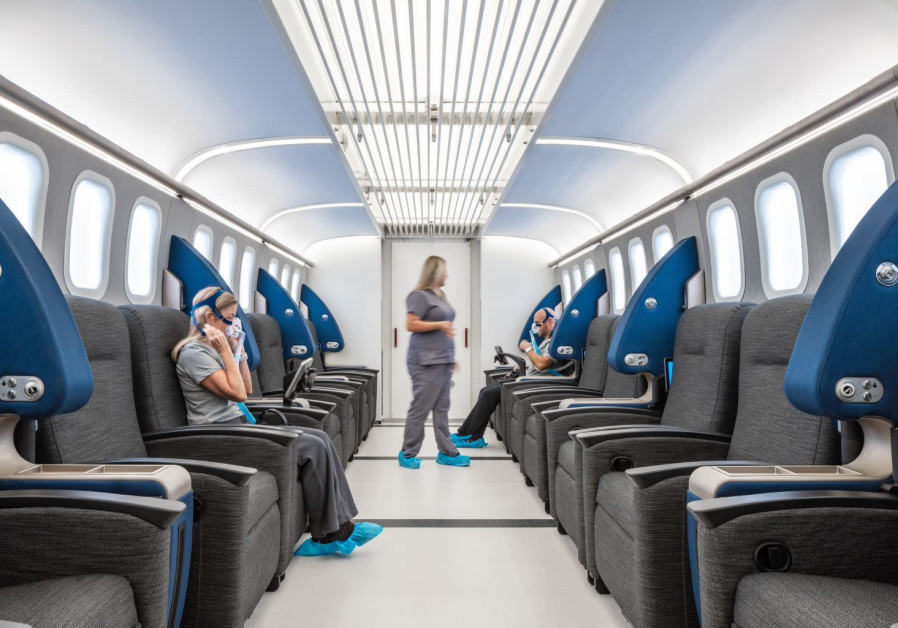
In other words, repeated intermittent hyperoxic (increased oxygen level) exposures induced many of the mediators and cellular mechanisms that are usually induced during hypoxia (decreased oxygen levels) – something Efrati explained is called the hyperoxic-hypoxic paradox.

“The oxygen fluctuation we generated is what is important,” he told The Jerusalem Post. “During this process, a state of oxygen shortage resulted, which caused cell regeneration.”  
The inside of a hyperbaric oxygen therapy chamber at Aviv Clinic in Florida (Credit: Aviv Clinic)The inside of a hyperbaric oxygen therapy chamber at Aviv Clinic in Florida (Credit: Aviv Clinic)
The practical ramifications include improvements in attention, information processing speed and executive functions, which normally decline with aging and about which more than 50% of people over the age of 60 express concern. According to the study, the changes were equivalent to how the participants’ bodies were at the cellular level 25 years earlier.
“We are not [just] slowing the decline - we are going backwards in time,” Efrati said. 
Efrati has been studying the aging process for a decade and runs the Aviv Clinics in Florida. This study, he said, is proof that the cellular basis for the aging process can be reversed, adding that it “gives hope and opens the door for a lot of young scientists to target aging as a reversible disease.” It could also enable doctors and scientists to find a way to monitor telomere length and develop medications that could help them grow back when needed.
Will it make people live longer? 
The effect’s duration is yet to be determined in the long-term, Efrati said. But “probably yes. We know that people with shorter telomeres die earlier, so it makes sense.”
One disadvantage of the study was its limited sample size.
Efrati added the experiment was conducted using a scientific, monitored HBOT chamber and people should not try this at home. He said, “There is a lot of junk out there” claiming sacs inflated with air are hyperbaric treatments. “This is not what is being used in the studies, it is not effective – and moreover, it could be dangerous.”

Thiel-backed Antibody therapy developer AbCellera seeks up to $200M in IPO

Peter Thiel-backed biotech developer AbCellera Biologics Inc, which has partnered with Eli Lilly for its COVID-19 antibody drug, on Friday filed for an initial public offering on the Nasdaq.

The listing plan from the Canadian firm comes at a time of strong demand for new biotechnology stocks, with almost half of the U.S. IPOs in 2020 coming from the healthcare sector, according to data from IPOScoop.

https://www.reuters.com/article/abcellera-ipo/update-1-thiel-backed-antibody-therapy-developer-abcellera-files-for-u-s-ipo-idUSL4N2I63RQ

Is the Vaccine Our One Giant Leap?

 On May 25, 1961, President John F. Kennedy stood before Congress with an audacious goal, proclaiming, “this nation should commit itself to achieving the goal, before the decade is out, of landing a man on the moon and returning him safely to the earth.”

NASA analysts put those chances at 1 in 10 of ever happening.

When Kennedy made his declaration that the United States would go to the moon we didn’t have the technology, tools or equipment to make it happen. In fact, we didn’t even know how to fly to the moon or what course would be required to get there.

In his excellent book about this mission, One Giant LeapCharles Fishman explains what we were up against:

On that day, May 25, 1961, when Kennedy asked Congress to send Americans to the Moon before the 1960s were over, NASA had no rockets to launch astronauts to the Moon, no computer portable enough to guide a spaceship to the Moon, no spacesuits to wear on the way, no spaceship to land astronauts on the surface (let alone a Moon car to let them drive around and explore), no network of tracking stations to talk to the astronauts en route. On the day of Kennedy’s speech, no human being had ever opened a hatch in space and gone outside; no two manned spaceships had ever been in space together or ever tried to rendezvous with each other. No one had any real idea what the surface of the Moon was like and what kind of landing craft it would support, because no craft of any kind had landed safely on the Moon and reported back. As Kennedy gave that speech, there was an argument—at MIT no less—about whether engineers could do the math required, could do the navigation required, and do it fast enough, to fly to the Moon and back.

Putting a human being on the moon may be our crowning achievement as a species to date.

The computer onboard Apollo 11 could execute 85,000 instructions per second. The newest iPhones can process 5 trillion instructions per second. Your dishwasher has more computing brainpower than the one that helped fly Armstrong, Aldrin and Collins to the moon.

Getting from a place in 1961 with no knowledge or tools about space travel to landing a man on the moon by 1969 required a herculean effort.

From 1964-1966, NASA had more staff and contractors than every company in the Fortune 500 save for General Motors. By 1966, there were 20,000 companies across the country in the supply chain for parts and assembly for the Apollo mission.

One of the most surprising after-effects of the sheer amount of brainpower and building required to make the moon landing a reality is how much innovation it sparked in the years ahead.

Fishman explains:

Historians of Silicon Valley and its origins skip briskly past Apollo and NASA, which seem to have operated in a parallel world without much connection to or impact on the wizards of Intel and Microsoft.

The space program in the 1960s did two things that helped lay the foundation of the digital revolution. First, NASA used integrated circuits—the first computer chips—in the computers that flew the Apollo command module and the Apollo lunar module. Except for the U.S. Air Force, NASA was the first significant customer for integrated circuits, and for years in the 1960s NASA was the largest customer for them, buying most of the chips made in the country. Microchips power the world now, of course, but in 1962 they were only three years old, and they were a brilliant if shaky bet. Even IBM decided against using them in the company’s computers in the early 1960s. NASA’s demand for integrated circuits, and its insistence on their near-flawless manufacture, helped create the world market for the chips and helped cut the price by 90 percent in five years.

What NASA did for semiconductor companies was teach them to make chips of near-perfect quality, to make them fast, in huge volumes, and to make them cheaper, faster, and better with each year. That’s the world we’ve all been benefiting from for the 50 years since.

NASA was the first organization of any kind—company or government agency—anywhere in the world to give computer chips responsibility for human life. If the chips could be depended on to fly astronauts safely to the Moon, they were probably good enough for computers that would run chemical plants or analyze advertising data.

NASA also brought the rest of the world into the era of “real-time computing,” a phrase that seems redundant to anyone who’s been using a computer since the late 1970s.

NASA revolutionized weather forecasting. NASA revolutionized global communications. NASA revolutionized rechargeable nickel-cadmium batteries.

Only 12 people have ever walked the moon so Kennedy’s audacious goal didn’t necessarily usher in a new space age but it may have inadvertently ushered in a new digital age.

Is it possible the Covid-19 vaccine could have similar offshoots?

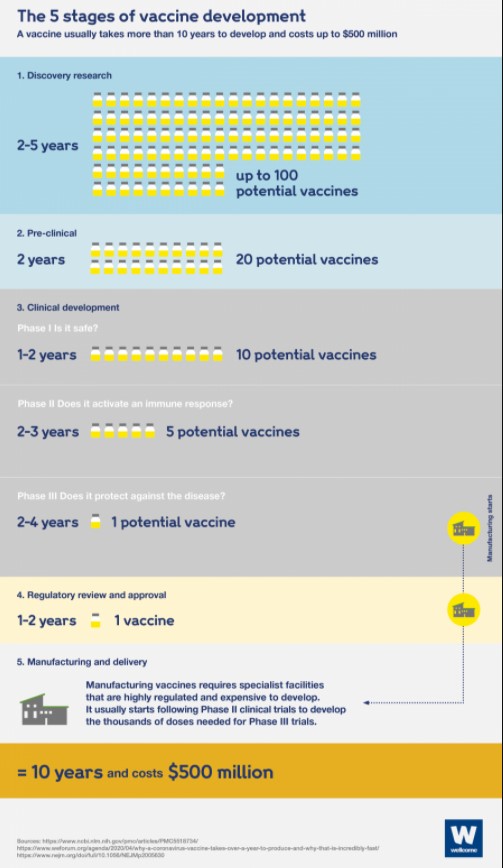
Look at the typical length of time it takes for vaccine development:

We just did 10 years’ worth of work in 9 months.1

Both Pfizer and Moderna have likely found effective vaccines that could help put an end to the pandemic.

There are still some hurdles to overcome including authorization by the FDA and production/distribution and I suppose there’s always an outside chance of an I Am Legend scenario where the vaccine turns us all into blood-thirsty zombies. But it appears science is going to provide one of the biggest bailouts in history.

Ending the pandemic is reason enough for celebration when it gets here but you have to imagine there will be even more breakthroughs based on what’s been learned through this experience.

Will it be easier to fight potential pandemics in the future?

How many new and effective treatments will be spawned?

What have scientists around the globe learned from their hyper-speed collaboration?

Will we discover new ways of fighting diseases in the future?

The next few months will likely present many real challenges as the virus continues to spread. But there is light at the end of the tunnel and I’m hopeful 2020 will come to be looked at as a pivotal year in terms of advancing the science of disease prevention and vaccine research.

I can’t wait to read the Michael Lewis book about the scientific and healthcare breakthroughs we’ve made in 2020.

https://awealthofcommonsense.com/2020/11/is-the-vaccine-our-one-giant-leap/

Facebook Denies 'Science' - Blocks Danish Study Questioning Efficacy Of Masks

 On Wednesday, scientists in Demark published a "revolutionary" study that demonstrates mask-wearing does very little to mitigate the spread of COVID-19. By Friday, an Oxford University professor, citing the study in an article published on The Spectator, reported that he was flagged by Facebook for "false information" as he attempted to repost the article on the social media platform. 

Before we begin, we want to remind readers that hours after the study's publication in Annals of Internal Medicine, titled "Effectiveness of Adding a Mask Recommendation to Other Public Health Measures to Prevent SARS-CoV-2 Infection in Danish Mask Wearer," we asked a straightforward question of how social media companies would respond to these new developments. 

Well, that answer quickly appeared as director of the Center for Evidence-Based Medicine at Oxford University Carl Heneghan tweeted Friday that his article titled "Landmark Danish study finds no significant effect for facemask wearers," citing the new study, was flagged as false information by Facebook. 

Here's Heneghan's tweet explaining what happened:

"Here's what happened when I posted our latest @spectator article to Facebook - I'm aware this is happening to others - what has happened to academic freedom and freedom of speech? There is nothing in this article that is 'false.'" 

In the article, published in The Spectator, he spoke about the new study: 

"Yesterday marked the publication of a long-delayed trial in Denmark which hopes to answer that very question. The 'Damask-19 trial' was conducted in the spring with over 6,000 participants, when the public were not being told to wear masks, but other public health measures were in place. Unlike other studies looking at masks, the Danmask study was a randomised controlled trial – making it the highest quality scientific evidence."

He continued:

"Around half of those in the trial received 50 disposable surgical face masks, which they were told to change after eight hours of use. After one month, the trial participants were tested using both PCR, antibody, and lateral flow tests and compared with the trial participants who did not wear a mask.

"In the end, there was no statistically significant difference between those who wore masks and those who did not when it came to being infected by Covid-19. 1.8 per cent of those wearing masks caught Covid, compared to 2.1 per cent of the control group. As a result, it seems that any effect masks have on preventing the spread of the disease in the community is small."

RT News points out Heneghan was also "under attack" by academic scholars, such as Thomas Conti of Brazil, who said the study was poorly designed - arguing that masks work.

Besides the publication of the study and Heneghan, arguing about the ineffectiveness of masks, Iowa Gov. Kim Reynolds (a Republican) said there's "science on both sides" of the mask debate. However, Reynolds still went ahead with imposing a new mask mandate in her state, along with other measures, as COVID-19 cases surge across the country, with the Midwest as the hardest-hit region.

"There's science on both sides, and you know that," Reynolds said, without providing details. "If you look, you can find whatever you want to support wherever you're at."

Most media outlets that reported on those remarks noted that the governor's statement contradicted the official CDC guidelines. But it's worth remembering that at one point or another, the FDA, the CDC, the Surgeon General, etc. have all suggested that masks do little to stop the spread of COVID-19. The CDC admitted that 80% of newly infected wore their masks following all restrictions.

The CDC recently released a new study purporting to show that masks protected both the wearer and the general public. Still, as the Danish researchers noted in their summary, the scientific links there actually aren't at all well-established. The researchers even cautioned that their findings are hardly conclusive, and shouldn't be relied upon by policymakers.

What's clear is that Facebook moderators are not allowing for both sides of the mask debate to be heard. 

https://www.zerohedge.com/medical/facebook-suppresses-danish-study-questioning-efficacy-masks 

Trump: Pfizer played ‘corrupt games’ with COVID-19 vax timing

 President Trump on Friday accused drugmaker Pfizer of playing “corrupt games” with the timing of COVID-19 vaccine data in order to sink both his re-election and his drug price reforms, as he urged his successor to keep the game-changing policies.

Trump has not conceded to President-elect Joe Biden, but implicitly recognized the state of the race as he formalized three policies to cut drug prices.

Although Trump told reporters in the White House briefing room that “I won” the election, he also said he hopes the pricing reforms outlast his presidency.

“I just hope they keep it. I hope they have the courage to keep it because the powerful drug lobby, Big Pharma, is putting pressure on people like you wouldn’t believe,” Trump said.

It was the president’s first briefing room appearance since major news networks declared Biden the president-elect. He spoke as Pfizer submitted a federal emergency use application Friday for its COVID-19 vaccine.

Pfizer publicly disclosed six days after the Nov. 3 election that its vaccine is more than 90 percent effective. The company denied delaying the results for political reasons.

Trump, who took no questions, announced two long-anticipated regulations on drug prices, which he said would take effect Jan. 1. One reform allows federal agencies to peg Medicare price rates to the lowest rate paid by other developed countries. Another seeks to slash payments to pharmaceutical middlemen.

A third reform announced by Trump will end a controversial program called the Unapproved Drugs Initiative, which allowed companies to knock generic drug rivals off the market.

Trump unveiled his dramatic plans to slash drug prices before the election and cast them as an important part of his legacy, noting he also moved to allow governors to import lower-cost drugs from Canada and brokered reduced insulin costs for diabetics.

Trump also tore into the drug companies for what he said was pro-Biden election meddling.

“Together, these reforms will save American patients many many billions of dollars every single year,” he said. “For generations, the American people have been abused by big Pharma and their army of lawyers, lobbyists and bought-and-paid-for politicians.”

“Big Pharma ran millions of dollars of negative advertisements against me during the campaign, which I won, by the way, but, you know, you’ll find that out — almost 74 million votes,” he said.

Trump continued: “Pfizer and others even decided to not assess the results of their vaccine, in other words not come out with a vaccine, until just after the election. That’s because of what I did with ‘favored nations’ and these other elements — instead of their original plan to assess the data in October.

“So they waited and waited and waited, and decided they thought would come out with it a few days after the election. And it would have probably had an impact. Who knows, maybe it wouldn’t have. I’m sure they would have found the ballots someplace, the Democrats and the group. These corrupt games will not deter us from doing what’s right for the American people.”

Trump’s campaign insists he can win a second term with recounts and litigation in states where Biden is narrowly ahead, including Arizona, Pennsylvania and Wisconsin. But he’s faced a series of setbacks, including Georgia officials saying Friday they will certify Biden’s thin win after a hand recount.

https://nypost.com/2020/11/20/trump-says-pfizer-played-corrupt-games-with-covid-19-vaccine-announcement/

Over 670K New Yorkers fly out for Thanksgiving despite CDC warning

 Punta Cana is hot but Chicago is not this Thanksgiving, according to data showing 670,000 travelers still plan to fly out of New York City airports this year despite record levels of COVID-19 cases spreading across the country.

About 275,300 passengers are expected to fly out of JFK, while another 271,700 booked flights out of Newark, and 127,100 travelers are estimated to be flying from LaGuardia, according to airline ticket-sale stats provided to The Post by aviation analytics firm OAG. It looked at bookings at the three major airports, along with Stewart in Orange County, as of Thursday for travel between Nov. 23 and 29.

Overall, the number of NYC fliers is down 55 percent from the 1.5 million who took to the skies last year during Thanksgiving week.

Bookings to last year’s most popular Thanksgiving destination, Los Angeles, are down 52 percent, while London is expecting 77 percent fewer travelers from New York. Boston (-74 percent); Chicago (-66 percent); Charlotte, NC (-60 percent), and San Francisco (-59 percent) are also off the map.

More New Yorkers — 42,100 — will fly to Orlando than any other place. About 38,400 are headed to Ft. Lauderdale; 33,200 to Atlanta; 27,700 to Los Angeles, and 25,000 to Miami.

Punta Cana in the Dominican Republic can expect an additional 800 NYC tourists compared to last year, while 2,200 more fliers are planning trips to Cancun, Mexico. Bookings to Key West, Cabo, Myrtle Beach and Nantucket are also up, the data show.

Millions of other Americans, meanwhile, have canceled Turkey Day plans amid a surge in coronavirus cases in some parts of the country. A whopping 74 percent of people say they will stay home for the holiday, according to a new Monmouth University poll. Just 25 percent plan to travel, and only 10 percent said they will stay somewhere overnight.

On Thursday, as the US death toll from the virus climbed to 250,000, the CDC issued a strong warning against traveling.

https://nypost.com/2020/11/21/over-670k-new-yorkers-flying-for-thanksgiving-despite-covid/

China’s ‘bat woman’ says COVID-19 did not originate in Wuhan lab

 China’s “bat woman” says that a new batch of tests prove that the coronavirus did not originate at her Wuhan virology lab.

Shi Zhengli, the deputy director of the Wuhan Institute of Virology who is well known for her work on the virus, said that updated tests of blood samples taken eight years ago from a group of miners who became ill after working in bat caves in southwest China show that none of them were infected with COVID-19, according to The South China Morning Post.

Shi’s findings were published this week as an update to a paper she released in February in the scientific journal Nature, the newspaper said.

Shi, known as China’s “bat woman,” has said the genetic characteristics of the viruses she’s worked on didn’t match those of the coronavirus spreading in humans. So far, the virus has infected nearly 58 million people around the world and killed over 1.37 million, according to Johns Hopkins University.

https://nypost.com/2020/11/21/chinas-bat-woman-says-covid-didnt-originate-in-wuhan-lab/