Jeffrey E. Gold, William H. Baumgartl, Ramazan A. Okyay, Warren E. Licht, Paul L. Fidel Jr., Mairi C. Noverr, Larry P. Tilley, David J. Hurley, Balázs Rada, John W. Ashford
The measles-mumps-rubella (MMR) vaccine has been theorized to provide protection against coronavirus disease 2019 (COVID-19). Our aim was to determine whether any MMR IgG titers are inversely correlated with severity in recovered COVID-19 patients previously vaccinated with MMR II. We divided 80 subjects into two groups, comparing MMR titers to recent COVID-19 severity levels. The MMR II group consisted of 50 subjects who would primarily have MMR antibodies from the MMR II vaccine, and a comparison group of 30 subjects consisted of those who would primarily have MMR antibodies from sources other than MMR II, including prior measles, mumps, and/or rubella illnesses. There was a significant inverse correlation (rs = −0.71, P < 0.001) between mumps virus titers (mumps titers) and COVID-19 severity within the MMR II group. There were no significant correlations between mumps titers and severity in the comparison group, between mumps titers and age in the MMR II group, or between severity and measles or rubella titers in either group. Within the MMR II group, mumps titers of 134 to 300 arbitrary units (AU)/ml (n = 8) were found only in those who were functionally immune or asymptomatic; all with mild symptoms had mumps titers below 134 AU/ml (n = 17); all with moderate symptoms had mumps titers below 75 AU/ml (n = 11); all who had been hospitalized and had required oxygen had mumps titers below 32 AU/ml (n = 5). Our results demonstrate that there is a significant inverse correlation between mumps titers from MMR II and COVID-19 severity.
IMPORTANCE COVID-19 has presented various paradoxes that, if understood better, may provide clues to controlling the pandemic, even before a COVID-19 vaccine is widely available. First, young children are largely spared from severe disease. Second, numerous countries have COVID-19 death rates that are as low as 1% of the death rates of other countries. Third, many people, despite prolonged close contact with someone who is COVID-19 positive, never test positive themselves. Fourth, nearly half of people who test positive for COVID-19 are asymptomatic. Some researchers have theorized that the measles-mumps-rubella (MMR) vaccine may be responsible for these disparities. The significance of our study is that it showed that mumps titers related to the MMR II vaccine are significantly and inversely correlated with the severity of COVID-19-related symptoms, supporting the theorized association between the MMR vaccine and COVID-19 severity.
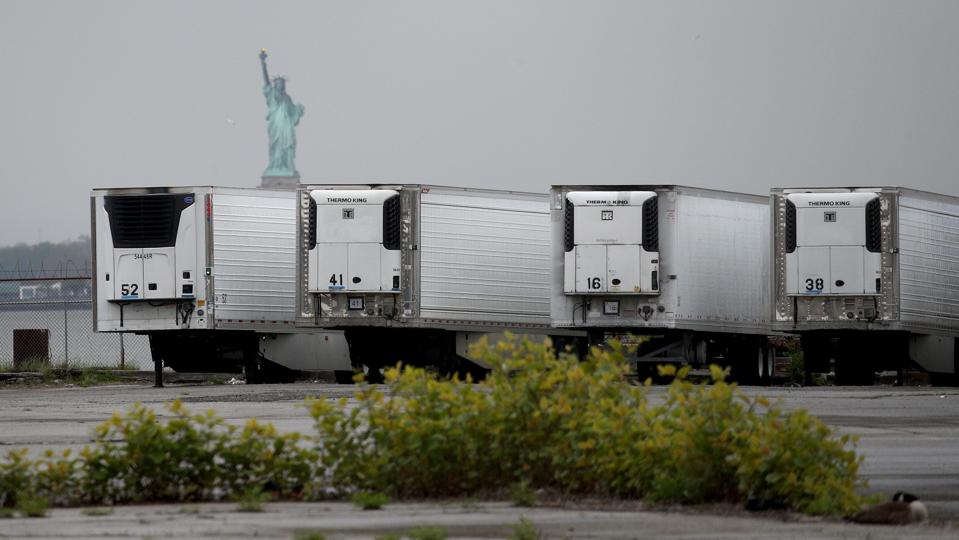
More than half a year after New York City’s deadly coronavirus surge, hundreds of bodies are still being stored in freezer trucks on the Brooklyn waterfront,The Wall Street Journal firstreportedSunday, a show of just how unprepared the country’s systems were for handling this deadly pandemic.
Refrigerated trucks functioning as temporary morgues are seen at the South Brooklyn Marine Terminal ... [+]
GETTY IMAGES
KEY FACTS
Per the report, about 650 bodies are still being stored in freezer trucks at a disaster morgue that was set up on a pier in Sunset Park in April.
According to New York City’s Chief Medical Examiner, many of the bodies are people who either couldn’t afford a proper burial or whose families couldn’t be located.
The Chief Medical Examiner’s office, which has 15 forensic-investigations staffers tasked with identifying bodies, was unprepared for the demands of the unprecedented and unexpected coronavirus pandemic, The Wall Street Journal found.
Equipped to handle 20 deaths a day, the number of deaths added to its caseload rose to around 200 per day during the height of New York City’s Covid-19 outbreak.
Due to the delays that resulted, some families found out “weeks or months after the fact that a loved one had died and was awaiting collection,” according to the WSJ.
Covid-19 also complicated tracking down family members, who the Medical Examiner’s office said on several occasions couldn’t be found because they themselves had also died from the virus.
KEY BACKGROUND
Before the pandemic, many of the unclaimed bodies would’ve been buried on Hart Island, located in the northeastern Bronx in New York City. However, Mayor Bill de Blasio barred mass burials after it was reported the city was considering using temporary graves on the island.
BIG NUMBER
24,202. That’s how many have died from Covid-19 in New York City. The majority of those deaths happened during late March, April and early May.
More than 200,000 dead since March. Cities in lockdown. Vaccine trials underway.
And a holiday message, of sorts: "See that Thanksgiving celebrations are restricted as much as possible so as to prevent another flare-up."
But it isn't the message of Thanksgiving 2020. It's the Thanksgiving Day notice that ran in the Omaha World Herald on Nov. 28, 1918, when Americans found themselves in a similar predicament to the millions now grappling with how to celebrate the holiday season amid the coronavirus pandemic.
"Every time I hear someone say these are unprecedented times, I say no, no they're not," said Brittany Hutchinson, assistant curator at the Chicago History Museum. "They did this in 1918."
On Thanksgiving more than a century ago, many Americans, like today, were living under various phases of quarantines and face mask orders. Millions were mourning loved ones. And health officials in many cities were issuing the same holiday warning: Stay home and stay safe.
The first cases were detected in the U.S. in March of that year, growing exponentially by the fall. In October, the virus burned through the nation. Dozens of cities across the U.S. implemented mandatory face mask orders and curfews and locked down for two to three weeks, temporarily closing schools, libraries, theaters, movie houses, dance halls, churches, ice cream parlors and soda shops. The virus killed an estimated 195,000 Americans during October alone.
Red Cross Women sit at long tables making influenza masks in Chicago, Illinois in 1918.IMAGE PROVIDED BY THE CHICAGO HISTORY MUSEUM. GRAPHIC BY KARL GELLES, USA TODAY.
As Thanksgiving rolled around, some cities were celebrating the relaxation of flu-related restrictions– partly due to successful opposition campaigns by retailers, theater owners, unions, mass transportation companies and other economically stressed stakeholders. Washington, D.C., Indianapolis, and Oakland had just lifted restrictions days before, and San Francisco was on the brink of lifting its mask mandate.
San Francisco, in particular, had one of the nation's largest anti-masking campaigns, spearheaded by the Anti-Mask League of San Francisco, according to Howard Markel, a professor of the history of medicine at the University of Michigan and co-editor-in chief of The American Influenza Epidemic of 1918-1919. Many people refused to wear masks and were arrested, and when the "line into the courtroom was so long, they laid off arresting people because the system couldn’t enforce it," Markel said.
But Nov. 13, the San Francisco Examiner reported that "Thanksgiving Day will be celebrated in San Francisco by the discarding of gauze masks, if the present rate of decrease in influenza continues."
A week later, San Franciscans ceremoniously removed their masks as a whistle-blow sounded across the city at noon. "San Francisco Joyously Discards Masks In Twinkling; Faces Beam As Gauze Covers Come Off At Time Fixed," the San Francisco Chronicle wrote on its Nov. 22 front page.
On page 7 of its Nov. 23 edition, the San Francisco Examiner reported "'Flu' Masks To Be Ousted Thanksgiving."IMAGE PROVIDED BY INFLUENZA ENCYCLOPEDIA. GRAPHIC BY KARL GELLES, USA TODAY
Resistance to public health measures was not as "vociferous or widespread as today," but it was there, Markel said. "A lot of these rules and regulations were wrapped up in the patriotism of World War I, and most people followed them. But we don’t have that unifying situation right now. You would think the pandemic would be unifying."
In some cities, Thanksgiving rituals brought a welcome sense of normalcy. Many Americans returned to religious services, performed charity work and went through with planned football games, parties and performances.
In Portland, a "grand reunion service" was planned for the Sunday following Thanksgiving, "in honor of the reassembling after being debarred from worship on account of the epidemic for the last five weeks." Members of various congregations were "ready to greet each other after the long absence," according to the Oregon Daily Journal on Nov. 16.
"The chimes of church bells will once more be heard on Sunday morning throughout the city, beckoning one and all to attend their chosen place of worship, where a double celebration will be held, first over the suppression of autocracy and, second, over the eradication of a frightful plague," the paper wrote.
Rabbis, priests, pastors and more conveyed a unified message at that time, Hutchinson said – one of "forgiveness and compassion."
"People are urging to be considerate of one another, to care for one another," Hutchinson said. "There are messages of putting the smallness of the individual into perspective with the vastness of humanity."
Other cities, however, were still trending in the opposite direction.
Lockdowns, quarantines on Thanksgiving
By the end of November, cases were rising in cities such as Atlanta, Denver, Louisville, Milwaukee, Omaha, Portland and Richmond. Many health experts attributed the "renewal of the grip epidemic" to festivities on Nov. 11 – later designated as Armistice Day – when thousands flooded the streets to celebrate the end of WWI.
"It is not the lifting of the closure ban that is the cause of spreading of the epidemic but the putting aside of all precautions and restrictions by the people of Denver when they celebrated on Victory Day," Denver City Manager of Health and Charity Dr. William H. Sharpley told the Denver Post in a Nov. 21 story.
IMAGE PROVIDED BY THE CHICAGO HISTORY MUSEUM. GRAPHIC BY KARL GELLES, USA TODAY
On Nov. 27, the day before Thanksgiving, St. Louis reported its highest new daily case count since the epidemic began, and Buffalo, New York, reported its largest jump in daily cases since the lifting of its pandemic ban weeks earlier. Both cities subsequently cracked down on public gatherings, limited the number of passengers on street cars and ordered those cars to be ventilated and cleaned.
In Salt Lake City, residents were under "quarantine" on Thanksgiving, shops were prohibited from holding sales and celebrations were postponed until Christmas Day. Placards indicating households infected with influenza were placed on the front and rear entrances of 2,000 homes.
"Owing to the influenza quarantine, the day’s festivities . . . had to be postponed till Christmas day. But Thanksgiving services of some sort are being held in nearly every home," an article on the front page of the Desert Evening News said. "Because the influenza quarantine prevents public gatherings, the day in Utah is being observed quietly and without any spectacular features."
Officials in Los Angeles were promoting a "Stay at Home Week" over Thanksgiving. The Los Angeles Times issued a call on its front page to "REMEMBER AFFLICTED THANKSGIVING DAY; Influenza Ban Is Felt," saying that "Thanksgiving Day held many attractions, although in a modified sense."
IMAGE PROVIDED BY THE CHICAGO HISTORY MUSEUM. GRAPHIC BY KARL GELLES, USA TODAY
"The Salvation Army served fifty pounds of turkeys to fifty old men, but dispensed with its usual big dinner to the outcasts at the headquarters, because of the influenza ban," the Times wrote.
Denver was under a face mask order, had just opened up three emergency hospitals and was issuing an urgent call for nurses. Churches were expected to hold Thanksgiving services, but "extra precautions will be taken to guard against spread of epidemic," the Rocky Mountain News reported the day before.
"Special pains have been taken to provide all the ventilation necessary and to make attendance at the services safe in spite of the influenza epidemic. In a number of churches electric fans have been placed in the auditoriums so as to change the air every few minutes," the article said.
In many cities, traditional Thanksgiving Day pageants were held outside. In Cincinnati, which was seeing a surge in cases among children and firemen, Thanksgiving "exercises" at school were held in auditoriums instead of classrooms to "avoid crowding," the Cincinnati Enquirer wrote Nov. 28.
A handful of cities began to see a surge in cases on Thanksgiving itself.
Cities see cases rise on Thanksgiving
Cincinnati health officials "requested parents to forego children’s parties and gatherings during the Thanksgiving vacation," but the number of hospitalized patients rose on the holiday. Schools added an extra day of vacation to the Thanksgiving holiday break to promote "a beneficial result in the influenza situation."
"We are not in a happy frame of mind tonight," Dr. Walter List, Superintendent of the city's General Hospital, told the Cincinnati Enquirer on Thanksgiving. "An institution such as this can stand the strain of an epidemic for five or six weeks, but when it continues for such a long period the situation is complicated."
Kansas City saw a similar trend. The week of Thanksgiving, the number of flu cases at the city's General Hospital doubled, and, on Thanksgiving Day, city health officials reinstituted home quarantine for influenza victims and their families. Schools on break for Thanksgiving were closed until further notice.
Public dance halls and restaurants were closed on Thanksgiving in Spokane, Washington, and private parties were prohibited. But, the next day, the city's emergency hospital received more applications for admission than on any other day during the entire epidemic. On Thanksgiving, "the hospital was filled and death a frequent visitor," the Spokesman-Review wrote.
Seattle resident Violet Harris recounts Thanksgiving Day in her diary on Nov. 28, 1918.PROVIDED BY ELIZABETH WEISE, USA TODAY
Jefferson, Iowa physician, Dr. C. W. Blake spent much of his Thanksgiving evening making house calls on people ill from influenza, author Thomas Morain wrote in his 1998 book, Prairie Grass Roots. Blake had been attending a Thanksgiving dinner at a farm outside of town and had let the local phone operator know he would be available later in the day. When he received the call about patients in the early evening, the operator had a list of 54 patients who had come down with the flu that day.
"At one farm north of Jefferson a family of four was too sick even to make themselves the most simple meal," Morain wrote. "While Blake checked each one, (his assistant) made a soup from ingredients on hand and left it for the family."
Hopes of a vaccine on Thanksgiving
By the fall of 1918, scientists in cities across the country were working on an influenza vaccine, and many were developed and used over the course of the pandemic. Researchers in New York, Boston, Pittsburgh, New Orleans and Seattle developed vaccines, and thousands of people in those cities and many others were inoculated.
Days before Thanksgiving, health officers in Rochester were encouraging people to obtain the vaccine available at a local health bureau. In Salt Lake City, the emergency hospital gave more than 100 vaccinations on Nov. 30. By early December, free inoculation clinics were established across the city, and thousands of residents lined up for their vaccinations.
A barber in a barbershop shaving a man's face wears a mask to protect against influenza in Chicago in 1918.IMAGE PROVIDED BY THE CHICAGO HISTORY MUSEUM. GRAPHIC BY KARL GELLES, USA TODAY
The problem? Researchers didn't know influenza was a virus.
"The vaccine that was made was a vaccine against (a bacteria), which they thought was the cause of influenza," Markel said. "So not only were vaccines of this era crude and not all that effective, the vaccine that they did produce was for the wrong organism."
Vaccine science was nowhere near the scientifically advanced level of 2020, said Markel, whose mother died from COVID-19 earlier this year. At the time, the study of virology was in its infancy, and researchers didn't yet have the tools to see viruses. While bacteria are much larger and can be viewed under a light microscope, viruses require an electron microscope, which was not yet invented in 1918, Markel said.
The vaccines that researchers did develop did not stop an impending third wave of the flu.
On Dec. 6, the St. Paul Daily News announced that more than 40 Minneapolis schools were closed due to the flu, below the headline "SANTA CLAUS IS DOWN WITH THE FLU." Local health officials asked "moving picture show" managers to exclude children, closed Sunday schools and ordered department stores to dispense with "Santa Claus programs."
On Dec. 6, the St. Paul Daily News announced that "SANTA CLAUS IS DOWN WITH THE FLU."IMAGE PROVIDED BY INFLUENZA ENCYCLOPEDIA. GRAPHIC BY KARL GELLES, USA TODAY
On Christmas Eve, state health officials in Nebraska made influenza a mandatory quarantine disease, with fines ranging from $15 to $100 for violations. Approximately 1,000 homes in Omaha were placarded, with their occupants unable to leave for at least four days after the fever had subsided.
"What did they do wrong? That’s hard to say, but all of these measures are like swiss cheese. They have holes, so you try to use as many layers as possible," Markel said. "To me, those surges just represented whether there was social distancing or not. Flu didn't stop circulating, the question was when did people go out and get exposed to it? And that’s what’s going on now."
A warning for 2020: 'Stay home and stay safe'
A century later, the nation has recorded more than 11.5 million cases of COVID-19, and more than 250,000 people in the U.S. have died. Dozens of states are re-implementing coronavirus-related restrictions, and health officials are echoing the stay-at-home guidance issued decades ago.
"The risk of not traveling is less than the risk of traveling," Dr. Anthony Fauci, the nation's leading infectious disease expert, told USA TODAY Wednesday. "During this interesting period of a lot of infection going on, colder weather, indoors: Do you want to travel and go to a Thanksgiving meal where there may be 12, 15, 20 people?"
Fauci said his three adult daughters won't be coming home for Thanksgiving this year. Hutchinson, the Chicago-based curator who had COVID-19 in April, said she's planning to celebrate Thanksgiving at home with her dog and Facetime family members. Markel, in Ann Arbor, said he plans to eat Thanksgiving dinner alone, downsize from a full turkey to a sliced turkey breast, and Zoom with family.
If history tells us anything, Markel said, it's that "the risk of contracting the virus or spreading the virus by congregating in groups or even traditional holiday parties is right now too great."
"It is disappointing, but let’s get through this so we can celebrate many, many more Thanksgivings," he said. "The better part of valor is to stay home and stay safe."
An ongoing study by local researchers found that the Sars-CoV-2 virus, which causes Covid-19, can survive - in sufficiently high amounts - on frozen fish, chicken and pork for three weeks at refrigeration temperature.
Co-led by Dr Danielle Anderson, scientific director of the Duke-NUS Medical School ABSL3 laboratory, in collaboration with Professor Dale Fisher from the National University of Singapore's Yong Loo Lin School of Medicine, the study was conducted to test the "longevity and infectivity of Sars-CoV-2" in refrigerated and frozen food.
High amounts of the virus were used to infect pieces of salmon, chicken and pork sourced from local supermarkets.
The samples were stored at three different temperatures: 4 deg C (refrigeration temperature), -20 deg C (freezer temperature) and -80 deg C (deep freezer temperature generally used in labs to preserve the virus) respectively.
The samples were then harvested at specified time points reflecting food transport timelines. It was found that the virus was able to survive and remain infectious at refrigeration and freezer temperatures, that is 4 deg C and -20 deg C respectively, for three weeks.
As such, it is possible for the virus to survive transport and storage, which occur in controlled settings with consistent temperature and humidity levels, comparable to that of a laboratory.
The study also noted that an infected food handler could be an index case to a new outbreak, and such an event - though unlikely - could still occur from time to time.
The team has recently been awarded a research grant from the World Health Organisation to further their study. They are now testing lower amounts of virus on food packaging to replicate a more "natural" situation, where transmission occurs through an infected worker contaminating the food or its packaging.
They are also studying the possibility of infection by consuming food that has been contaminated with the Covid-19 virus.
After scrambling to hoard cash in the spring, some large U.S. companies that halted their dividend payments are reversing their decision, a sign that their leaders believe the worst of the crisis is behind them.
Earlier this year, when much of the country's economy shut down in the first waves of the coronavirus pandemic, companies withdrew cash from credit lines, stopped repurchasing stock and halted dividend payments amid the uncertainty. The public health plight continues, but many businesses -- from factories to law firms -- have learned how to operate during the pandemic. Retailers, fast-food restaurants and car makers are doing better, and there is hope among executives that any new restrictions to battle the latest U.S. surge in cases won't be as severe.
"Multinationals are beginning to exhale," said Mark Zandi, chief economist at Moody's Analytics. "The resumption of corporate dividend payments is an encouraging sign that executives believe that the pandemic will soon be behind us."
Kohl's Corp. was one of the 42 companies in the S&P 500 index that suspended its dividend to preserve cash after the Covid-19 virus arrived. In September, finance chief Jill Timm said the retailer would protect its cash reserves because of continued uncertainty. "As we see stabilization, we'll move back into paying a dividend," she said at an investor conference.
Her tone changed last week when the department store chain reported third-quarter results that showed its business recovering after reopening locations. Revenue fell 14%, compared with a 23% drop in the previous quarter. Kohl's said it would resume its dividend in the first half of 2021.
"We have shown progressive improvement and stability in the business," Ms. Timm said on a conference call.
A company's decision to pay a dividend typically depends on management's comfort with having enough cash flow for other uses -- post-payment -- along with its ability to access other cash. It is a commitment to make regular payouts to shareholders and suspending it is frequently a last resort in a crisis.
Of the 42 companies in the S&P 500 index that suspended their dividend earlier this year, six have resumed paying their dividend and several more have given a timeline to do the same, according to S&P Dow Jones Indices.
Despite the economic shocks this year, many large companies have successfully navigated the pandemic, and some are benefiting by taking market share from smaller competition. "It may not be a barometer of the strength of the broader economy," Mr. Zandi said, referring to renewed dividend payments.
Oil producer Marathon Oil Corp. halted its dividend payments in May after oil prices dropped because of a decline in consumption of gasoline and jet fuel as millions of people worked from home and avoided driving and flying. Last month, the company declared a dividend for payment in December.
"We believe we have successfully repositioned our company for success in a lower, more volatile commodity price environment," Chief Executive Officer Lee Tillman said at the time.
Other companies resuming their dividends include Darden Restaurants Inc., operator of Olive Garden, LongHorn Steakhouse and other chains; cosmetics company Estée Lauder Cos.; and timber giant Weyerhaeuser Co.
Apparel chain Gap Inc. halted its dividend in March while also skipping rent payments, issuing debt and drawing cash out of its credit line. In late October, finance chief Katrina O'Connell said the company would be "returning to paying a consistent and competitive dividend" in early 2021.
General Motors Co. CEO Mary Barra told investors in early November that the company would aim to resume its dividend, suspended in April, around mid-2021 if the current recovery continues for the auto maker. In 2019, GM paid more than $2.3 billion in shareholder dividends.
Louis Navellier, chief investment officer of money manager Navellier & Associates Inc., said companies have been working to free up cash flow in the pandemic, and he sees more companies resuming their dividends. He expects investors to focus more on dividend-paying stocks because interest rates will remain low for a prolonged period. "I think dividends will become more important, and more companies will do it," he said.
Some companies are doing more than just resuming dividends.
Retailer TJX Cos. said last week that it would resume its dividend, but at a 13% higher rate than it last paid in March, citing its cash flow and $10.6 billion in cash on its balance sheet. The company has reopened most of the TJ Maxx, Marshalls and HomeGoods stores it had closed in the spring.
"We are very bullish on the longer-term outlook because that feels significantly better than it did at the beginning of [the third quarter] when we didn't know where all of this was heading," CEO Ernie Herrman said on a conference call.
One of the nation's largest hospital chains, Universal Health Systems Inc., said Thursday that it wasn't quite yet ready to resume paying a dividend, largely because of the recent surge in cases across the country. If the company can manage through another difficult Covid-19 period, finance chief Steve Filton said on a conference call, it would feel more comfortable paying out cash to shareholders in dividends and share repurchases.
"We'd like to get through the next couple of months," Mr. Filton said, "and then maybe sometime in February, take stock of where we are."