Search This Blog

Saturday, November 28, 2020

At-home exercises can aid seniors' immune system, health in age of COVID-19

 Older adults, especially those over 65, have five times the risk of hospitalization and 90 times the risk of death from COVID-19 compared with younger adults.

According to the U.S. Centers for Disease Control and Prevention, 78% of the more than 114,000 COVID-19 related deaths between May and August 2020 were people age 65 and older. Many of those individuals had compromised immune systems due, in part, to a variety of other  conditions including obesity, cardiovascular disease, diabetes, respiratory disease and hypertension. The CDC suggests these additional health problems could lead to increased severity of COVID-19.

The good news, however, is that regular exercise and cardiorespiratory fitness can significantly reduce the risk COVID-19 poses to older adults by improving overall health and boosting the immune system.

Now is not the time to stop moving

Staying active can be challenging, as many older adults are remaining at home most, if not all, of the time to avoid the novel coronavirus. As a result, the very changes in lifestyle that keep people safe from exposure can also result in their adopting sedentary habits—which leave people vulnerable to serious health consequences should they get COVID-19.

Exercise, especially , which gets the heart pumping hard and improves has multiple health benefitsincluding reduced risk for strokeheart attackdepression and age-related cognitive decline and Alzheimer's disease.

The U.S. Department of Health and Human Services recommends that older adults get at least 150 minutes a week of moderate- to vigorous-intensity exercise. That means three 50-minute sessions each week, or a little over 20 minutes per day.

Firing up the immune system

Not only can exercise enhance overall health, it can also specifically improve immune system response, which is critical to surviving COVID-19.

As humans age, the immune system becomes progressively less effective at responding to new viruses because of an age-related weakening of the immune system, also known as "immunosenescence."
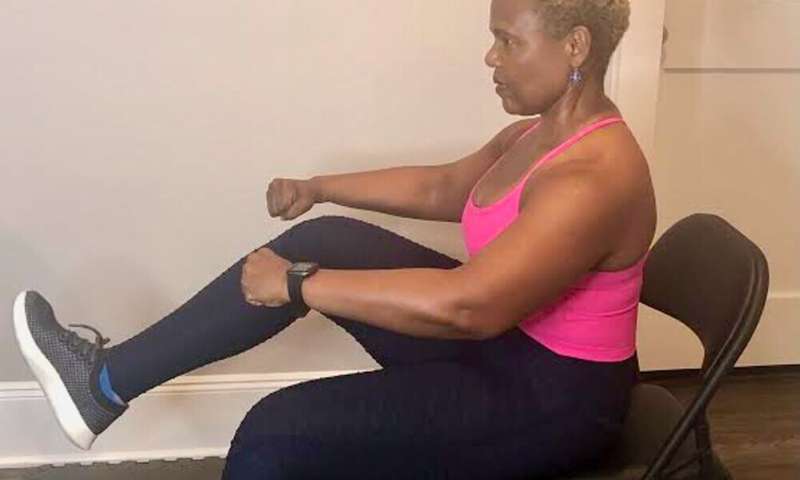
These at-home exercises can help older people boost their immune system and overall health in the age of COVID-19
How to work out your core while seated. Credit: Lisa Charles, CC BY-NC-SA

The good news is that exercise improves the efficiency of the  in people of all ages. Every session of exercise mobilizes billions of immune cells throughout the body. The more immune cells circulate, the better they are at spotting and attacking potential pathogens.

Although there is no data yet on how exercise and cardiorespiratory fitness can reduce risk of hospitalization or death from COVID-19, previous studies show that regular exercise improves the immune response to other viral infections. Regular exercise has also been shown to lower the risk of death from viral and respiratory illnesses. Furthermore, increased physical activity is known to improve and prolong the immune response from the flu shot.

Working out at home

How can  safely exercise and keep aerobically fit while stuck mostly at home without access to a gym? At the Aging & Brain Health Alliance at Rutgers University-Newark, we have been offering virtual  classes, by video conference or phone, for seniors using materials they can easily find around the home.

Here are a few suggested exercises from our fitness classes you can do on your own safely at home.

One of the best exercises to get you started on your fitness journey is to walk the floors of your home. Whether in a house or an apartment, take time every hour to get up and just walk. Set aside five to 10 minutes with the goal of increasing your daily step count and improving your overall cardiorespiratory health. Challenge a family member to join you and make it fun.

You should also take advantage of your walls. Wall sits are an easy way to engage your muscles and work your body. Simply stand with your back against a wall; step your feet two feet away from the wall and open your legs hip-distance apart. While keeping your shoulders against the wall, slowly and carefully lower your body until you are sitting in an imaginary chair.

Remember to keep breathing, inhaling through your nose and exhaling from your mouth, and you will begin to feel the burn in your leg muscles. Try coming up and down five times if you feel safe and comfortable doing so. (For extra security, keep a chair or something else near by to hold on to if you lose your balance.)

Finally, use a chair. Sit at the edge of a solid chair focusing on maintaining good posture. Plant your feet hip-distance apart; take a big inhale and, on the exhale, slowly lift one knee toward your chest. This is a seated crunch and it will engage your deep core muscles. Complete five of these knee lifts on each side, making sure to do each knee lift on the exhalation.

Exercise habits developed during this period of COVID-19—and maintained after the threat has passed—will support your immune health for years to come.

Explore further

Improving immunity through exercise – new advice on lowering infection impact
https://medicalxpress.com/news/2020-11-at-home-older-people-boost-immune.html

COVID's collateral damage: Germicidal lamps may damage corneas

 COVID's collateral damage: Germicidal lamps may damage corneas

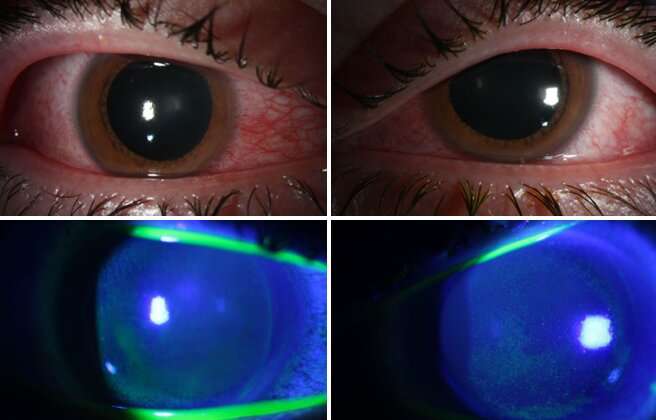
Injected conjunctiva (redness) of the right and left eye (top row)Diffuse staining of the cornea with green dye indicating epithelial damage (bottom row). Credit: Bascom Palmer Eye Institute

In a paper published in the journal of Ocular Immunology and Inflammation, physicians from the Bascom Palmer Eye Institute at the University of Miami Miller School of Medicine reported that several patients using germicidal lamps in an attempt to sanitize against the coronavirus, developed painful inflammation of the cornea, a condition called photokeratitis. These consumer-available ultraviolet (UV) emitting devices were being used in an attempt to eliminate coronavirus from homes and offices.

"During the height of the pandemic, we noticed an increased number of patients coming in with irritation, pain and sensitivity to light," said first author and Bascom Palmer resident Jesse Sengillo, M.D. "We realized this was after direct exposure to germicidal lamps that emit UV light in the C range to kill bacteria and viruses. This can be quite a painful experience for the patient, but with prompt topical lubrication and antibiotics to prevent infection, patients often do very well."

UV photokeratitis occurs when the cornea is overexposed to ultraviolet radiation. This can happen at , where less UV rays are absorbed by the atmosphere, or near water, snow or other reflective surfaces in the environment. A few hours after exposure, patients experience burning in their eyes and sometimes intense light sensitivity.

Numerous germicidal lamps are on the market, and while they may be safe for at-home use, customers need to pay close attention to manufacturer recommendations to prevent damage to the eyes and skin.

"The patients we met were not aware of these recommendations, and many were unknowingly exposed at work" said co-author and fellow resident Anne Kunkler, M.D., B.S. "For UV-C emitting devices, it is best to leave the room while the  is on. Our patients were directly exposed to the light for various lengths of time. A few hours later, they felt discomfort and sought ."

Dr. Sengillo and colleagues encourage anyone feeling eye discomfort after exposure to one of these devices to promptly seek medical attention a medical professional from an ophthalmologist.

While germicidal lamps are being purchased to protect people during the pandemic, this study did not attempt to address whether they are effective in destroying coronaviruses. "There are many COVID-19 related publications recently. It is important that we disseminate information accurately and responsibly to avoid public confusion." Dr. Sengillo and colleagues note that some UV-C emitting germicidal devices are proven to be effective in killing various microbes and viruses, but to the authors knowledge, they have not been tested against COVID-19 specifically yet. "Our study was not designed to answer that question. If you choose to use these lamps, just make sure to follow manufacturer recommendations closely to avoid unnecessary injury," said Dr. Sengillo.

https://medicalxpress.com/news/2020-11-covid-collateral-germicidal-lamps-corneas.html


Narcolepsy fiasco spurs Covid vaccine fears in Sweden

 Take a vaccine developed in haste? Never again, says Meissa Chebbi, who, like hundreds of other young Swedes suffered debilitating narcolepsy after a mass vaccination campaign against the 2009-2010 swine flu pandemic.

The experience has shaken Swedes' confidence in any future vaccine against the new coronavirus, compounding fears about unknown long-term side effects.

"I will never recommend that," 21-year-old Chebbi told AFP when asked about taking a speedily developed vaccine. "Unless you really have to take it because of life-threatening circumstances."

The Swedish case highlights the complex task governments face in rolling out vaccines against the coronavirus, especially at a time when rabid social media misinformation is feeding scepticism in state institutions and even about the disease itself.

The trauma over vaccines is particularly notable in Sweden, which normally boasts participation of more than 90 percent in its voluntary children's vaccination programme.

But a recent survey conducted by the Novus polling institute suggested that 26 percent of Swedes do not plan to take any of the COVID-19 vaccines being developed and 28 percent are undecided.

Forty-six percent said they would get a jab.

Of those opposed, 87 percent said it was due to fears over as-yet unknown side effects.

Health authorities in the Scandinavian country in 2009 urged the public to voluntarily take the Pandemrix vaccine against swine flu, made by British drug company GlaxoSmithKline.

More than 60 percent heeded the call—the highest level in the world.

But Chebbi and hundreds of others, primarily children and young adults under 30, were later diagnosed with narcolepsy as a side effect of the vaccine.

A link was eventually established to an adjuvant, or booster, in the Pandemrix vaccine which was intended to strengthen the immune response.

Narcolepsy is a chronic disorder of the nervous system that causes excessive and often uncontrollable drowsiness.

"I have sleep attacks all the time in all kinds of situations and at inappropriate times... In my food, at job interviews, at lectures, seminars, at university. I've fallen asleep at my workplace, I fall asleep on buses and everywhere," Chebbi says.

"It has destroyed my life."

The Swedish Pharmaceutical Insurance has so far approved 440 of 702 narcolepsy claims linked to Pandemrix, paying out a total of 100 million kronor (9.8 million euros, $11.6 million) in compensation.

Side effects accompany all vaccines, but serious ones are proportionally very rare, as with the narcolepsy cases in Sweden.

The effectiveness of vaccines are also widely agreed upon and they have led to the eradication of many diseases.

'If only we had known'

Anders Tegnell, Sweden's state epidemiologist and the face of the country's controversial 'softer' response to the new coronavirus, was among a group of experts at the Board of Health who called for the mass vaccination in 2009-2010.

"Of course the decision would have been completely different if we had known about the side effects. But they were completely unknown, they were a surprise to everybody," Tegnell told AFP in an interview.

"There has been an international consensus for many years that the best thing to do during a pandemic is to vaccinate, and that's really the only long-term solution we have."

Babis Stefanides, a 36-year-old Stockholm resident, said he's too wary to take a COVID jab.

"I'm not planning to take the vaccine," he told AFP. "There are just too many questions."

Tegnell said he understood Swedes' concerns.

"Of course when you have a new vaccine that we don't know very much about yet—against a disease that we don't know very much about—everybody ... wants to have more information before they make a decision on this," he said.

"We are going to inform about these vaccines when we know a little bit more about them."

Tegnell ruled out making any future vaccine mandatory.

According to the director of the Swedish Public Health Agency, Johan Carlson, 60 to 70 percent of the population would have to be vaccinated in order to stop the spread of the virus.

"Everyone needs to have a think and decide what to do. Usually in Sweden, most people end up getting vaccinated," Carlson told Swedish Television on Sunday.

In a bid to assuage fears, Sweden plans to set up a register to quickly detect any side effects from a future COVID vaccine.

Solidarity in question

Hannah Laine, a 37-year-old social worker in Stockholm, said she, her husband and their three kids would definitely be getting the vaccine—despite her fears.

"If it's approved for the market and we notice that the public health agency and society is saying that we should take the vaccine, we'll do it," she told AFP.

"We have to take our moral responsibility for the elderly and the sick. We'll take it, maybe not for our sake but for society's."

That kind of thinking worries Elisabeth Widell, chairperson of the Narcolepsy Association.

She says health authorities were not wrong to call for a mass vaccination in 2009, but they appealed too heavily to Swedes' sense of solidarity and she hopes they won't do that again.

"People who choose not to get vaccinated should not be blamed and shamed. Because it's not mandatory, which means it's a free choice."

She urged Swedes to "do your own risk and benefit analysis".

Narcolepsy sufferer Chebbi remains determined.

"I'm not going to take the (COVID) vaccine until after about five years when we know what the risks are."

UK regulator set to approve COVID-19 vaccine next week

 Britain is set to approve a COVID-19 vaccine developed by BioNTech SE and Pfizer Inc next week and deliveries would begin within hours of the authorisation, the Financial Times reported on Saturday. https://on.ft.com/3o6JrSG 

https://www.marketscreener.com/news/latest/UK-regulator-set-to-approve-COVID-19-vaccine-next-week-FT--31886493/

German minister says partial lockdown could last until Spring 2021

 Germany’s partial lockdown measures could be extended until early Spring if infections are not brought under control, Economy Minister Peter Altmaier said in a newspaper interview published on Saturday.

Altmaier told Die Welt it was not possible to give the all-clear while there were incidences of more than 50 infections per 100,000 inhabitants in large parts of Germany.

“We have three to four long winter months ahead of us,” he was quoted as saying. “It is possible that the restrictions will remain in place in the first months of 2021.”

Chancellor Angela Merkel agreed with leaders of Germany’s 16 federal states on Wednesday to extend and tighten measures against the coronavirus until at least Dec. 20.

Germany imposed a “lockdown light” in early November, which closed bars and restaurants but allowed schools and shops to stay open. The measures have stopped the exponential growth of cases but infections have stabilised at a high level.

There were 21,695 new confirmed coronavirus cases in Germany, data from the Robert Koch Institute (RKI) for infectious diseases showed on Saturday, bringing total cases since the pandemic began to 1,028,089.

Serum Institute in active talks with Indian govt on potential COVID-19 vaccines

 Serum Institute of India (SII), the world’s largest vaccine producer, is in active discussions with the Indian government on pricing and distribution of potential COVID-19 vaccines, said its Chief Executive Adar Poonawalla on Saturday.

His comments come following Indian Prime Minister Narendra Modi’s visit to the Serum Institute of India’s sprawling campus in the western city of Pune. [L4N2IE01V]

Serum Institute, the world’s largest vaccine manufacturer, has partnered with global players including AstraZeneca and Novavax Inc to run domestic trials on their vaccine candidates and produce the vaccines if they secure approvals.

Poonawalla said in the next few weeks SII plans to apply for emergency use authorization for AstraZeneca’s COVID-19 vaccine candidate that he described as a “very good” option.

https://www.reuters.com/article/health-coronavirus-seruminstituteofindia/serum-institute-says-in-active-talks-with-indian-govt-around-potential-covid-19-vaccines-idUSKBN2880H9

U.S. vaccine plans take shape but no let-up on restrictions

 U.S. health authorities will hold an emergency meeting next week to recommend that a coronavirus vaccine awaiting approval be given first to healthcare professionals and people in long-term care facilities.

The meeting, announced on Friday by a U.S. Centers for Disease Control and Prevention (CDC) committee on immunizations, suggests that the Food and Drug Administration (FDA) may be close to authorizing distribution of the long-awaited medication, at least to those considered most vulnerable.

United Airlines has begun moving shipments of the vaccine, developed by Pfizer Inc, on charter flights to ensure it can be quickly distributed once it is approved, according to a person familiar with the matter.

The CDC’s Advisory Committee on Immunization Practices will vote on Tuesday to recommend that the FDA allow healthcare professionals and long-term care facilities to be the first two groups to get initial vaccine supplies, a CDC spokeswoman said.

A green light for any vaccine would come as welcome news to Americans, who political leaders have clamped under increasingly aggressive measures to curtail the spread of the virus.

Los Angeles County health officials on Friday banned all public and private gatherings for at least three weeks and urged residents to stay home as much as possible.

The county exempted religious services and protests from the order, citing constitutional protections in an apparent acknowledgment of a U.S. Supreme Court ruling this week that rejected New York state’s restrictions on churches and synagogues.

New York Governor Andrew Cuomo, a Democrat, dismissed the top court’s decision as “irrelevant,” saying it was narrowly tailored to specific areas no longer subject to the limits.

But the ruling could drive legal challenges against similar limits placed on houses of worship in other states, including California.

“It is fair to say that this Supreme Court ruling has broader implications and governors would be wise to be guided by it in any attempts to single out houses of worship for disparate treatment,” Randy Mastro, lead attorney for the Catholic Archdiocese of Brooklyn in the case, told Reuters.

Washington D.C. Mayor Muriel Bowser said this week her latest COVID-19 restrictions on gatherings also applied to indoor religious services, reducing the maximum number of worshippers from 100 to 50 people.

‘SKIP THE CROWDS’

Americans already weary from eight months of lockdowns began the holiday season on Friday under pressure to stay home, avoid gatherings and curtail Christmas shopping.

One day after the nation marked a low-key Thanksgiving, malls and retailers imposing strict COVID-19 rules saw fewer shoppers for the traditional Black Friday start of holiday shopping.

“Remember, skip the crowds and shop from home this Black Friday,” Kentucky Governor Andy Beshear, a first-term Democrat, wrote on Twitter.

Roughly 90,000 patients were being treated for COVID-19 in hospitals on Friday, a number that has doubled in the last month to the highest since the pandemic began.

“This is the reality we face when COVID-19 is allowed to spread unchecked – ICUs at capacity, not enough health care workers available,” New Mexico Governor Michelle Lujan Grisham said in a tweet.

Grisham, a Democrat, did not say who she believed had let the virus spread unchecked. The governor has imposed a lockdown requiring all “non-essential” businesses to close and residents to stay home.

About 880 people were hospitalized with COVID-19 on Friday in New Mexico. A hospital in rural Curry County was the latest to reach capacity in its intensive care unit this week, according to the county’s Facebook page.

Some politicians and health experts feared Americans traveling for Thanksgiving could spread the contagion. Many heeded advice to stay home on Thursday but others chose to travel, saying they were willing to risk illness to see family.

On the day before Thanksgiving, typically one of the busiest travel days of the year in the United States, more than 1.07 million people transited through U.S. airports - the most of any day since the start of the pandemic, according to the Transportation Security Administration.

More than 4 million traveled through airports from Sunday to Thursday, compared with more than 11 million for the same period last year, TSA data shows.

https://www.reuters.com/article/health-coronavirus-usa/u-s-vaccine-plans-take-shape-but-no-let-up-on-restrictions-idUSKBN28729G