Search This Blog

Tuesday, December 1, 2020

US govt prepares for COVID-19 vaccine fraud surge

 With the first COVID-19 vaccines now nearing approval, the US government is preparing a crackdown on an anticipated spike in falsified and unauthorised medicines by fraudsters.

Homeland Security Investigations (HSI) – part of Immigration and Customs Enforcement (ICE) – is launching Operation Stolen Promise 2.0 in an attempt to identify and prevent the production, sale and distribution of illicit COVID-19 treatments and vaccines.

Organised criminals may well try to cash in on pent-up demand for vaccines in particular, tapping into public fears of missing out on the first wave of immunisations when supplies will be limited.

At the same time, many US states are worried they may not have the ancillary supplies they need to administer the shots – like needles, syringes and alcohol pads – which could impede the roll-out, according to a Government Accountability Office (GAO) report.

It’s quite possible that counterfeit versions of the first wave of vaccines – from the likes of Moderna and Pfizer/BioNTech – are already being produced by counterfeiters. Use of online pharmacies has already risen since the start of the pandemic, thanks to lockdown restrictions, and that raises the risk of exposure to a fake product.

HSI says it has been actively working with many of the leading pharmaceutical companies that are currently developing vaccines and treatments to try to minimise illicit sales.

Operation Stolen Promise 2.0 will try to disrupt and dismantle fraud schemes, removing illicit websites and other online marketplaces and seizing counterfeit or illicit vaccines and treatments. 

It is an extension of Operation Stolen Promise, which was launched in April as the pandemic was starting to gather momentum, and targeted financial aid fraud as well as counterfeit and unapproved products.
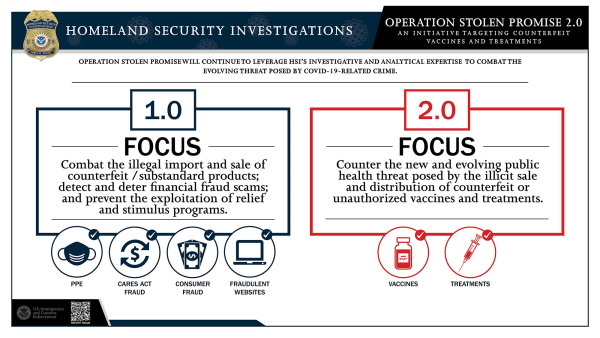
Click image to expand

Since the first operation started, ICE has seized more than $26m in illicit proceeds; made 170 arrests; executed 148 search warrants and analysed more than 69,000 COVID-19 domain names.

Working with US Customs and Border Protection, more than 1,600 shipments of mislabelled, fraudulent, unauthorised or prohibited COVID-19 test kits and other related items have been seized.

https://www.securingindustry.com/pharmaceuticals/us-govt-prepares-for-covid-19-vaccine-fraud-surge/s40/a12659/#.X8baYs1KjIV


Brazil sees one-dose, unfrozen vaccine as ideal for COVID-19

  A senior Brazilian Health Ministry official said on Tuesday that the ideal vaccine to immunize the country against COVID-19 would be one that could be stored at temperatures of a regular refrigerator and does not require multiple doses.

"Ideally it would be made in a single dose," said Health Surveillance Secretary Arnaldo Medeiros, although he recognized that was probably not possible.

Among the vaccines Brazil is considering for eventual purchase, the only single-dose option is the one being developed by Johnson & Johnson.

Medeiros, speaking at a ministry AIDS event, explained that Brazil's cold chain lacks the ultra-frozen capacity of wealthier nations. That would rule out the vaccine developed by Pfizer Inc in partnership with Germany's BioNTech SE, which needs to be transported and stored at -70 degrees Celsius and given in two doses about a month apart.

Pfizer has proposed building an extreme cold-storage chain using dry ice.

Moderna Inc's two-dose vaccine uses a similar technology as Pfizer's but can be stored at the more convenient temperature between 2 degrees and 8 degrees Celsius (36-46 F).

The Brazilian government has an agreement with British drugmaker AstraZeneca Plc to buy and produce a vaccine it is developing with Oxford University. Their two-dose vaccine, which can be easily transported and stored at normal fridge temperatures, would be made in Brazil by the government's Fiocruz biomedical center in Rio de Janeiro.

Sao Paulo state has a similar agreement with China's Sinovac Biotech to buy and eventually produce its two-dose CoronaVac vaccine, which can remain stable for up to 3 years while stored at between 2 to 8 degrees Celsius.

https://www.marketscreener.com/quote/stock/SINOVAC-BIOTECH-LTD-5714593/news/Brazil-sees-one-dose-unfrozen-vaccine-as-ideal-for-COVID-19-official-31914719/

Blueprint Medicines Says FDA Approves Gavreto to Treat Thyroid Cancer

 Blueprint Medicines Corp. on Tuesday said the U.S. Food and Drug Administration approved Gavreto as a treatment for certain types of thyroid cancer.

The company said the FDA approved Gavreto, or pralsetinib, as a treatment for patients with RET-altered thyroid cancers.

Blueprint Medicines said it is co-commercializing Gavreto in the U.S. with Genentech, under Blueprint's collaboration with Roche.

"In the Phase 1/2 ARROW trial, Gavreto showed durable efficacy and was generally well-tolerated in patients with RET-altered thyroid cancers with or without prior systemic therapy," Blueprint said.

"Earlier this year, the FDA granted accelerated approval to Gavreto for the treatment of adults with metastatic RET fusion-positive non-small cell lung cancer as detected by an FDA approved test," the company added.

https://www.marketscreener.com/quote/stock/BLUEPRINT-MEDICINES-CORPO-22033569/news/Blueprint-Medicines-Says-FDA-Approves-Gavreto-to-Treat-Thyroid-Cancer-31913750/

COVID-19 patients on some cancer therapies may be contagious for months

 COVID-19 patients who received cancer treatments that suppress their immune system may remain contagious and able to spread the coronavirus for two months or more, according to a study published on Tuesday.

The U.S. Centers for Disease Control and Prevention (CDC) currently recommends that when patients have compromised immune systems, healthcare workers follow extra precautions such as wearing respirators instead of face masks and isolate patients for up to 20 days after symptoms appear.

In the new study, researchers analyzed sputum and swab samples from 20 immunosuppressed cancer patients infected with the new coronavirus. They found that three were contagious for more than three weeks after their symptoms began, including one who remained contagious for 61 days.

The three patients had received either a stem-cell transplant or therapy with genetically engineered immune cells called CAR T-cells within the previous six months. Two of the three had developed severe COVID-19. None of them had antibodies to the virus.

Current public health recommendations for COVID-19 patients with weak immune systems are based on limited data and may need to be revised, the researchers said in a letter published in the New England Journal of Medicine.

“We know from several studies that if you’re ... healthy, you are no longer infectious after the first week of illness. But there is very little we know about immunocompromised patients,” said Mini Kamboj, one of the study’s authors from the Memorial Sloan Kettering Cancer Center. “Is that 20 days enough or do we need to exercise precautions for longer than that?”

While only a small proportion of cancer patients with COVID-19 are likely to remain contagious for prolonged periods, “it’s a residual risk that we need to address,” Kamboj said. “We need to keep an open mind about how (much) longer immunocompromised patients could pose an infection risk to others.”

https://www.reuters.com/article/us-health-coronavirus-cancer/covid-19-patients-on-some-cancer-therapies-may-be-contagious-for-months-study-idUSKBN28B5S1

Scarce early vax supply should go to health workers, nursing homes: U.S. advisers

 A panel of advisers to the U.S. Centers for Disease Control and Prevention (CDC) on Tuesday voted 13 to 1 to recommend that healthcare workers and residents of long-term care facilities should be first in line to receive the first doses of COVID-19 vaccines when they become available.

The CDC said at a meeting of its Advisory Committee on Immunization Practices that it expects only 5 million to 10 million doses will be available per week once U.S. regulators authorize vaccines.

That may require state and local officials tasked with distributing the vaccines to designate sub-groups within those categories who are at highest risk of complications from COVID-19.

The initial scarcity should only last a few weeks. Ultimately, the CDC expects to have as many as 40 million doses of vaccine available by the end of the year, which would cover roughly 20 million individuals.

Dr. Nancy Messonnier, director of the CDC’s National Center for Immunization and Respiratory Diseases, said most state and local jurisdictions expect to be able to vaccinate their healthcare workforce within three weeks of receiving the first shipments of a COVID-19 vaccine.

https://www.reuters.com/article/us-health-coronavirus-vaccines-cdc/scarce-early-vaccine-supply-should-go-to-health-workers-nursing-homes-u-s-health-advisers-idUSKBN28B6B3

FDA OKs emergency use of Roche test measuring anti-SARS-CoV-2 antibody levels


Thermo Fisher expects stronger Q4


  • Thermo Fisher (TMO +1.3%sees FY adjusted EPS of $19.17, beating consensus estimate $18.32, representing growth of 55% over 2019, compared to the original expected growth of 48% provided on October 21.
  • Forecasts Q4 organic revenue growth 40%, compared to original expectation of 29%, driven by increased levels of organic growth in both the base business and COVID-19 response revenue.
  • https://seekingalpha.com/news/3640532-thermo-fisher-expects-stronger-fourth-quarter