LUMAKRAS Shows Median Overall Survival of 12.5 Months in Patients With Previously Treated Non-Small Cell Lung Cancer
Data Confirms Rapid, Deep, and Durable Responses With Median Duration of Response of 11.1 Months
Data Presented at ASCO 2021 and Simultaneously Published in New England Journal of Medicine
Amgen (NASDAQ: AMGN) today presented data on overall survival, a secondary endpoint, from the Phase 2 results of the CodeBreaK 100 clinical study for LUMAKRASTM (sotorasib) in previously treated patients with non-small cell lung cancer (NSCLC) during the 2021 American Society of Clinical Oncology (ASCO) Annual Meeting. These data were also simultaneously published in the New England Journal of Medicine (NEJM). The publication includes mature overall survival and duration of response data, and results from subgroup and exploratory biomarker analyses.
LUMAKRAS shows a median overall survival (OS) of 12.5 months among 124 evaluable patients, the majority of which were previously treated with both platinum-based chemotherapy and immunotherapy (81%) (data cutoff of March 15, 2021). The results confirmed an objective response rate (ORR) of 37.1%, duration of response (DoR) of 11.1 months and disease control rate (DCR) of 80.6%, with an additional patient achieving complete response (bringing the total to four complete responses and 42 partial responses) compared to previously reported results. The data published in NEJM are updated from results presented at the International Association for the Study of Lung Cancer (IASLC) 2020 World Conference on Lung Cancer (WCLC) held in January 2021 and are based on a longer follow-up time of 15.3 months.
"Patients with KRAS G12C-mutated non-small cell lung cancer face poor outcomes so we are pleased with these overall survival results and the impact LUMAKRAS may have for patients with this devastating mutation," said David M. Reese, M.D., executive vice president of Research and Development at Amgen. "The results published in the New England Journal of Medicine further confirm the deep and durable responses we have seen with LUMAKRAS throughout the CodeBreaK clinical trial program, the most advanced KRAS G12C clinical trial program with the longest follow-up."
Revered scientific journal The Lancet has created a ‘task force’ to investigate the origins of the coronavirus that caused a global pandemic, yet it has decided to employ as it’s leader the very guy who funded the dangerous gain of function research at the Wuhan lab and subsequently allegedly ‘bullied’ other scientists into avoiding looking into the lab as a potential source of the outbreak.
In the wake of renewed scrutiny of the lab leak hypothesis, the Lancet’s task force will reportedly “focus on analyzing data on all of the theories put forward on the origins of COVID, on the reasons why SARS-CoV-2 was able to break out of Wuhan and spread globally, and on the most plausible strategies to prevent future pandemics.”
It also states that “The Task Force will review thoroughly and objectively all publicly available evidence, particularly the peer-reviewed literature, and conduct interviews with key leaders in science, medicine, policy and civil society.”
‘Objectively’. Right.
Dr Peter Daszak, who is heading up this task force, is perhaps the least suitable scientist on the planet to objectively analyse the data, given his track record.
Daszak, as President of the EcoHealth Alliance, shovelled at least $600,000 to the Wuhan Institute of Virology in the past few years to play around with coronaviruses inside the lab through the now infamous ‘gain of function’ research.
Daszak, who also works for the World Health Organisation, is on record admitting that he was involved with manipulating coronaviruses. Here is a video of him talking in DECEMBER 2019 about how ‘good’ the viruses are for altering in a lab:
Daszak notes that “coronaviruses are pretty good… you can manipulate them in the lab pretty easily… the spiked proteins drive a lot about what happens. You can get the sequence you can build the protein, we work with Ralph Baric at UNC to do this, insert into the backbone of another virus and do some work in a lab.”
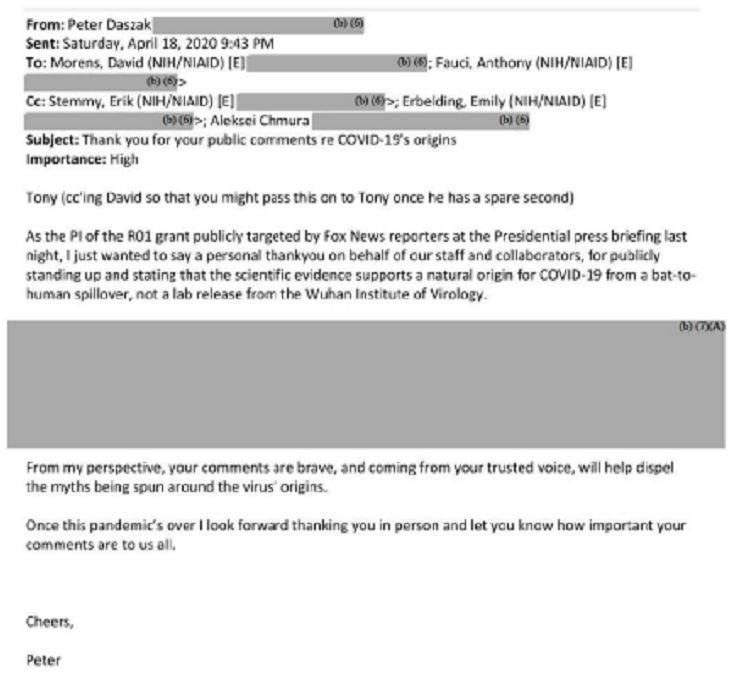
Recently released emails now document that Daszak thanked Dr Fauci for dismissing the lab leak theory before any scientific research had been done on the possibility.
Daszak’s Twitter profile is basically one long ‘it came from bats not a lab’ thread, much to the annoyance of some other scientists:
Why does this guy keep getting put in charge of investigations, task forces and ‘fact checking’, when it’s abundantly clear that he has the biggest motive to dismiss the lab leak notion?
As microbiologist Professor Richard Ebright has noted, “Daszak was the contractor who funded the laboratory at the Wuhan Institute of Virology that potentially was the source of the virus with subcontracts from $200million [£142million] from the US Department of State and $7million [£5million] from the US National Institutes of Health and he was a collaborator and co-author on research projects at the laboratory.”
Daszak has already lied about the type of research that was being conducted at the Wuhan lab, claiming, after the outbreak happened, that he didn’t know if it was gain of function or not. His own previous statements, and the Fauci emails prove he knew full well what was going on in the lab.
In addition, as reported by The Daily Mail and other outlets, Daszak “orchestrated a ‘bullying’ campaign and coerced top scientists into signing off on a letter to The Lancet aimed at removing blame for Covid-19 from the Wuhan lab he was funding with US money.”
Daszak used his influence to get the journal to publish the letter, which stated that to even suggest the lab leak theory had any credibility was equal to spreading “fear, rumours, and prejudice.”
It effectively shut down discussion among the scientific ‘consensus’ of the lab leak potential for a whole year until intelligence findings brought the matter back to the attention of the mainstream media.
WHO scientific advisor Jamie Metzl described Daszak’s letter as “scientific propaganda and a form of thuggery and intimidation.”
“By labelling anyone with different views a conspiracy theorist, the Lancet letter was the worst form of bullying in full contravention of the scientific method,” Metzl added.
The letter further stated that “We stand together to strongly condemn conspiracy theories suggesting that Covid-19 does not have a natural origin,” and even had the audacity to state that “We declare no competing interests.”
Indeed, Daszak had made sure that the letter would be devoid of any link to EcoHealth, and even considered leaving his own name off it, emails released via the Freedom of Information Act have revealed.
To make matters worse, the other members of The Lancet’s task force are practically all minions of Daszak, some of whom helped him draft the letter that unequivocally stated the lab leak theory was dangerous, and others who either worked with him on ‘fact checking’ for Facebook, or were cited as sources during that activity.
Taking all this into account, it is obvious what the outcome of The Lancet’s inquiry will be, and it should not and cannot be used as credible evidence against the lab leak theory.
Presentation available on demand as part of 2021 American Society of Clinical Oncology (ASCO) Annual Meeting
Incyte (NASDAQ:INCY) and MorphoSys US Inc., a fully owned subsidiary of MorphoSys AG (FSE: MOR; NASDAQ:MOR), today announced new three-year follow-up data from the ongoing Phase 2 L-MIND study of tafasitamab (Monjuvi®) in combination with lenalidomide in adult patients with relapsed or refractory diffuse large B-cell lymphoma (DLBCL). A total of 80 out of 81 enrolled study patients receiving tafasitamab plus lenalidomide were included in the efficacy analysis at approximately three years follow-up (≥35 months)1.The long-term analysis, as assessed by an independent review committee (IRC), showed that patients treated with tafasitamab plus lenalidomide had an overall response rate (ORR) of 57.5% (95% CI = 45.9, 68.5; 46 out of 80 patients), including a complete response (CR) rate of 40% (32 out of 80 patients). Additionally, the median duration of response (DoR) was 43.9 months (95% CI = 26.1, Not Reached [NR]), with a median overall survival (OS) of 33.5 months (95% CI = 18.3, NR) and median progression free survival (PFS) of 11.6 months (95% CI = 6.3, 45.7).
Regulators on Friday said a new version of a popular diabetes medicine could be sold as a weight-loss drug in the U.S.
The Food and Drug Administration approved Wegovy, a higher-dose version of Novo Nordisk’s diabetes drug semaglutide.
In company-funded studies, participants taking Wegovy had average weight loss of 15%, about 34 pounds (15.3 kilograms). Participants lost weight steadily for 16 months before plateauing. In a comparison group getting dummy shots, the average weight loss was about 2.5%, or just under 6 pounds.
“With existing drugs, you’re going to get maybe 5% to 10% weight reduction, sometimes not even that,” said Dr. Harold Bays, medical director of the Louisville Metabolic and Atherosclerosis Research Center. Bays, who is also the Obesity Medicine Association’s chief science officer, helped run studies of Wegovy and other obesity and diabetes drugs.
In the U.S., more than 100 million adults — about one in three — are obese.
Dropping even 5% of one’s weight can bring health benefits, such as improved energy, blood pressure, blood sugar and cholesterol levels, but it often doesn’t satisfy patients who are focused on weight loss, Bays said.
Bays said Wegovy appears far safer than earlier obesity drugs that “have gone down in flames” over safety problems. Wegovy’s most common side effects were nausea, diarrhea and vomiting. Those usually subsided, but led about 5% of study participants to stop taking it.
The drug also shouldn’t be given to people at risk for some cancers, because of a potential risk for certain thyroid tumors, the FDA said.
Patients inject Wegovy (pronounced wee-GOH’-vee) weekly under their skin. Like other weight-loss drugs, it’s to be used along with exercise, a healthy diet and other steps like keeping a food diary.
Novo Nordisk sells two semaglutide versions for controlling blood sugar in Type 2 diabetics: a daily pill called Rybelsus and Ozempic, which patients inject weekly. The Danish company hasn’t disclosed Wegovy’s list price, but Ozempic typically costs $850 or more per month without insurance.
Wegovy builds on a trend in which makers of relatively new diabetes drugs test them to treat other conditions common in diabetics. For example, popular diabetes drugs Jardiance and Novo Nordisk’s Victoza now have approvals for reducing risk of heart attack, stroke and death in heart patients.
Phylander Pannell, 49, of Largo, Maryland, joined a patient study after cycles of losing and then regaining weight. She said she received Wegovy, worked out several times a week and lost 65 pounds over 16 months.
“It helped curb my appetite and it helped me feel full faster,” said Pannell. “It got me on the right path.”
Shortly after she finished the study and stopped receiving Wegovy, she regained about half the weight. She’s since lost much of that, started exercise classes and bought home exercise equipment. She’s considering going back on Wegovy after it’s approved.
Wegovy is a synthesized version of a gut hormone that curbs appetite. That’s a new strategy in treating obesity, said Dr. Robert Kushner, a member of Novo Nordisk’s medical advisory board who heads Northwestern Medicine’s Center for Lifestyle Medicine.
Novo Nordisk also is developing a pill version that should start final patient studies later this year.
Liminal BioSciences Inc. (Nasdaq: LMNL) ("Liminal BioSciences" or the "Company") announced today that the U.S. Food & Drug Administration (FDA) has approved Ryplazim®(plasminogen, human-tvmh) ("Ryplazim®") for the treatment of patients with plasminogen deficiency type 1 (hypoplasminogenia) through its subsidiary, Prometic Biotherapeutics Inc., holder of the biological license application ("BLA") for Ryplazim®. With this approval, Ryplazim®becomes the first FDA approved therapy for this rare genetic disorder.
The efficacy of Ryplazim® in pediatric and adult patients with plasminogen deficiency type 1 was evaluated in a single-arm, open-label clinical trial. A total of 15 patients who had a baseline plasminogen activity level between <5% and 45% of normal were enrolled. All patients received Ryplazim® at a dose of 6.6 mg/kg administered every two to four days for 48 weeks to achieve at least an increase of individual trough plasminogen activity by an absolute 10% above baseline and to treat the clinical manifestations of the disease. Ryplazim® was well tolerated in the clinical study (See Important Safety Information).
Efficacy was established on the basis of overall rate of clinical success at 48 weeks defined as 50% of patients with visible or other measurable non-visible lesions achieving at least 50% improvement in lesion number/size, or functionality impact from baseline. All patients with any lesion at baseline showed at least 50% improvement in the number or size of their lesions.
"Receiving our first drug approval is a major milestone for Liminal and for the patients, caregivers, and physicians who have been with us every step of the way in this important research effort. We are very pleased that Ryplazim® will be available to US patients suffering from congenital plasminogen deficiency," said Bruce Pritchard, the CEO of Liminal BioSciences. "The receipt of a Rare Pediatric Disease Priority Review Voucher (PRV) also has the potential to provide Liminal with non-dilutive cash to support our ongoing efforts to advance and expand our small molecule R&D strategy".
Introduces Galleri, a Groundbreaking Multi-Cancer Early Detection Blood Test
Galleri’s ability to detect more than 50 types of cancer with a single blood draw could transform early cancer detection as a complement to existing screenings; test now available in U.S. by prescription only
GRAIL, Inc., a healthcare company whose mission is to detect cancer early, today presented the first results from the interventional PATHFINDER study evaluating Galleri™, a multi-cancer early detection (MCED) blood test. The results, presented at the 2021 ASCO Annual Meeting, support Galleri’s performance in clinical settings. The company also announced today that Galleri is now available in the U.S. by prescription only.
"The interim results of PATHFINDER demonstrate that a routine blood test is capable of detecting many different cancers even before symptoms arise, an approach that has significant potential advantages," said Dr. Tomasz M. Beer, deputy director at the OHSU Knight Cancer Institute and presenting author. "Most importantly, it can detect cancers that have no recommended screening tests today, and more than two-thirds of cancers go unscreened for this reason. These results are a pivotal step toward extending early detection to many more types of cancer."