The European Union submitted to the World Trade Organization on Friday a plan it believes will more effectively broaden supply of COVID-19 vaccines than the intellectual property (IP) rights waiver backed by the United States.
India, South Africa and dozens of developing countries are demanding an IP rights waiver for COVID-19 vaccines and other treatments to address what they say is a "staggering inequity" in access to global public goods.
A surprise U.S. shift in May to support a patent waiver heaped pressure on remaining opponents, such as the European Union and Switzerland that are home to many drugmakers.
The European Commission, which oversees trade policy for the 27-nation EU, said on Friday it had submitted an alternative, stressing limits on export restrictions and existing WTO rules allowing countries to grant licences to producers.
WTO members discussed a revised waiver proposal on Monday, their 11th meeting on the topic since an initial proposal in October, though still with no breakthrough. Another meeting is planned for next Tuesday and Wednesday.
The EU plan, which it says could be put into action much quicker, consists of three elements.
Export restrictions should be kept to a minimum. The EU has stressed it has exported more than 200 million vaccine doses, a level not matched by others such as the United States.
The EU would encourage vaccine makers and developers to enter licensing and manufacturing deals with producers in developing countries and pledge increased supplies to vulnerable nations, as Pfizer/BioNTech, Johnson & Johnson and Moderna have done.
Thirdly, the EU plan highlights existing WTO rules allowing countries to grant licences to manufacturers even without the consent of the patent-holder, although they would still receive compensation. Such licences should help ensure vaccines are available at affordable prices.
The National Institutes of Health has started a Phase 1/2 clinical trial in which adult volunteers who have been fully vaccinated against COVID-19 will receive booster doses of different COVID-19 vaccines to determine the safety and immunogenicity of mixed boosted regimens. The National Institute of Allergy and Infectious Diseases (NIAID), part of NIH, is leading and funding the study through theInfectious Diseases Clinical Research Consortium, a clinical trials network that encompasses the Institute’s long-standing Vaccine and Treatment Evaluation Units (VTEUs).
“Although the vaccines currently authorized by the U.S. Food and Drug Administration offer strong protection against COVID-19, we need to prepare for the possibility of needing booster shots to counter waning immunity and to keep pace with an evolving virus,” said NIAID Director Anthony S. Fauci, M.D. “The results of this trial are intended to inform public health policy decisions on the potential use of mixed vaccine schedules should booster doses be indicated.”
The trial is led by principal investigators Robert L. Atmar, M.D., at Baylor College of Medicine, Houston, and Kirsten E. Lyke, M.D., at the University of Maryland, College Park. It will include approximately 150 individuals who already have received one of the three COVID-19 vaccine regimens currently available under FDA Emergency Use Authorization in the United States: the Janssen COVID-19 vaccine (also referred to as the Johnson & Johnson vaccine, or Ad26.COV2-S), the Moderna COVID-19 vaccine (also known as mRNA-1273), and the Pfizer-BioNTech COVID-19 vaccine (also known as (BNT162b2). Each vaccine group will enroll about 25 people ages 18 through 55 years and approximately 25 people age 56 years and older. Twelve to 20 weeks following their initial vaccination regimen, participants will receive a single booster dose of the Moderna COVID-19 vaccine as part of the trial.
People who have not yet received an FDA authorized COVID-19 vaccine are also eligible to enroll in the trial in a separate cohort. Initially, these volunteers will receive the two-dose Moderna COVID-19 vaccine regimen and will be assigned to receive a booster dose of a vaccine about 12 to 20 weeks later.
The trial has an adaptive design and may add arms as vaccines are awarded EUA and/or variant lineage vaccines become available for evaluation.
All trial participants will be followed for one year after receiving their last vaccination as part of the study. They will be asked to complete telephone check-ins and various in-person follow up visits. Trial investigators will evaluate participants for safety and any side effects post-vaccination. Participants also will be asked to provide blood samples periodically so that trial investigators can evaluate immune responses against current circulating strains of SARS-CoV-2, as well as emerging variants. If trial participants develop laboratory-confirmed symptomatic COVID-19, investigators will perform genetic sequence analyses on the participant samples to see if a variant strain of SARS-CoV-2 caused the infection.
Initial trial results are expected in late summer 2021. For more information about the trial, including a list of enrollment locations, please visit clinicaltrials.gov and search identifier NCT04889209.
So Dr. Anthony Fauci in the pandemic’s early months was casting doubt on the lab-leak theory of COVID’s origins — even as he wasalso receiving at least one alertfrom a genomic researcher that “some of the features look (potentially) engineered.”
Notably, he forwarded “anti-conspiracy theory” articles that quoted Peter Daszak — the head of a US nonprofit that used some grant money from Fauci’s agency to fund coronavirus work at the Wuhan Institute of Virology — attacking the lab-leak idea. Daszak and others wrote Fauci personally to thank him for dumping on the theory.
We still don’t know if the virus evolved normally and somehow jumped to humans, but Chinese researchers have been searching hard for evidence of the bug in some intermediate species (as the “natural” theory would require) and have so far come up empty.
Meanwhile, Beijing refuses to cooperate in any meaningful independent investigation — and even launched a trade war with Australia after Aussie leaders called for such a probe.
For a year, we’ve been told to “trust the science” — but Fauci, our leading scientist, made declarations that certain theories were “debunked” when they weren’t. Why did he back up Daszak’s self-serving dismissal of the lab theory with no real evidence — when, in fact, he was getting e-mail evidence to the contrary?
These revelations don’t ease the growing concern that US taxpayer cash might have helped unleash this plague.
Dr. Fauci received some notice last year that COVID-19 could have been manmade.AP
All of it is just more reason for the Biden administration to get to the bottom of the mystery — and make getting China to cooperate at last the No. 1 issue in talks with Beijing. And all the more reason, as we’ve argued before, that Fauci needs to stop being the spokesperson for America’s pandemic response.
The FDA has approved a digital device developed by Cognoa that can be used to diagnose autism spectrum disorder (ASD), just a few weeks after it was filed for approval.
Cognoa says the artificial intelligence (AI) based device is the first to be authorised by the US regulator that can help doctors diagnose autism in primary care, and will be launched “in the coming months”.
At the moment, autism can be difficult to diagnose as there are no medical markers to confirm its presence. Instead, doctors have to look at a child’s developmental history and behaviour over time before making a diagnosis.
While that process can be quite quick in severe cases of ASD, for the vast majority of children who are less affected it can take years to get a diagnosis, and in some countries waiting times for assessments are very long.
Cognoa thinks its Canvas Dx software as a medical device (SaaMD) could change this, providing an efficient and accurate assessment in primary care that would do away with the need for a lengthy referral to a specialist.
While autism can be reliably diagnosed in children as early as 18 months, the average age of autism diagnosis has remained at 4 to 5 years old for decades, according to the company.
It is estimated that ASD affects one in every 54 children in the US, with cases rocketing 178% since 2000 in part due to greater detection of milder forms, and increasing awareness of the neurodevelopmental condition.
“Autism spectrum disorder can delay a child’s physical, cognitive and social development, including motor skill development, learning, communication and interacting with others,” said Jeff Shuren, director of the FDA’s Center for Devices and Radiological Health.
“The earlier ASD can be diagnosed, the more quickly intervention strategies and appropriate therapies can begin,” he added.
It consists of a mobile app for caregivers to answer questions about behavioural problems and to upload videos of their child, plus a video analysis portal that allows specialists to view and analyse those videos.
It also includes a healthcare provider portal that can be used to enter answers to questions about behaviour, track information provided by caregivers, and review results.
Canvas Dx has been approved by the FDA to diagnose children aged between 18 months and five years, based on a pivotal study published last autumn involving 425 children aged with concerns about their development, but with no formal assessment for autism.
The study compared the device’s ability to detect ASD by comparing its diagnostic output with the clinical reference standard made by a specialist clinician, and validated by specialist peers.
Cognoa said the results showed the device was highly accurate across males and females as well as ethnic and racial backgrounds, which could address a longstanding issue of disparities in autism diagnoses.
“The current system is already at a breaking point as it is unable to provide early diagnoses and intervention opportunities to many children and families,” said Dave Happel, Cognoa’s chief executive.
“With rapidly-rising autism rates, this crisis will only worsen without new approaches and innovations.”
Grail’s liquid biopsy today became the third pan-cancer blood test to be launched in the US. But it is being sold for a slightly different use versus the two approved tests. Galleri, which is not approved by the FDA but sold under a Clia waiver, is on sale as a screen, and can be used to test people aged over 50 at elevated risk of cancer. The other two tumour-agnostic liquid biopsies are used in patients who already have a confirmed cancer diagnosis, as a way to assess the mutations a tumour carries and therefore help assign targeted drugs. Grail is pitching its Galleri test at $949, quite a bit cheaper than both its rivals: Roche’s FoundationOne Liquid CDx sells at $5,800 and Guardant’s Guardant360 around $1,000 more than that. But the latter two have formal FDA approval, granted last August, making reimbursement easier – no reimbursement is yet in place for Galleri. Meanwhile Illumina’s $8bn bid to acquire Grail is no nearer closing. The FTC recentlywithdrew a lawsuit seeking to block the acquisition, which sounds like good news, but is in fact the opposite. The suit will likely be refiled later, delaying the deal's close further.
China National Pharmaceutical Group (Sinopharm) has the capacity to provide more than 1 billion COVID-19 vaccine doses to the world beyond China in the second half of this year, the firm's chairman Liu Jingzhen said late on Wednesday.
That level of supply capability assumes vaccination demand in China is being met, Liu said at a panel of the Global Health Forum of the Boao Forum for Asia.
"Our annual production capacity exceeds 5 billion doses," Liu said, "This is our own capacity."
He declined to disclose how many shots the state-backed drugmaker has agreed to give to the global COVAX programme for sharing doses, mainly with poor countries.
Two vaccines from Sinopharm are being used in China, one of which has gained emergency use approval from the World Health Organization, a prerequisite for a vaccine to be included in the COVAX initiative.
Liu said Sinopharm has also planned a manufacturing facility for a third shot, which is being tested in an early-stage clinical trial.
The GAVI vaccine alliance is in talks with Sinovac Biotech (SVA.O), another major COVID-19 vaccine provider from China, to expand the COVAX portfolio, a GAVI spokesperson said on Wednesday. read more
China promised in February to provide 10 million doses to COVAX.
57% in U.S. say lives are "somewhat" back to normal; 9% "completely"
For first time, majority think healthy people should lead normal lives
Record-high 84% think coronavirus situation is getting better
Now that the majority of Americans aged 18 and older are fully vaccinated against COVID-19 and restrictions meant to curb the spread of the disease are increasingly being rolled back, two-thirds of U.S. adults (66%) say their lives are either "somewhat" or "completely" back to normal.
While this marks a sharp reversal from October when a majority said their lives were not yet back to normal, few Americans -- 9% -- say life is completely back to normal, while 57% describe it as somewhat normal. The remaining 34% say normalcy has not yet returned.
Majority in U.S. Now Say Life Somewhat Back to Normal
Thinking about your life before the start of the coronavirus, would you say your life right now is -- completely back to normal, somewhat back to normal but not completely normal [OR] not yet back to normal?
Oct 2020
May 2021
Change
%
%
pct. pts.
Completely back to normal
3
9
+6
Somewhat back to normal
34
57
+23
Not yet back to normal
62
34
-28
GALLUP PANEL
The latest findings are from Gallup's May 18-23 COVID-19 probability-based web panel survey.
Almost all demographic subgroups of the population show large shifts since last fall in reports that their lives are back to normal. Additionally, similar proportions of major subgroups now say their lives are completely or somewhat back to normal, including by gender, age, region, household income, parental status and employment status.
One exception to these general patterns is that Democrats (57%) are less likely than independents (68%) or Republicans (77%) to say their lives are at least somewhat back to normal. Republicans were much more likely than other groups in October to say their lives were at least somewhat back to normal (67%); therefore, the change in Republicans' opinions has been less dramatic than those for other groups.
Change in Self-Reports of Life Being Back to Normal, by Political Party
Thinking about your life before the start of the coronavirus, would you say your life right now is -- completely back to normal, somewhat back to normal but not completely normal [OR] not yet back to normal?
Republicans
Independents
Democrats
Oct 2020 %
May 2021 %
Oct 2020 %
May 2021 %
Oct 2020 %
May 2021 %
Completely back to normal
8
17
2
10
1
2
Somewhat back to normal
59
60
30
58
20
55
Not yet back to normal
33
24
68
32
79
43
GALLUP PANEL
Americans may be unlikely to say their lives are completely back to normal because a majority, 52%, still say their life is being disrupted by the coronavirus, including 14% who report "a great deal" of disruption and 38% "a fair amount." While still a majority, the current figure is well below the high point -- 81% -- from late March/early April 2020 polling, when much of the country was still living under state-issued stay-at-home orders.
Currently, 57% believe the disruption caused by the virus will continue through the end of 2021 (39%) or longer than that (18%). This is a smaller majority expecting protracted disruption than the 67% recorded in April. Meanwhile, 11% of Americans today expect the disruption to continue a few more weeks, while 31% say a few more months.
Majority Now Think Healthy People Should Lead Normal Lives
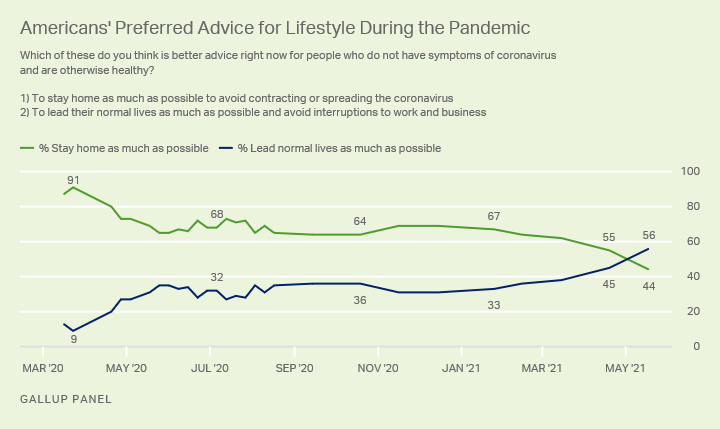
As a sense of normalcy returns, Americans have become less likely to believe that the best advice for healthy people during the pandemic is to stay home to help prevent the spread of the virus, dropping from 91% in March 2020 to 67% at the start of this year to 44% now. In fact, for the first time in Gallup's COVID tracking, a majority (56%) say the better advice is for people to live their normal lives as much as possible.
Line graph. Trend from March 2020 to May 2021 in Americans' view that the better advice for healthy people during the pandemic is to stay home as much as possible to avoid contracting or spreading the coronavirus, rather than to lead their normal lives as much as possible. The percentage recommending staying home as much as possible has declined from a high of 91% last March to 67% in January and is 44% today.
As seen previously, there is a substantial partisan divide on the advice question, with 87% of Republicans versus 64% of independents and 29% of Democrats recommending people should strive to lead their normal lives. Conversely, 71% of Democrats believe people should stay home as much as possible, although this is down from 85% in April.
Optimism About Coronavirus Situation Hits New High
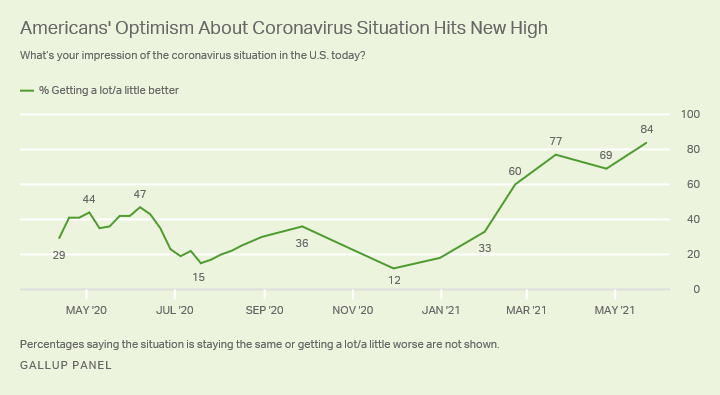
An increasingly larger share of U.S. adults (84%) think the coronavirus situation is getting better, a 15-percentage-point increase since April.
February was the first time that a majority said the situation was improving, after majorities said it was worsening for much of last summer through the end of 2020.
Line graph. Percentages of Americans who think the coronavirus situation in the U.S. is getting a lot or a little better since April 2020. Currently, 84% of U.S. adults say it is getting better, up from 69% in April and the highest on record.
Equal percentages now say the situation is getting "a lot better" as say "a little better," whereas the previous month twice as many said "a little better" as said "a lot better."
Currently, 11% in the U.S. say the situation is staying the same and 5% say it is getting "a lot" or "a little" worse.
Worry About Contracting COVID-19 at Lowest Point Since Beginning of Pandemic
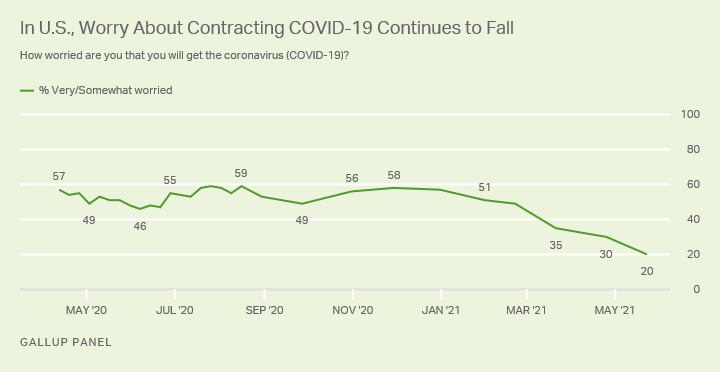
Consistent with Americans becoming much more positive about the trajectory of the pandemic since January, their worry about contracting COVID-19 has decreased sharply over the same period.
The 20% of Americans who now say they are "very" or "somewhat" worried that they will get the disease is the lowest recorded over the past 14 months. This marks a 10-point drop in worry just since April and a 37-point drop since the end of 2020, when U.S. infections and deaths were spiking and the vaccine rollout was just beginning.
Line graph. Percentages of Americans who are very or somewhat worried about getting COVID-19 since April 2020. The latest 20% is the lowest on record, down from 57% late in 2020.
Satisfaction With Vaccine Rollout High; Leadership Ratings Less So
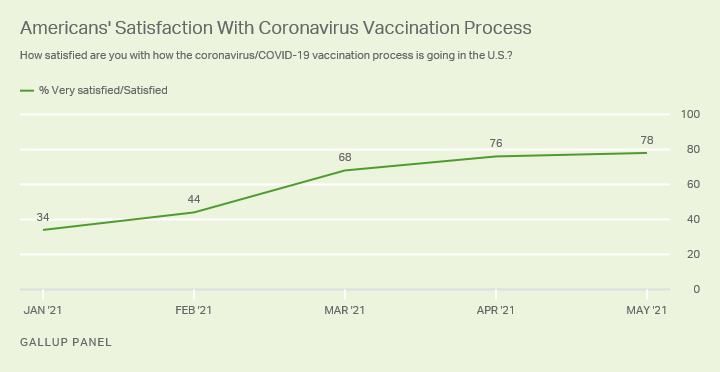
Americans are more pleased with the vaccine rollout now than at any point since it began, as 78% say they are "very" or "somewhat" satisfied. Satisfaction has steadily grown from 34% since late January.
Line graph. Americans' satisfaction with the COVID-19 vaccination process in the U.S. since January. Currently, 79% are either very satisfied or satisfied, up from 34% in January, 44% in February, 68% in March and 76% in April.
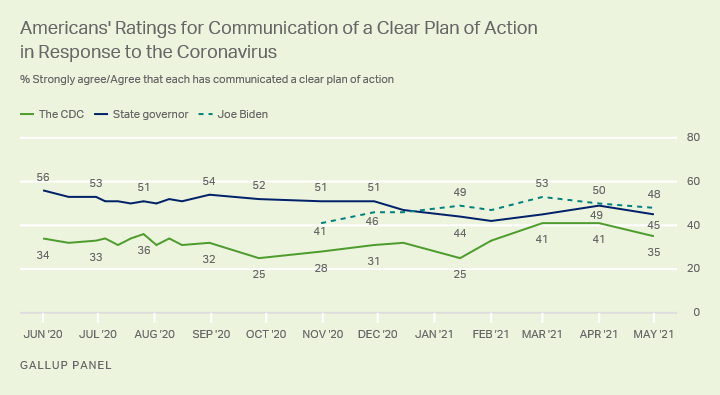
While Gallup does not directly ask the public whom they credit for the vaccination rollout, monthly coronavirus leadership ratings offer insight into how various players are perceived. Gallup has tracked Americans' ratings of state governors, the Centers for Disease Control and Prevention (CDC), and the president since last June for communicating a clear plan of action in response to the coronavirus.
Until President Joe Biden took office, state governors consistently received the highest marks for their communication of a clear pandemic response plan. Since his inauguration, however, Biden has far surpassed his predecessor, Donald Trump, and outpaced or tied state governors, while the CDC has the lowest ratings of the three for its communication.
Currently, 48% of U.S. adults agree that Biden has communicated a clear plan, while 45% say state governors have and 35% say the same of the CDC. The reading for the CDC is down six points since April, coming on the heels of its May 13 announcement that fully vaccinated Americans could remove their masks indoors. The new guidelines for mask use came as a surprise to many and reportedly led to some confusion among state government officials, business leaders and ordinary citizens.
Line graph. Americans' ratings of the communication of a clear plan of action in response to the coronavirus by the CDC, state governors and Joe Biden. Ratings represent the percentages who agree that each has communicated a clear plan. The readings for the CDC and state governors began in June and Biden's began in October. The latest reading finds 48% agree Biden has communicated a clear plan, 45% say their state governors have and 35% say the CDC has.
Bottom Line
Americans' concern about the coronavirus has greatly diminished as the majority are now at least partially vaccinated, cases have been dropping, and state and local restrictions on public activity have been cut back significantly or removed completely. As such, Americans for the first time endorse healthy people living their lives as normally as possible, and many more say their lives are personally getting back to normal, if not completely so.
Still, the public does not believe the U.S. is completely past the pandemic, with the majority saying they are experiencing COVID-related disruption in their lives and close to six in 10 expecting such disruption to persist in the U.S. through the end of the year or longer.