The neurotransmitters GABA and glutamate have complementary roles—GABA inhibits neurons, while glutamate makes them more active. Published 22nd July inPLOS Biology, researchers led by Roi Cohen Kadosh and George Zacharopoulos from the University of Oxford show that levels of these two neurotransmitters in the intraparietal sulcus of the brain can predict mathematics ability. The study also found that the relationships between the two neurotransmitters and arithmetic fluency switched as children developed into adults.
Levels of brain excitement/inhibition are thought to be related to learning, especially during critical periods. However, little is known about how they are related to complex learning that can take place over decades. To address this issue, the researchers measured the levels of GABA andglutamatein 255 people, ranging from 6-year-olds to university students. The participants also took two math achievement tests, and their performance on the arithmetic problems were correlated with the GABA and glutamate levels.
The team found that among young people, higher GABA levels in the left intraparietal sulcus of the brain (a fold in the top, left, back part of the brain) were associated with greater math fluency, while the reverse was true for glutamate. In adults, the results were almost exactly opposite; low GABA concentrations were related to greater math fluency, and again, the reverse was true for glutamate. Because the participants were tested twice about 1.5 years apart, the researchers were also able to show that neurotransmitter levels at the time of the first test could predict math achievement at the later date.
Much of what we know about GABA, glutamate, and learning comes from rodent experiments in the lab, which cannot say anything directly about natural school-based skills such as mathematics that develop over time. This longitudinal study in humans will help researchers better understand the relationship between learning and brain plasticity, particularly during critical periods that might span years.
Cohen Kadosh adds, "Our finding of developmental switches in the link between GABA and glutamate and academic achievement highlights a general, unknown principle of plasticity. In contrast to previous studies on humans or animals that focused on narrower developmental stages, our cross-sectional-longitudinal study suggests that the link between plasticity and brain excitation and inhibition across different stages is unlikely to be immutable. Our findings have also important implications for the development of brain-based interventional programs, which we hope to examine in the future."
More information: Zacharopoulos G, Sella F, Cohen Kadosh K, Hartwright C, Emir U, Cohen Kadosh R (2021) Predicting learning and achievement using GABA and glutamate concentrations in human development. PLoS Biol 19(7): e3001325. doi.org/10.1371/journal.pbio.3001325
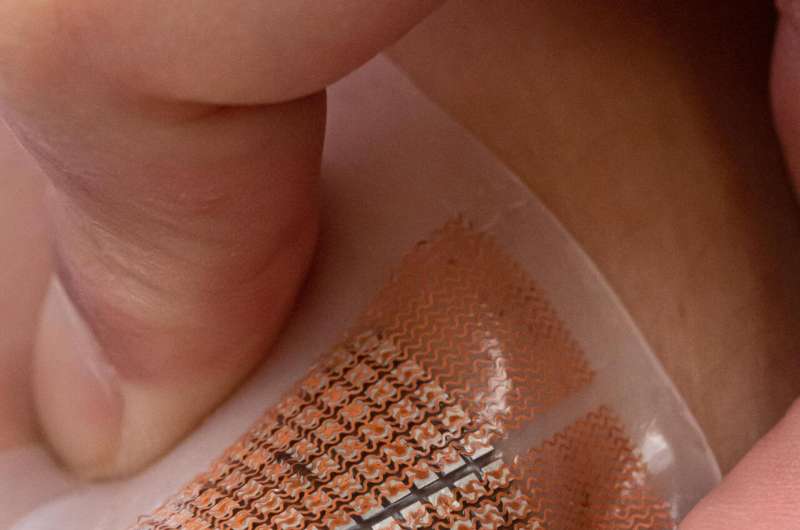
This soft, stretchy skin patch uses ultrasound to monitor blood flow to organs like the heart and brain. Credit: Nature Biomedical Engineering
Engineers at the University of California San Diego have developed a soft and stretchy ultrasound patch that can be worn on the skin to monitor blood flow through major arteries and veins deep inside a person's body.
Knowing how fast and how much blood flows through a patient's blood vessels is important because it can help clinicians diagnose various cardiovascular conditions, including blood clots, heart valve problems, poor circulation in the limbs, or blockages in the arteries that could lead to strokes or heart attacks.
The new ultrasound patch developed at UC San Diego can continuously monitor blood flow—as well as blood pressure and heart function—in real time. Wearing such a device could make it easier to identify cardiovascular problems early on.
A team led by Sheng Xu, a professor of nanoengineering at the UC San Diego Jacobs School of Engineering, reported the patch in a paper published July 16 in Nature Biomedical Engineering.
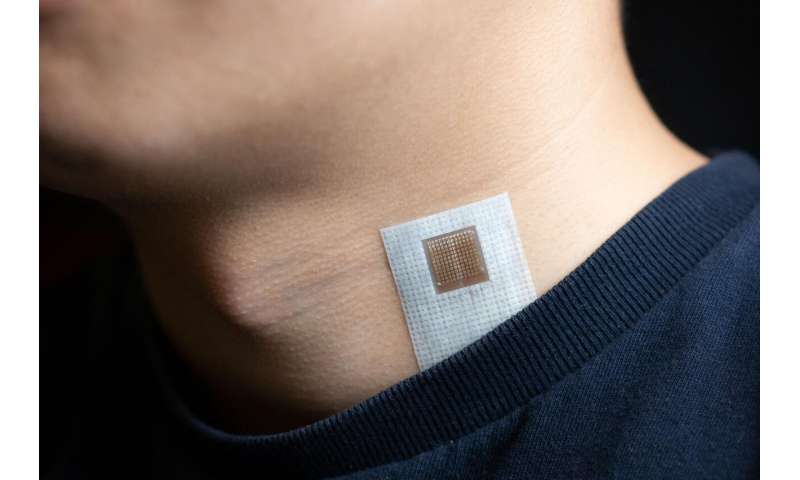
The patch can be worn on the neck or chest. What's special about the patch is that it can sense and measure cardiovascular signals as deep as 14 centimeters inside the body in a non-invasive manner. And it can do so with high accuracy.
"This type of wearable device can give you a more comprehensive, more accurate picture of what's going on in deep tissues and critical organs like the heart and the brain, all from the surface of the skin," said Xu.
"Sensing signals at such depths is extremely challenging for wearable electronics. Yet, this is where the body's most critical signals and the central organs are buried," said Chonghe Wang, a former nanoengineering graduate student in Xu's lab and co-first author of the study. "We engineered a wearable device that can penetrate such deep tissue depths and sense those vital signals far beneath the skin. This technology can provide new insights for the field of healthcare."
Ultrasound patch worn on the neck. Credit: Nature Biomedical Engineering
Another innovative feature of the patch is that the ultrasound beam can be tilted at different angles and steered to areas in the body that are not directly underneath the patch.
This is a first in the field of wearables, explained Xu, because existing wearable sensors typically only monitor areas right below them. "If you want to sense signals at a different position, you have to move the sensor to that location. With this patch, we can probe areas that are wider than the device's footprint. This can open up a lot of opportunities."
How it works
The patch is made up of a thin sheet of flexible, stretchable polymer that adheres to the skin. Embedded on the patch is an array of millimeter-sized ultrasound transducers. Each is individually controlled by a computer—this type of array is known as an ultrasound phased array. It is a key part of the technology because it gives the patch the ability to go deeper and wider.
The phased array offers two main modes of operation. In one mode, all the transducers can be synchronized to transmit ultrasound waves together, which produces a high-intensity ultrasound beam that focuses on one spot as deep as 14 centimeters in the body. In the other mode, the transducers can be programmed to transmit out of sync, which produces ultrasound beams that can be steered to different angles.
"With the phased array technology, we can manipulate the ultrasound beam in the way that we want," said Muyang Lin, a nanoengineering Ph.D. student at UC San Diego who is also a co-first author of the study. "This gives our device multiple capabilities: Monitoring central organs as well as blood flow, with high resolution. This would not be possible using just one transducer."
The phased array consists of a 12 by 12 grid of ultrasound transducers. When electricity flows through the transducers, they vibrate and emit ultrasound waves that travel through the skin and deep into the body. When the ultrasound waves penetrate through a major blood vessel, they encounter movement from red blood cells flowing inside. This movement changes or shifts how the ultrasound waves echo back to the patch—an effect known as Doppler frequency shift. This shift in the reflected signals gets picked up by the patch and is used to create a visual recording of the blood flow. This same mechanism can also be used to create moving images of the heart's walls.
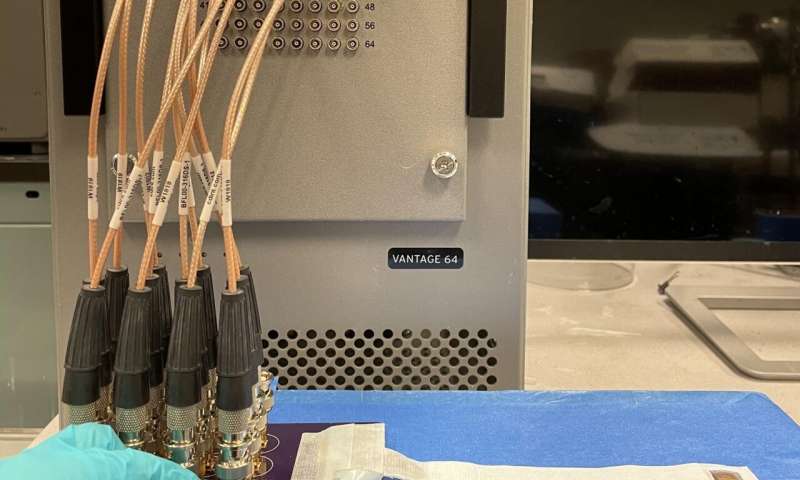
Ultrasound patch wired to its full experimental setup. Credit: Nature Biomedical Engineering
A potential game changer in the clinic
For many people, blood flow is not something that is measured during a regular visit to the physician. It is usually assessed after a patient shows some signs of cardiovascular problems, or if a patient is at high risk.
The standard blood flow exam itself can be time consuming and labor intensive. A trained technician presses a handheld ultrasound probe against a patient's skin and moves it from one area to another until it's directly above a major blood vessel. This may sound straightforward, but results can vary between tests and technicians.
Since the patch is simple to use, it could solve these problems, said Sai Zhou, a materials science and engineering Ph.D. student at UC San Diego and co-author of the study. "Just stick it on the skin, then read the signals. It's not operator dependent, and it poses no extra work or burden to the technicians, clinicians or patients," he said. "In the future, patients could wear something like this to do point of care or continuous at-home monitoring."
In tests, the patch performed as well as a commercial ultrasound probe used in the clinic. It accurately recorded blood flow in major blood vessels such as the carotid artery, which is an artery in the neck that supplies blood to the brain. Having the ability to monitor changes in this flow could, for example, help identify if a person is at risk for stroke well before the onset of symptoms.
The researchers point out that the patch still has a long way to go before it is ready for the clinic. Currently, it needs to be connected to a power source and benchtop machine in order to work. Xu's team is working on integrating all the electronics on the patch to make it wireless.
More information: Chonghe Wang et al, Continuous monitoring of deep-tissue haemodynamics with stretchable ultrasonic phased arrays, Nature Biomedical Engineering (2021). DOI: 10.1038/s41551-021-00763-4
Background A two-dose regimen of ChAdOx1 coronavirus disease 19 (Covid-19) vaccine with an inter-dose interval of three months has been implemented in many countries with restricted vaccine supply. However, there is limited evidence for the effectiveness of ChAdOx1 by dose in elderly populations in countries with high prevalence of the Gamma variant of severe acute respiratory syndrome 2 (SARS-CoV-2). Methods We conducted a test-negative case-control study to estimate the effectiveness of ChAdOx1 vaccine in adults aged 60 years or older during a Gamma-variant-associated epidemic in São Paulo state, Brazil, between 17 January and 2 July 2021. Cases and matched test-negative controls were individuals, identified from surveillance databases, who experienced an acute respiratory illness and underwent SARS-CoV-2 RT-PCR testing. We used conditional logistic regression to estimate the effectiveness by dose against RT-PCR-confirmed Covid-19, Covid-19 hospitalization, and Covid-19-related death. Results 61,164 individuals were selected into matched case-control pairs. Starting ≥28 days after the first dose, adjusted effectiveness of a single dose of ChAdOx1 was 33.4% (95% CI, 26.4 to 39.7) against Covid-19, 55.1% (95% CI, 46.6 to 62.2) against hospitalization, and 61.8% (95% CI, 48.9 to 71.4) against death. Starting ≥14 days after the second dose, the adjusted effectiveness of the two-dose schedule was 77.9% (95% CI, 69.2 to 84.2) against Covid-19, 87.6% (95% CI, 78.2 to 92.9) against hospitalization, and 93.6% (95% CI, 81.9 to 97.7) against death. Conclusions Completion of the ChAdOx1 vaccine schedule afforded significantly increased protection over a single dose against mild and severe Covid-19 outcomes in elderly individuals during widespread Gamma variant transmission.
Competing Interest Statement
The authors have declared no competing interest.
Funding Statement
We are grateful for the Pan American Health Organization's support and the São Paulo State in making the databases available for analysis. JC is supported by the Oswaldo Cruz Foundation (Edital Covid-19 - resposta rápida: 48111668950485). OTR is funded by a Sara Borrell fellowship (CD19/00110) from the Instituto de Salud Carlos III. OTR acknowledges support from the Spanish Ministry of Science and Innovation through the Centro de Excelencia Severo Ochoa 2019-2023 Program and from the Generalitat de Catalunya through the CERCA Program.
Genetic variants of SARS-CoV-2 have repeatedly altered the course of the COVID-19 pandemic, and disease in individual patients. Delta variants (B.1.617.2, AY.2, and AY.3) are now the focus of international concern because they are causing widespread COVID-19 disease globally. Vaccine breakthrough cases caused by SARS-CoV-2 variants also are of considerable public health and medical concern worldwide. As part of a comprehensive project, we sequenced the genomes of 3,913 SARS-CoV-2 from patient samples acquired March 15, 2021 through July 3, 2021 in the Houston Methodist hospital system and studied vaccine breakthrough cases. During the study period Delta variants increased to cause 58% of all COVID-19 cases and spread throughout the metropolitan Houston area. In addition, Delta variants caused a significantly higher rate of vaccine breakthrough cases (19.7% compared to 5.8% for all other variants). Importantly, only 6.5% of all COVID-19 cases occurred in fully immunized individuals, and relatively few of these patients required hospitalization. Our genomic and epidemiologic data emphasize that vaccines used in the United States are highly effective in decreasing severe COVID-19 disease, hospitalizations, and deaths.
Competing Interest Statement
The authors have declared no competing interest.
Funding Statement
The research was supported by the Houston Methodist Academic Institute Infectious Diseases Fund and many generous Houston philanthropists. James Davis was funded in whole or in part with Federal funds from the National Institute of Allergy and Infectious Diseases, National Institutes of Health, Department of Health and Human Services, under Contract No. 75N93019C00076.
Glaucoma can cause blindness and has no cure, as current therapies only slow vision loss by decreasing elevated eye pressure. Mount Sinai researchers have developed a one-time gene therapy that they hope will prevent vision loss induced by glaucoma and other conditions that cause retinal degeneration.
The researchers found that by reactivating an enzyme called CaMKII in retinal ganglion cells, which are responsible for sending images to the brain to process visual cues, they were able to prevent vision loss in mouse models of glaucoma. The results of the new study, published Thursday in the online version of the journal Cell, have led to commercial interest that could one day translate into new treatments.
The team started by testing CaMKII (calcium/calmodulin-dependent protein kinase II pathway) in a wide range of eye-disease models. They discovered that it is critical to the survival of retinal ganglion cells, making it a “desirable therapeutic target” for preserving vision, said senior author Bo Chen, Ph.D., director of the Ocular Stem Cell Program at Mount Sinai’s Icahn School of Medicine, in a statement.
The researchers then used an adeno-associated viral vector to introduce an over-active version of CaMKII into the retinal ganglion cells of the mouse models just before they became damaged.
In the gene therapy-treated mice, 77% of the retinal ganglion cells survived 12 months after they were damaged, compared to 8% in the control group. The same results occurred six months after optic nerve crush, which leads to slower degeneration, versus 7% in the control mice.
"The fact that manipulation of CaMKII would involve a one-time transfer of a single-gene adds to its vast potential to treat serious retinal conditions in humans," Chen said. "The next step is testing this in larger animal models, which may pave the way for starting clinical trials."
CaMKII has been studied in gene therapy research for other indications, as well. In July 2019, researchers at Boston Children’s Hospital said they created a gene therapy that targeted irregularities in CaMKII to treat cardiac diseases marked by irregular heartbeats.
In March, scientists at the University of Cambridge said they developed a gene therapy expressing two therapeutic proteins that showed promise in mouse models of glaucoma and of misfolded tau protein, which is linked to Alzheimer’s and dementia. A modified version of that therapy is now being developed by Astellas.
There have been some disappointments in bringing forward gene therapies for eye diseases, however. Biogen said in June that its candidate for choroideremia, a rare genetic retinal disease that causes progressive vision loss and ultimately blindness, had failed a late-stage clinical trial.
Roche also struggled to advance a gene therapy for choroideremia. Ten days after Biogen’s blunder, Roche said it was walking away from a deal with 4D Molecular Therapeutics on a sponsored trial. The small biotech said it will move forward with developing the therapy after it regains the full rights in September.
The Mount Sinai team is now filing patent applications for its gene therapy and is in active discussions with multiple companies to move the treatment into the clinic, Mount Sinai said.
Potential cancer-causing agents turning up in drugs has been a major headache for the pharma industry. But some trade groups are balking at new rules for monitoring the chemicals, arguing that they could lead to shortages of crucial drugs.
The FDA needs to change its new approach to tracking nitrosamine, three trade groups recently told the agency. Nitrosamine was the culprit in Pfizer's Chantix recall this week, as well as numerous others around the world in recent years.
The FDA should work with other global regulators to set similar rules, adopt better testing strategies and limit testing to drugs at the highest risk of contamination, the industry groups said at a recent meeting with the agency, which was first reported by Endpoints News.
Current nitrosamine testing is expensive and can often lead to false positives, while the timelines for companies to assess risk and complete testing are "too short," the trade groups Pharmaceutical Research and Manufacturers of America (PhRMA), the Association for Accessible Medicines (AAM) and the Consumer Healthcare Products Association (CHPA) said, as summarized in a meeting memorandum.
Those challenges could ultimately delay the release of medicines and cause shortages, the groups warned.
Nitrosamines, which are everywhere in nature, can increase the risk of cancer if a person is exposed to high levels over time. Over the past few years, the nitrosamine N-Nitrosodimethylamine (NDMA) triggered high-profile, worldwide recalls of blood pressure drugs and the diabetes medication metformin. Regulators across the globe have responded by asking companies to monitor for impurities that can crop up in certain drugs.
As for the possibility of nitrosamine-fueled shortages, look no further than Pfizer's smoking-cessation drug Chantix. The drug was recently recalled after Pfizer's testing flagged unacceptable levels of the nitrosamine N-nitroso-varenicline. With Chantix now in shortage, the FDA is allowing Apotex to ship doses of its Chantix generic from Canada.
Many of the industry groups' complaints come down to consistency. The FDA's nitrosamine strategy isn't aligned with international standards set out in the industry guidance known as ICH M7, they said. Specifically, not all nitrosamine acceptable intake levels are set to the M7 standards.
The "FDA uses a more conservative approach," the groups said in the memorandum.
Meanwhile, the FDA's guidance allows different dose forms with the same active ingredient to have divergent AI levels, while many nitrosamines linked to complex drugs are missing AIs altogether.
Impurity testing itself is expensive and can yield false positives, the groups said. To cut back on testing, they suggested regulators set nitrosamine AIs for drugs with insufficient toxicity data.
Regulators should also limit their focus to drugs that present the highest risk and use the length of time a patient takes a given drug to calculate allowed levels of nitrosamine inputs, the groups argue.
During a question and answer portion of the meeting, the FDA said it "can work with manufacturers to mitigate the risk of nitrosamine impurities ... while avoiding interruptions by taking into account FDA’s determination of the need for the product and impact on drug supply."
The regulator says it has previously allowed companies hit with nitrosamine concerns to continue distributing batches "to alleviate a shortage," noting that it aims to weigh the benefits against risks for each potentially contaminated product on a "case-by-case basis."
"The biopharmaceutical industry supports broader global adoption of uniform standards through the International Council of Harmonisation to help ensure that the latest science about nitrosamines will guide decisions worldwide," Andrew Powaleny, senior director of public affairs at PhRMA, said in an emailed statement. The industry puts patient safety first when developing or making drugs, he said, which includes "taking immediate action" when potential impurities crop up.
In the case of Chantix, the FDA said it would allow certain manufacturers to temporarily distribute varenicline tablets with N-nitroso-varenicline above the FDA's acceptable intake limit of 37 ng per day but below an interim limit of 185 ng a day "until the impurity can be eliminated or reduced to acceptable levels." Verenicline is the generic name for Chantix.