Search This Blog

Saturday, August 21, 2021

Abbott disputes report it told Maine workers to toss millions of COVID-19 tests

 Abbott Laboratories is disputing a report that it told workers in Maine to destroy “millions” of rapid antigen tests for COVID-19 in the weeks before the company announced layoffs.

Abbott’s rapid coronavirus test. Courtesy photo of Abbott Laboratories

The New York Times reported Friday afternoon that as sales plunged this spring, along with cases of the virus, the Chicago-based company ramped down production of the 15-minute BinaxNOW test, closing a plant in Illinois that was making the test, canceling contracts, and laying off 400 full-time employees in Westbrook and Scarborough. Now, with the delta variant surging across the country, Abbott is scrambling to rehire workers and restore its production capacity.

When Maine employees were instructed this summer to dismantle stockpiled tests and “stuff them into garbage bags,” some were upset that the tests weren’t being donated other countries that could use them, the Times reported. Many of the company’s manufacturing workers are immigrants from African countries, where COVID-19 tests and vaccines are not as available.

Abbott Laboratories issued a lengthy statement rebutting the Times article late Friday night, saying that in May, as vaccinations climbed and demand for the tests plummeted, the company had “significant amounts” of finished test kits in inventory, and none of them was destroyed. The testing cards that were shredded and thrown away – the Times estimated the number around 8.6 million – were nearing the end of their shelf life and “disposed of in accordance with our standard inventory management process.”

The company said it had saved and stored other components of the testing kits, such as reagent bottles, cardboard packaging, and swabs “so that we could have them in the event that we needed to scale back up, which is exactly what’s happening now.”

The Times article said that photographs of some of the estimated 8.6 million Abbott test cards that employees said were shredded show expiration dates that were more than seven months away.

Abbott announced in August 2020 that the FDA had issued an Emergency Use Authorization for the do-it-yourself test, which is about the size of a credit card and doesn’t require a prescription. The company said it planned to hire another 1,200 employees in Westbrook and, by October, would be making 50 million tests per month. The White House struck a deal with Abbott to acquire 150 million tests for $760 million that would be used in nursing homes, schools and other high-risk locations.

The Times interviewed both Abbott employees and public health officials about the destruction of the testing cards, who lamented the waste. Amal Barakat, a virologist at the WHO’s Eastern Mediterranean regional office, told the newspaper: “My heart, it hurts.”

Abbott said that the BinaxNOW test is not approved outside of this country, and that other countries do not accept short-dated products because of the time it takes to process them.

“It would have taken months to complete manufacturing, create individualized regulatory filings in countries, obtain regulatory approvals, ship product overseas in exact specified storage conditions, and then get it to the people who need it—too late for the product to be widely used,” Abbott said.

https://www.pressherald.com/2021/08/20/abbott-laboratories-disputes-report-that-it-tossed-millions-of-covid-19-tests/

Healthcare organizations pay to settle ransomware attacks? Weighing in at HIMSS21

 Cyberattacks have risen in frequency over the past few years and that pace is only expected to accelerate as COVID-19 lingers in the U.S. But what's the best strategy for healthcare organizations hit with a ransomware attack — should they pay to restore their data, or not?

There's no one clear answer, cybersecurity executives said Tuesday at the HIMSS21 conference in Las Vegas. But even as hackers have ramped up their operations during the COVID-19 crisis, so too do payers and providers need to prepare for attacks that seem increasingly inevitable.

"I just think we really need to step back and reassess here," Michael Rogers, director of the National Security Agency during the Obama administration, said.

Healthcare companies were especially vulnerable to cyberattacks even before COVID-19, as increased investment in technology and a growing focus on data sharing, coupled with outdated infrastructure — including underfunding IT departments and legacy medical devices with little-to-no cybersecurity features — have exponentially increased the number of potential infiltration points for cyberattacks.

Fewer than half of healthcare organizations met national cybersecurity standards in 2019, even as cyberattacks grew in complexity, according to consultancy CynergisTek.

One such attack popular with hackers is ransomware, a type of malware that doesn't access or steal an organization's data, but instead extorts users by encrypting it until they pay to regain access.

More than a third of healthcare organizations were hit by a ransomware attack last year, according to cybersecurity company Sophos. Roughly a third of medical companies that had data stolen paid to recover their information, which is actually lower than estimates in other industries. Recent research by the Neustar International Security Council found six in 10 organizations said they would pay hackers for the decryption key in event of a ransomware attack.

It's technically illegal in the U.S. for a company to pay a ransom to an individual, group or entity that's been sanctioned by a government, so healthcare companies need to make sure their lawyers aren't involved if they decide to pay up, said Michael Coates, former chief information security officer for Twitter.

But "whether you pay should be a different conversation than should you be in conversation with the entities who are doing this," Coates said.

Engaging in talks with cyber criminals — regardless of your willingness to pay — gives you time to respond and loop in law enforcement, along with insight into how the criminals might have gained access to your organization.

"I don't think there's a single yes or no," Coates said, though "my personal professional perspective has always been not to pay."

But "it almost always makes logical sense to pay," especially in healthcare, said Alex Stamos, Facebook's former chief security officer. With patient lives on the line, continuity of care is essential — and it might cost more to fight the attack by halting operations and bringing in pricey outside cybersecurity consultants.

In one of the first high-profile ransomware attacks in healthcare, Hollywood Presbyterian Medical Center in Los Angeles chose to pay $17,000 in bitcoin to hackers in 2016 to recover its data.

According to Sophos, the average healthcare ransom payment is roughly $131,000.

"The quickest and most efficient way to restore our systems and administrative functions was to pay the ransom and obtain the decryption key," CEO Alan Stefanek said in a statement defending his decision at the time. "In the best interest of restoring normal operations, we did this." 

By comparison, hospital chain Universal Health Services fell victim to a massive cyberattack in September and elected to fight the malware, shutting down its digital operations and diverting ambulance traffic and scheduled procedures to competitors.

The incident — one of the largest medical cyberattacks in U.S. history — eventually cost the operator some $67 million pre-tax.

"If you're considering paying, definitely negotiate," said cybersecurity analyst Keren Elazari. "There's a lot of times where the negotiation can halve the price, or bring it to a more manageable amount."

But at the end of the day the decision goes beyond finances: In healthcare, it's a moral judgement, too. In September, a patient died as a result of delayed care after University Hospital Düsseldorf in Germany was forced to turn patients away from its emergency room after a ransomware attack.

"It's continuity," Coates said. "You need to get those systems up and running. You need to save lives."


That rising interconnectedness of medical delivery and technology, along with an extensive use of third-party software vendors for clinical, revenue cycle management and other back-end functions, means the healthcare sector will remain vulnerable to breaches, experts say.

So it's now, in the period between attacks, when organizations should be investing heavily in their IT infrastructure and readiness plans, according to the panelists. Currently, security experts are experiencing a strategic sea change in how they counter cyberattacks, shifting from a focus on shoring up defense — an increasingly outdated and ineffective plan, given the increasing volume and complexity of cyberattacks, coupled with the massive size of healthcare organization's IT surfaces that need protection — to survivability.

Panelists recommended companies assess their IT strengths and weaknesses to know how to prepare, even role-playing a breach to see how their contingency processes play out and workforce responds.

That could even include "red team testing," suggested Elazari, where companies bring in friendly hackers and have them test IT systems the way true attackers would, to identify weak spots.

Additionally, it's important to have a culture shift, Stamos said, moving away from blaming just security personnel for breaches to a more supportive environment where security is a universal goal.

"It should be boring," Coates said. "What builds resiliency in cybersecurity is thinking about fundamentals. And that is boring, and it's also hard."

Data suggests the desire for increased investment in cybersecurity is there in healthcare, even if the urgency isn't. According to a Moody's report published in May, 37% of hospital executives say cybersecurity performance is an organizational objective. And, though nonprofit providers spend just 5% of their budgets on cybersecurity, that's still up from just 3% in 2018.

But with industry trends continuing to unsilo IT operations and incentivize technological adoption, "you have to rethink how you position yourself in this new normal you're in. Maybe your priorities need to change," Elazari said. "Survivability is key, and security isn't a destination. You don't get there and you're done. It's a journey."

https://www.healthcaredive.com/news/should-healthcare-organizations-pay-to-settle-a-ransomware-attack-experts/604754/

Nursing home groups decry mandate push by CMS for staff to get COVID-19 vaccine

 Several nursing home advocacy groups charge that the Biden administration is unfairly penalizing the industry with a staff vaccination mandate, even as data show rates have languished among staff.

The Centers for Medicare & Medicaid Services (CMS) announced its intention to issue an interim final rule by next month stating that if staff do not get the COVID-19 vaccine, facilities could risk losing funding. Several nursing home associations blasted the requirement as heavy-handed and inappropriate in light of a lingering staff shortage exacerbated by the pandemic.

Penalizing nursing homes by “withholding or withdrawing funds is not the right way to increase vaccination rates,” said Katie Smith Sloan, president and CEO of LeadingAge, an association of nonprofit aging service providers such as nursing homes, in a statement after the CMS announcement. “Without Medicaid and Medicare funding, nursing homes cannot provide the quality care that our nation’s most vulnerable older adults need.”

Sloan said the group has encouraged its members to require vaccinations for staff as a condition of employment, with exceptions for religious or medical reasons.

Other groups have argued that a federal mandate could hamper efforts to get enough staff to care for patients.


The American Health Care Association and National Center for Assisted Living (AHCA/NCAL) said Wednesday that the government needs to add more provider groups for vaccine mandates.

“Focusing only on nursing homes will cause vaccine-hesitant workers to flee to other healthcare providers and leave many centers without adequate staff to care for residents,” said AHCA/NCAL President and CEO Mark Parkinson in a statement.

Nursing home employment has been hit hard since the onset of the pandemic and has remained stubbornly low even as other sectors of the healthcare industry have rebounded.

The nursing home industry has seen an 11.5% decline in its workforce since February 2020, a decline of 182,000 jobs, according to a report released in March by consulting firm Altarum.

The decline was less pronounced in other parts of the healthcare industry. For example, Altarum found hospital employment had declined by 2% from February 2020.

A vaccine mandate focused just on nursing home staff could create a “disastrous workforce challenge,” said Parkinson.

Vaccination rates, however, appear to have lagged among staff, according to data from the AARP.

An analysis released last month from the group found that 4 in 5 nursing homes were behind on their goals for staff vaccinations.

The latest data from the CMS as of Aug. 8 show that 60% of staff were vaccinated nationally compared to 82% of nursing home residents who were fully vaccinated.

It remains unclear whether the hospital industry could face a similar vaccine mandate from CMS or risk losing Medicare funding.

However, more than 130 hospital systems have implemented their own mandates.

https://www.fiercehealthcare.com/practices/nursing-home-groups-decry-mandate-push-by-cms-for-staff-to-get-covid-19-vaccine

CDC: Delta Wave 'Likely Peaked Across Northeast'

 New England has one of the highest rates of vaccination in the US. Yet, in recent weeks, local businesses in Connecticut and Massachusetts have been asking customers to mask up once again - in restaurants, bars and gyms - as the number of breakthrough infections rises and Dr. Anthony Fauci turns the variant fearmongering up to 11.

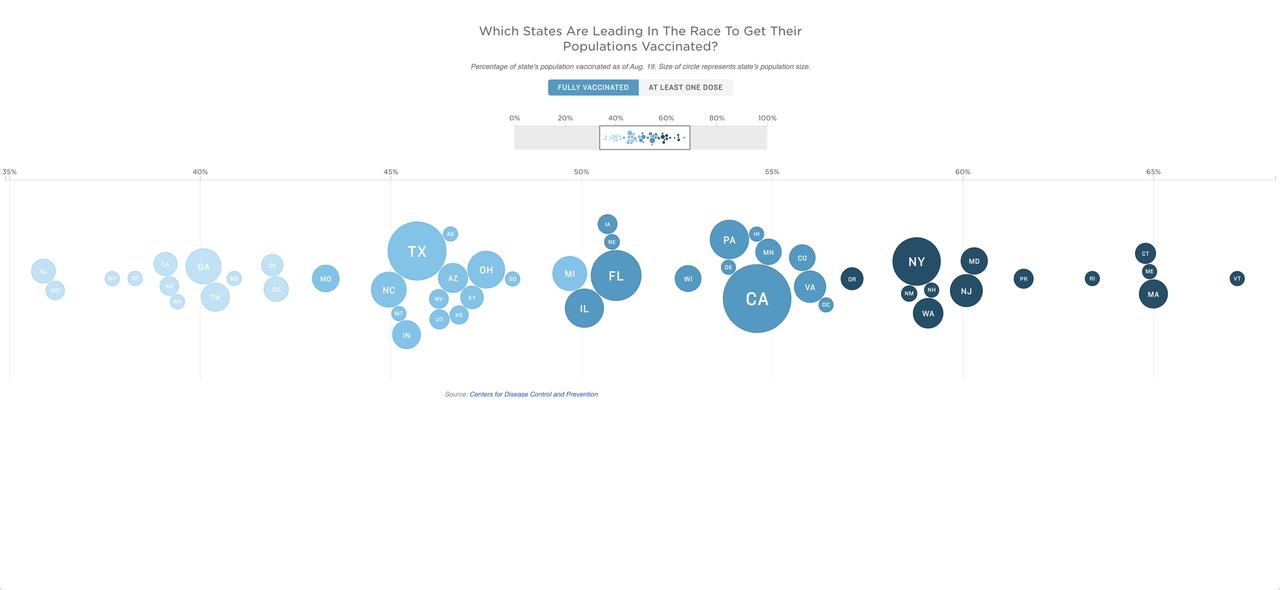
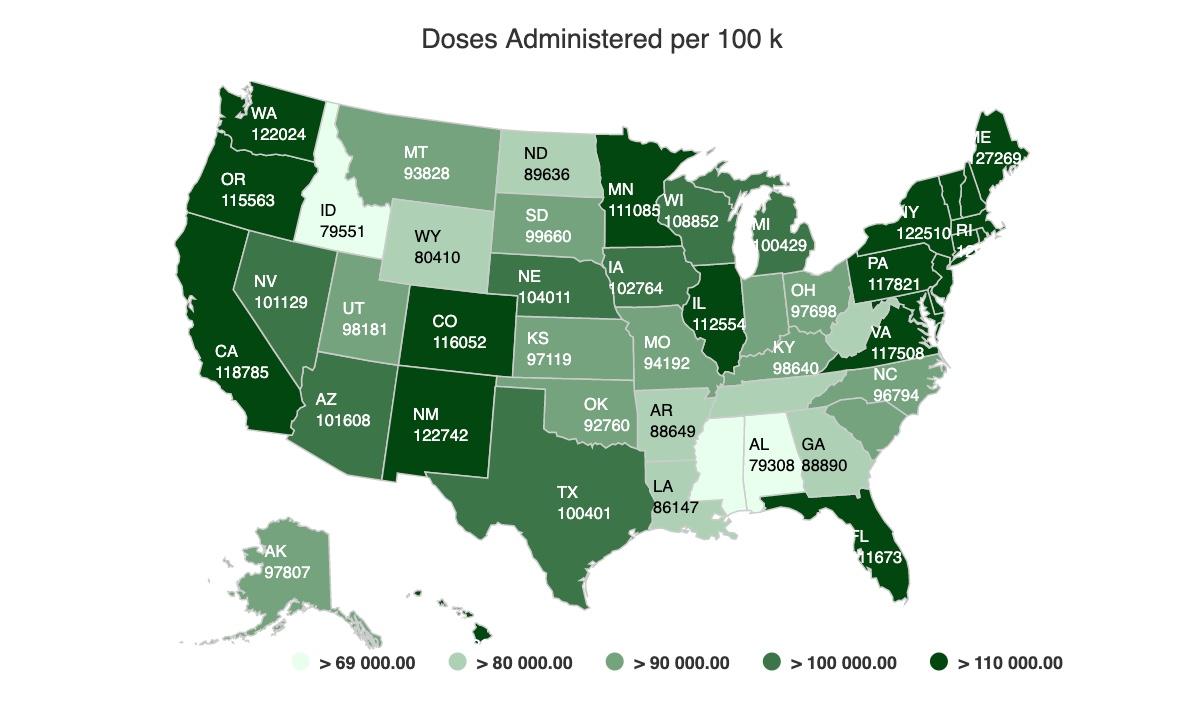
Here are a few data visualizations showing how the northeast is perhaps the most heavily vaccinated region in the entire US.

While the mainstream media has mostly focused on reports about crowded ICUs and daily infection rates, the data show far is consistent with forecasts from Dr. Scott Gottlieb and others who expect the present delta-driven wave to peak in the US in early September.

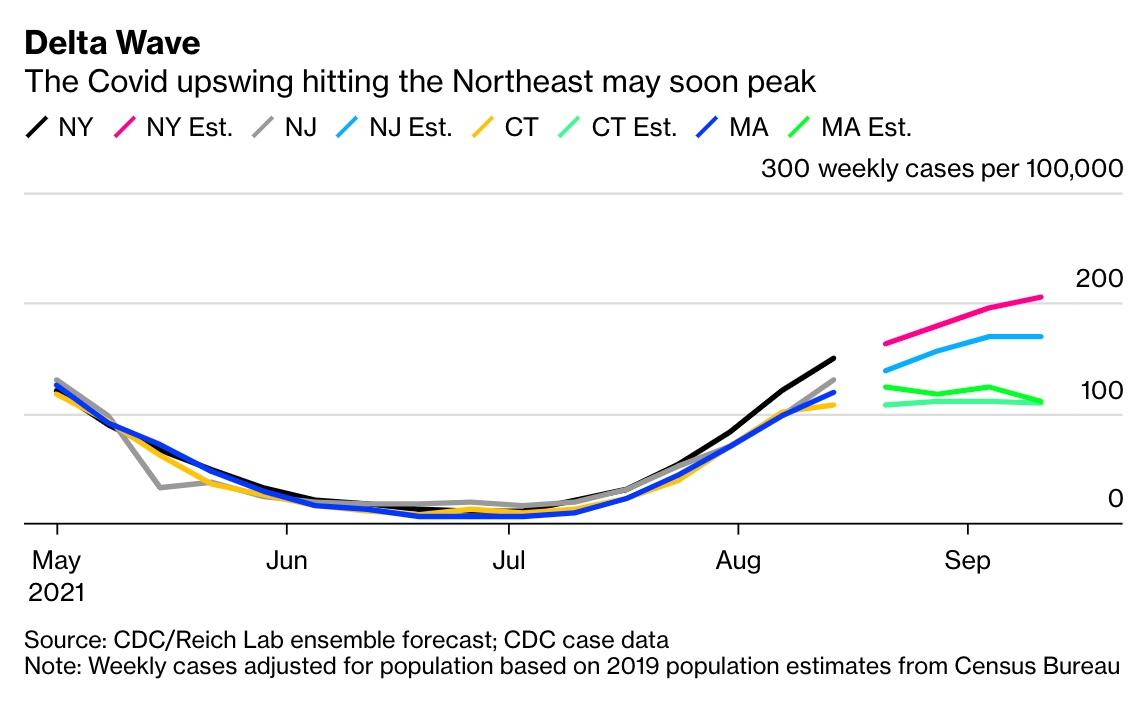
Now, more data has arrived to suggest the delta variant has likely already peaked across the northeast, even as hospitalizations may continue to climb. in the near term. And before Fauci-worshippers question the souce, the projections, shared here by Bloomberg, were developed and released by the CDC.

Parts of the U.S. Northeast may be near the peak of the latest Covid-19 wave, though there are still key areas of concern. Hospitalizations and deaths are likely to mount in the weeks to come.

Cases in Connecticut and Massachusetts have probably topped out, according to the consensus of forecasts published by the U.S. Centers for Disease Control and Prevention. Yet New York and New Jersey still are expected to see infection rates increase.

Since around mid-July, the Northeast has been feeling the effects of the U.S. Covid-19 wave that started in Arkansas and Missouri and fueled record hospitalizations in Florida. Daily hospital admissions are now on the rise in every state in the Northeast, according to Department of Health and Human Services data.

"There are continued increases, but not to the level that we’ve seen in previous surges here in the Northeast," Dr. Roy Gulick, chief of infectious diseases at Weill Cornell Medicine and New York-Presbyterian hospital, said by telephone. "I’m seeing some modeling to suggest that peak won’t occur until late September, early October -- but of course we don’t know for sure."

Even in NYC, the city now requiring IDs and proof of vaccination for patrons to visit restaurants and gyms (yet New Yorkers still don't need an ID to vote), the worst of delta is probably already in the rearview mirror, and the prevailing "r" rate - the rate of spread represented by the number of people infected, on average, by a single case - suggests the city and all of New York State likely won't ever see levels of prevalence anywhere near states like Florida.

The rates of infection are still far below those seen in early Delta-variant hot spots, and leading indicators suggest the region is likely to crest without getting anywhere near Florida-like levels of viral prevalence. Nationwide cases are still projected to rise for several weeks.

In New York City, the original epicenter of the U.S. pandemic, the effective reproduction number, or Rt -- an estimate of how many new infections come from a single Covid carrier -- suggests sustainable declines in case numbers may be on the horizon. Manhattan’s Rt is estimated to have fallen to 1.0, and when it falls below that level cases are expected to decrease in the near future. Rt is somewhat higher in the Bronx, Queens and Brooklyn, according to covidestim, a project with contributors from Yale School of Public Health, Harvard’s T.H. Chan School of Public Health and Stanford Medicine.

One scientist said that opening schools without vaccinating kids could exacerbate spread (despite multiple studies showing schools aren't locuses of COVID spread), though he acknowledged that he couldn't predict the course of the virus.

"Multiple factors challenge our ability to predict what’s going to happen next," said Gulick, including the range of vaccination rates, masking habits and breakthrough cases. "Certainly opening school without having vaccinations available for kids under 12 also potentially will influence the course," he said.

So, if the virus is waning, then what's the argument for forcing Americans, even the young and healthy, to get a third dose of the vaccine?

https://www.zerohedge.com/covid-19/cdc-says-delta-wave-has-likely-peaked-across-northeast

New treatment dramatically halts prostate cancer progression: report

 A drug already proven effective in battling breast cancer could help men win the war against prostate cancer, according to a landmark study out of London.

The drug, called talazoparib, is taken as a daily pill and is already used successfully by breast cancer patients, according to the Sunday Times.

The report, citing research by the Institute of Cancer Research in London and the Royal Marsden NHS Foundation Trust, said that phase two trials of the drug halted the progression of advanced prostate cancer by an average of 5.6 months – double the time possible with existing treatments.

“Talazoparib is now among a handful of precision medicines that have been shown to be safe and effective at controlling advanced prostate cancer,” said Matthew Hobbs, director of research at Prostate Cancer UK. “We need to drive progress in this area as quickly as possible.”

The treatment was found to be particularly effective for men with a mutated BRCA gene who are genetically predisposed to prostate cancer – similar to the mutation carried by Angelina Jolie, which increased her risk of ovarian and breast cancer.

The Lancet oncology journal published the results of the study this month.

https://nypost.com/2021/08/21/new-treatment-halts-prostate-cancer-progression-report/

Coherus, known for biosimilars, nears immunotherapy battle with big pharma


  • Coherus Biosciences and China's Junshi Biosciences on Wednesday said their experimental immunotherapy succeeded in a Phase 3 trial in non-small cell lung cancer and that they aim to seek approval of the drug in the U.S., China and elsewhere.
  • Interim results show the drug toripalimab, when combined with chemotherapy, kept tumors from spreading for a median of 8.3 months, versus 5.6 months for chemotherapy alone. The trial hasn't gone on long enough to prove the combination helped patients live longer, though the trend currently favors treatment with the Junshi and Coherus drug.
  • The results could position Coherus, best known as a maker of copycat biologic drugs, to become the next entrant in oncology's most competitive market. Its commercial prospects are unclear, however, as Merck & Co.'s Keytruda has become the standard of care for most patients and drugs from Roche, partners Regeneron and Sanofi and others are fighting for market share.
After spending years developing biosimilars, Coherus broadened its ambitions in February. Using the profits generated from a copycat version of Amgen's Neulasta, the company bought partial rights to Junshi's drug, marking its first foray into innovative medicines.

Coherus executives signaled the deal was part of a transition to "Coherus 2.0," using its biosimilar cash to fund a pipeline of experimental cancer immunotherapies. Toripalimab, a so-called checkpoint inhibitor that works similarly to Keytruda, Bristol Myers Squibb's Opdivo and others, is meant to be the linchpin of that effort.

Already approved in China for melanoma, the drug is in testing for a dozen different tumor types, among them cancers of the breast, lung and liver. Coherus aims to use toripalimab, along with options for other Junshi oncology assets or deals with other companies, to develop multi-drug combinations. Its first step is a U.S. approval filing in nasopharyngeal carcinoma, a submission that is currently underway. With the results disclosed Wednesday morning, lung cancer might be next.

Toripalimab's U.S. arrival could, in theory, represent an opportunity to launch a lower-priced checkpoint inhibitor, which have six-figure annual price tags even though there are now seven available. Costs could keep rising, too, as multiple checkpoint inhibitors are progressing from their original approvals in advanced disease to earlier lines of care, where many existing treatments are generic and cheap.

Coherus hasn't specifically divulged its pricing plans, though some analysts expect the company to undercut others. "We believe ... Coherus is really going to make the PD-1 game about access and working with providers differently," wrote Mizuho analyst Salim Syed, in February, "in part [with] price cuts."

EQRx, a well-funded startup with grand ambitions, is planning a similar strategy, having licensed its own checkpoint inhibitor from China's C-Stone Pharmaceuticals. 

But Coherus' drug has to pass muster with U.S. regulators first, and that's not a certainty. The trials supporting its use in nasopharyngeal carcinoma and lung cancer were each run in China. Coherus doesn't expect to need to run "bridging studies" to secure approval, though management acknowledged such a requirement depends on the FDA and hasn't been discussed yet, Syed wrote in July.

Coherus plans to meet with the FDA "to discuss a potential submission," the company said in a statement Wednesday.

Syed wrote that Junshi's drug "seems to line up fairly well" against Merck's Keytruda given the Phase 3 result. But it's unclear how the two exactly compare. Regulators first approved the Keytruda-chemotherapy combination in 2018. Junshi's lung cancer trial began afterwards, but tested toripalimab and chemotherapy against an outdated comparator — a strategy for which Regeneron, whose drug Libtayo was approved in lung cancer this year, has already drawn criticism.

https://www.biopharmadive.com/news/coherus-junshi-immunotherapy-lung-cancer/605275/

Decision on J&J COVID vaccine booster doses could take weeks

 A decision on booster shots for the approximately 13.8 million Americans who received Johnson & Johnson's single-shot coronavirus vaccine is likely to take weeks, according to people familiar with the issue.

Federal health officials are waiting on results from a government-backed clinical trial and from studies by Johnson & Johnson to determine whether those who received the  should get a second shot of that vaccine or a booster using another vaccine, CBS News reported.

The government trial has tested pairing a wide array of vaccine combinations, including a Pfizer or Moderna booster shot for people first vaccinated with Johnson & Johnson's vaccine. The trial's scientists hope to finalize early results by the end of August, CBS News reported.

"Our original intention was to release results as early as early September. We are pressing to get that a little bit more accelerated, but we have lots of different arms and people, meaning a lot of different cohorts of groups that have all these different combinations," Dr. Kirsten Lyke, a professor at the University of Maryland who is helping to lead the study, told CBS News.

U.S. health officials emphasized that data on the J&J vaccine is coming later because it was approved later than the Pfizer or Moderna vaccines.

"The J&J vaccine was not administered in the U.S. until March of 2021, and we expect more data on J&J in the coming weeks. With those data in hand, we will keep the public informed with a timely plan," Surgeon General Vivek Murthy said Wednesday.

In response to concerns about waning immunity with all COVID-19 vaccines, the Biden administration this week said people who received the two-dose Pfizer and Moderna shots should get booster shots of those vaccines eight months after their second dose, CBS News reported.

Johnson & Johnson has said that early data from its own research suggests it's single-shot vaccine triggers "strong and stable" immunity for at least eight months, and that the vaccine remains effective against the highly contagious Delta variant that now accounts for nearly all cases in the United States.

"We are engaging with the U.S. FDA, CDC, and other  and will share new data shortly regarding boosting with the Johnson & Johnson COVID-19 vaccine," the company said in a statement late Wednesday.

https://medicalxpress.com/news/2021-08-decision-jj-covid-vaccine-booster.html