Search This Blog

Friday, August 27, 2021

Israeli Study Shows Natural Immunity 13x More Effective Than Vaccines At Stopping Delta

 Dr. Anthony Fauci and the rest of President Biden's COVID advisors have been proven wrong about "the science" of COVID vaccines yet again. After telling Americans that vaccines offer better protection than natural infection, a new study out of Israel suggests the opposite is true: natural infection offers a much better shield against the delta variant than vaccines.

The study was described by Bloomberg as "the largest real-world analysis comparing natural immunity - gained from an earlier infection - to the protection provided by one of the most potent vaccines currently in use." A few days ago, we noted how remarkable it was that the mainstream press was finally giving voice to scientists to criticize President Biden's push to start doling out booster jabs. Well, this study further questions the credibility of relying on vaccines, given that the study showed that the vaccinated were ultimately 13x as likely to be infected as those who were infected previously, and 27x more likely to be symptomatic.

Alex Berenson, a science journalist who has repeatedly questioned the efficacy of vaccines and masks at preventing COVID, touted the study as enough to "end any debate over vaccines v natural immunity."

Here's an excerpt from a report by Science Magazine:

The new analysis relies on the database of Maccabi Healthcare Services, which enrolls about 2.5 million Israelis. The study, led by Tal Patalon and Sivan Gazit at KSM, the system’s research and innovation arm, found in two analyses that people who were vaccinated in January and February were, in June, July, and the first half of August, six to 13 times more likely to get infected than unvaccinated people who were previously infected with the coronavirus. In one analysis, comparing more than 32,000 people in the health system, the risk of developing symptomatic COVID-19 was 27 times higher among the vaccinated, and the risk of hospitalization eight times higher.

This time, the data leave little doubt that natural infection truly is the better option for protection against the delta variant, despite the fact that the US won't  acknowledge the already infected as having antibodies protecting them from the virus.

As the first country to achieve widepsread coverage by the vaccine, Israel is now in an unthinkable situation: daily case numbers have reached new record levels as the delta variant penetrates the vaccines' protection like a hot knife slicing through butter.
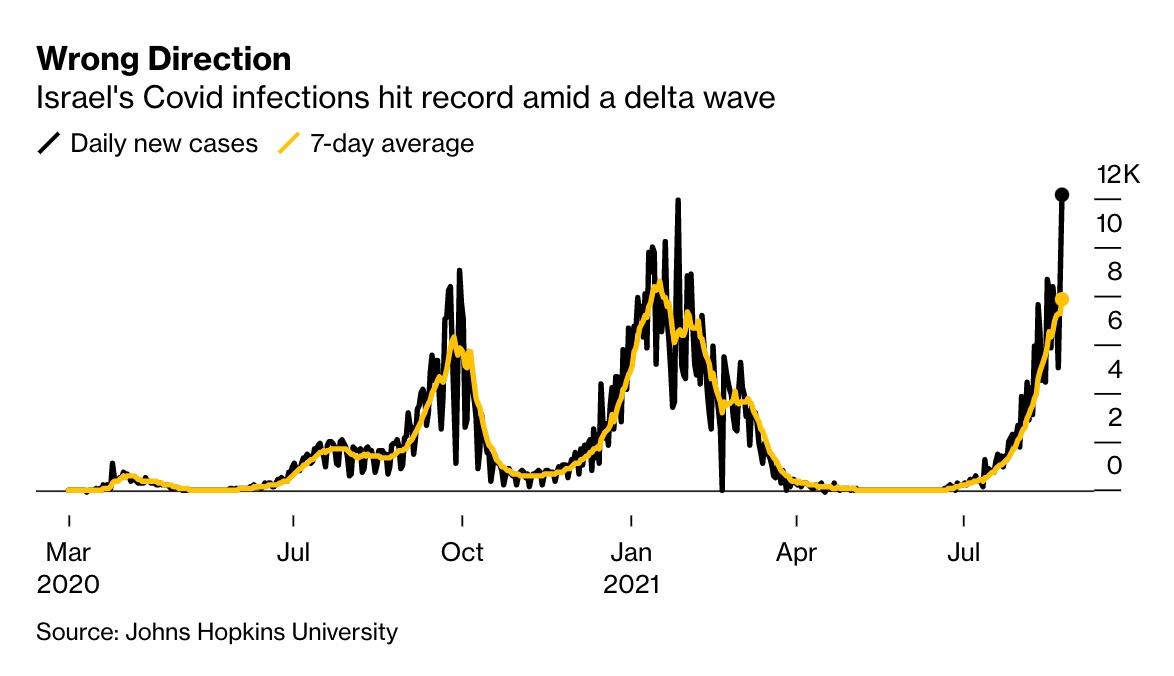
Source: Bloomberg

At the very least, the results of the study are good news for patients who have already successfully battled COVID but show the challenge of relying exclusively on immunizations to move past the pandemic.

"This analysis demonstrated that natural immunity affords longer lasting and stronger protection against infection, symptomatic disease and hospitalization due to the delta variant," the researchers said.

Unfortunately, the study also showed that any protection is time-limited. Protection offered by natural infection wanes over time, just like the protection afforded by vaccines: The risk of a vaccine-breakthrough delta case was 13x higher than the risk of developing a second infection when the original illness occurred during January or February 2021. That's significantly more than the risk for people who were ill earlier in the outbreak.

What's more, giving a single shot of the vaccine to those who had been previously infected also appeared to boost their protection. Still, the data don't tell us anything about the long-term benefits of booster doses.

This latest data showing the vaccines don't offer anywhere near the 90%+ protection that was originally advertised by the FDA after the emergency authorization. Other studies are finding harmful side effects caused by the mRNA jabs are also more prevalent than previously believed.

Read the study pre-print below:

2021.08.24.21262415v1.full by Joseph Adinolfi Jr.


https://www.zerohedge.com/covid-19/ends-debate-israeli-study-shows-natural-immunity-13x-more-effective-vaccines-stopping

Chembio Launches Commercial Distribution of 3rd-Party COVID-19 Antigen Assay

 Chembio Diagnostics, Inc. (Nasdaq: CEMI), a leading point-of-care diagnostics company focused on infectious diseases, today announced its launch of commercial distribution of an FDA Emergency Use Authorized, patent pending, rapid point-of-care COVID-19 antigen test for use in decentralized and traditional testing settings. Product inventory is on-hand and immediately available for shipment to Chembio customers across the United States.

The SCoV-2 Ag Detect™ Rapid Test, manufactured by InBios International, Inc., is a rapid immunoassay test authorized for use in laboratories with a CLIA waiver certification. It provides results in 20 minutes from a nasal swab and requires no instrumentation. The test can be used for both patients who are suspected of COVID-19 by their healthcare provider within 5 days of symptom onset and for asymptomatic serial testing.

“We are excited about the addition of this differentiated product to our menu of COVID-19 assays,” said Charles Caso, Vice President of Sales and Marketing for Chembio. “We are now offering U.S. customers SCoV-2 Ag Detect™, a test for COVID-19 antigens in both symptomatic and asymptomatic populations, as well as Status™ COVID-19/Flu A&B, a product that differentiates flu from COVID-19 using a single nasal swab sample. Our expanded commercial team can now offer testing solutions for CLIA waived settings and work and school settings.”

“The SCoV-2 Ag Detect™ Rapid Test complements our internal development efforts on our DPP Respiratory Panel product and our DPP SARS CoV-2 Antigen assay,” continued Mr. Caso. “We believe this product is an important addition to our portfolio at a time when testing volume is increasing as Delta variant infections are on the rise. The United States has seen a spike in 7-day average confirmed COVID-19 cases from a 2021 low of 11,651 on June 18, 2021 to 133,056 as of August 18, 2021, per the U.S. Centers for Disease Control and Prevention tracking data.”

BioNTech Evaluates mRNA Vaccine Manufacturing in Rwanda, Senegal to Up Long-Term Supply

 BioNTech SE (Nasdaq: BNTX, "BioNTech" or "the Company") agreed today to evaluate the establishment of sustainable vaccine manufacturing capabilities in Rwanda and Senegal to support vaccine supply for the Member States of the African Union. Following the invitation of the kENUP Foundation, President Paul Kagame of Rwanda, President Macky Sall of Senegal, and President Ursula von der Leyen of the European Commission met U ur ahin, CEO and Co-Founder of BioNTech in Berlin to discuss the development of sustainable vaccine production for Africa. The meeting resulted in a joint communiqué affirming BioNTech's intention to manufacture mRNA vaccines arising from its Malaria and Tuberculosis vaccine development programs on the African continent.

"We would like to thank all participants for today's discussion and for the support and trust they put in us. Our goal is to develop vaccines in Africa and set-up sustainable vaccine production capabilities to jointly improve medical care," said Prof. Dr. Ugur Sahin, CEO and Co-founder of BioNTech. "We are committed to investing in cutting-edge research and innovation to support vaccine development in addition to the establishment of manufacturing facilities and build-up of manufacturing expertise on the African continent."

BioNTech has already started the evaluation of manufacturing capabilities, following the Company's announcement of its aim to develop a well-tolerated and highly effective Malaria vaccine and to implement sustainable end-to-end vaccine supply solutions on the African continent. The decision to evaluate manufacturing solutions in Rwanda and Senegal follows the guidance of the African Union, the Africa Centres for Disease Control and Prevention (Africa CDC) and the African Medical Agency under formation. The prospective locations of the necessary manufacturing sites are expected to co-locate with the World Health Organization's (WHO) upcoming Vaccine Hubs. These efforts will be aligned with the Team Europe Initiative on manufacturing and access to vaccines, medicines and medical technologies (MAV+) led by the European Commission in collaboration with the EU Member States.

Dr. John Nkengasong, Director of the Africa CDC, Dr. Matshidiso Moeti, WHO Africa Regional Director, and Dr. Werner Hoyer, President of the European Investment Bank (EIB), also participated in the meeting, which took place at the margins of the G20 Compact with Africa Summit. The WHO, the European Commission and other organizations have previously been involved in the early planning phase of BioNTech's Malaria project and have offered their support to identify and set up the necessary infrastructure.

https://www.marketscreener.com/quote/stock/BIONTECH-SE-66771992/news/Press-Release-Joint-Communique-BioNTech-Evaluates-mRNA-Vaccine-Manufacturing-Solutions-in-Rwanda-36263059/

Exit game: Central banks' shift from crisis policies gathers momentum

 While the financial world waits for the Federal Reserve to start reversing its ultra-loose policy stance, recent moves by a clutch of other central banks signal the days of pandemic-era accommodation are already numbered even as COVID-19 continues to impede smooth economic recoveries around the world.

South Korea’s central bank on Thursday raised its benchmark interest rate by a quarter of a percentage point to blunt rising financial stability risks posed by a surge in household debt, becoming the first major monetary authority in Asia to do so since the coronavirus broadsided the global economy 18 months ago.

Even before the rate hike in South Korea, though, central banks in Latin America and eastern and central Europe had begun lifting interest rates this year to beat back inflation that is building on the back of currency fluctuations, global supply chain bottlenecks and regional labor shortages.

And larger-economy central banks also are getting into the swing. The Bank of Canada has already cut back on its bond purchases and could proceed to raise borrowing costs in 2022, and the Reserve Bank of New Zealand (RBNZ) is expected to lift rates by the end of this year despite balking at an expected hike last week in the face of a snap COVID-19 lockdown.

For its part, the Fed is lumbering toward tapering its $120 billion in monthly asset purchases, with an announcement expected before the end of 2021, possibly as early as next month. An actual U.S. interest rate increase is likely a year or more away, however.

Fed Chair Jerome Powell is set to speak later on Friday on the economic outlook at the U.S. central bank’s annual Jackson Hole summer research conference, which is being held virtually for the second year in a row. His remarks may color expectations at the margin for when the Fed makes its move but are not likely to offer any concrete signal.

THE DIFFERENCE A YEAR MAKES

When Powell spoke at last year’s conference - unveiling a new policy framework that is just starting to be tested - fewer than half of the 22 million U.S. jobs lost to coronavirus shutdowns in the spring of 2020 had been recovered and inflation was running at half the Fed’s 2% target rate. The outlook outside the United States was no less bleak, with lockdowns still widespread.

The situation in the United States and other economies could hardly be more different a year later.

The U.S. economy has more than fully recouped all of its lost output, roughly 9 million more jobs have been regained and inflation is well above target. Elsewhere, most of the world’s economies are back squarely in growth mode, albeit unevenly so in many cases as COVID-19 outbreaks fueled by the highly contagious Delta variant trigger localized lockdowns.

In South Korea, the economy grew 5.9% on a year-over-year basis in the second quarter, the fastest pace in a decade, and young people are bingeing on debt and kindling financial stability concerns at the Bank of Korea. The export-reliant Asian nation’s key factory sector expanded in July for a 10th straight month, even as the Delta variant crimped manufacturing output for rivals like China, Vietnam and Malaysia.

Central Europe’s recovery also accelerated in the second quarter as lockdowns in the region eased. The improvement - along with an upswing in inflation - has already spurred the Czech central bank to raise interest rates twice this summer and the Hungarian central bank to deliver its third hike on Aug. 24, the first increases across the European Union. Both are expected to deliver more tightening, and Czech officials are debating if they need to deliver more than the standard quarter-percentage point increase.

While the earliest movers have been emerging market countries where inflation is often aggravated by movements in choppy currency markets, the gears of tightening are also starting to move in top-tier economies.

The RBNZ opted not to raise rates last week because of the messaging complications that would have arisen from such a move alongside a hastily-called lockdown after the island nation reported its first local COVID-19 infection in six months. Central bank officials, however, appear determined to get a rate hike in before the year runs out.

Meanwhile, Norway’s central bank is signaling it will not veer from its plan for its first rate hike next month despite a recent rise in infections, putting it on course to be the first of the Group of 10 (G10) developed economies to raise borrowing costs.

“In the committee’s current assessment of the outlook and balance of risks, the policy rate will most likely be raised in September,” Norges Bank Governor Oeystein Olsen said in a statement last week.

While the Fed and several other G10 banks now appear on course to start reducing their pandemic accommodation measures this year, tightening moves by the Fed’s two largest peers - the European Central Bank and Bank of Japan - look much further off.

Still, that doesn’t mean they don’t see some improvement in conditions even as the Delta variant spreads.

Japan was among the Asian economies to experience factory sector growth last month even as COVID-19 cases hit a record high. And a key ECB policymaker sees only a limited headwind to the euro zone’s recovery due to the variant.

“I would say we’re broadly not too far away from what we expected in June for the full year,” Philip Lane, the ECB’s chief economist, told Reuters on Wednesday. “It’s a reasonably well-balanced picture.”

https://www.reuters.com/article/usa-fed-jacksonhole-global/exit-game-central-banks-shift-from-crisis-policies-gathers-momentum-idUSL1N2PW2PE

Fed's Bostic says 'reasonable' to begin bond-buying taper in October

 It would be “reasonable” for the Federal Reserve to trim its bond-buying program beginning in October if strong job gains continue, Atlanta Fed President Raphael Bostic said in the latest call by a U.S. central banker to start tapering the purchases soon and end them fast.

FILE PHOTO: Federal Reserve Bank of Atlanta President Raphael Bostic participates in a panel discussion at the American Economic Association/Allied Social Science Association (ASSA) 2019 meeting in Atlanta, Georgia, U.S., January 4, 2019. REUTERS/Christopher Aluka Berry//File Photo

The Fed has been buying $120 billion in U.S. Treasury bonds and mortgage-backed securities each month to stem the economic fallout from the coronavirus pandemic, but is now moving toward reducing the stimulus as the recovery gains momentum.

“I would be comfortable with an October timeline for starting this” if U.S. job growth in August matches the nearly one million jobs that were added in each of the previous two months, Bostic told Reuters in an interview published on Friday.

The Fed could announce a plan to “taper” the asset purchases at its Sept. 21-22 policy meeting. A change is expected sometime this year, with debate still unfolding over when the plan should be announced and how fast the purchases should be reduced.

Bostic said that, once the taper started, he was “definitely looking to get this done as quickly as possible,” and could support a full end to the Fed’s asset purchases “toward the end of Q1” of 2022.

He spoke to Reuters ahead of the Fed’s marquee Jackson Hole research conference, which will be kicked off with a speech on Friday by Fed Chair Jerome Powell. Bostic is a voting member of the Fed’s policy-setting committee this year, and joins a vocal group of mostly Fed regional bank presidents who are ready to end one of the central bank’s signature pandemic programs.

Beyond the taper debate, however, Bostic delved into the Fed’s next-phase discussion of when to raise interest rates.

Since early this year he has said he expected inflation to be stronger than expected, and anticipated the Fed will need to lift its benchmark overnight interest rate above the current near-zero level sometime in 2022 - a step towards tempering the economic expansion to ensure prices remain under control. Most of his colleagues don’t see rates rising until 2023 or later.

But more fundamental than the timing, Bostic said he felt Fed officials needed to begin to talk more precisely about how their new inflation approach will play out in practice, particularly now that the pace of price increases has run faster, for longer, than expected.

Inflation this year is pushing 4%, and the pace of the price hikes has been so strong this year that it has pushed average U.S. inflation over a period of several years up to the Fed’s 2% target.


Reuters Graphic

Under a new approach adopted a year ago, the Fed is focusing on that average figure and will allow high-inflation “overshoots” to help reach it. But the central bank is not explicit on how long the averaging period should run or how much of an overshoot might be tolerated.

“By some metrics that are straightforward we have already met the goal,” Bostic said, adding that the Fed will face inevitable questions about what yardstick it will use. “We should be transparent to the marketplace. This is our first round going through this and approaching this benchmark, so I do think there is value in thinking about how to communicate and signal more directly where we think we are.”

A second pledge, to get the economy to “maximum employment,” is also undefined, but assessments of that will have to be a “game-time decision” for Fed officials weighing the labor market recovery against inflation risks that may emerge, Bostic said.

The Fed has said the job gains should be “broad-based and inclusive,” but Bostic said at the same time “there is not a consensus view on a metric” for measuring the completeness of a jobs recovery.

“There is not a clean analogue on the employment side relative to what we have for inflation,” he said. If an interest rate hike seems required, but the job recovery seems less than finished among different demographic groups, “policymakers ... will have to decide and weigh the risks of forbearance ... There is a learning curve to how it is going to play out.”

‘THE MATH’

For the more imminent decision about the bond-buying taper, however, Bostic said the numbers are starting to add up.

A gain of around 700,000 or more jobs in August would mean the U.S. economy will have reclaimed half of the 10 million jobs missing because of the pandemic as of last December, when the Fed promised it would continue its bond purchases until there had been “substantial further progress” in the recovery.

“That is the math that I am doing,” Bostic said.

Reuters Graphic

There are other calculations in the mix, including to what extent a surge in coronavirus cases fueled by the highly contagious Delta coronavirus variant hurts the economy.

Concerns about COVID-19 risks prompted the cancellation last week of the in-person portion of the Fed’s Jackson Hole conference in Wyoming. It will be held on a virtual platform for the second year in a row.

The shift highlighted the risks the Fed faces as it plans its transition from emergency programs set in place in the spring of 2020 to policies needed to manage bursts of both economic growth and inflation more reminiscent of the 1970s.

Bostic said the rise and spread of the Delta variant had not changed his economic outlook in any fundamental way so far.

“What I have seen is some suggestion that things are slowing down, but they are still just slowing from extremely high levels. I have not seen big changes in the underlying dynamic,” Bostic said.

https://www.reuters.com/article/us-usa-fed-bostic-exclusive/exclusive-feds-bostic-says-reasonable-to-begin-bond-buying-taper-in-october-idUSKBN2FS0UQ

Fed Chair Powell's big moment and 3 ways he could play it


The stakes for Federal Reserve Chair Jerome Powell when he delivers a speech on Friday, his fourth at the influential Jackson Hole economic symposium hosted each August by the Kansas City Fed, could not be much higher.

Investors and traders will hang on his every word, from his assessment of the progress in the labor market and his outlook for inflation, to any details on when and how he'd expect to start trimming the central bank's support for the economy.

Perhaps even more importantly, his words will be scrutinized by a White House considering whether to keep him for another four years, or nominate another leader to take over when his term expires in February.

"It's an opportunity for him. If he really impresses people that he's on top of all this, then that could really smooth the way for his reappointment," says Dartmouth College's Andrew Levin, an adviser to former Chair Janet Yellen and who in recent weeks has publicly advocated for a change in Fed leadership.

Yellen, who is now Treasury Secretary, has reportedly told senior advisers to President Joe Biden that she backs reappointing Powell.

Here are three approaches Powell may take in his speech:

UNEVEN OUTLOOK

The highly contagious Delta variant of the coronavirus has set off a fourth wave of the pandemic in the United States, and for some regions - like much of the South - it has become the worst yet. Assessing its impact is one way Powell could go.

For example, infections, hospitalizations and deaths in Florida, the country's fourth-largest state economy, are all at record highs. High-frequency data indicators of consumer behavior show marked drop-offs in restaurant bookings and retail foot traffic there.

Still, those declines more likely represent "a loss of momentum rather than a pullback in economic activity," Jefferies Chief Financial Economist Aneta Markowska wrote this week.

That dovetails with the line Powell and his colleagues have taken this summer: that consumers and businesses have learned to navigate the riskier health environment.

Nearly 1.9 million jobs were created in June and July, though that pace may have moderated in August. Still, many economists expect employment to fully recoup the 22 million jobs lost to COVID shutdowns in 2020 by next year.

Overall, the economy has more than retraced the drop in output, and while some economists have lowered estimates for the current quarter, they are merely shifting growth into later periods rather than wiping it off the board.

Nodding to all that would put Powell in position to reiterate that the Fed is making progress - perhaps "substantial further progress" - toward its goals of full employment and 2% inflation. Clearing that hurdle sets the stage for the start of the "taper" later this year, when the Fed is expected to slow its $120 billion a month of bond purchases aimed at keeping rates low and supporting the economy.


"Substantial further progress" for the Fed?

TAPER TALK

Powell may decide to use the speech to shape expectations around when and how the taper may play out.

A number of the Fed's more hawkish policymakers engaged in their own effort on that score Thursday, with the heads of three regional banks all stumping for a quick start to the taper. Other policymakers have previously said they'd prefer to see a few more months of data, given the Delta surge.

Fed policymakers meet to discuss their next moves in mid-September.

Even if he doesn't offer any new details, Powell may take the opportunity to remind investors that a reduction in asset purchases is separate from an interest rate hike. The Fed has set separate hurdles for that, and Powell has previously said those will not be met for quite a while.

With inflation already running well above target, a growing number of policymakers concerned it may not recede as quickly or definitively as previously expected, and employment still well short of the labor market's true capacity, the Fed may face tough choices ahead.


Fed's communications report card

IT'S THE FRAMEWORK, STUPID

Powell could push back against emerging criticism of the new framework, which allows for more tolerance for above-target inflation in deference to allowing the economy to run "hot" long enough to foster the kind of robust labor market that had taken hold just before the pandemic.

Powell unveiled the framework at last year's Jackson Hole conference when the biggest threat to recovery was seen to be the enormous jobs hole left by COVID. Few, if any, policymakers imagined inflation - then running at barely half their target - would emerge so quickly as a force to be reckoned with, perhaps at the expense of completing their work helping the job market fully rebound.

Powell could argue that jobs and inflation are not in conflict, that they are not on course for an either-or moment when policymakers must sacrifice the one to contain the other.

Many of the factors driving inflation now do appear connected to the task of restarting a $20 trillion economy, and some - like used car prices - are already showing signs of moderating. Moreover, even those inside the Fed most anxious about inflation concede the last several months of rapid price increases have not resulted in a material lift to inflation expectations, which should anchor a return to a more palatable inflation situation.

Even this approach comes with some risk, potentially leaving Powell to look defensive about rather than confident in his new policy blueprint. And addressing the issue at all could be a tacit acknowledgement of a deeper debate underway.

On the first anniversary of the framework, though, it's arguably the moment for a full-throated defense of a change in monetary policy that will define Powell's legacy if it works, and which has been a key reason even some of the most progressive allies of Biden support his renomination.

https://www.marketscreener.com/news/latest/Fed-Chair-Powell-s-big-moment-and-3-ways-he-could-play-it--36262603/

CVS Limits Purchases of Rapid Covid-19 Tests, Citing Demand

 CVS Health Corp. is limiting customers’ purchases of rapid, over-the-counter Covid-19 tests, with a maximum of six packages available online and four in its pharmacies, as the spread of the delta variant spurs demand.

Put in place this week, the limits apply to Abbott Laboratories’s BinaxNOW along with a test from the startup Ellume, according to an email from a CVS spokesperson. Both tests are available without a prescription.

Surging interest in rapid virus tests have made the products a scarce commodity at some online retailers and in certain stores. 

https://news.bloomberglaw.com/health-law-and-business/cvs-limits-purchases-of-rapid-covid-19-tests-citing-demand