Search This Blog

Tuesday, September 13, 2022

Team Biden still can’t get the baby-formula shortage under control

 Team Biden just trumpeted that another flight carrying imported baby formula is on its way, this one from Australia. More formula for our nation’s babies is a good thing, but the announcement feels like this administration merely has its finger in the dike and isn’t dealing with the root causes of a broken market.

The average out-of-stock rate in stores and online last month stood at 61%, per Datasembly. The administration has yet to take full responsibility for the shortage while also taking a painfully long time to rectify it.

In fact, the Food and Drug Administration has dragged its feet, taking three months just to relax requirements for imported formula — even though it was an emergency and all the major European formula brands but one met FDA nutrient requirements. A vaccine to combat COVID took less time to be developed; at the same point into the pandemic as we are now at with the formula shortage, we almost had a vaccine emergency-use-authorization application done.

It’s so bad that even in its Monday “good news” press release announcing the newest flight, the administration points users to a website that doesn’t exist, delivering an “Error 404” message — the Internet’s version of “Womp, womp.” If doctors acted like the Biden team, they would lose their licenses.

The shortage is pretty simple to understand. First, the government shut down a baby-formula plant in February after several infants tragically died and one correlational data point was they were all drinking formula produced at the same plant. Formula produced at that plant was recalled, and the plant was shut down. The bacteria that caused the children’s illnesses, however, was not found at the plant. It took time get the clearance needed to restart the plant, and in the meantime the problem got worse.

This shutdown unmasked an even bigger problem — there are so few baby formula plants in the United States that a single shutdown can have major consequences, as we’ve been seeing.

That doesn’t mean we need new legislation mandating more baby-formula manufacturers and plants. In fact, the right answer is that we need less government, not more.

Doctors have been calling for less government in health care for years — and politician after politician, year after year, and party change after party change kept going the other way and adding more and more regulations to the market. Everything changed when COVID swept across the globe. Members of Congress saw that the glut of restrictions that had been put on doctors was making it impossible for their constituents to be cared for in a timely way.

Joe Biden
President Joe Biden announced there is another load of formula heading to US.
Reuters/Jonathan Ernst

In response, our elected officials rolled back rules about data sharing and health care. They rolled back rules regarding certificate of need (or how many surgical beds were allowed in a state). And they rolled back laws around licensing, making it easier for doctors to see patients in multiple states (or over the phone). It was only after state and federal officials began waiving rules and regulations that things began improving. And of course, the COVID vaccines only came about so quickly because the FDA condensed its review process.

The answer to the pandemic was less government, not more. The answer to the formula shortage is likely also less government instead of more, but an administration that won’t admit anything is wrong is never going to arrive at the correct and enduring solution.

It’s bleak to think that the future of raising a child in the United States is a 61% out-of-stock rate on baby formula. Or maybe the Biden team could just get out of the way and let entrepreneurs solve the problem the same way they have done with almost every other challenge in America.

Marion Mass is a Philadelphia-area pediatrician who trained at Duke University Medical School and Northwestern University and a co-founder of Practicing Physicians of America.

https://nypost.com/2022/09/12/months-in-team-biden-still-cant-get-the-baby-formula-shortage-under-control/

Monday, September 12, 2022

Natera Presents New Colorectal and Breast Cancer Data at ESMO

  Natera Inc. (NASDAQ: NTRA), a global leader in cell-free DNA testing, today announced new data on its personalized and tumor-informed molecular residual disease (MRD) test, Signatera, at the 2022 European Society for Medical Oncology (ESMO) World Congress, taking place September 9-13 in Paris, France.

Signatera data was presented in 4 abstracts, including both oral and poster presentations. These include results from a real-world study on colorectal cancer (CRC) patients as well as an early readout from the BELLINI trial that highlights how circulating tumor DNA (ctDNA) dynamics can help inform neoadjuvant treatment decision-making in hormone receptor negative, HER2 negative (triple-negative) breast cancer (TNBC).

https://www.biospace.com/article/releases/natera-presents-new-colorectal-and-breast-cancer-data-at-esmo-2022-highlighting-signatera-s-ability-to-inform-treatment-decisions-in-the-adjuvant-and-neoadjuvant-settings/

FDA Action Alert: Obseva, bluebird bio and Heron

 The U.S. Food and Drug Administration is heading into fall with a few new Prescription Drug User Fee Act (PDUFA) dates. Here's a look at this week's upcoming action. 

Obseva's Linzagolix for Uterine Fibroids

Obseva, based in Geneva, Switzerland, has a target action date of Sept. 13 for a New Drug Application (NDA) for linzagolix to treat uterine fibroids.

The drug is the first and only GnRH receptor antagonist that provides flexible dosing options, including a low dose for women who can't or do not want to take hormones.

The NDA was built on data from two Phase III PRIMROSE trials (1 and 2). The studies evaluated two dosing regimens, 100mg once daily and 200mg once daily, alone or in combination with hormonal add-back therapy (ABT). This is for the treatment of heavy menstrual bleeding linked to uterine fibroids. The NDA was made up of positive 24-week treatment data from both trials and supportive data from Week 52 and 76-week post-treatment follow-up.

Bluebird bio's Eli-Cel for Cerebral Adrenoleukodystrophy

Bluebird bio has a target action date of Sept. 16 for its gene therapy, elivaldogene auto excel (eli-cel), for cerebral adrenoleukodystrophy (CALD).

Eli-cel has tended to be linked with bluebird's other gene therapy, Zynteglo (betibeglgene autotemcel) for beta-thalassemia, which the FDA approved on Aug. 18. Both had PDUFA goal dates three months earlier, which were pushed back when the agency requested additional material. They both use a Lenti-D lentiviral vector.

"We all share a responsibility to be diligent for patients as we progress this novel field," said bluebird CEO Andrew Obenshain in a Jan. 18 statement.

CALD is a progressive, irreversible and eventually fatal disease that primarily affects young children. It is a neurologic disorder that causes rapid loss of neurological function after the initial onset of the disease. Almost half of the patients who aren't treated die within five years of the start of symptoms. 

The accumulation of very long-chain fatty acids (VLCFA) in the adrenal cortex and the brain and spinal cord white matter destroys myelin, the protective sheath of the brain nerve cells responsible for thinking and muscle control.

Eli-cel utilizes ex vivo transduction with the Lenti-D lentiviral vector (LVV) to insert functional copies of the ABCD1 gene into a patient's own hematopoietic stem cells (HSCs). This allows patients to manufacture the ALD protein, which is believed to help break down very long-chain fatty acids.

Heron's HTX-019 for Prevention of Postoperative Nausea and Vomiting 

Heron Therapeutics has a target action date of Sept. 17 for its NDA for HTX-019 for the prevention of postoperative nausea and vomiting (PONV).

The drug is an IV injectable emulsion formulation designed to deliver aprepitant, the active ingredient in EMEND capsules, directly. This is the only Neurokinin 1 receptor antagonist (NK1 RA) approved in the U.S. 

EMEND was approved by the FDA for oral dosing within three hours before induction of anesthesia for surgery. In a Phase I trial, HTX-019 32mg as a 30-second IV injection was bioequivalent to oral aprepitant 40mg.

"In a recent Cochrane Meta-Analysis, aprepitant was found to be the most effective agent for PONV prevention with activity similar to two-drug combinations," said Barry Quart, Pharm.D., chairman and CEO of Heron, in a November 2021 statement. "In fact, the use of oral aprepitant has grown by almost 80% in the past three years without any promotional efforts."

https://www.biospace.com/article/fda-action-alert-obseva-bluebird-bio-and-heron/

Pfizer, Moderna, CVS Among Goldman Sachs Most Underweighted Value Stocks

 With the S&P 500 falling 14% year to date but rising 5% since just Sept. 6, you can make arguments for buying stocks or for staying away.

For those of you who plan to purchase stocks or at least keep them in your portfolio, Goldman Sachs strategists, led by David Kostin, offer these four insights to “drive performance” through year-end.

1. “Stocks with quality fundamental metrics will benefit, because tightening financial conditions and the increased cost of capital will constrain valuation expansion for the overall market,” the strategists wrote in a commentary.

2. “Value stocks will outperform under two scenarios – if inflation peaks in the near future and focus turns to the end of the hiking cycle, but also if the Fed tightens too much and the economy slips into recession.

3. “Dividends offer investors exposure to S&P 500 fundamental growth while minimizing exposure to equity valuation risk.

4. “Stocks with primarily domestic revenues will outperform companies with a high proportion of foreign sales.”

Rate Hikes

As for financial conditions, Goldman Sachs expects the Federal Reserve to lift interest rates by 75 basis points in September, 50 basis points in November and 25 basis points in December.

Looking at value stocks, “value has historically outperformed growth when inflation peaks and the Fed hiking cycle ends,” the strategists said.

But investors are concerned about recession. “And history shows value stocks outperform around the start of recessions,” they said.

Their baseline forecast calls for the S&P 500 index to end the year at 4,300. That’s up 5% from the afternoon of Sept. 12.

“Incorporated in our forecast are several important assumptions,” the strategists said.

· “The Fed’s forceful pace of tightening will lead to continued deceleration in economic growth during the next several months,

· “The 10-year Treasury yield will end the year roughly unchanged from the current level of 3.3%, and

· “The projected pace of 2023 S&P 500 earnings growth will equal 3%, versus 7% now.”

Troubles Overseas

As for the outlook overseas, “the path of U.S. growth may be uncertain, but the economic situation in Europe is dire,” the strategists said. Goldman Sachs expects recessions in both the U.K. and the euro area.

“Despite concerns that investors have about the U.S. equity market, we believe it offers greater absolute and risk-adjusted return potential than recession-plagued European markets,” the strategists said.

Goldman Sachs cites 25 stocks “in the long leg of our value factor that value-oriented mutual funds are most underweight.” Here are the top 10 starting with the most underweight.

1. Pfizer  (PFE, the drug giant.

2. AT&T  (T, the telecommunications giant.

3. Moderna  (MRNA, the biotech company.

4. Ford Motor  (F, the auto titan.

5. Altria  (MO, the tobacco company.

6. Consolidated Edison  (ED, a utility.

7. CVS Health  (CVS, the healthcare company.

8. Ventas  (VTR, a real estate investment trust.

9. Micron Technology  (MU, a semiconductor maker.

10. Nucor  (NUE, a steel maker.

https://www.thestreet.com/investing/goldman-underweighted-value-stocks-pfizer

Novocure will release data from a pivotal lung cancer trial early next year


  • Novocure's Optune is already FDA-approved for glioblastoma and mesothelioma.
  • Optune uses specially tuned frequencies to disrupt cancer cell division, improving outcomes.
  • Phase 3 trial data is expected in stage IV non-small cell lung cancer in January.

World on Fire

 by Jeffrey Tucker via The Brownstone Institute,

Every day, news reporters, traders, and workers of all sorts the world over wake to do their work as they always have. Part of that requires that everyone pretend that life is normal, fixable, and more or less stable. All of this is temporary. It will come and go and really not be that bad. 

Strange, isn’t it? Human beings have a hard time adjusting to disaster, in their decision-making and even in their mindset. Reporters have to do their jobs as they are trained. Traders too. Everyone does. They please their bosses. They don’t sound alarms. They don’t scream and yell as they probably should. 

But there is a moment in the day when the work is done and perhaps a cocktail comes out or the dishes are washed and the kids are in bed and the room falls silent. At this moment, millions and billions of people the world over know it. Disaster is all around us. We are just pretending otherwise, simply because this is what we have to do. 

It was this way during lockdowns. They must know what they are doing otherwise why would we be forced to do this. If we all do our part, maybe this will end sooner rather than later. The experts surely know better than we do what is what. What can we do but trust?

Let us adjust and find a way to normalize all of this in our minds. We are powerless to change it in any case. 

And thus the peoples of the world adjusted and will continue to do so as the fundamentals decay and rot, long past the end of lockdowns and most vaccine mandates, even as all the old rituals and signals of life as we once knew it fade further into memory. 

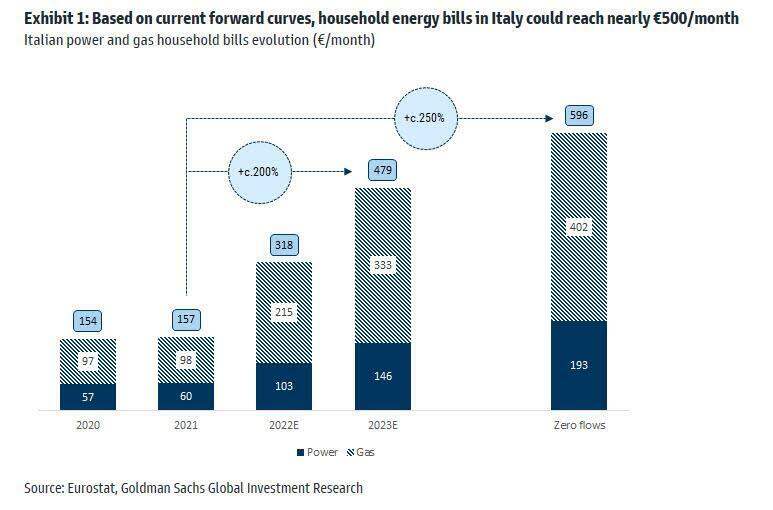
Enough with the dreary existentialism. Let’s talk about life in a one-bedroom apartment in London. The price of energy for heat has nearly doubled, seemingly overnight. Truly, it took months but it has felt like one day to the next. The energy bills will be approaching a substantial portion of the rent itself. And the forecast — which one has to do because that’s how energy markets work on the consumer end — is showing a doubling and doubling again. 

Here is what Goldman Sachs is seeing. 
Small businesses cannot function under these conditions. “Tom Kerridge, the celebrity chef, revealed that the annual energy bill at his pub has soared from £60,000 to £420,000 and warned that ‘ludicrous’ price rises left the hospitality sector facing a ‘terrifying landscape’,” reports Telegraph. 

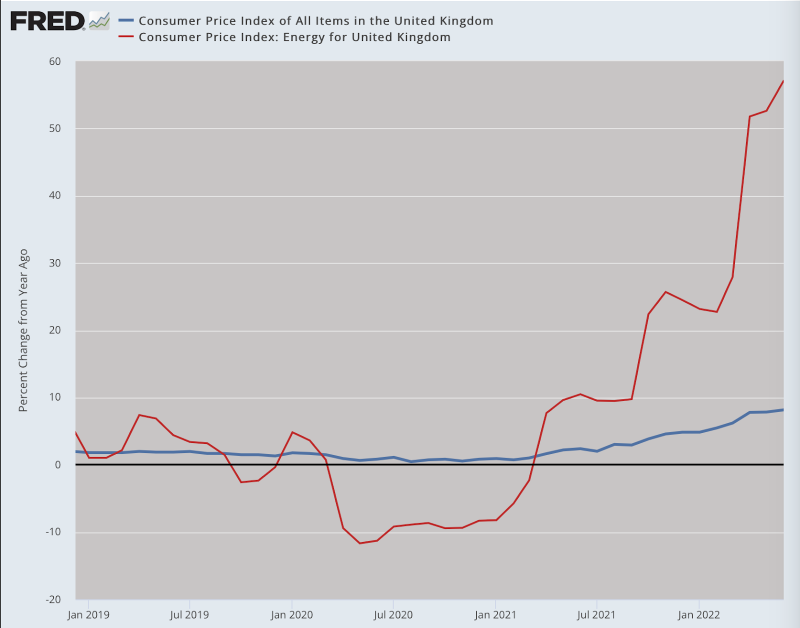
This is all running wildly ahead of consumer prices generally. This is only through June. We are already approaching 100% inflation in energy. 
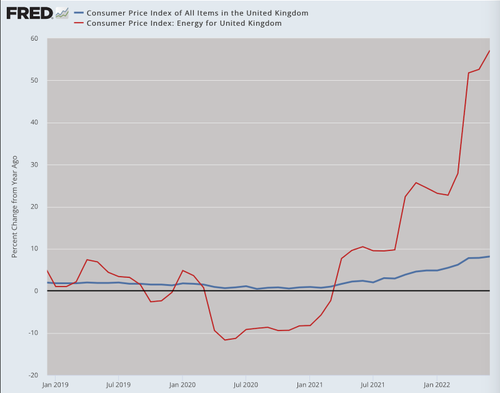
Many will need to close up shop. The new Prime Minister Liz Truss, who calls herself a conservative, has capped price increases for consumers while pushing the largest spending bill to bail out energy companies ever. It truly seems like she had no choice. Yes, that’s what they all say, but in this case, it might be true simply because otherwise, the entire nation would totally fall apart. 

It could happen anyway. 

“The U.K. may be facing a wave of business bankruptcies exceeding anything witnessed during the post-2008 panic and recession,” reports Joseph Sternberg. “Some 100,000 firms could be forced into insolvency in coming months, bankruptcy consultancy Red Flag Alert warned this week. These are otherwise healthy firms with at least £1 million in annual revenue. Business failures on this scale would dwarf the roughly 65,000 firms of any size that went under from 2008-10.”

Everyone wants to know why. As always, there are a number of factors. The sanctions on Russia for its struggle over the borders of Ukraine were ill-advised. That has never stopped the deployment of such tactics: sanctions against Cuba still in force began 60 years ago, all in an effort to make some foreign state behave in a way that the US demands. 

They have driven up the price of energy all over Europe and the UK. But even then, Russian sources only about 3% of the UK’s energy needs. 

Another culprit is the fanatical attempt on the part of the government to convert a fossil-fuel economy to one powered by the wind and sun. For reasons of climate change, we know how good politicians are at controlling the global climate by taking away your consumer conveniences. 

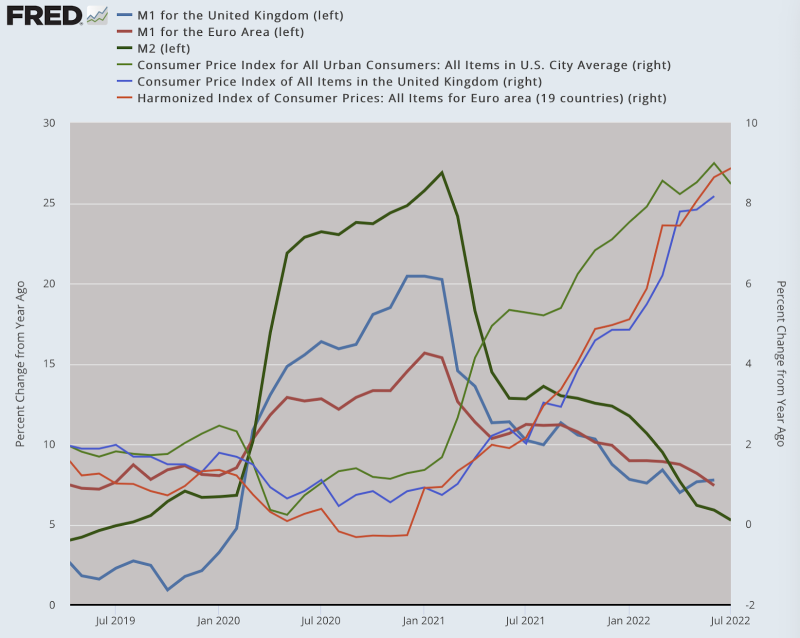
But really even these two factors would not be enough to cause this level of carnage. The real root of the problem is monetary, which in turn traces (again!) to lockdown policies: the wild currency debasement starting March 2020 and continuing through lockdowns has wrecked the place. How could they not see this coming? It’s ridiculous. 

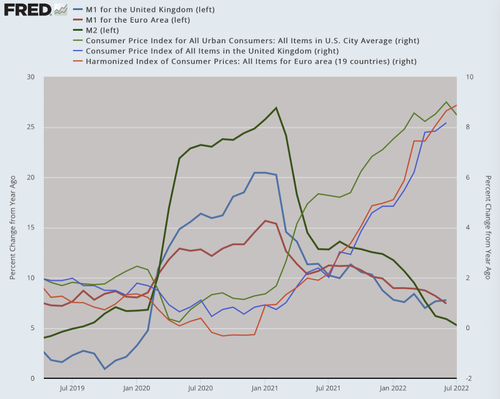
And it happened the world over. The chart below that I put together looks messy but it tells the whole story of how one generation of central bankers wrecked the world. The key on the left tells you monetary inflation rates and the key on the right tells you price inflation rates. One lags the other by 16-18 months. I’ve color-coded it so that you can see the relationships. 

This covers the U.S. (green), the EU (red), and the UK (blue). You can see the massive oceans of paper being pumped out to cover up for the egregious evil of lockdowns. Do you remember those days when governments the world over imagined that they could somehow shut things down while keeping the data looking pretty with the printing press? 
How Quickly Things Fall Apart 

My friends in the UK are truly panicked. They want to come to the U.S. just to get away. But many of my friends are rebels and did not accept the vaccine because they are healthy and under the age of 80. They rejected the jab. Now they cannot come to the U.S. because the U.S. is still imposing rules that forbid travelers from foreign countries who are not vaccinated from getting across the borders. 

These policies again trace to the lockdown era: March 12, 2020, in particular, when the office of the president decided on its own to do the unthinkable and shut travel from Europe, UK, Australia, and New Zealand. It caused family disruption, business loss, and tragedy all around. It is still not normalized, which makes the point: no one in Washington has any regrets. 

This is the essence of policy in America today. Truly people are being locked out of our country for being insufficiently loyal to Pfizer, which seems to be the real government here at home, at least as it pertains to public health. 

The most striking feature of that which afflicts the UK today is the sheer speed of it all. One day life was normal and then suddenly the bills were through the roof. No one could explain why. It was some kind of mystery, and extremely disorienting. 

Why energy, for example? Well, inflation strikes in strange ways. It gravitates to the thing most vulnerable to price hikes. This could be dictated by fashion or policy or both. But when it happens, no power can stop it. 

The story of going from normal to double and triple prices, forecasting to go much higher, reminds me of books I’ve read about Weimar, how things were fine until suddenly they were not and life itself took a shocking turn. 

Until recently, Americans have looked at the chaos abroad and thought oh that’s what these weird foreign people do, just strange stuff with unstable governments and unsound financial systems. And yet right now it is happening to our mirror country across the pond, a place that Americans think of as cousins with a Royal family. 

The remarkable thing is that the UK’s monetary policy was not as bad as the U.S.’s own. The only difference is that there is a larger international market for dollars than for pounds. This allows the Fed a bit of breaking room to do more damage. 

But can it happen here? Yes, certainly, and it could happen before year’s end. The policies of the last three years have created an incredible powder keg. No one knows when it will go off, and no one knows what to do when it happens. 

There are so many other data points: missing workersfood shortages, political instability, and the breathtaking entrenchment of Xi-backed lockdowns in China. 

The world is on fire. Most people are not willing to think about it or talk about it. Yet. 

https://www.zerohedge.com/geopolitical/world-fire

New long-term opioid use after lung cancer surgery tied to 40% higher death risk in next 2 years

 New long-term use of opioids to quell pain after lung cancer surgery is linked to a 40% heightened risk of death from any cause within the next 2 years, finds research published online in the journal Regional Anesthesia & Pain Medicine.

Male sex, older age, use of chemo, anxiety and insomnia are among the factors associated with new long-term (6 or more months) use, the findings show.

Lung cancer is the leading cause of cancer death worldwide, with nearly 2.3 million diagnoses and 1.8 million deaths in 2020. New persistent post-operative  has been reported in up to 12% of patients.

The researchers therefore wanted to know what proportion of them become opioid users for the first time following , whether particular factors are associated with long-term use, and if this is associated with any harmful effects within the subsequent 2 years.

They included all adults diagnosed with  and who had undergone surgery for their disease between 2011 and 2018 in South Korea, details of which were retrieved from the National Health Insurance Service (NHIS) database.

Doctors in South Korea must enter details of their patients' diagnoses, procedures, and prescription drugs in order to be reimbursed for treatment costs by the government. The database also contains background personal information, including age, sex, and household income on every registrant and the date of their death.

Codeine, dihydrocodeine, and tramadol were categorized as less potent opioids; all other opioids, such as fentanyl, morphine, oxycodone, hydromorphone and methadone, were categorized as potent opioids.

The researchers took account of other underlying conditions/disabilities, surgery type and whether it was a repeat or first time procedure, where it was performed, and whether the patient was discharged home or to long-term care.

Some 60,031 adults underwent lung cancer surgery during the study period, and after excluding those who died in hospital or within the first 6 months of discharge, the final analysis included 54,509 of them.

Six months after surgery, 3325 patients (just over 6%) who had recently been prescribed opioids were still taking them: 859 (1.6%) were on potent drugs and 2466 (4.5%) were on less potent drugs.

New long-term opioid use was associated with a heightened risk of death from any cause within the next 2 years; 17.5% (574/3325) of long-term opioid users died compared with 9.5% (4738/51,184) of those not taking opioids.

Compared with those not taking opioids, new long-term users of these drugs were 40% more likely to die within the next 2 years of any cause.

When stratified by potency, those taking less potent opioids were still 22% more likely to die; those taking more potent opioids were 92% more likely to die.

Certain factors were associated with a greater likelihood of becoming a new long-term user: older age, male sex, particular surgical procedures, especially thoracotomy where a cut was made between the ribs, longer length of hospital stay, a greater degree of disability, chemotherapy treatment, and preoperative anxiety and insomnia.

This is an observational study, and as such, can't establish cause. And the researchers highlight that they weren't able to ascertain lung health before surgery, important lifestyle behaviors, such as smoking and drinking, or tumor stage, all of which may have influenced the findings.

But previously published research indicates that opioids may help promote tumor growth and inhibit cancer cell , while also suppressing the immune system, they note.

Additionally, they point out, "This is the first study to identify the association of new long-term  with poorer long-term  after lung cancer surgery using real-world data based on a national registration database."


Explore further

Difficulty swallowing linked to chronic opioid use

More information: New, long-term opioid use after lung cancer surgery is associated with reduced 2-year survival: a retrospective population-based cohort study in South Korea, Regional Anesthesia and Pain Medicine (2022). DOI: 10.1136/rapm-2022-103966
https://medicalxpress.com/news/2022-09-long-term-opioid-lung-cancer-surgery.html