Search This Blog

Thursday, January 19, 2023

BeiGene: BRUKINSA® Approved in U.S. for Chronic Lymphocytic Leukemia

 BeiGene (NASDAQ: BGNE; HKEX: 06160; SSE: 688235), a global biotechnology company, today announced that the U.S. Food and Drug Administration (FDA) has approved its Bruton’s tyrosine kinase inhibitor (BTKi) BRUKINSA (zanubrutinib) for the treatment of adult patients with chronic lymphocytic leukemia (CLL) or small lymphocytic lymphoma (SLL).

https://finance.yahoo.com/news/brukinsa-approved-u-chronic-lymphocytic-220300917.html

Mirati: IND Clearance for Phase 1 for Oral KRASG12D Selective Inhibitor

  Mirati Therapeutics, Inc. (NASDAQ: MRTX), announced today the U.S. Food and Drug Administration (FDA) has cleared the Investigational New Drug (IND) application of MRTX1133, a potential first-in-class oral KRASG12D selective inhibitor for clinical evaluation. KRASG12D mutations impact approximately 180,000 patients in the US and Europe, representing approximately a 2.5-fold increase in prevalence compared to KRASG12C mutations. No targeted oncology treatment options currently exist for these patients.

https://finance.yahoo.com/news/mirati-announces-ind-clearance-u-220000300.html

Supreme Court Probe 'Unable To Identify Who Leaked Roe v Wade Decision'

 The Supreme Court says a team has been unable to find the person responsible for the leak of a draft majority opinion overturning Roe v. Wade:

They have conducted 126 formal interviews of 97 employees, all of whom denied disclosing the opinion.

Despite these efforts, investigators have been unable to determine at this time, using a preponderance of the evidence standard, the identity of the person(s) who disclosed the draft majority opinion in Dobbs v. Jackson Women’s Health Org. or how the draft opinion was provided to Politico.

Investigators continue to review and process some electronic data that has been collected and a few other inquiries remain pending.

To the extent that additional investigation yields new evidence or leads, the investigators will pursue them.

ABVC: ADHD Candidate Safe, Efficacious in Several Dosages in Small Study

 ABVC BioPharma, Inc. (NASDAQ: ABVC), a clinical stage biopharmaceutical company developing therapeutic solutions in oncology/hematology, CNS, and ophthalmology, today announced that Dr. Keith McBurnett, Professor of Psychiatry at the University of California San Francisco, presented the results of the Phase IIa study of its medical treatment, ABV-1505 ADHD, on January 14, 2023 at the 2023 Conference of The American Professional Society of ADHD and Related Disorders (APSARD) Poster Session. APSARD is a world-renowned organization consisting of a broad spectrum of allied mental health experts working to improve the quality of care for patients with ADHD through the advancement and dissemination of research, and evidence-based practices.

The active pharmaceutical ingredient of ABV-1505, PDC-1421, was used in the Phase IIa study which involved six adult subjects with confirmed ADHD. Each patient was administered two doses of PDC-1421 (low, 380mg; and high, 760mg) three times a day for four weeks and a one-week post-treatment follow-up.  The study found that both low and high doses of PDC-1421 were safe, well-tolerated and efficacious during the treatment and the follow-up period. Dr.

McBurnett’s presentation is available on the APSARD website at https://apsard.org/2023-conference/ with a Submission ID number 3001531.

As a result of the Phase IIa study results, ABVC is currently conducting a Phase IIb randomized, double-blind, placebo-controlled study entitled “A Phase II Tolerability and Efficacy Study of PDC-1421 Treatment in Adult Patients with Attention-Deficit Hyperactivity Disorder (ADHD), Part II” that will eventually involve a total of approximately 100 patients at the University of California, San Francisco and five research hospitals in Taiwan.

https://finance.yahoo.com/news/abvc-biopharma-abv-1505-adhd-133000926.html

US Consumer Has Cracked: Discover Plunges After "Shocking" Charge-Off Forecast

 One week ago we looked at the latest consumer credit data where we found not one but two flashing red alerts:

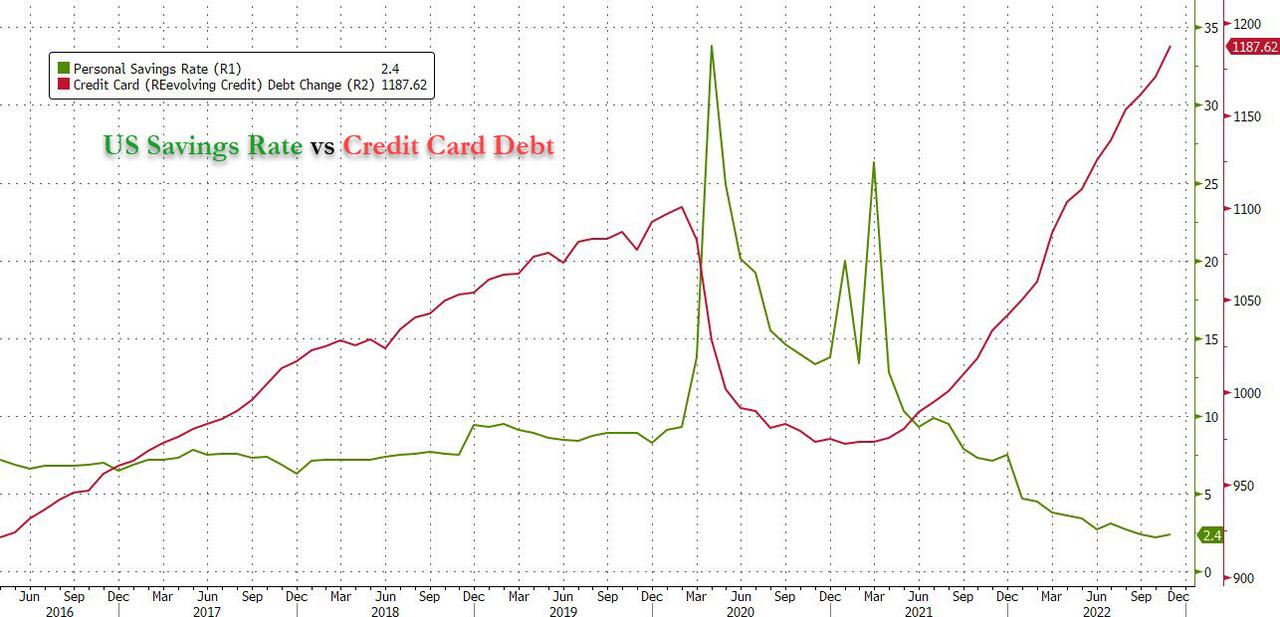
  • First, the total amount of credit card debt hit a new all time high, which however was to be expected from one of the most consistently increasing series across all US economic data, and one which predictably is correlated to the US savings rate which is at all time lows.

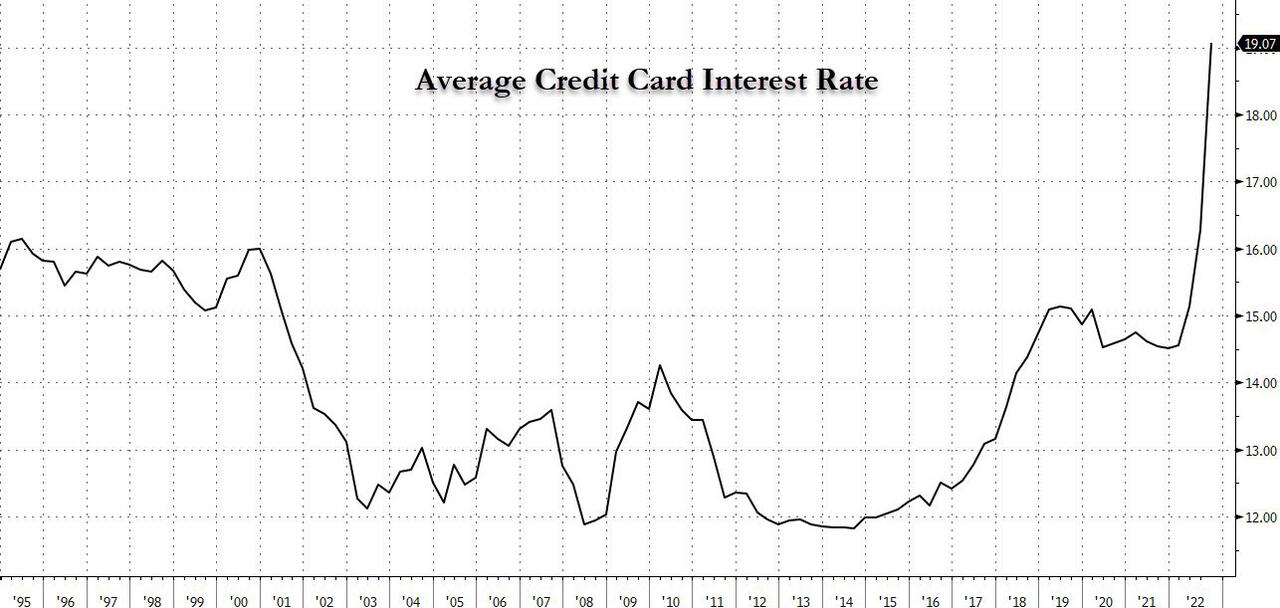
  • Second, thanks to the Fed's crusade to spark a great recession, the average rate across US credit cards just rose to an all time high 19%+

Summarizing these ominous trends we concluded that...

The combination of record high credit card debt and record high credit card interest is nothing short of catastrophic for both the US economy, and the strapped consumer who has no choice but to keep buying on credit while hoping next month's bill will somehow not come. Unfortunately, it will and at some point in the very near future, this will also translate into massive loan losses for US consumer banks; that's when Powell will finally panic.

And while the big US banks are diversified enough - and flooded with enough reserves for now - to deflect attention from spiking charge offs rates on their balance sheets, even though as we discussed last week the credit loss provisions (a hedge against a spike in bad debt) across the Big Four banks did in fact jump the most in a decade (excluding the covid shock)...

... some of the smaller credit-card companies can no longer avoid the reality that the US consumer has finally cracked and a wave of defaults is coming.

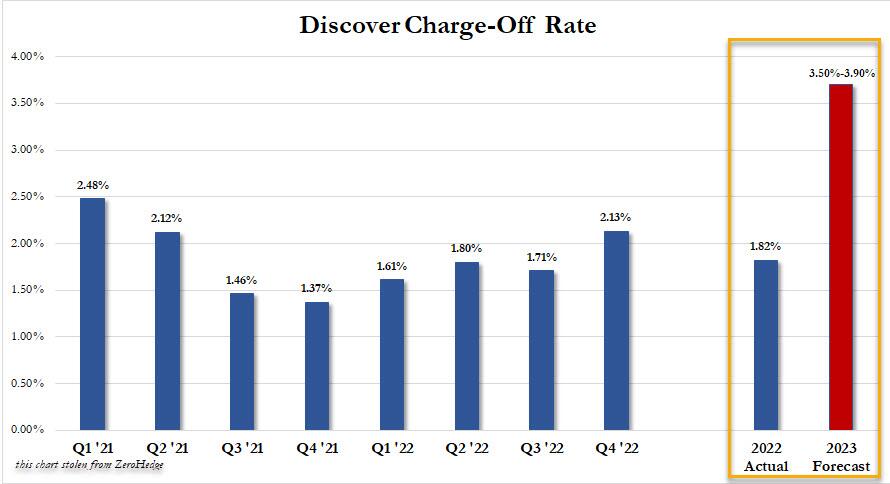
Presenting Exhibit A: Discover Financial Services (DFS), a credit card issuer which traditionally targets to low to middle-income households, and which yesterday reported earnings that were so scary, Wall Street has uniformly dubbed them "shocking." But while the bulk of the company's historical results were actually not all that bad, it was its forecast that a stunner: in a presentation on its website, DFS forecast that its charge offs would climb as high as 3.9% this year (it gave a range of 3.50% to 3.90%) which is more than double the 1.82% net charge off rate it booked for all of 2022 and was about 100bps higher than the 2.8% consensus estimate.

Cutting to the chase, this is what the company's historical and projected charge offs look like:

And since this is a net number, the gross number will likely hit 5% or more, a level not seen outside of painful recessions.

As Bloomberg explains, credit cards typically reach their peak loss rates about 18 months after origination. That means that Discover is expecting losses to tick up this year on accounts it started in 2021, which was a much bigger year for credit-card growth than 2020, when the pandemic forced the company to curtail new business. Starting last year, Discover began gradually tightening underwriting standards by offering smaller lines of credit to new customers, although the combination of a recession plus tapped out consumers will ensure a surge in charge offs for that and any one vintage. 

Wall Street was predictably unhappy with this doubling in the company's charge off forecast. Here is a summary of analyst reactions:

Piper Sandler, Kevin Barker

  • While DFS’s topline was stronger, it missed estimates mainly because of an increase in provisions due to outsize growth, along with higher operating expense growth
  • Analyst notes the “rapid” net charge-off (NCO) growth will likely be an issue across the industry due to outsize growth the past two years

Oppenheimer, Dominick Gabriele

  • “Consensus shocker” is DFS’s NCO guidance; even to reach the low end, it likely means charge-offs near 5%
  • Peers may not share DFS’s expected NCO normalization/ramp, yet it will likely make investors incrementally cautious on low FICO players, analyst says
  • Notes that management team is generally conservative and believes that some investors will see the guidance as too bearish

KBW, Sanjay Sakhrani

  • Says that it was a better-than-expected quarter but the outlook for net charge-offs is likely weighing on the stock
  • Notes that the forecast “likely contemplates a range of scenarios on the macroeconomic backdrop”
  • Adds that while investors are “nervous” about credit quality, the guidance isn’t “thesis- changing”

Citigroup, Arren Cyganovich

  • “We expect DFS shares to underperform peers on Thursday given a much higher expected 2023 net-charge off guide than the street”
  • Says rest of the company’s guidance was mixed but notes that “earnings materials lacked details of assumptions included in the guidance, which would appear to us to imply the beginnings of a mild recession assumed”
  • “While likely a positive long-term, investors will likely question growing consumer loans by double digits as we likely enter into a recession”

Chief Executive Officer Roger Hochschild tried to put some lipstick on the big, and told Bloomberg that “The losses are going up from artificially low levels,” adding that “overall, we feel really good about what we’re seeing in our portfolio" the market did not share his sentiment and DFS shares tumbled as much as 7.7%, their biggest drop in 6 months before recovering some losses. The company’s results also weighed on rivals Capital One and Synchrony, with all three credit-card issuers among the worst performers in the 67-company S&P 500 Financials Index.

As for the company's charge off forecast, we can assume that it was made with the company not making a recession its base case. So throw a recession in, a tapped-out consumer with a record low savings rate which means most middle class spending is now funded on credit, and you have an extremely explosive mixture just waiting for a match.

https://www.zerohedge.com/markets/us-consumer-has-cracked-discover-plunges-after-shocking-charge-forecast

Leap Therapeutics jumps into growing Claudin18.2 field by buying Flame Biosciences

 Flame Biosciences gave up on its IL-1ß inhibitor last fall after Novartis’ asset in the class failed multiple studies. To save itself, the biotech is selling to Leap Therapeutics.


Not in the foreground of the picture? The IL-1ß inhibitor, known as FL-101. Instead, Leap’s buyout focuses on anti-Claudin18.2 antibody FL-301 and two preclinical antibodies, including an anti-Claudin18.2/CD137 bispecific and anti-GDF15 monoclonal.


At the end of last year, Flame — backed by the likes of Samsara BioCapital and Cormorant — still had about half of the $100 million investment it disclosed in the fall of 2020. Leap acquired that approximately $50 million net cash, which will boost the combined companies’ cash heap to about $115 million, enough to keep the lights on through mid-2025, according to the Tuesday deal press release. The deal already closed, the companies said.


Flame shareholders will own about 58% of the outstanding shares, Leap said. Leap landed on Nasdaq more than five years ago after a reverse merger with regenerative med company Macrocure. Shares of the penny stock $LPTX were down about 9% before Tuesday’s opening bell.


“Acquiring FL-301 is a perfect fit with our vision of developing novel biomarker-targeted therapies for cancer patients, that is represented by our DKN-01 program. We believe that DKK1 and Claudin18.2 will become important patient selection biomarkers in gastric cancer, alongside HER-2 and PD-L1 expression, with the potential for delivering personalized medicines to patients who currently have poor survival outcomes,” Leap president and CEO Douglas Onsi said in a statement.


On an investor call, he said Leap and Flame have been talking for “well over a year.”


Leap won’t focus on taking forward FL-101 and another anti-IL-1ß antibody, known as FL-103. Flame thought if it could inhibit the cytokine key to inflammation, then it could help reduce cancer. But Novartis’ drug canakinumab repeatedly showed that wasn’t the case, so Flame halted work. Flame’s shareholders can still get some cash on the assets. If Leap finds licensees or buyers, then 80% of after-tax net proceeds will go to Flame shareholders.


With the new cash, Leap will focus on its anti-DKK1 monoclonal antibody DKN-01, which is in Phase II trials in gastric, endometrial and colorectal cancer patients. The studies include combos with BeiGene’s tislelizumab and Roche’s Tecentriq.


The second focus will be on FL-301, to which Flame acquired the ex-China rights in 2021. NovaRock, which is testing the drug in China, received $7.5 million upfront and stands to earn another $172.5 million in development biobucks and $460 million in sales milestones.


Onsi said Leap will await signal from NovaRock’s dose-escalation study of the drug in China before moving forward with its own trial in the US. He described a roadmap of going right into higher doses of FL-301 in “more commercially and clinically relevant combinations.”


FL-301 focuses on Claudin18.2, the target of multiple biotechs that are using monoclonal antibodies, bispecifics, CAR-T cell therapies and T-cell engagers. The list includes AstraZeneca-partnered Harbour BioMed, Elevation Oncology-allied CSPC Megalith, Astellas, Amgen, CARsgen and others.


The Astellas antibody, which comes from the BioNTech founders, passed a Phase III last November. BioNTech is also in the Claudin18.2 field.

https://endpts.com/leap-therapeutics-jumps-into-growing-claudin18-2-field-by-buying-flame-biosciences/

Penumbra upped to Buy from Neutral by Citi

 Target to $212 from $217

https://finviz.com/quote.ashx?t=PEN&ty=c&ta=1&p=d