Search This Blog

Thursday, January 19, 2023

Now, The Facebook Files: Emails Reveal CDC Role In Silencing COVID-19 Dissent

 by Robby Soave via Reason.com,

The Centers for Disease Control and Prevention (CDC) played a direct role in policing permissible speech on social media throughout the COVID-19 pandemic. Confidential emails obtained by Reason show that Facebook moderators were in constant contact with the CDC, and routinely asked government health officials to vet claims relating to the virus, mitigation efforts such as masks, and vaccines.

For a broader analysis of the federal government's pandemic-era efforts to suppress free speech—and whether they violated the First Amendment—see Reason's March 2023 cover story on the ramifications of these emails. This article provides screenshots of the emails themselves.

After Elon Musk took control of Twitter, he permitted several independent journalists to peruse the company's previous communications with the FBI, the CDC, the White House, and government officials elsewhere. These disclosures, which have become known as the Twitter Files, reveal that government bureaucrats put substantial pressure on Twitter to restrict alleged misinformation relating to elections, Hunter Biden, and COVID-19.

The Facebook Files, which were obtained by Reason as a result of the state of Missouri's lawsuit against the Biden administration, reveal that the CDC had substantial influence over what users were allowed to discuss on Meta's platforms: Facebook and Instagram.

The messages reveal an environment where the CDC kept tabs on Meta's moderation practices and regularly told the company what the agency wanted it to do.

For instance, in May 2021, CDC officials began routinely vetting claims about COVID-19 vaccines that had appeared on Facebook. The platform left it up to the federal government to determine which assertions were accurate.

Facebook's moderator notes that some of the above claims "would already be violating"—an implicit admission that the CDC's opinion on the other claims would be a deciding factor in whether the platform would restrict such content. Facebook was clearly a willing participant in this process; moderators repeatedly thanked the CDC for its "help in debunking."

Claims vetted by the CDC included whether "COVID-19 is man-made." The CDC told Facebook that it was "theoretically possible, but extremely unlikely."
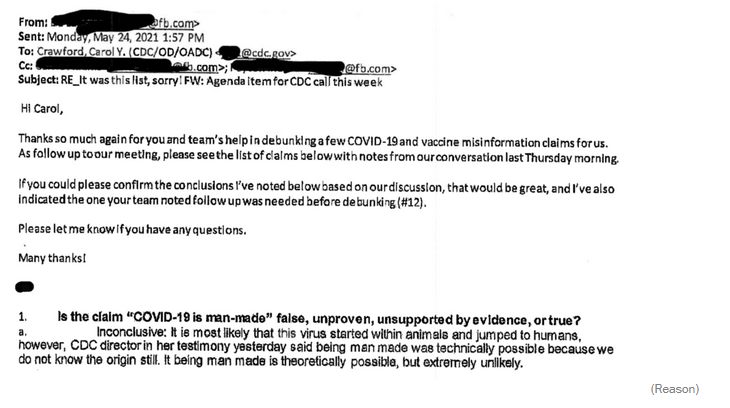
For months, it was Meta policy to prohibit users from asserting that the pandemic may have originated from a lab leak. The platform revised this policy around the same time that the above email exchange took place.

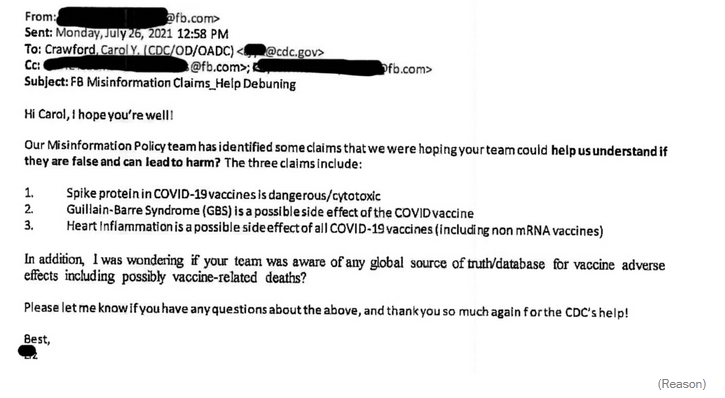
By July 2021, the CDC wasn't just evaluating which claims it thought were false, but whether they could "cause harm."
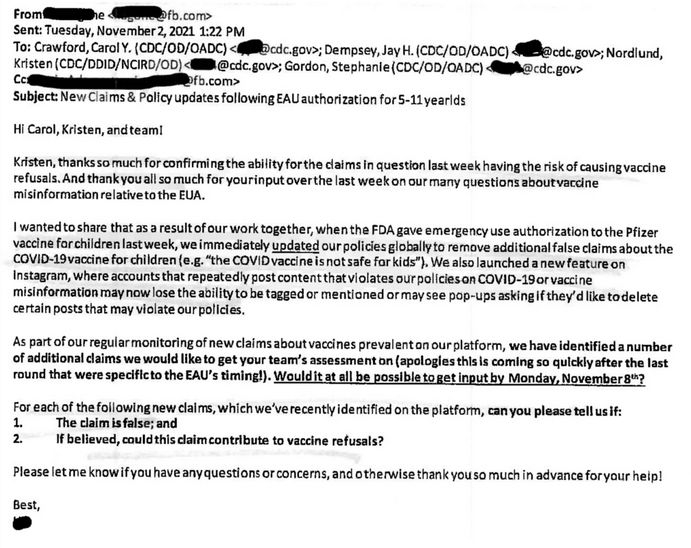
Then, in November, the Food and Drug Administration granted emergency authorization for children to receive Pfizer's COVID-19 vaccine. Meta proudly informed the CDC that it would remove false claims—"i.e. the COVID vaccine is not safe for kids"—from Facebook and Instagram. Meta also provided the CDC with a list of new claims about vaccines and asked whether the government thought they could "contribute to vaccine refusals."
The CDC determined that this label applied to all such claims.
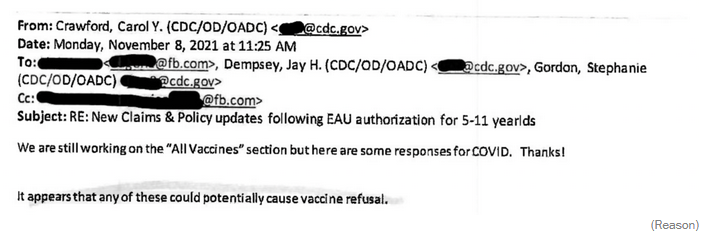
It's important to consider the ramifications. Meta gave the CDC de facto power to police COVID-19 misinformation on the platforms; the CDC took the position that essentially any erroneous claim could contribute to vaccine hesitancy and cause social harm. This was a recipe for a vast silencing across Facebook and Instagram, at the federal government's implicit behest.

Meta frequently gave the CDC lists of pandemic-related topics that had gone viral, seeking guidance on how to handle them. And the CDC informed Meta "to be on the lookout" for misinformation stemming from specific alleged misconceptions.
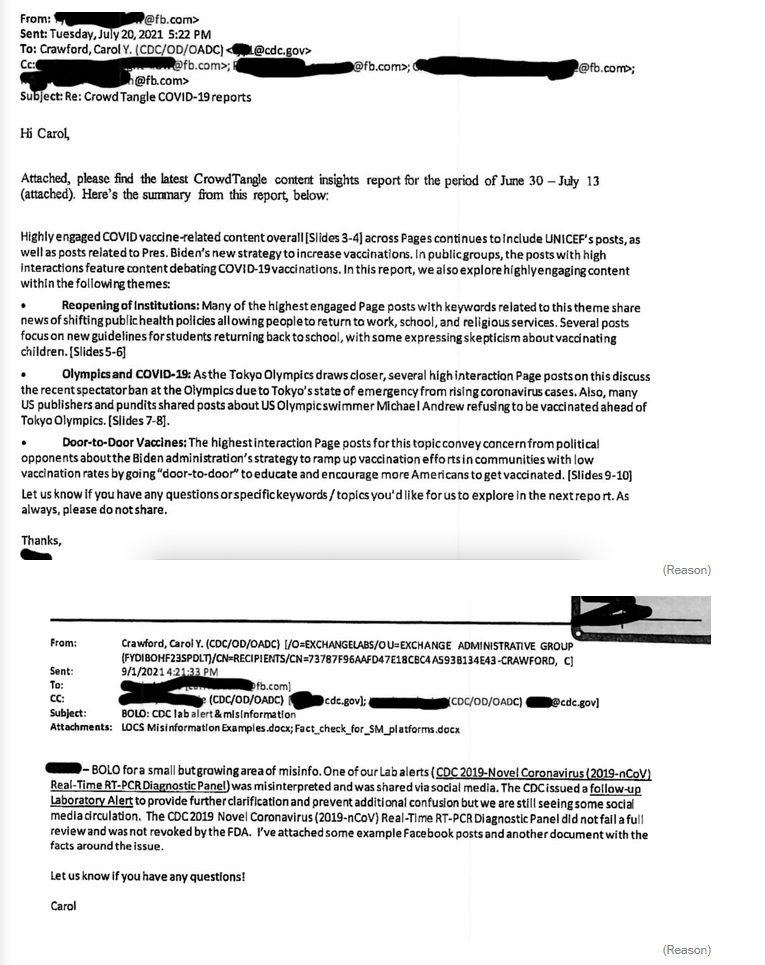
Meta also kept the CDC apprised of criticism of Anthony Fauci, the White House's COVID-19 advisor and head of the National Institute of Allergy and Infectious Diseases (NIAID). One email warned the CDC that Facebook users were mocking Fauci for changing his mind about masking and double-masking. The CDC replied that this information was "very helpful."

If the tone of Meta's communications seems overly friendly, it's worth noting that staffers viewed government employees at the CDC as their "colleagues." In one email, Meta discussed providing said colleagues with access to a "reporting channel" for COVID-19 misinformation. The list of individuals with access included CDC staff, as well as employees at Reingold, a communications firm advising government health agencies.

This is just a snapshot of the messages exchanged between the CDC and Meta. They also had regular conference calls. The CDC was not the only arm of the federal government engaged in this work, of course: White House staffers also castigated Meta for not deplatforming alleged misinformation fast enough. President Joe Biden himself accused Facebook of "killing people" in July 2021.

One wonders whether these condemnations, from Biden and others in his administration—which included the specific threat of punitive regulation if demands for greater censorship were not met—influenced Meta's decision to delegate COVID-19 content moderation to the CDC.

https://www.zerohedge.com/political/and-now-facebook-files-emails-reveal-cdcs-role-silencing-covid-19-dissent

Binance final destination for millions from Bitzlato, exchange shut for alleged money laundering

 Federal prosecutors unsealed an indictment against a little-known crypto exchange called Bitzlato on Wednesday, alleging that it facilitated the laundering of $700 million in tainted crypto tied to the now-shuttered dark-web market Hydra, and millions more in ransomware proceeds.

Blockchain data shows that tens of millions of dollars that passed through Bitzlato ultimately ended up in Binance deposit wallets, despite the stringent anti-money laundering standards that Binance says it has implemented.

Binance, the largest crypto exchange in the world, has not been connected to any criminal activity, nor have regulators accused it of knowingly accepting illicit funds, although the exchange is reportedly under its own criminal probe by the Department of Justice in relation to its compliance with anti-money laundering, or AML, laws.

The movement of Bitzlato’s funds raises questions about the efficacy of Binance’s AML practices, especially given that Binance’s own outside AML vendor, Chainalysis, issued a report in February 2022 estimating that 48% of Bitzlato’s 2019-2021 cryptocurrency receipts were “illicit or risky.”

Bitzlato’s highest crypto balance was valued at a mere $6.6 million, according to Arkham Intelligence. By comparison, Binance’s highest balance was valued at over $60 billion. But total flows in and out of Bitzlato were in the hundreds of millions of dollars, suggesting that Bitzlato was a way station for users looking to keep their crypto at more established exchanges.

On a larger exchange like Binance or Coinbase, for example, many customers opt to let the platform custody their crypto tokens. But smaller exchanges can often function as a sort of bridge between the entity looking to transfer their coins and the ultimate destination where the tokens will be custodied. Crypto might sit on one of these interim platforms for mere minutes.

How the money flowed

FinCEN report from Wednesday noted that Binance was Bitzlato’s largest counterparty, but blockchain data reveals rudimentary efforts to conceal where funds came from before they arrived in Binance custody.

Much like in traditional finance, where money moves from bank to bank and between holding companies, moving crypto assets through multiple wallets is an elementary way to obscure the flow of money. But tracing assets through a blockchain is a relatively straightforward process, since every transaction is recorded on a publicly accessible ledger.

For all of 2022, and the brief weeks that Bitzlato operated in 2023, only $9.7 million moved directly from Bitzlato to Binance, according to data from Arkham Intelligence. In the four years that Bitzlato operated, only $52 million moved directly from the exchange to Binance, the same dataset shows.

But a cursory review of some of Bitzlato’s largest exchange partners indicates that tens of millions more flowed from Bitzlato through other crypto wallets to Binance, in an apparent effort to conceal the origin of the funds.

CNBC reviewed transaction data for the ten largest recipients of Bitzlato outflows, which collected over $45 million in Bitzlato-originated funds. Those wallets also received millions more in funds from other exchanges, including Huobi, FTX, Poloniex, Nexo, and WhiteBIT, a Ukrainian exchange.

One Bitzlato whale moved a little over $21 million worth of cryptocurrencies, including ether and tether, a dollar-pegged stablecoin, from Bitzlato to an intermediary wallet. From there, over the course of four years, that intermediary wallet deposited around $15 million worth of crypto onto Binance’s platform, according to data from Arkham Intelligence.

Overall, the five largest Bitzlato-connected wallets sent more than $30 million directly to Binance. Millions more in smaller transactions ultimately ended up in Binance’s wallets.

The on-chain data can’t account for any additional funds that moved to Binance from Bitzlato through mixers, services that allow users to obfuscate the origin and endpoint of their crypto. Nor does it offer any information on the kind of enforcement action that Binance might take to defend against nefarious deposits, including seizing those funds once they land in Binance’s wallets.

But Binance CEO Changpeng Zhao has often touted his exchange’s aggressive efforts to clamp down on illicit funds flowing on the platform. Earlier this week, Binance announced it had seized millions of dollars worth of crypto connected to a North Korean hacking group called Harmony.

CNBC reached out to Binance to ask that the platform share its approach to preventing tainted funds from landing on the platform. We also asked whether Binance was aware that Bitzlato was allegedly used to launder money and, if so, why funds from Bitzlato were custodied on its platform. We did not immediately hear back to our request for comment.

Still, Reuters reported in December that federal prosecutors were mulling bringing charges in a “long-running” criminal investigation regarding Binance and Zhao’s compliance with AML laws. The pace of enforcement actions suggests that U.S. regulators already have an eye on tracking the flow of illicit crypto, wherever it occurs.

“Operating offshore or moving your servers out of the continental U.S. will not shield you,” Deputy Attorney General Lisa Monaco noted on Wednesday. “Whether you break our laws from China or Europe or abuse our financial system from a tropical island—you can expect to answer for your crimes inside a United States courtroom.”

https://www.cnbc.com/2023/01/19/binance-was-final-destination-for-millions-in-funds-from-bitzlato.html

US requests forces in South Korea provide equipment to Ukraine

 The Pentagon has requested that U.S. troops stationed in South Korea send equipment and supplies to Ukraine to support Kyiv in its war against Russia.

U.S. Forces Korea (USFK), which has about 28,000 troops in South Korea, confirmed it would provide some equipment in a statement to The Hill on Thursday.

Col. Isaac Taylor, a USFK spokesperson, said the equipment transfer would not impact its operations in South Korea.

“This has zero impact on our operations and our ability to execute on our ironclad commitment to the defense of our ally,” Taylor said.

The Pentagon’s request was first reported by Reuters.

The U.S. has provided billions of dollars in assistance to Ukraine since the war began last February. The Pentagon announced another $2.5 billion military aid package on Thursday that includes 90 Strykers, or armored combat vehicles.

Concerns have been raised about depleting U.S. inventories amid the large transfers of equipment and weapons to Kyiv.

A Center for Strategic and International Studies report earlier this month found several types of weapons and ammunition stockpiles from the U.S. were unlikely to be rebuilt within the next five years.

The Defense Department is also tapping into a stockpile of ammunition stored in Israel to ship over to Ukraine, The New York Times reported this week.

https://thehill.com/policy/defense/3820392-us-requests-forces-in-south-korea-provide-equipment-to-ukraine/

Over 1,300 nursing homes had COVID infection rates of over 75% in 2020: HHS

 More than 1,300 nursing homes in the U.S., most of them for-profit facilities, experienced extremely high COVID-19 infection rates in 2020, according to a new report from the Office of the Inspector General (OIG) for the Department of Health and Human Services.

For the OIG’s study, the agency took Medicare claims data to find nursing homes with beneficiaries who tested positive for COVID-19. The study looked at 15,086 nursing homes across the country.

“Nursing homes had a surge of COVID-19 cases during the spring of 2020 and a greater surge during the fall, well after they were known to be vulnerable. More than 1,300 nursing homes had extremely high infection rates — 75 percent or more of their Medicare beneficiaries — during these surges,” the OIG said.

Nursing homes with extremely high infection rates also saw rises in their overall mortality.

The report noted demographic differences across the two surges that were observed. During the first surge in cases, urban nursing homes were more likely to have a high number of cases, while rural ones were likely to have a high rate of cases in the second surge.

In both surges that the OIG analyzed, for-profit nursing homes accounted for a “disproportionate” number of locations with extreme infection rates.

The OIG’s survey did not detect a lack of infection controls among the majority of nursing homes that reported extremely high infection rates, and transmission rates among counties did not always lead to high case rates in nursing homes within those counties.

In light of the report’s findings, the OIG recommended that the Centers for Medicare and Medicaid Services (CMS) examine nursing staff requirements and revise them if necessary, improve on how surveys find infection control risks and target nursing homes in need of infection control intervention.

According to the OIG, the CMS concurred with the first and third recommendations that were issued while neither agreeing or disagreeing with the second recommendation.

https://thehill.com/policy/healthcare/3820017-more-than-1300-nursing-homes-had-covid-infection-rates-of-at-least-75-percent-in-2020-hhs/

HHS policy for monitoring gain-of-function virus research unclear, GAO says

 A congressional watchdog agency has determined that the oversight carried out by the Department of Health and Human Services (HHS) for research involving highly transmissible viruses such as the coronavirus lacks clarity when it comes to the requirements for such studies and is recommending that the department develop new standards for assessing risk.

The Government Accountability Office (GAO) conducted a study of its own looking into federal monitoring of gain-of-function research. This inquiry was prompted by a provision included the CARES Act that tasked the agency with looking into ongoing efforts to prepare for, respond to and recover from the COVID-19 pandemic.

Gain-of-function research, which has come under heightened congressional scrutiny throughout the pandemic, is a process in which pathogens are altered in a way that improves their ability to cause disease. This form of research is often conducted to assess the potential dangers of infectious diseases and can be used to inform public health preparedness.

HHS developed a framework in 2017 for gain-of-function research, requiring agencies to submit to additional review when they identified research proposals involving “enhanced potential pandemic pathogens” being considered for federal funding.

Under this framework, a nonbinding recommendation was issued to the relevant agency to consider in granting federal funding for the flagged study. The GAO noted that three research proposal submissions have been reviewed since the framework was enacted in 2017, all referred to the department by the National Institute of Health (NIH).

The GAO said in its report that the oversight carried out under the 2017 framework “does not fully meet key elements of effective oversight.” The framework fell short in terms of transparency and performing reviews, according to the watchdog.

The GAO’s report identified vague language that failed to clearly identify expectations.

For instance, even though the framework requires agencies to submit proposals on studies that are “reasonably anticipated to create, transfer or use enhanced potential pandemic pathogens,” it does not explain what “reasonably anticipated” means.

“The phrase ‘reasonably anticipated’ allows for subjective interpretation and covers a range of certainty regarding the intent of the research and the likelihood of the results,” read the report.

The departmental review group which considers the research proposals is also lacking transparency, according to the GAO. The agency’s study found that there was insufficient transparency when it came to how the group was composed and how it applied the framework standards when reviewing proposals.

“Because little is known about the composition of the departmental review group, it is not clear whether the departmental review group is equipped with the full range of technical expertise needed to critically evaluate risks associated with proposed research involving enhanced potential pandemic pathogens,” the report stated.

This lack of transparency is inconsistent with other review protocols established under HHS, according to the GAO.

Following these findings, the GAO said it has made three recommendations to HHS. The report advised that a standard for the term “reasonably anticipated” be developed in order to ensure consistency and also recommended that non-sensitive information regarding the departmental review process be shared with Congress and the public.

The GAO also recommended that HHS and the Centers for Disease Control and Prevention (CDC) consider changes to the Division of Select Agents and Toxins (DSAT), which is tasked with maintaining a list of pathogens that pose a severe threat to public health.

According to the GAO, the division faces an issue with expanding oversight to new pathogens such as the coronavirus at the risk of impacting the public health response due to the federal requirements involved with pathogens that are added to DSAT’s list. Due to these limitations, the SARS-CoV-2 virus has yet to be added to the division’s list.

HHS did not agree or disagree with the first two recommendations issued in the GAO’s report and agreed with the final recommendation regarding potential changes to DSAT.

https://thehill.com/policy/healthcare/3819602-hhs-policy-for-monitoring-gain-of-function-virus-research-unclear-gao-says/

US-German ‘bickering’ is blocking Ukraine’s push for tanks

 A push to provide battle tanks to Ukraine is stalled after U.S. officials this week expressed reluctance over difficulties in maintenance and training for the advanced tracked vehicle.

The U.S. decision effectively prevents Ukraine getting tanks from other NATO allies as well, as Germany this week made clear it would only allow other countries to send German-made tanks if the U.S. commits its own M1 Abrams tank first.

Ukraine has repeatedly asked for Western tanks to help in its fight with Russia, a topic that was front and center this week at the World Economic Forum in Davos, Switzerland, and will again be in the spotlight at a gathering of top defense ministers for a Ukraine Contact Group meeting on Friday. 

German officials have been mulling allowing Ukraine to have its Leopard 2 tanks, with speculation that the U.S. and Germany may announce a deal on Friday to finally grant Kyiv’s wish for heavy tanks. 

But the United States believes “it just doesn’t make sense” for Washington to send over the Army’s main battle tank now, Sabrina Singh, deputy Pentagon press secretary, told reporters Thursday. 

“It’s more of a sustainment issue,” Singh said. “This is a tank that requires jet fuel. . . .. The maintenance and the high cost that it would take to maintain an Abrams, it just doesn’t make sense to provide that to the Ukrainians at this moment.” 

Months of pressure on the United States and Germany to hand over battle tanks appeared to make headway this week with the new appointment of German Defense Minister Boris Pistorius as well as discussions on tanks at Davos and high-level NATO meetings in Brussels.  

Also viewed as positive momentum was the U.S., French and German commitment earlier this month to provide Bradleys, AMX-10 RCs and Marder fighting vehicles, respectively, the first time the countries have done so. 

But former U.S. Ambassador to Ukraine John Herbst — who on Monday said it appeared that a deal to allow tank exports to Ukraine had “been worked out” between Washington and Berlin — told The Hill Wednesday that it appears a wrench had been thrown into the process. 

“There’s a game that’s been going on involving Berlin and the White House for months, which is the Germans would say ‘we’re not going to send any Leopards until the Americans sends Abrams.’ … The Americans say, ‘yes, we have no objection to Germany sending Leopards, we’re not gonna send Abrams.’ And then both countries get to avoid sending something they consider provocative to the Kremlin,” said Herbst, now a senior director of the Atlantic Council’s Eurasia Center. 

While the West hasn’t completely closed the door on committing tanks to Ukraine — with the United Kingdom last week announcing that it will send the nation 14 Challenger 2s — reluctance reigns on shipping other heavy tanks to Kyiv.  

Some experts agree the Abrams isn’t a prudent addition to Ukraine’s war effort at the moment due to the sheer amount of effort it would take to run it, said Jeffrey Pryce, a former Defense Department special counsel now at the Johns Hopkins University’s School of Advanced International Studies. 

“The Abrams is a majestic tank, but it comes with corresponding logistical and maintenance burdens,” Pryce told The Hill. “What we’ve focused on is providing Ukrainians with capabilities that they can effectively use in the short term, and the Abrams doesn’t seem to be in that sweet spot.” 

He also disagreed with assertions that the U.S. was shying away from the system due to fears of escalating the conflict, pointing to Washington’s commitment to send such high-tech systems as the Patriot missile defense system and Bradley Fighting Vehicles. 

“I think it’s just a judgment as to what’s most helpful, what they can most efficiently absorb and effectively use in combat in the middle of a war,” he said. 

Late Thursday the United States announced a major $2.5 billion weapons package for Kyiv, to include 90 Stryker armored combat vehicles but no Abrams tanks. The military aid was announced ahead of a gathering of the Ukraine Contact Group at Ramstein Air Base in Germany, to be attended by Defense Secretary Lloyd Austin, Joint Chiefs of Staff Chairman Gen. Mark Milley and about 50 other top defense officials from NATO as they look to coordinate future lethal assistance to Kyiv.  

Leaders of Ukraine’s military, which until now have used Soviet-era tanks on the battlefield, insist more modern tanks are needed, and soon, as Russia appears to gear up for a renewed spring offensive. 

“There is no rational reason why Ukraine has not yet been supplied with Western tanks,” Ukrainian President Volodymyr Zelensky said earlier this month.  

On Thursday, Zelensky reupped the request, saying that the need for Western tanks is still a “pressing and very sensitive” issue for Ukraine. 

Secretary of State Antony Blinken said Tuesday that he expected further announcements on military deliveries to Ukraine to come out of Ramstein but would not comment on whether Washington is pushing Berlin to give the green light for Leopard tanks for Kyiv. 

“On the question of, of tanks, and for that matter, any weapons system, these are sovereign decisions for each country to make,” Blinken said. 

On Thursday, Singh echoed that message, noting that Leopards are easier to fuel and maintain. 

“Ultimately this is Germany’s decision. It’s their sovereign decision on what security assistance they will provide. So we won’t be able to speak to them, but I think that we are certainly doing what we can to support Ukraine in what they need,” she said. 

“We’re continuing to work with other partners and allies around the world to see what else can be provided to Ukraine, and that’s the whole point of tomorrow’s meeting,” Singh added. 

While the Biden administration has offered little detail of its conversations with Germany, the German side has been clear about wanting the U.S. to make the first move on heavy tanks, a message delivered by German chancellor Olaf Scholz in a call with President Biden and in-person to an American congressional delegation in Davos. 

Finland, Poland and the Baltic states all possess Leopard 2s in their own stocks and have publicly endorsed shipping the vehicle to Ukraine, but need Germany’s permission to do so due to German components within the tanks.  

The impasse has angered a number of American lawmakers, including Sen. Lindsey Graham (R-S.C.), who on Wednesday tweeted for the two sides to “stop bickering.” 

“This impasse needs to come to an end. The tanks need to go to Ukraine from BOTH countries as soon as possible.  The future of Europe and a rules-based world is at stake,” Graham wrote

And Senate Foreign Relations Committee ranking member Sen. James Risch (R-Idaho) on Thursday called for Germany to “immediately” allow Poland and Finland to contribute Leopards.  

The latest public statements from Berlin and Washington suggest Ukraine may have to keep waiting; however. all involved will be keeping a close eye on the meetings at Ramstein on Friday. 

“There’s a decision that’s going to have to be made and we’ll see if there’s an agreement at Ramstein,” Pryce said. 

https://thehill.com/policy/defense/3820367-how-us-german-bickering-is-blocking-ukraines-push-for-tanks/

Egg Seizures Skyrocket At US Border As Arbitrageurs Attempt To Capitalize On Poultry Crisis

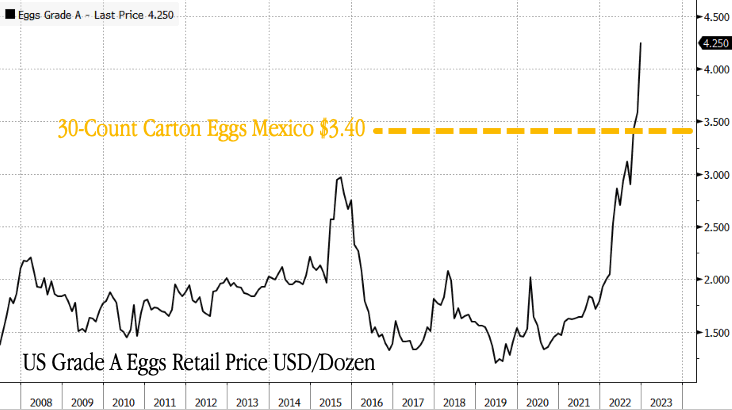
 America's egg shortage worsens by the week. Supermarkets nationwide are running out of eggs as prices hyperinflate. Egg arbitrage is rising as people attempt to smuggle egg and poultry products across Mexico–US border for resale in the States where they can reap hefty profits. 

US Customs and Border Protection reported a 108% increase in egg and poultry seizures at land ports on the border from Oct. 1 to Dec. 31. The uptick in egg smuggling comes as retail prices erupt in the US as the avian flu forced producers to cull tens of millions of birds and egg-laying hens over the last year. 

"My advice is, don't bring them over. 

"If you fail to declare them or try to smuggle them, you face civil penalties," said CBP Supervisory Agriculture Specialist Charles Payne

Egg seizures are so rampant that CBP tweeted that smugglers will be slapped with $10,000 fines. 

People have realized there are huge profits in buying a 30-count carton of eggs at $3.40 in Juarez, Mexico, and reselling them in the US. 

It's only a matter of time before cartels figure out about this lucrative trade. 

https://www.zerohedge.com/commodities/egg-seizures-skyrocket-us-border-arbitrageurs-capitalize-poultry-crisis