Search This Blog

Monday, January 23, 2023

Hypertension drug could be repurposed to delay aging

 Researchers have found that the drug rilmenidine can extend lifespan and slow aging.

Published in Aging Cell, the findings show that  treated with rilmenidine, currently used to treat hypertension, at young and older ages increases  and improves health markers, mimicking the effects of caloric restriction.

They also demonstrate that the healthspan and lifespan benefits of rilmenidine treatment in the roundworm C. elegans are mediated by the I1-imidazoline receptor nish-1, identifying this receptor as a potential longevity target.

Unlike other drugs previously studied for this purpose by the researchers, the widely-prescribed, oral antihypertensive rilmenidine has potential for future translatability to humans as  are rare and non-severe.

To date, a caloric restriction diet has been considered the most robust anti-aging intervention, promoting longevity across species. However, studies of caloric restriction in humans have had mixed results and side effects, meaning finding medications like rilmenidine that can mimic the benefits of caloric restriction is the most reasonable anti-aging strategy.

Professor João Pedro Magalhães, who led the research while at the University of Liverpool and is now based at the University of Birmingham, said, "With a global aging population, the benefits of delaying aging, even if slightly, are immense. Repurposing drugs capable of extending lifespan and healthspan has a huge untapped potential in translational geroscience. For the first time, we have been able to show in animals that rilmenidine can increase lifespan. We are now keen to explore if rilmenidine may have other clinical applications."

More information: Dominic F. Bennett et al, Rilmenidine extends lifespan and healthspan in Caenorhabditis elegans via a nischarin I1 ‐imidazoline receptor, Aging Cell (2023). DOI: 10.1111/acel.13774


https://medicalxpress.com/news/2023-01-hypertension-drug-repurposed-delay-aging.html

Why Are Millennials Having So Many Strokes?

 Strokes commonly strike the old. The average age for the devastating condition — in which blood supply to a part of the brain is blocked or when a blood vessel in the brain bursts — is around 71.4 years in men and 76.9 years in women. Millennials, however, are starting to bring those averages down.

Now ranging in age from 27 to 42, Millennials are suffering strokes at higher rates than their forebears did at the same age, reversing a 40-year decline in stroke deaths. Between 2003 and 2012, there was a 32% spike in strokes among 18- to 34-year-old women and a 15% increase for men in the same age range, according to CDC researchers. When Scientific American further parsed the data, they found that the hike was mostly centered in the West and Midwest, where stroke rates among young people rose 70% and 34%, respectively, with particularly sharp increases in urban areas. Now, about one in ten people who has a stroke in the U.S. is under the age of 45.

There are many potential explanations for this disconcerting trend. Rising stress, falling physical activity levels, and fewer doctor visits among Millennials could all play a role. One narrative rises to the forefront, however. As cigarette use in the U.S. declined from an alarming high of around 45% in the 1950s to just 12.5% in 2020, all Americans collectively reaped the benefit of less smoke in public places, which manifested in reduced rates of lung cancer, heart disease, and stroke. But since the 1970s, the public health benefits from reduced smoking are being eroded by rising obesity and its related health complications.

Childhood obesity is particularly noxious in regard to early stroke, and Millennials were the first generation to truly be affected by this alarming trend. The rate of childhood obesity more than tripled from 5% in 1978 to 18.5% in 2016, leaving many more children burdened by associated conditions such as diabetes and hypertension, which can lead to a stroke.

There is good news. Thanks to improved medical care, stroke fatality rates have fallen significantly between 1975 and 2019, about 65% for hemorrhagic stroke (caused by a burst blood vessel) and 80% for ischemic stroke (caused by a blood vessel blockage). And with greater brain plasticity, young people are more apt to recover. Still, strokes can leave Millennials with lasting complications, such as occasional seizures, incontinence, cognitive impairment, hindered speech, and diminished muscle control, not to mention a sharply elevated risk of a future stroke.

Increased stroke isn’t the only health issue that Millennials are contending with. The rates of many cancers, especially those tied to poor diet, are rising for people under age 50.

The best solution to reverse the rise in early stroke is for Millennials and future generations to eat right and exercise, especially from a young age. Schools and parents have a vital role to play here. Obesity’s grasp can be hard to break if it takes hold at a tender age, but if healthy lifestyle practices are instilled early, it’s likely they will remain second nature.

https://www.realclearscience.com/blog/2023/01/23/why_are_millennials_having_so_many_strokes_877191.html

Remove the HSA Ceiling to Improve Health Care

 According to the Centers for Medicare and Medicaid services, the health share of the economy is projected to rise from 17.7 percent in 2018 to 19.7 percent in 2028. Yet the average life span has only grown two years since 2000. The U.S. is a global outlier. While we spend more than any other nation on health, and more than three times other wealthy nations, our life expectancy is shorter than countries that spend far less. Considering our expenditures are higher than any other nation with less than desirable results, we should begin to look at new avenues for health reform by examining health care regulations rather than continually increasing spending.

Unsurprisingly, politicians hope to alleviate this health dilemma by, incorrectly, relying on “fat taxes,” banning snack cakes, and crouching closer and closer to the implementation of horrific socialized medicine. Rather than enacting such policies that prioritize top-down solutions, government should work to encourage personal responsibility for our well-being. To do this, policymakers should increase access to health savings accounts (HSA). 

HSAs allow Americans to take control of their own health care. An HSA is operationally comparable to a 401(k). Individuals can set aside money from their salary on a pre-tax basis to pay for qualifying medical expenses, including deductibles and prescriptions. And, unlike flexible spending accounts, there is no “use it or lose it” policy. HSAs naturally incentivize prospective patients to be more cautious with their dollar and encourage patient-led health. Nationally, HSA account balances exceed $100 billion. But, alas, due to regulatory constraints, 90% of Americans have no access to an HSA.

Under current law, individuals may not open an HSA account unless they have a high-deductible health plan (HDHP). These plans typically have lower premiums but require more out-of-pocket expenditures before health insurance agrees to cover some costs. Unfortunately, on top of such restrictions, most employers fail to offer HDHP plans anyway, and federal insurance such as Medicare and Medicaid do not qualify. In addition, those lucky enough to access an HSA may not contribute more than $3,650 individually or $7,300 in a joint account. This hamstrings current contributors who may have high medical bills or wish to have more coverage. 

These restrictions fail to accommodate health care innovation that lowers costs and improves the quality of care. By limiting patient access to HSAs, which can pay for lifestyle change services such as gym memberships, Congress is actively inhibiting healthier, more affordable living. To improve health outcomes and empower individuals, Congress must decouple HSAs from insurance. Unfortunately, though, Washington bureaucrats have failed to show much enthusiasm for expansion. 

While we can't perfectly prevent unhealthy lifestyle choices, we can begin to fundamentally change the way our health care system works. Improving and expanding individual health care options emboldens patients to have more control over their health and respond to health concerns accordingly. Our health can only improve when our health care system is run by us, not government. Removing the HSA ceiling is a necessity.

Without federal action, 90% of Americans will continue to face barriers to care, and government will continue to spend wastefully, stalling any health improvement nationwide. To improve life expectancy, encourage healthier lifestyle choices, cut costs, and reform our disastrous, exclusionary health care system, HSAs must be accessible to all.

Jessica Dobrinsky is a Policy Analyst for the Cardinal Institute for West Virginia Policy.

https://www.realclearpolicy.com/articles/2023/01/23/remove_the_hsa_ceiling_to_improve_health_care_877142.html

Soros Urged Use Of E. Euro Soldiers To "Reduce Risk Of Body-Bags For NATO" In 'New World Order' Article

 by John Cody via Remix News,

As the war in Ukraine rages on, there is little doubt that the human cost has been enormous for Ukraine, including what is likely more than 100,000 soldiers who have died in combat operations.

However, there was one man who predicted much of what has come to pass in the battle in the east of Europe: George Soros.

The billionaire oligarch financier, often portrayed as a humanist, promoted a hard-nosed geopolitical strategy in his 1993 piece entitled “Toward a New World Order: The Future of NATO.”
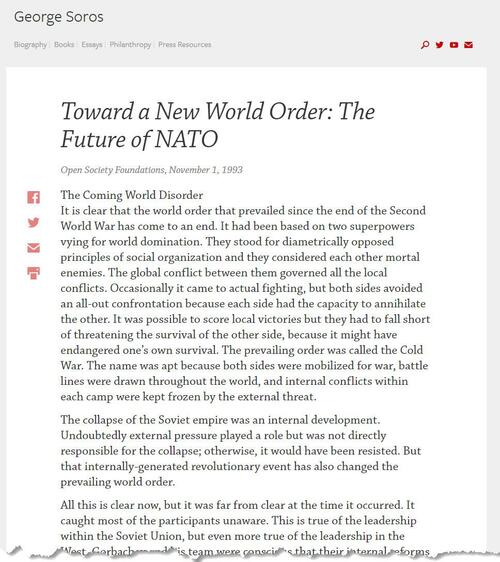
In the piece, he outlines how Eastern Europeans could be used as the “manpower” in coming conflicts in an effort to reduce the number of deaths in Western countries, which Soros argues the West would not politically tolerate, unlike the east of Europe.

“The United States would not be called upon to act as the policeman of the world. When it acts, it would act in conjunction with others. Incidentally, the combination of manpower from Eastern Europe with the technical capabilities of NATO would greatly enhance the military potential of the Partnership because it would reduce the risk of body bags for NATO countries, which is the main constraint on their willingness to act. This is a viable alternative to the looming world disorder,” wrote Soros in the article.

Soros acknowledges that the NATO countries have no appetite for “body bags,” but his statement implicitly indicates that Eastern Europeans can fill this role.

What Soros described appears to be unfolding exactly as he predicted regarding the war in Ukraine. Armed with high-end NATO weapons, Ukrainian soldiers are actively countering Russia, which Soros had already feared would become a nationalist nation opposed to the global order he was promoting in 1993. The powerful Western countries have the necessary weapons, and Ukraine has the manpower. Given that Soros already saw the potential of what this symbiotic match could produce on the battlefield decades in advance will likely bolster his reputation as a calculating — and perhaps ruthless — strategic thinker.

As Soros predicted, Ukrainian society appears to be tolerating the high death toll in its current conflict with Russia. During the Vietnam War, the U.S. lost 58,220 over the course of approximately 10 years, and yet, the war saw strong opposition from the American public. Despite a far higher death toll in a far shorter period of time, Ukrainian society has seen little in terms of protests.

The lack of protest in Ukraine may also be helped by the fact that Ukraine has suspended most of civil society, banned opposition parties and media, and even outlawed the Russian Orthodox Church. Another key factor in society’s perspective on the conflict is that the war is taking place on Ukrainian soil, which is a highly motivating factor for Ukrainian soldiers.

All those Ukrainian bodies, of course, have come with a major price tag for Russia, with the country’s cemeteries also filling up as quickly or even more so. Exact figures on casualties for either side remain unofficial and are likely inexact, but the war is costing both nations dearly in terms of life.

In the same article, Soros called for a “new world order.” The term is often derided in establishment media as a conspiracy theory, but Soros openly uses it. In addition, in the piece, the new world order he calls for is remarkably globalist and centralized. In other words, exactly the type of new world order critics of his, such as Hungarian Prime Minister Viktor Orbán, have been warning about for over a decade.

“Therefore, the only basis for action is collective security. And that is where the problem lies. The collapse of the Soviet empire has created a collective security problem of the utmost gravity. Without a new world order, there will be disorder; that much is clear. But who will act as the world’s policeman? That is the question that needs to be answered,” Soros wrote.

Soros outlines a number of his theories in the piece, referring to open and closed societies as well as the “theory of revolutionary change,” which he said he had also applied to financial markets. The billionaire describes how the dissolution of the Soviet Union presented new global security challenges but also opportunities.

The original mission was to defend the free world against the Soviet empire. That mission is obsolete; but the collapse of the Soviet empire has left a security vacuum which has the potential of turning into a “black hole.” This presents a different kind of threat than the Soviet empire did. There is no direct threat from the region to the NATO countries; the danger is within the region, and it concerns conditions within states as much as relationships between states. Therefore, if NATO has any mission at all, it is to project its power and influence into the region, and the mission is best defined in terms of open and closed societies.

Closed societies based on nationalist principles constitute a threat to security because they need an enemy, either outside or within. But the threat is very different in character from the one NATO was constructed to confront, and a very different approach is required to combat this threat. It involves the building of democratic states and open societies and embedding them in a structure which precludes certain kinds of behavior.

Soros also writes in his piece that NATO was racing to grant membership to countries in Central and Eastern Europe before “Russia recovers.” Soros appears to see NATO as actively transgressing against Russia during a time the country was still in chaos following the fall of communism.

“The countries of Central Europe are clamoring for full membership of NATO as soon as possible, preferably before Russia recovers. Russia objects, not because it harbors any designs on its former empire but because it sees no advantage in consenting. Its national pride has been hurt and it is sick and tired of making concessions without corresponding benefits,” writes Soros.

The billionaire activist also makes a number of other proposals in the piece, including offering NATO membership to Japan, his goal being the creation of a “new world order.”

Japan should be asked to join NATO. Then we would have the beginnings of an architecture for a new world order. It is based on the United States as the remaining superpower and on open society as the organizing principle. It consists of a series of alliances, the most important of which is NATO and, through NATO, the Partnership for Peace which girds the Northern Hemisphere,” he writes.

https://www.zerohedge.com/geopolitical/george-soros-urged-use-eastern-european-soldiers-reduce-risk-body-bags-nato-countries


NY financial regulator takes aim at firms co-mingling crypto funds


New York's chief financial regulator is set to release new guidance on Monday dictating that companies separate customers' crypto assets from their own, after alleged co-mingling of funds at collapsed crypto exchange FTX and its affiliated trading firm Alameda Research led to billions of dollars in losses for customers.

The New York State Department of Financial Services (NYDFS), which leads one of the few state agencies with a regulatory system in place for cryptocurrency companies, will also stipulate that state-regulated companies disclose to customers how they account for clients' digital currency.

The guidance is the latest in a series of crypto-related directives NYDFS has issued in the past year, which saw a market collapse that wiped about $1.3 trillion off the value of crypto tokens in 2022 and triggered the bankruptcies of crypto firms such as FTX, Celsius Network and most recently, Genesis Global Capital, whose lending unit filed for U.S. bankruptcy protection on Thursday.

It comes as federal regulators such as the U.S. Commodity Futures Trading Commission (CFTC) are warning about the lack of consumer protections in the crypto sector. Federal agencies like the CFTC say much of what they can do is limited without congressional legislation that would give them additional authority.

"It's timely, but truth be told, it was something we had on our policy roadmap even before FTX," said Adrienne Harris, the superintendent of NYDFS, in an interview.

Federal prosecutors in Manhattan have accused FTX founder Sam Bankman-Fried of stealing billions of dollars in customer funds to plug losses at his hedge fund, Alameda Research. Concerns about the crossover between the two firms helped fuel a flurry of customer withdrawals in November, forcing the exchange to file for bankruptcy. Bankman-Fried has denied any criminal wrongdoing and has pleaded not guilty.

Harris, who was confirmed as superintendent last year and is a former senior advisor at the U.S. Treasury Department, has spent much of her first year in the role bolstering her agency's crypto focus. She says the virtual currency unit at NYDFS has almost 50 employees, and is working on hiring more.

New York requires firms to undergo examinations making sure they are in-line with state requirements and comply with know-your-customer, anti-money laundering and capital requirements. Most other states do not subject crypto firms to examinations.

"While I would never be foolhardy enough to say that no New Yorker will be harmed in all of this, I think it's very fair to say that New Yorkers are better off than anybody else in the country because of the framework we have," Harris said.

Nevertheless, the crypto meltdowns of the past year have still touched the state's residents.

New York's attorney general Letitia James earlier this month sued Celsius Network founder Alex Mashinsky, claiming he defrauded investors out of billions of dollars in digital currency by concealing the failing health of his now-bankrupt cryptocurrency lending platform.

James said Mashinsky's alleged fraud ran from 2018 to June 2022, when deposits were frozen, with more than 26,000 New Yorkers among his victims. A lawyer for Mashinsky has denied the allegations. NYDFS did not immediately respond to a request for comment on the Celsius lawsuit.

Crypto exchange Gemini, which has a limited purpose trust charter in New York and is permitted to serve New York residents, had partnered with now-bankrupt Genesis Global Capital to offer a crypto yield product, and locked customers from accessing those accounts when Genesis suspended customer withdrawals in November. Gemini says it is owed $900 million from Genesis.

Harris says she recognizes there is more her office can do, and says her agency is working on additional guidance on stablecoins, advertising and disclosures in crypto and consumer protection.

Crypto firms' compliance with anti-money laundering rules has also been "a big issue," she said, one she expects her office will continue focusing on in 2023.

Earlier in the month, NYDFS announced a $100 million settlement with Coinbase Inc over the firm's compliance with rules to prevent money laundering. That followed a $30 million fine the department imposed on the crypto arm of Robinhood Markets Inc for alleged violations of anti-money laundering, cybersecurity and consumer protection rules.

"We've really been working hard, not just through enforcement, but through examination, and just in our conversations with industry to say this is a non-negotiable," said Harris.

https://www.marketscreener.com/quote/stock/COINBASE-GLOBAL-INC-121300010/news/New-York-s-financial-regulator-takes-aim-at-firms-co-mingling-crypto-funds-42791652/

Elevance to Acquire Blue Cross and Blue Shield of La.

 Elevance Health, Inc. (NYSE: ELV) and Blue Cross and Blue Shield of Louisiana announced today that the companies have entered into a definitive agreement through which Elevance Health agrees to acquire Blue Cross and Blue Shield of Louisiana (BCBSLA). BCBSLA will join Elevance Health’s affiliated Anthem Blue Cross Blue Shield family of brands.

This acquisition will unite two organizations deeply rooted in the communities they serve and aligned in a mission to improve whole health. Together they will continue to prioritize what is best for Louisiana’s members and customers by improving access, quality, affordability, and the experience that Louisianians have trusted for almost 90 years.

The combination builds on the existing collaboration in Louisiana through joint ownership of Healthy Blue, which serves Medicaid and Medicare Dual Eligible members. It will also accelerate BCBSLA’s strategic evolution to improve access, affordability and quality of services delivered by BCBSLA to the more than 1.9 million members they serve with capabilities developed by Elevance Health and its healthcare services organization, Carelon. With more than $4 billion invested over the past several years, Carelon delivers behavioral health, complex and chronic care programs, and innovative digital models.

https://finance.yahoo.com/news/elevance-health-acquire-blue-cross-213000934.html

Axcella Announces Regulatory Path to Registration of AXA1125 for Long COVID Fatigue

MHRA guidance aligns on key measurements for a registration trial, including primary endpoint and trial design elements

IND for phase 2b/3 trial submitted to the FDA

Axcella to host a conference call Tuesday, January 24 at 8:00 a.m. ET; To register, click here

https://finance.yahoo.com/news/axcella-announces-regulatory-path-registration-211500566.html